


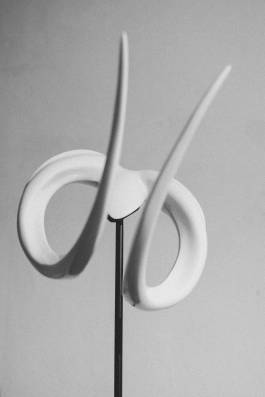
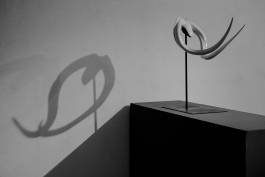
“Taurus”, 2015, Installation view, Ala Moderna del Museo della Città di Rimini, Photo: Tessa Chung (Yingntao Zhong)
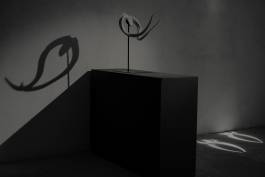
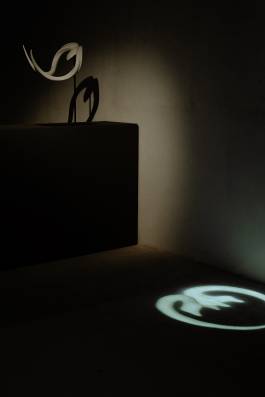
“Taurus”, 2015, Installation view, Ala Moderna del Museo della Città di Rimini, Photo: Tessa Chung (Yingntao Zhong)
2019
ANA RAJČEVIĆ “ANIMAL: ANOTHER SIDE OF EVOLUTION” AND “TAURUS”
“Skin+Bones” was the title of an exhibition that explored parallels between fashion and architecture, emphasising the relationship between surface and structure, between inside and outside.
These same terms also come to mind in front of the work of Ana Rajčević, a designer trained in architecture, before she engages with the fashion artefact. What she creates can be defined as prothetic body sculpture: a hybrid between adornment and sculpture, which can be both exhibited and worn.
Exhibited, these sculptural objects appear slightly enigmatic, although their abstracted, horn or bone-like shapes evoke the presence of the body. When worn, they become something more than mere adornment or a mask: they are extensions that radically redesign the body's shape.
Horn-like elements from her “Animal: Another Side of Evolution” series, “Taurus” and other works, transform the body into something still to be defined, a hybrid in which human and animal features are fused.
Fashion history, especially recent ones, shows how alterations of the silhouette have complex symbolic and semantic connotations. When Georgina Godley began applying curvy additions beneath her garments from the “Bump and Lump” collection, she aimed to challenge the ideals of femininity imposed by the “power dressing” of the 80s. Similarly, as Rei Kawakubo did a decade later with the “Body Meets Dress” collection, Godley asked why body shapes that glorify maternity and fertility are excluded from dominating ideals of the fashionable body. They both addressed the question of what is considered a normal and aesthetically acceptable body, a concern in which Ana Rajčević recognises herself, too.
She adorns the body with horn-like wearable sculptures, alluding to the question of the border between human and animalesque. A border explored by Alexander McQueen, too (also in his collaborations with Shaun Leane, Naomi Filmer, or Philip Treacy), to launch a critique of the fashion system and its irrepressible appetite for novelty and amazement. Rajčević’s collections add another layer to these discussions, in the context of the present time, the Anthropocene, when culture overpowered nature. Evolution, about which she speaks, is the one that hasn’t happened yet: the one in which no hierarchy exists between the species.
Ana Rajčević is an award-winning artist working at the crossroads of sculpture, fine art, and design, exploring different ways of transforming the body through intricate pieces of adornment known as ‘prosthetic body-sculptures’. Her artistic practice addresses how the ever-changing physical forms and materials in which human subjects are embodied shape our understanding of ‘humanity’ itself. Her multidisciplinary approach combines experimental art and design with research in biomedicine, history, materials science, and psychology. In 2015, she was elected a member of the Royal Society of Arts, and she frequently works and collaborates within the performing arts sector.
“Taurus”, 2015, Installation view, Ala Moderna del Museo della Città di Rimini, Photo: Tessa Chung (Yingntao Zhong)
“Taurus”, 2015, Installation view, Ala Moderna del Museo della Città di Rimini, Photo: Tessa Chung (Yingntao Zhong)