


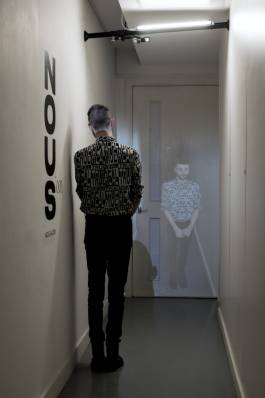
“NOUS001”, 2017, installation view, ACF - Austrian Cultural Forum, London, Photo: Lisa Edi
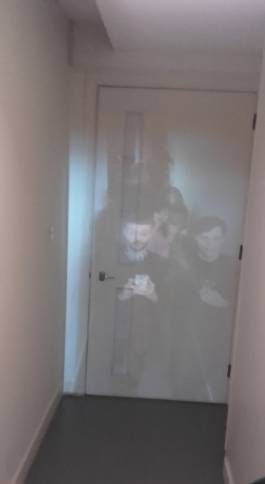
“NOUS001”, 2017, installation view, ACF - Austrian Cultural Forum, London, (Maximilian Mauracher & Bernhard Eiling)
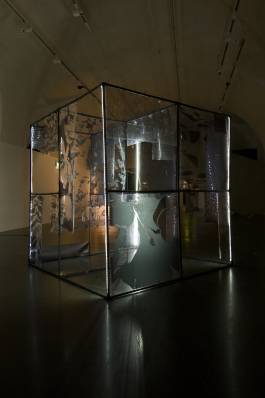
“NOUS001”, 2018, installation view, MQ - MuseumsQuartier, Vienna, Photo: Konrad Strutz
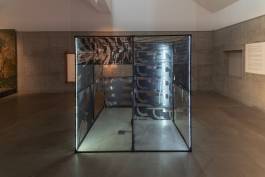
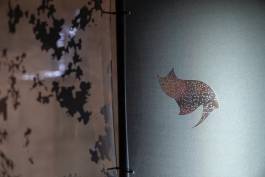
“NOUS001”, 2018, installation view, Kalmar Art Museum, Photo: Michelangelo Miskulin
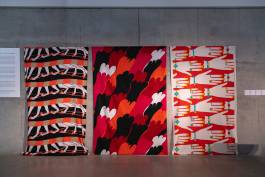
Textile samples from the collection of the Kalmar Art Museum, Photo: Michelangelo Miskulin
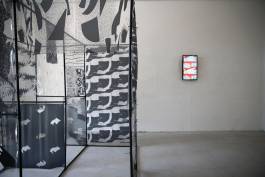
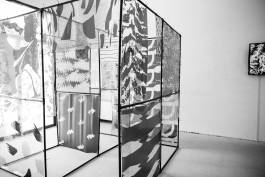
“NOUS001”, 2019, installation view, Ala Moderna del Museo della Città di Rimini, Photo: Giulia Ripalti
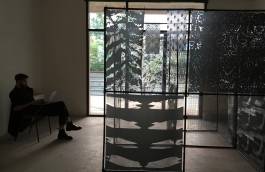
“NOUS001”, 2019, installation view, Ala Moderna del Museo della Città di Rimini, Photo: Dobrila Denegri
2019
MAXIMILIAN MAURACHER “NOUS001”
Maximilian Mauracher is a graphic designer and art director who occasionally ventures into collaborations with other creatives, realising projects where design, fashion and art meet.
Within the “Transfashional” project, he contributed as both a graphic designer and an artist, developing works presented in exhibitions and designing the project's books and website.
Through all his contributions runs, like an undercurrent, his interest in patterns and textures, all rigorously developed in black and white, elements on which he builds his entire graphic vocabulary. He initially developed patterns and textures as graphic elements to give the project a visual ID, and then moved towards creating a work that addressed how AI software can be used to generate patterns.
Together with Bernhard Eiling, an information artist and software engineer, he began work on the project entitled “NOUS001”, installed at the exhibition in London as a kind of scanner that would capture and memorise the patterns of the audience's clothing.
The idea was to create a database of patterns that would be processed from which a computer would generate new ones.
“NOUS001” was imagined as a form of intelligence that would grow and develop through different phases of the exhibition: first observing the world and learning, then processing and elaborating, and finally creating something without being fully controlled by its creators, Mauracher and Eiling. Thus, “NOUS002” was presented at the exhibition in Vienna: a sculptural piece made from prints on PVC of some of the generated patterns and the outcomes of this artistic experiment.
One of the main motivations for presenting “Transfashional” at Kalmar Konstmuseum was to engage with the museum's vast Design Archive, which falls under the museum’s competencies and preserves the textiles of some of the most renowned Swedish designers. From sketches and studies to textile samples, this archive provided a fascinating and valuable source of research, and, finally, “NOUS002” reached a new level by assimilating new information, processing it, and generating new versions of patterns. Additional PVC sheets were printed and incorporated into a display device designed by Maximilian Mauracher.
We are in the moment when AI seems to be the “next big thing”, and this artistic experiment represented a way to engage with the different possibilities and implications of this technological turn we are undertaking. Here, the co-creative process involved human and non-human intelligence, questioning the lines of control each has. Taking back this prerogative of “creator”, Maximilian developed a final (for now) stage of the piece, elaborating on the generative process and morphing of graphic shapes which constitute some of the patterns made through a symbiosis of different formats of “us”, which is what the title “NOUS002” implies.
Maximilian Mauracher graduated in Graphic Design from the University of Applied Arts Vienna and works as an art director with a strong emphasis on typography and simplicity.
He is “part of a wave of remarkable European designers” (It’s Nice That), but his creative scope also extends to collaborative projects involving art and fashion, especially related to his interest in our self-perception (or “self-construction”) through digital photography and social media.
“NOUS001”, 2017, installation view, ACF - Austrian Cultural Forum, London, Photo: Lisa Edi
“NOUS001”, 2017, installation view, ACF - Austrian Cultural Forum, London, (Maximilian Mauracher & Bernhard Eiling)
“NOUS001”, 2018, installation view, MQ - MuseumsQuartier, Vienna, Photo: Konrad Strutz
“NOUS001”, 2018, installation view, Kalmar Art Museum, Photo: Michelangelo Miskulin
Textile samples from the collection of the Kalmar Art Museum, Photo: Michelangelo Miskulin
“NOUS001”, 2019, installation view, Ala Moderna del Museo della Città di Rimini, Photo: Giulia Ripalti
“NOUS001”, 2019, installation view, Ala Moderna del Museo della Città di Rimini, Photo: Dobrila Denegri