


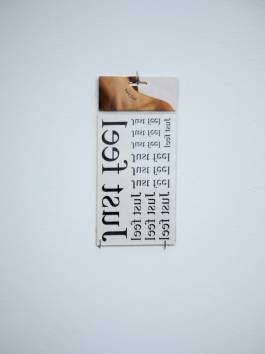
Anna-Sophie Berger, “Just Feel”, 2014, Removable tattoo, c-print on cardboard
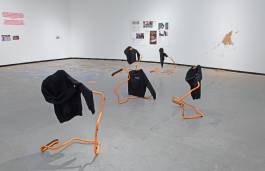
In the back: Anna-Sophie Berger , “Time that Breath Cannot Corrupt” (3 Coats), 2019, Polyester lace coats, thread, mud; three parts
In the front: Dennis Loesch, The Hanger (The Dioreebok), 2021 Sweatshirt, / Sweatshirt, modified cantilever chair (replica), Produced with the support of the Marta Patronage Fund for New Art, Herford
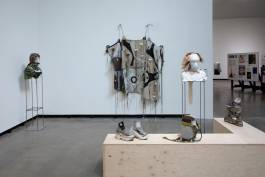
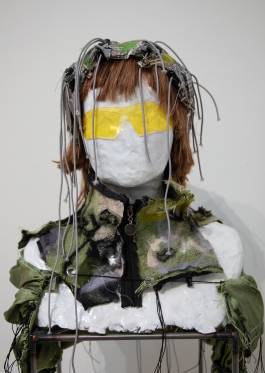
Hendrickje Schimmel / Tenant of Culture , from the series: “Eclogues”, 2019, Recycled garments, curtains and accessories, thread, resin, clay, eyelets, cord, elastics, felt, stoppers, paint, varnish, steel, plaster, potato sack, sunglasses, handmade wig and real hair braid
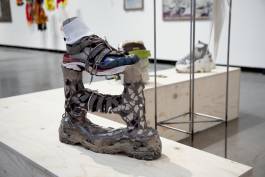
Hendrickje Schimmel / Tenant of Culture, from the series: “Flash s/s/“, 2020, Recycled shoes and socks, laces, plaster, tiles, grout
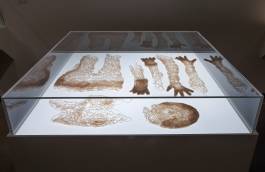
Sonja Bäumel, “Crocheted Membrane”, 2009, Mohair wool, illuminated pedestal
2022
TOWARDS TRANSFASHIONALITY
Speaking about the work of Atelier Van Lieshout (AVL), its founder Joep van Lieshout declared: “Rather than stating ‘this is art’ or ‘this is design’ I prefer to think of it as interaction between the two.”
Now, in a time when “interactions” between different creative domains have become so widespread, we can talk about post-interdisciplinarity, or at least about the urge to create new systems of the denomination and categorisation of emerging hybrid practices.
But “interactions” between art, fashion, design or architecture aren’t just a modern-day product. The histories of all these disciplines, especially those of art and fashion, are full of examples of convergence, crossover, and contamination. Each of these examples represents one aspect of a complex, multilayered relationship that began to develop in the eighteenth century, if not before.
During the French Revolution, for instance, an artist was asked for the first time to redesign current fashion. However, the “uniforms” for the members of the Paris Commune designed by Jacques-Louis David remained just that: designs.
This isn’t the only time artists have used garments as an expressive medium to “reshape” reality and merge art with life. Following Rodchenko’s credo expressed in the early years of the October Revolution—“It is time for art to flow into the organisation of life”—Vladimir Tatlin, Varvara Stepanova, Liubov Popova, Kazimir Malevich, and other protagonists of the Russian avant-garde designed items of clothing which were intended to express the new Soviet spirit and its moral superiority over the West. Accordingly, they worked on a system of clothing based on the principles of class and gender equality, functionality, and economical production, creating a sort of antithesis to the notion of fashion, which Bolsheviks regarded as a “depraved child of capitalism.” Yet once again, none of these designs reached mass production, and their illuminated aesthetic programs had no significant influence on communist society.
If fashion is fashion only when it is accepted by a specific social group, one of the rare examples of “artistic” fashion occurred in the post-WW1 period in Italy when the Futurist Thayaht (Ernesto Michahelles) created the “TuTa” (“overall”) based on similar design principles to the Russian Constructivists and Productivists. This new unisex “uniform” was so popular that a movement called “I tutisti” (“Overallers”) arose.
Artists tried to impact social (if not political) reality through a series of aesthetic revolutions from the Belle Époque onwards, redesigning everything from buildings and interiors to garments and accessories. William Morris, Vanessa Bell, Henry van der Velde, Josef Hoffmann, Gustav Klimt, and many others were part of this new wave that introduced Modernity to European cities. Nevertheless, even this aesthetic revolution was mostly confined to narrow intellectual circles.
Only when artists began collaborating with fashion designers—such as Raoul Dufy with Paul Poiret, or Jean Cocteau and Salvador Dalí with Elsa Schparelli—did fashion become a channel capable of spreading artistic concepts more broadly. Creative fellowships between fashion designers and artists continued after WW2, as they shared a common belief in creative renewal, technological progress, and the synthesis of the arts. In Milan, the rising fashion capital, designer Bruna Bini from atelier Bini-Telese challenged Lucio Fontana to collaborate with him on dresses for the collection “Models—Forms—Ideas” (1961), anticipating what we now call high-tech fashion. Germana Marucelli, another famous Milanese fashion designer, pursued this same direction throughout the 1960s in frequent collaborations with artists, including protagonists of programmed and op art such as Paolo Scheggi and Getulio Alviani. More than a shop, her atelier was a dynamic artistic and literary salon frequented by prominent Italian intellectuals like Gillo Dorfles and Giuseppe Ungaretti.
While in the US interaction between fashion and art mostly amounted to commercial and social hype around Andy Warhol and pop art, for Europeans it remained a way to continue avant-garde precepts of individual and collective emancipation and anti-conformism.
These two terms, emancipation and anti-conformism, also marked the beginnings of one of the most popular contemporary artists: Yayoi Kusama from Japan. Her polka dots cover almost everything, from sumptuous spaces in museums and galleries to shop windows and luxury goods made by top brands such as Vuitton. In the mid-1960s, while still an emerging artist, Kusama launched a fashion label and produced some of the most provocative “défilés”. In the groovy atmosphere of the New York art scene, charged with the spirit of youth and anti-war protests, she organised happenings. She designed clothes which were actually manifestos for sexual liberation and female emancipation. Rather than dresses, her creations might be described as soft frames which contoured parts of the body left naked and exposed: breasts, belly, pubic area.
The radicalism of the neo-avantgarde movements of the late 1960s/early 1970s was replaced by the spirit of post-modern relativism of the 1980s, and in this hedonistic climate of “anything goes,” creative dialogue between fashion and art reached some of its peaks. In the following decades, these two worlds grew even closer, their “affair” culminating in highly acclaimed co-branding initiatives featuring blue-chip artists and major luxury brands. “It has been, and continues to be, a monumental marriage of art and commerce. The ultimate cross-over—one for both the fashion and art history books,” was Marc Jacobs’ comment on the collaboration between Louis Vuitton and Takashi Murakami in 2008, one of many in which Bernard Arnault’s corporation engaged celebrities from the world of art.
Now, when the names of Damien Hirst, Jeff Koons, and Marina Abramović are associated with Prada, Louis Vuitton, and Givenchy, this inevitably begs the question: who is actually providing (cultural) capital to whom here?
One of the most poignant statements about the relationship between these two powerful industries was made by Marina Abramović, who posed as Michelangelo’s Pietà and nursed then Givenchy’s Riccardo Tisci as a frail Christ from her naked breast. The message of this iconographic clash is simple: art nurtures fashion. Asked about the relationship between the two, Abramović was in no doubt that “Fashion is a Xerox copy of art.”
Long before becoming a global celebrity and fashion icon, she was critical of fashion’s Pantagruelian appetite for the “new” and its carelessness in appropriating, copying, mixing, and reinterpreting imagery created by others, above all artists.
This ambivalent and contradictory nature of fashion, which is both a huge industry and a powerful system of signs, now poses a challenge for younger generations of creatives who, even if trained as fashion designers, choose not to make fashion and instead produce discourse about it.
Anna-Sophie Berger, Tenant of Culture (Hendrickje Schimmel), D&K/Dolci & Kabana (Ricarda Bigolin, Nella Themelios), Christina Dörfler, Femke de Vries, Minna Palmqvist, Clemens Thornquist, Lara Torres, Adele Varcoe, and Elisa van Joolen are among those whose work can be defined as “transfashional.”
Conceptually, it is grounded in fashion but remains nomadic in its choice of media, which may include film, installation, performance, text, or other expressive forms. Rather than “goods,” they produce ideas, situations, and statements critically addressing multifaceted notions of contemporary fashion, its value systems, and the social relations derived from them.
And above all, they create new ways for fashion and art to coincide.
Anna-Sophie Berger, “Just Feel”, 2014, Removable tattoo, c-print on cardboard
In the back: Anna-Sophie Berger , “Time that Breath Cannot Corrupt” (3 Coats), 2019, Polyester lace coats, thread, mud; three parts
In the front: Dennis Loesch, The Hanger (The Dioreebok), 2021 Sweatshirt, / Sweatshirt, modified cantilever chair (replica), Produced with the support of the Marta Patronage Fund for New Art, Herford
Hendrickje Schimmel / Tenant of Culture , from the series: “Eclogues”, 2019, Recycled garments, curtains and accessories, thread, resin, clay, eyelets, cord, elastics, felt, stoppers, paint, varnish, steel, plaster, potato sack, sunglasses, handmade wig and real hair braid
Hendrickje Schimmel / Tenant of Culture, from the series: “Flash s/s/“, 2020, Recycled shoes and socks, laces, plaster, tiles, grout
Sonja Bäumel, “Crocheted Membrane”, 2009, Mohair wool, illuminated pedestal