


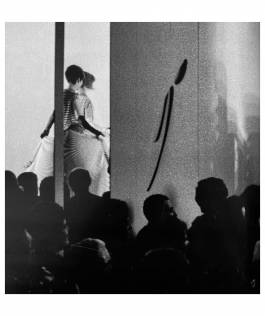
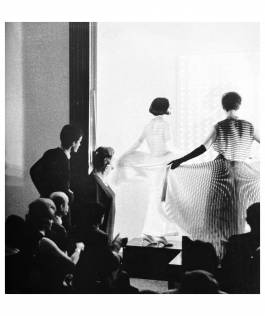
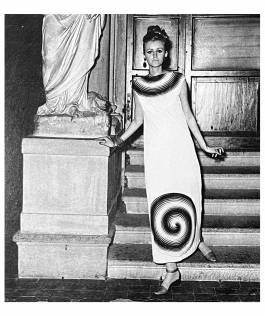
Fashion show of the collection “Optical Line”, Germana Marucelli atelier, Milan, 1964.
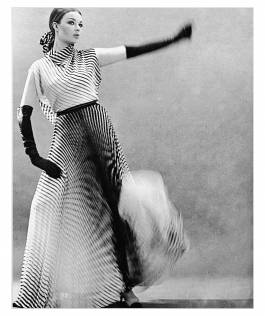
“Optical Line”, silk dress, 1964.
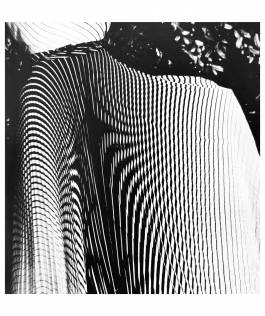
“Optical Line”, silk dress (detail), 1964.
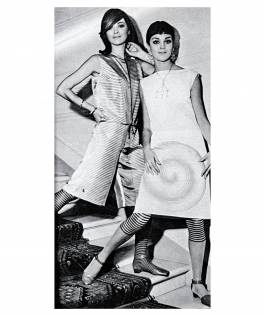
“Optical Line", 1964.
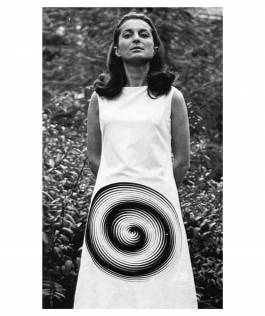
“Wedding Dress”, 1964.
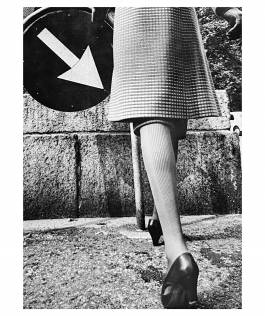
“Optical Line”, nylons, 1964.
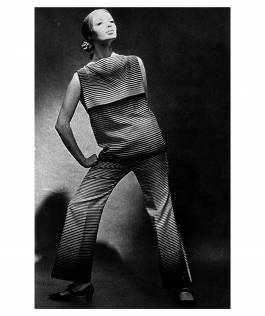
“Optical Line", 1964.
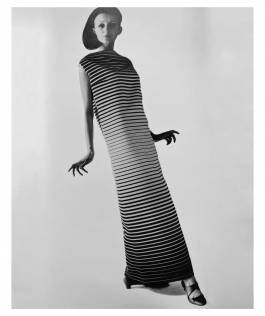
“Optical Line", 1964.
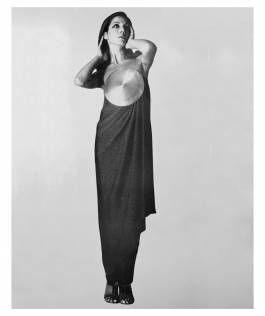
“Circle + Square”, 1965.
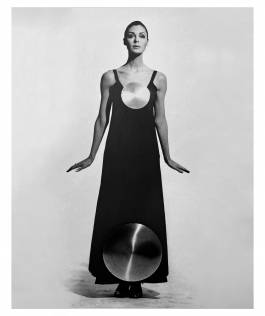
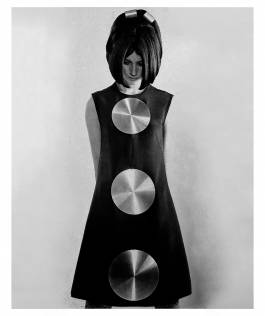
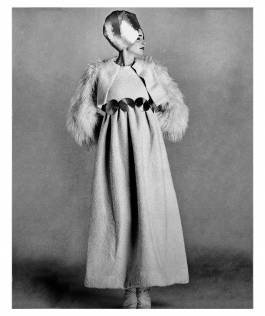
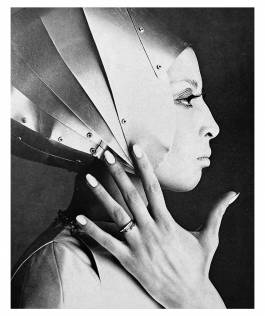
“Aluminium Line”, 1965.
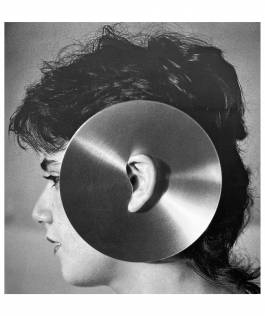
“Monorecchia”, 1965.
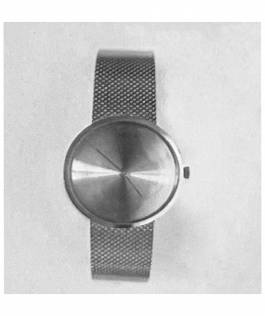
“Senza Tempo”, the 1970s.
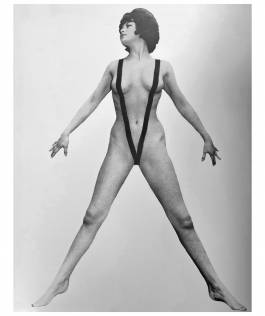
“Bat(h) Tape”, 1966.
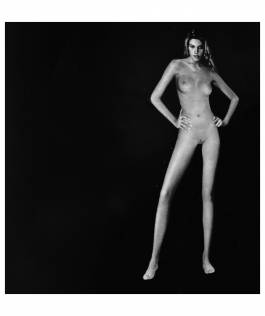
“Zero Level”, end of the 1960s.
2003
GETULIO ALVIANI: FASHION IS VERY DISTANT FROM ME. I HAD SOME IDEAS... SMALL IDEAS THAT COULD BE WORN
Dobrila Denegri: You are an artist who, at times, has approached the world of fashion, and I would like to talk about this.
Getulio Alviani: I have never been a craftsman, because I do not do anything for a living. I can be an architect, I can be an urban planner, I can be a designer, I can be a graphic designer, I can do everything related to the world of seeing, because through seeing, we have almost 90% of information. So I am interested in everything related to seeing, and everything that man has done has been designed. Therefore, my world is immense. In fact, I have done too little, because there are so many things to do.
DD: Can we talk about the collections you created with Germana Marucelli in the 1960s? How did your collaboration come about?
GA: The collaboration with Germana Marucelli came about in a very simple way.
It began thanks to the screen prints I had made in Yugoslavia. At the time, I was living in Friuli, and the most enjoyable thing I did was go to Ljubljana and Zagreb, where I met the graphic designer Branimir “Brane” Horvat and many other artists and critics. I remember that even the smell of the air was different in Yugoslavia: there were, I don't know, lorries that used a different fuel, a different air, a different universe. It wasn't easy to go there because it took months to get a passport and a visa. It was something exclusive. I, who always loved being a little different and not doing what everyone else did, enjoyed going there. In fact, I went on to develop a professional life in Eastern Europe, starting in Ljubljana and then continuing in Russia, Poland, and Ukraine.
Brane Horvat and I created three graphics in 1962/63, when I was using aluminium and steel. I couldn't use my usual materials, so I designed foldable geometric structures to be screen printed in black and white.
I found Eastern Europe very fascinating. When I returned to Italy, I would say to everyone, “Look what they can do in those countries”, whereas here it wasn't like that. Everything was difficult. I remember that we young people who frequented a gallery were told not to come on a specific day because Capogrossi was coming and he didn't want to see anyone. This did not happen with other artists, such as Lucio Fontana, for example, who was a close friend and, like us, young in spirit.
So, one day I arrived in Milan, where I had a friend, Paolo Scheggi, and showed him the graphics. I said to him, “Look what I've done, how wonderful!” Screen printing was unknown in Italy; no one even knew what it was. I explained to him, “You see, with this, by doing this, turning it over, turning it over again with a tiny mould, you can make these things. Ah, how beautiful!” And I left him a couple of pieces of each. “Come on, think of some ideas yourself, maybe I'll make them for you if you come down there. It's a whole other world over there." And in fact, it was true.
A few days or weeks later, I don't remember, Scheggi said to me: “You know, my aunt Germana Maruccelli has a dressmaking atelier. She saw these designs and had some ideas. Why don't you meet her? Come along, she wants to meet you.”
At the time, unfortunately, I knew nothing, not even how to sew, nothing. I was parachuted into this role, as has often happened in my life. However, we made several collections. We printed on fabrics and used different colours... and she made several garments... I remember a fuchsia one and a black-and-white one...
Germana held a presentation of the collection first in Milan, then in New York and Pitti, with great success. Because, in fact, these dresses were very beautiful: if a woman stood still, she was almost entirely in black; if she walked, she became entirely in white: it was a spectacle.
It was called “Linea Optical”, but it predated the Op Art fabrics used in England and America, with patterns inspired by Bridget Riley's paintings. But we worked on the dress's structure; we didn't just apply a geometric pattern to the fabric. The effect was different. It was quite an amusing phenomenon: if you moved, the dress almost changed colour and pattern. Sonia Delaunay and her idea of simultaneity come to mind, but even there, there wasn't quite the same effect of perceptual transformation.
DD: What was Germana Marucelli like?
GA: Marucelli was very talented. The cut of her clothes was perfect. She was a masterful seamstress, that is to say, someone who immediately understood the cut to give to a garment and constructed everything in an unimaginable way. And she was also very close to the art world. Yes, because she held these meetings at her house on Thursdays. Everyone went there... Campigli, De Chirico, Fontana, Quasimodo, Montale. They discussed art and spirituality. They got together and talked about introspection and what thought is. All in a dressmaker's atelier!
DD: How many times were the collections you created together presented?
GA: I can't remember all of them now, but I think a couple in New York... and most of them in the atelier in Milan, designed by Paolo Scheggi. At the time, there wasn't much advertising; it was all word of mouth. And everyone came to these fashion shows, not only customers, but also intellectuals and people from the art world: Fontana, Dorfles, Marina Apollonio and many more.
DD: How many things did you do together?
GA: For a fashion show, you need 50 or 100 dresses, so you make the prototype in three colours and then, to sell, you have to do lots of other things that I would never have done. In fact, I always wanted her to say, “These are my creations with Alviani fabrics.” The fabric was there, though, and many creations had their own feel: one was innovative, another less so. I'm only interested in innovation, something that moves forward.
Then she said to me, “Why don't we do something with aluminium?”
Well, let's try, great. I told her, “Look, I'll make you a dress I've designed with aluminium.”
I made her this dress consisting of a tubular piece of fabric with an aluminium circle that could be attached and detached at the bust. A circle and a square: that's the dress!
We made these aluminium discs in various sizes, which could be attached and detached, making the dress different every time.
DD: They were pieces that combined the concept of clothing with that of accessories.
GA: I also made jewellery, and my favourite piece is a single aluminium earring: it is a large disc with a hole in the centre, shaped like an ear.
Recently, I must say, I saw one of these very talented designers from the Belgian school who picked up a young girl on the street and said, “Please, put this earring on”. On the street, in a small village, she was there, you put it on her, and it became a sensation, they photographed it a thousand times... wonderful.
For me, it's a concept: the earring that becomes an amplifier for an ear... The earring in Italian is called “orrechino”, indicating small ear, but this piece is big, really big, in Italian it would be “orrechione”. I was interested in these puns, these somewhat paradoxical situations, you can grasp in Italian... it was a game of words.
DD: Were there other pieces of jewellery? Artists of the time, such as Fontana and Capogrossi, designed several.
GA: Yes, I made another piece of jewellery later, in the 1980s. It was inspired by those long needles you use to pick things up... When you clean the beach, for example, there are clumps of seaweed rolling around... That's where I got the inspiration for “Infilo contro-natura” (I thread against nature)... Here too, there's a play on words: steel is artificial, while seaweed is natural. It was a bit erotic, too... I like double meanings...
DD: Did you only make clothes in collaboration with Marucelli, or were there other cases too?
GA: I made a wedding dress for a girl who was getting married, because for me, marriage was when you felt like it, or “quando ti gira”, as we say in Italian, you understand? I am opposed to marriage in principle, though. But I made this dress: a simple white sheath dress with a graphic design of concentric circles printed at the centre. This circle has to do with “quando ti gira”, of course. It was always a graphic motif created with Brane Horvat. Your mother, Biljana, also had a dress like that, but it was shorter with a pink circle at the bottom.
DD: Yes, I remember wearing it when I was little... Biljana also had a pair of nylon stockings, also one of your creations, she told me... I was always playing with her garments at my grandmother's house. I think it was thanks to dressing up as a kid that my passion for fashion was born...
How did you perceive your relationship with fashion back then?
GA: Fashion was very distant from me. I came up with some small ideas... small ideas that could be worn.
DD: Today, this conceptual aspect of design has given rise to a series of studies in which the two disciplines almost merge. Sometimes it is nearly impossible to tell whether it is critical design or art. Among your most extreme projects, I remember “Bat(h)tape”. Can you tell me how you came up with the idea?
GA: I asked 3M Adhesive Tapes and its art director, who was a friend, “Couldn't we study 3M, a tape, a tape that lets sunlight through?” They said, “Yes, we can.” So I made some pieces of material that were adhesive on one side, and we made strips, circles and squares that you could wear, or actually pitch on your body.
It's my ideal swimsuit, my “Bat(h)tape”, which allows the body to tan completely. Usually, after the holidays, you would see girls with white bottoms and tanned legs, so I proposed the “Bat(h)” (pronounced “Butt”) tape as my version of the bikini.
DD: In the 1960s and 1970s, the “Nude Look” was in fashion anyway...
GA: By the way, when a lady asked me to make a special dress, I designed one with holes in it. Dresses are meant to cover your breasts, genitals, etc., but I made them show instead; I did the opposite. I enjoyed doing the opposite; from there, however, my concern was that dresses should not exist at all.
If I had to make a dress today, I wouldn't, or rather, I definitely wouldn’t.
Garments serve to protect the body from temperature fluctuations. They have no other reason, none whatsoever, and yet billions and billions of materials, consumables, cottons, silks, trade and money are produced. I think about how many billions are spent when it would be enough to maintain one's body at the body temperature of the environment.
If you keep your body at 36 or 37 degrees, while outside it is 30 degrees above zero or 30 degrees below zero, you no longer need clothes.
In my mind, I have this idea of pneumatic spaces expanding: it is absurd that a car occupies 4 or 5 cubic metres, whether it is stationary or moving. If all cars are stationary, whether full or empty, it is absurd to me. When not needed, it should shrink; when needed for one person, it should expand like this; when needed for four, it should expand like this. The pneumatic space, which is an old theory of mine, an old manifesto I made in the 1970s, precisely on the expandability of things.
DD: With a machine it's not so simple, but with fabric it's more feasible, I imagine...
GA: Yes, I thought about clothing, the clothing of the future. This ends up with naked people ingesting something or smearing themselves with something: I don't know what it will be, but it will be possible to cover bodies in another way, without fabric.
I also spoke with chemists and doctors: it is possible to maintain the body at a certain temperature. Mostly, it's about having the desire, the will to get to that point... But the world is still too far behind... It's going backwards, backwards. Instead of studying real problems, today's design is aimed at a society of idiots. Everything that is done today is for the idiot, and the idiot knows very well what his fellow idiots like, so we have absolute regression.
DD: What, in your opinion, is the role of the designer or the creative person?
GA: Well, the author, the creator, together with the physicist, the chemist, the engineer, and all the people who can contribute to this, must produce what is really needed in a world overloaded with objects and products... they must not make useless things.
DD: So it's the idea that counts?
GA: It can be a dress, an accessory, a piece of clothing... but if there is an idea behind it, it is like art... it makes you think.
I made a watch without numbers. It was called “Timeless”. At the time, it seemed crazy, strange, and it was called “Senza tempo”. The bracelet's knitwear was very carefully designed. This knitwear, as it seems, comes to life. This was done in the 1960s; it was a knit with flavour and anger. These were the 1960s! And they made fifty copies of this watch. Fabrizio Nuvena was the producer, if I remember correctly.
At the time, I only did things that interested me, without trying to sell them in this or that way. That's what I did in the field of fashion.
In general, it's as if you could frame the question of the world through different expressions and forms. When I saw artists approaching fashion and design, it was always to express in another form what was at the basis of their thinking, so this too. Most of the time, the thinking is serious. Sonia Delaunay painted cars as she did her tables, her clothes and her lamps. Not me, I make cars: a specific type of car. I think about them in a structural way to introduce innovation and more sustainable functionality.
Fashion show of the collection “Optical Line”, Germana Marucelli atelier, Milan, 1964.
“Optical Line”, silk dress, 1964.
“Optical Line”, silk dress (detail), 1964.
“Optical Line", 1964.
“Wedding Dress”, 1964.
“Optical Line”, nylons, 1964.
“Optical Line", 1964.
“Optical Line", 1964.
“Circle + Square”, 1965.
“Aluminium Line”, 1965.
“Monorecchia”, 1965.
“Senza Tempo”, the 1970s.
“Bat(h) Tape”, 1966.
“Zero Level”, end of the 1960s.