



2009
MICHAEL VAN DER HAM
Every year, the Vertice award, in collaboration with Artissima, reinterprets the encounter between art and fashion by giving visibility to young designers who could venture where every distinction between these two worlds is lost, a realm of creativity and experimentation, where any bias on art or fashion is questioned. After Heaven Tanudiredja and Yuima Nakazato, this year the award was given to Michael van der Ham, a young Dutch talent who just emerged from Louise Wilson’s class at Central St. Martins College of Art and Design, placing himself at the intersection between different ages and styles and creating a collage of forms where one can still hear the echo of the great pop art guru, Andy Warhol. After illustrating glossy magazines and after Campbell’s paper dress, Warhol in the 1970s continued to work for the fashion world, creating first the pattern for some fabrics for Stephen Brice and then collaborating on various Halston collections, of which the memorable “Brillo Box Dress” remains. A further step was taken with the clothes which appeared in an exhibition curated by Diana Vreeland, a series of creations based on the decomposition and recomposition of models by great designers like Diane von Fürstenberg, Halston, Oscar de la Renta or Valentino. The sleeve of a Halston dress with a top by Valentino and so on… a patchwork that only Warhol could create and which has become today the point of reference of a young designer who resumes Warhol’s principle to create a short circuit in the mechanism of fashion seasonal change.
Michael van der Ham has already received several awards, to which we now add the award created by Vertice for ITS – International Talents Support, an extraordinary initiative carried out by Barbara Franchin and her collaborators and promoted by Diesel, which every year gathers the best young creatives all over the world.
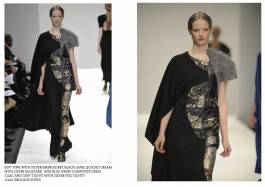
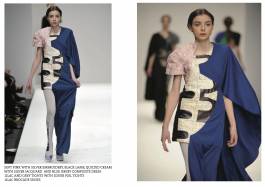
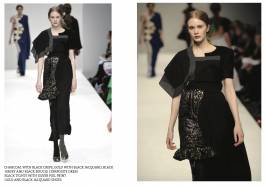
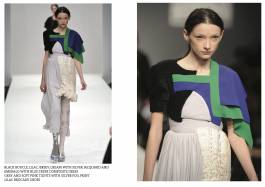
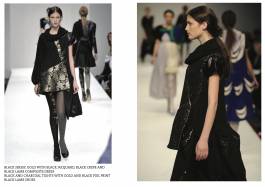
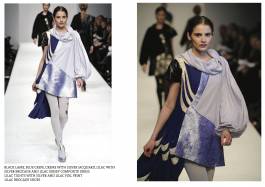
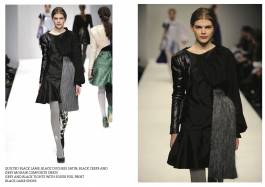
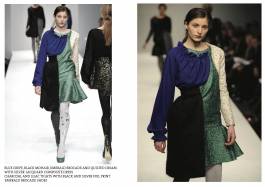
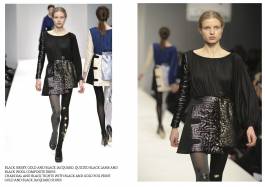
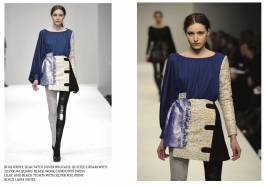
The young Dutchman is honoured for his 2009 autumn/winter collection inspired by Warhol and his “combined” clothing, revised in such a way as to stimulate a reflection on the syncopated rhythms imposed by the mechanism of the present fashion industry. Van der Ham’s clothes are created as a collage of the most recognisable and symptomatic models in the history of fashion: so the 1920s live side by side with the 1950s, the 1960s and the 1970s and, on the same body, ages and styles intertwine in a temporal synthesis which would show that today’s fashion rhythm has accelerated so much that the sense of designing for the single seasons has lost its meaning. From Warhol, who mixed the famous creations of great designers, to the young Van der Ham, who, through the recomposition of various “fashions”, has created his signature, we find that, once again, the new is born from a new reading of the past.
Published in cura.artmagazine n.02
2009
MICHAEL VAN DER HAM
Every year, the Vertice award, in collaboration with Artissima, reinterprets the encounter between art and fashion by giving visibility to young designers who could venture where every distinction between these two worlds is lost, a realm of creativity and experimentation, where any bias on art or fashion is questioned. After Heaven Tanudiredja and Yuima Nakazato, this year the award was given to Michael van der Ham, a young Dutch talent who just emerged from Louise Wilson’s class at Central St. Martins College of Art and Design, placing himself at the intersection between different ages and styles and creating a collage of forms where one can still hear the echo of the great pop art guru, Andy Warhol. After illustrating glossy magazines and after Campbell’s paper dress, Warhol in the 1970s continued to work for the fashion world, creating first the pattern for some fabrics for Stephen Brice and then collaborating on various Halston collections, of which the memorable “Brillo Box Dress” remains. A further step was taken with the clothes which appeared in an exhibition curated by Diana Vreeland, a series of creations based on the decomposition and recomposition of models by great designers like Diane von Fürstenberg, Halston, Oscar de la Renta or Valentino. The sleeve of a Halston dress with a top by Valentino and so on… a patchwork that only Warhol could create and which has become today the point of reference of a young designer who resumes Warhol’s principle to create a short circuit in the mechanism of fashion seasonal change.
Michael van der Ham has already received several awards, to which we now add the award created by Vertice for ITS – International Talents Support, an extraordinary initiative carried out by Barbara Franchin and her collaborators and promoted by Diesel, which every year gathers the best young creatives all over the world.
The young Dutchman is honoured for his 2009 autumn/winter collection inspired by Warhol and his “combined” clothing, revised in such a way as to stimulate a reflection on the syncopated rhythms imposed by the mechanism of the present fashion industry. Van der Ham’s clothes are created as a collage of the most recognisable and symptomatic models in the history of fashion: so the 1920s live side by side with the 1950s, the 1960s and the 1970s and, on the same body, ages and styles intertwine in a temporal synthesis which would show that today’s fashion rhythm has accelerated so much that the sense of designing for the single seasons has lost its meaning. From Warhol, who mixed the famous creations of great designers, to the young Van der Ham, who, through the recomposition of various “fashions”, has created his signature, we find that, once again, the new is born from a new reading of the past.
Published in cura.artmagazine n.02


INSTAGRAM
@EXPERIMENTS.FASHION.ART