


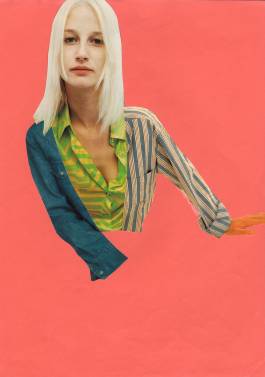
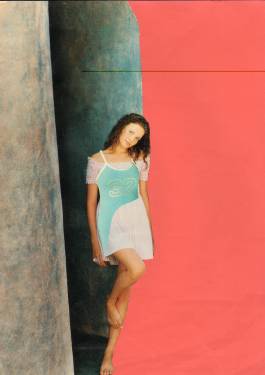
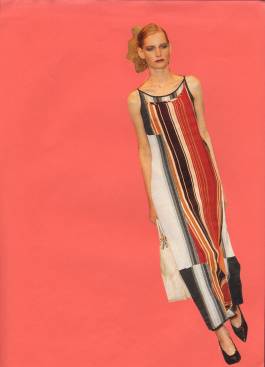

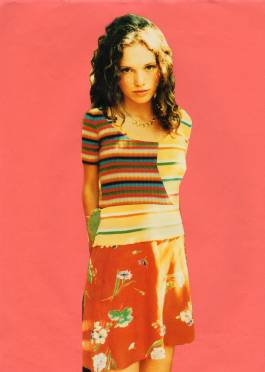
Pietra Pistoletto, Collages, 1999.
2009
PIETRA PISTOLETTO: MY CONCEPT OF FASHION IS ANTI-FASHION
‘My concept of fashion is anti-fashion, because I recycle clothes that are no longer in fashion to create garments that last over time,’ says Pietra Pistoletto.
She creates her designs by assembling and combining parts of existing clothes, transforming and reinventing their usual use. Thus, stockings or underwear become the material for making dresses and skirts, while hidden elements, such as padded shoulder straps, “come out” to the surface, becoming T-shirts. Through this process of recycling and reusing out-of-fashion garments, she creates unique pieces that reinterpret the principles of haute couture in a completely new way, making them relevant again. She goes even further in her process, offering the wearers the opportunity to be creative and choose and assemble the parts according to their own tastes. This is evident in the jacket, which is cut in the middle, allowing different pieces to be combined and connected with zippers. It was this idea that marked the beginning of her creative journey, which has unfolded in parallel in the fields of fashion and art since the mid-1990s.
After graduating in advertising graphics and then costume design in Italy, and completing internships at Christian Dior, Carlin International and Emanuel Ungaro in Paris, Pietra Pistoletto was invited to participate in an exhibition on the theme of clothing at the Academy of Fine Arts in Vienna. There, she had the idea of “cutting up” different types of jackets, both elegant and sporty, leaving it up to the public to combine the two parts. Since then, she has exhibited and shown her work in art venues such as the Mudima Foundation and Triennale in Milan, at the Florence Fashion Biennale within the exhibition “Habitus / Abito / Abitare” at the Pecci Museum in Prato in 1996/97, curated by Michelangelo Pistoletto and Bruno Corà, and at the Biennale Giovani Artisti in Turin in 1997 and Rome in 1999.
Her work reveals a close connection between art and fashion, to such an extent that she could be defined as an artist for whom clothing serves as a means of expression. She confirms this, stating that: ‘the relationship between my fashion and art is unconscious, perhaps it arose spontaneously from living within the artistic world’, and goes on to emphasise the important points of her work: "Over time, the art world has drawn me to it, to the point where I now think of myself as an artist who uses clothing to express herself. The importance of recycling is fundamental to me, and I will continue to pursue this theme because it will become increasingly relevant. If a designer or production company ever asks me to produce some of my garments from scratch to be sold in series, it does not mean that I will not accept; I will enter the world of fashion a little more, but I will always continue to explore the world of art through research.”
Dobrila Denegri: ‘You think and act the way you dress!’ ... Do you agree with this statement by Giacomo Balla? How would you like people who wear clothes you have designed to think and act?
Pietra Pistoletto: I agree with Giacomo Balla's statement because it is true that the way you dress influences the way you act. This is precisely why you need to feel completely at ease in the clothes you wear and allow your personality to shine through without any constraints. Fortunately, my customers are exactly how I would like them to be. First of all, they are socially eco-responsible, so they are happy to wear clothes that have been transformed, linked to the concepts of recycling and ethics. They are people who love to travel, work, and have children, so they are constantly busy and get dressed in the morning, ready to go until the evening. They love to dress in a particular way without being too flashy; they want to dress comfortably and feel at ease without worrying about being unsuitable for various situations.
DD: Replacing squares with circles, cubes with spheres, redesigning spaces, revolutionising architectural forms —shortly, improving the environment around us — would lead to the improvement of people, Buckminster Fuller believed... Do you think there could be a type of clothing that would lead to greater individual and collective emancipation? How would you imagine it?
PP: I have been working since 1994 with the belief that what I create can be a stimulus for greater individual and collective emancipation. My first idea was that of “half jackets”, where the individual can choose between the left and right sides of the jacket and combine them as they wish, thus highlighting their individuality. Still, at the same time, they can exchange a half jacket with anyone else who has another one, therefore opening up to the community. All this acquires value when you consider that these jackets are based on the fundamental idea of recycling and reusing garments that are no longer beautiful or fashionable, which today's society often rejects.
DD: You have often described your creations as ‘anti-fashion’... and I would like to explore this term with you, which I find particularly fascinating as it alludes to everything unconventional, but not only that, it also refers to the most exceptional creative adventures that emerged within the historical avant-garde and post-avant-garde movements of the second half of the last century... we remember truly “rebellious” creations such as the “anti-bourgeois” Futurists, 'anti-neutral', modifiable and bellicose creations that were part of the “Futurist Reconstruction of the Universe” announced in 1909... or those proposed by Yayoi Kusama in 1969, celebrating a free and sexually uninhibited body through creations that framed the body, creations that, rather than dressing it, undressed it. Today, in such an oppressive and conservative time, what kind of ‘message’ does this term convey and, in particular, what does anti-fashion mean to you?
PP: For me, it means creating a garment that will always be popular, regardless of changing fashions. Therefore, it does not follow the current fashion trends in which it was created. I must say that, practically, everything I have created in the past 14 years remains relevant today.
Published in the cura.magazine, issue 00
Pietra Pistoletto, Collages, 1999.