


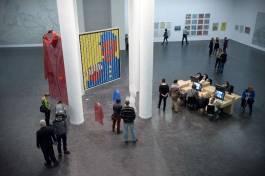
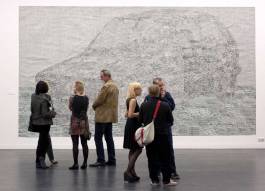
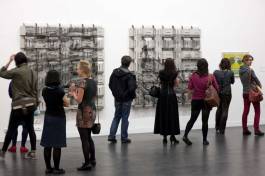
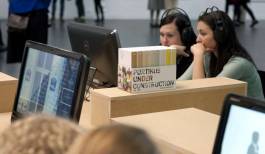
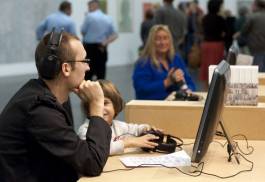
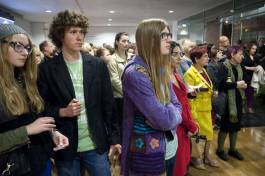
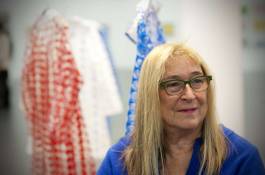
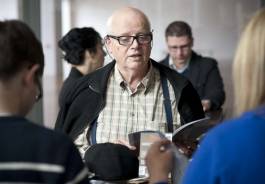
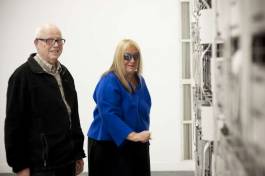
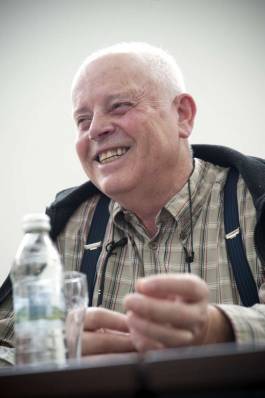
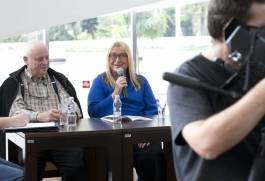
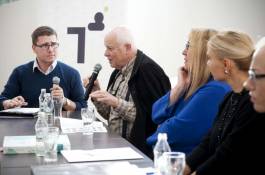
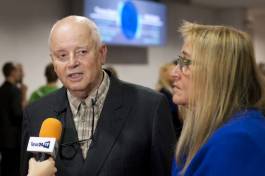
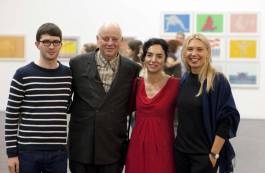
Opening of the exhibition “Thomas Bayrle - From weft to warp, and back again & Helke Bayrle - Portikus under construction”, curated by Dobrila Denegri, Centre of Contemporary Art in Torun.
2012
THOMAS AND HELKE BAYRLE: CONVERSATIONS UNDER CONSTRUCTION
Dobrila Denegri: Thomas, this is your first major exhibition in Poland. I recall that when you visited the museum and the exhibition space for the first time, you commented that this year you had been invited to display your work in huge spaces: firstly, during Documenta 13 in the large Documenta hall, and shortly afterwards here in Torun. We are showcasing works from different stages of your career, starting with early prints on PVC and paper, and progressing to your most recent computer graphics created in collaboration with Helke.
Alongside these, we are presenting Helke’s series of art documentaries, “Portikus under Construction,” and are trying to foster a dialogue between these two distinct artistic approaches. This conversation undoubtedly reflects your fifty-year relationship and close collaboration, which has taken place on many levels, as well as your shared sensibility towards teaching and the educational significance of art. Instead of a traditional interview, it would be interesting to undertake something akin to Helke’s method of capturing the evolving process of “exhibition in becoming,’ to record and document its genesis and tell a story of your work, both yours and Helke’s, as the exhibition takes shape. I propose we create a sort of “conversation under construction.’
To start, I’d like to ask what was critical for your artistic formation? It is always interesting to learn about concrete triggers within daily life or the surrounding cultural context that influenced the work that would later develop.
Thomas Bayrle: In every existence, there are some crucial moments, and mine are closely connected with my childhood. I was born in Berlin, but soon after my birth, we moved to a small village where we were the only protestants. I lived a very average life, walking in the fields or running in the meadows… and from an early age, I was impressed by the hum, buzz, and song of millions of tiny creatures filling the air. In contrast, sometimes on summer afternoons, I would sneak into the small village church, where a group of elderly women sat and prayed. Here again, I found the same kind of humming, buzzing, and singing, but above, there was a fascinating, monotonous rhythm.
I felt the same fascination several years later, when, aged 18, I entered a textile factory to study and practise weaving and textile finishing. The sound of hundreds of machines running in the vast hall was overwhelming for the workers. Everybody, totally subdued and isolated, felt utterly alone and, in a way, started to coalesce with the machines. I thought that I had to tune myself in with the rhythm of my machine, otherwise I wouldn’t survive. It was almost a trance-like state of mind that made me feel a strange sense of meditation. As I thought the repetition and rhythm of my machine tuned into a state of being “One with me,” the movements and feelings of body and soul became analogous. The contradictions that necessarily exist somehow vanished. In this moment, the singing of the engines and the singing of the nuns of my childhood fell together…
DD: In the 1960s, you mainly used painterly media and made “Theatre-like Machines” - a set of oil-painted wooden boxes that could be “animated”. What triggered the shift towards montage, collage, silkscreen and similar reproductive techniques?
TB: Between 1964 and 1966, I made about 10 of these machines, driven mainly by the interest in dealing with the various ways of mass production and the mass consumption movement of people and goods. In a mixture of funny, stupid monotone repetitions and noises, these boxes expressed equal gestures in parades, beer halls, showrooms, and football stadiums. The repertoire of images I used came from both capitalist and socialist contexts. It didn’t matter much because I saw the differences between communist and capitalist ideologies as less important compared with all the others at the time. I saw more of what they had in common.
A certain idiotic reality… in the West: trucks which carried cars, planes stuffed, car parks filled with cars... and in the East: fields with grids of tractors full of happy workers waving red flags... China seemed in its overdrive of super-fun almost the same…
The shift to other methods of production occurred in 1967 with a request from a small German fashion house to create patterns that could be used for either fabric or plastic. They wanted to make a series of plastic raincoats with those patterns. I made grids of shoes, cups and cows. Here in the show, positioned in the centre of the space, we have an original oversized red coat made of PVC. Back then, wearable coats were also produced, distributed, and sold in large stores, and some of them were also shown in galleries.
DD: In that time, you were also making patterns for Pierre Cardin, one of the biggest names of French fashion and father of the so-called “futuristic” look, right?
TB: It was a different story, though. I was asked by Iris Clert (a famous Parisian gallerist), who promoted artists like Arman and Yves Klein, to make some patterns for Pierre Cardin. These patterns were never put into production, and they were also never returned to me. In any case, when I started working on patterns, I didn’t know where it would lead me.
DD: Was there a change content-wise, after this shift, towards reproductive media?
TB: Initially, I worked with images of everyday things: shoes, cups, logos of milk cheese like “La vache qui rit”... for instance… For two years, I worked in the advertising industry. Often, I worked on commission, so in advertisements for Camel cigarettes, I’d use camels, or in publicity for tripods, I’d use a tripod. While in the commissioned portrait “Knopfmann,” I chose to use a button as an element to construct the face of the owner of a department store. Pretty often, those who commissioned the work didn’t like it in the end. That’s how I've accumulated such a collection of crazy graphics now.
DD: You didn't work on commission in all the cases, right? Here, we have images of a sandy beach, even before highways and urban landscapes emerged.
TB: The sandy beaches of “Rimini I” and “Rimini II”. At the beginning of the 1970s, I conducted numerous field studies, visiting the FIAT plant near Turin, the Opel factory in Ruesselsheim, and even a “vacation factory” in Rimini. I only went there for three days to measure the number of visitors, observe the parking lots, and so on. I wanted to study how this works. One could see rows and rows of umbrellas and bodies under the sun… It was so unbelievable and fascinating for me. Only in Italy could one find, in the late 1960s, such friendly and rigidly organised vacation factories. Going to “Riviera Romagnola” was already then quite an experience!
This phenomenon, as well as the people and things from my immediate surroundings, were my motives: for instance, my mother, whom I portrayed using telephones or windows. Louis Armstrong, Orson Welles, Norman Mailer—I portrayed many personalities…
DD: Here we have portraits of Norman Mailer made of pencils, Stalin made of his moustaches, Orson Wells made of wheelbarrows, and a picture of Willy Brandt entitled “Nicotine”, how come?
TB: He was famous for smoking a lot, so that’s why I made him in Tobacco brown like this... and then we also have “Fenster”: Duchamp’s window made of many small windows...
DD: Seems quite a tautological principle... does it have any relation with the use of tautology in conceptual art?
TB: I would say, when I did these works, they came rather associatively... in a kind of silly way, not very conceptual... often just fun.
DD: But seen from today’s perspective, it seems almost stunning that imagery belonging to ideologically antagonistic contexts, like communism and capitalism used to be, appears positioned on the same level, “interwoven” together in a unique pattern, so to say, in your graphics made in the early 1970s... was it still based on this associative principle?
TB: Like in the works from the mid-1960s, here the visual, optical aspect was also much more crucial than the ideological one. It was the impact of technological progress and the phenomenon of multiplication in modern societies, in all its various forms, that triggered my interest. From there, I developed photo collages, often made from found elements. Later on, I varied these few elements into hundreds of different-looking elements to make the constructed works appear individual.
DD: Could you tell me more about the technical aspects of photo-collages, photocopy-collages and later animations: how were you able to achieve such a mesmerising optical impact, or almost pulsing effect of the image with relatively low-tech means?
TB: On one side, fragments of photos, containing just a few objects (cars or buildings, for example) were combined, creating very complex structures which would almost give the illusion of a third dimension in all its flatness.
Mapping was also very important for me. In particular, the process of mapping on organic forms. I began to develop a technique that would enable me to do it much earlier than computers became available and capable of doing it. To achieve the effect I wanted, I needed to have a surrogate. To create the large collages featured in the show, pieces like “Auto”, “Capsel”, and “Stadt” required hundreds, or even thousands, of distortions of the same image to fill in organic faces or bodies. For about 13 years, I worked together with Helke and two other students to make films.
Helke Bayrle: Yes, it was a collaborative work, and we have now decided to show the process as well. Now we are including images where it is possible to see fingers and hands holding and stretching the printed latex rubbers on our copy machine.
TB: The process itself consisted of making clichés of images and printing these on latex rubber. On the copy machine, these rubbers had to be stretched and copied into outlines that had been prepared beforehand.
DD: This exhibition bears the title “Weft and Wrap - and Back Again”. You have often used this metaphor in different contexts. To what should it relate here?
TB: My experience of working in the textile factory had a strong impact on the development of my work. Fifty years ago, weaving was not often used as a metaphor. This has changed. Today, it stands for almost everything.
In this regard, it’s interesting to mention that Joseph Marie Jacquard, to whom we owe the “Jacquard” type of fabric and the invention of the first programmed looms, is also one of the crucial figures in the history of computing... Today, we may feel like societies are like weavings, one infinite texture…
DD: Helke, the series of documentary films you have realised so far counts more than 130 titles. How did it all start, and where has this process led you?
HB: In 1992, I met Kevin Slavin at the Städel School. He was a guest student from the Cooper Union, and he created a complex work in Frankfurt, featuring happenings at six different locations throughout the town. When he saw that I owned a camera, he asked me to assist him by accompanying him throughout his spots in the City. When I showed it in the film class at the Städel School, I received very positive and encouraging comments. This was an extra impulse to continue. After trying other institutions in Frankfurt, such as MMK, I started to concentrate on Portikus, which had been an appendix of the Städel School since 1990. In Portikus, one could ideally see how every artist does something different in the very same box. So, I decided to learn more, not only about specific artistic practices, but also about the practice of filmmaking. For me, this process of learning was very important, and it's something I wish to share, because “Portikus under Construction” can be considered a very useful teaching material as well.
DD: For all those who are working in the field of art, such as curators, artists, and generally all those who can be considered “insiders”, these films are fascinating because they are about the process of the becoming of an exhibition. We know how exciting, but also how delicate this process can be. How is your approach when you make footage for your films?
HB: Firstly, the artist should agree, and till now there have only been two cases in which they didn’t. The second important thing is that I take my time, filming all the phases from the arrival of the works and artists until the opening, which can take about a week. Then, from this extensive footage, I edit. It can be a lengthy process, too, as I wish to select only a few special moments that can keep the character of these films fresh and spontaneous. My angle is very subjective. I’m also aware that the space I’m entering with my camera is quite “private”, and every artist works differently. So, I try to feel the situation, get in tune with the atmosphere, and act as discreetly as possible, being respectful towards the artist and their mood, needs, and working rhythm. Sometimes we can get engaged in conversation, which is always interesting because it's a “first-hand” statement about the work on show. In some other cases, I’m just interested in the process of “building” the show, or the work and its inner aesthetics take me. However, in the final cut, I tend to preserve the spirit of the moment, and I intentionally keep them relatively short.
DD: My first impression, seeing all of the films in a row, was that they can be considered as “notes for the history of exhibition-making”. They can indeed be seen as portraits of artists, as well as of their works, but what seems to be in focus most of all here is the moment of “becoming”, the very process of the creation of an exhibition. When seen as sequences of a larger story, it is interesting to observe how the space was decisive for the nature of certain artistic interventions, or how programmatic directions change each time when curators change. Your films are like a window on a spot that has undergone many transformations in the last twenty years... and keeps on changing...
HB: I’m happy if these transformations are visible, because it’s something I found very precious too. The location of Portikus has changed three times since it was founded by Kasper König in the early 1990s: so from the plain white cube “hidden” behind a big neoclassical colonnade, it moved “within the walls” of the historic building with the temporary structure designed by Tobias Rehberger, up to its current and final location in the building designed by the Frankfurt architect Christoph Mäckler, with light interventions by Olafur Eliasson. These three different spaces were each time changed by the artistic interventions, sometimes very radically and sometimes in a less perceptible way. But surely the space itself played a part as well, of course, as the choices made by the curators, which changed through the years. Daniel Birnbaum succeeded Kasper König, working alongside curators Jochen Volz and Nikola Dietrich. Now, the place is directed by Nikolaus Hirsch. All of them provided space not only for well-known international artists but also for many younger artists from the Städelschule and, of course, for those who were, or still are, teaching there, such as Peter Cook, Simon Starling, Wolfgang Tillmans, and many more.
TB: Many of these artists are our friends and have been my colleagues, and as an artist, I see Helke’s films as an important source of confrontation. It's true that artistic work can be developed as a solitary practice, kept aside from all other practices that happen contemporarily, but it’s also true that all these practices are creating a sort of network of knowledge. Seeing Helke’s films helps to navigate that network.
DD: It’s not for the first time that you are showing together, but here, maybe it is a particular situation that your works are in a dialogue, coexisting in the same space. But an even more special aspect of this show, so to speak, is the fact that it brought you together to the city in which Helke was born. How does that feel?
HB: I’m so happy to be in Torun again. I was four years old when, with my family, we left the place during the Second World War in really dramatic circumstances. But this show has given me an opportunity to share something positive with this place through my work, and through Thomas’s work as well. After many years, we are still doing things together, and I hope we still have time in the future, because it feels so good!
Published in the catalogue of the exhibition “Thomas Bayrle - From weft to warp, and back again
& Helke Bayrle - Portikus under construction” curated by Dobrila Denegri
5 October – 30 December 2012, Centre of Contemporary Art in Torun, Poland
Opening of the exhibition “Thomas Bayrle - From weft to warp, and back again & Helke Bayrle - Portikus under construction”, curated by Dobrila Denegri, Centre of Contemporary Art in Torun.