


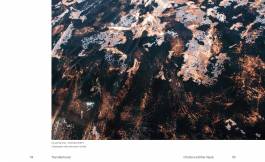
Pages from Transfashional catalogue
2017
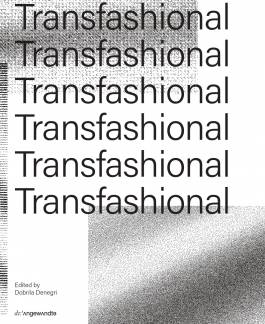
TRANSFASHIONAL
What semantic resonances can fashion and fashion-related practices have when shown within the context of art institutions? Can both art and fashion shape new paradigmatic positions in response to our current social, economic, cultural, and environmental urgencies?
These are some of the initial questions that “Transfashional” attempted to address through a set of discursive and exhibitive events held in 2016/17 in Vienna, London, Warsaw, and Vienna again.
Conceived as an exhibition-in-progress, “Transfashional” began as a session of talks and workshops which involved renowned fashion-designer Hussein Chalayan, curators José Teunissen, Susanne Neuburger, Beatrice Jaschke and artist Barbara Putz-Plecko, as well as a heterogeneous group of creatives whose academic formation and practice are situated in the liminal zone between art, fashion and textile design, photography, graphic and product design, performance and architecture.
The transdisciplinary approach, inherent to each participant's work, served as the point of departure for a broader reflection on the potential meanings of the term ‘transfashional’.
It is coined from the prefix ‘trans’, which stands for across, beyond, through, and the term fashion transformed into an adjective, so that allusion to something relational, processual and “in-the-state-of-becoming” is emphasised even further. It echoes, of course, many similar terms, such as transit, transfer, transform, translate, transverse, transcend, transpose, and transgress, in which the prefix trans means 'beyond.' Movement which, in this case, should open new ways of understanding and defining future declinations of fashion.
Being an invented term, “transfashional” is a floating signifier, “in itself void of meaning and thus apt to receive any meaning,”¹ to use the words of Claude Lévi-Strauss. Thus, it can assume the role of a signifier which has to find and articulate the proper meaning and potential field of references. In this sense, taken as the project's title, it was meant to act as a trigger for questioning, first of all, the existing vocabulary, which often appears limited and inadequate in the face of numerous creative productions that intentionally challenge the notions of functionality, wearability, or even categorisation and recognisability.
Productions that sometimes appear as enigmatic body-related objects, or as visualisations of fashion-related concepts, and which carry within their DNA a way of thinking inherent to art, architecture, and performing arts, but cannot fit in any of these conventional disciplinary categories alone. Being somewhere “beyond” or “out of” conventional disciplinary boundaries, these productions ask to be addressed, analysed, contextualised, named and defined, in order to gain legitimisation, affirmation and most necessarily, support. Being beyond categories or between disciplines also means being situated in that still indefinite space that separates product from artwork. So, through lexical considerations, this project also sought to address the practical issue of recognising and supporting practices that are aesthetically and conceptually on the cutting edge, but, in terms of research and production, often quite challenging to sustain, especially outside the academic frame.
Being mainly related to younger and emerging practitioners, “Transfashional” wanted to provide an occasion to stimulate and present these critical and experimental practices, using the context of renowned art institutions as the most adequate platform. Thanks especially to this platform and the “cultural capital” it provides, this project sought to foster collective reflection on the various potential meanings of the term chosen for its title.
One semantic interpretation of the term “transfashional” is clearly oriented towards the question of disciplinary boundaries and the need for new forms of denomination and categorisation for those hybrid productions which challenge the notion of functionality, or even knowability. Similar questions arose within the field of product design, in relation to the growing emergence of objects that seem to overshoot the usual formulas: “art or design?” / “art and design?”. While resisting the classical typologies of traditional sculpture, product or furniture, these objects make palpable the gradual dissipation of divisions between contemporary art and design. To this phenomenon, designer Robert Stadler and curator Alexis Vaillant dedicated two exhibitions, “Quiz” and “Quiz 2”, realised in Nancy in Galerie Poirel, in 2014 and in Luxembourg in MUDAM, as well as a reader entitled “On Things as Ideas”, published in 2016 on the occasion of the second show. Alexis Vaillant’s words from the introduction to this book might offer an interesting analogy for what the “Transfashional” project investigated.
“For over half a century, the boundaries between art and design have dissolved, and those disciplines are increasingly interrelated. Paradoxically, the specificities of these fields survive despite their porosity, particularly in the production and dissemination. Out of this porosity, which might be termed “post-interdisciplinary,” scarcely recognisable objects have emerged. These include artworks, of course, but also objects conceived by designers. These functionally opaque objects provide access to a path towards a better world - the classic promise of design - that is less self-evident and more critical. Some artists, for example, have produced sleek, industrial-looking objects whose forms might give the impression of deviant design. They are all things that belong to both design and art, and which deal with similar issues in different ways, without art becoming design or design becoming art. Amongst these shared issues is the ability for works to be apprehended as ideas - hence the title, ‘On Things as Ideas’.”²
In the context of “Transfashional”, the term “things as ideas” could be paraphrased in several different ways, starting with “clothes as ideas” or “adornments as ideas”.
In specific cases, connected to the works of some of the participants, these terms might serve as indications for questioning the process of making clothes, the principles of constructing a garment, and the symbolic purpose of an adornment.
Kate Langrish-Smith’s “Mode Metonym” could hardly be considered a collection of accessories, or any sort of adornment as conventionally defined. Obviously, they are conceived as body-related objects, but they challenge any notion of wearability, and they seem to question even the basic knowability. The question that they trigger first is “what are they?”, before even posing a question about how they can be worn or used. In fact, “Mode Metonym” is a set of beautifully crafted sculptural objects, whose organic and sensual shapes allude to the body. Their shiny or velvety surfaces tempt us to be felt and touched, and yet they are fascinating, most of all, because they make us wander. They function primarily as activators; they provoke thoughts, interpretations, and even performative gestures. Indeed, they can be described as “things as ideas.” Most of all, they pose the basic question of the symbolic function and value of the adornment.
Another example may be found in the short film of Lara Torres, which brings into focus the process of making clothes, through the very negation of their materiality. In “An Impossible Wardrobe for the Invisible” from 2011, a collection of apparently wearable, almost uniform-looking white garments undergo a transformation in the moment when they come into contact with the water. They literally dissolve, leaving the body revealed, or just symbolically “dressed” in what remains as a residue of a garment: its outline made of stitches. In a metaphorical sense, what remains is something that might be seen as “dress as idea”.
Yet another example might be found in Afra Kirchdorfer’s “Clothing System”, through which she seems to bring back to level zero the process of the construction of the garment. “Clothing System” stands for a set of quite minimal means: simple, geometrically cut pieces of cloth and some connecting elements. What is potentially infinite, though, is the possibility of using them as constructive elements, which can be combined, assembled and transformed into a kind of proto-clothes. Eventually, garments created through this inventive and ludic process might also be worn, but what they mainly do is bring into focus the process of making through rethinking the fundamentals of what clothing is or might be. Thus, the term “clothing as idea” comes to mind.
Art is an important reference point for all these young practitioners, and, intentionally or not, they incorporate artistic references into their work. In the case of the three above-mentioned examples, one can recognise echoes of the great tradition of British sculpture, from Henry Moore to Rachel Whiteread; or to the radical and engaged position of Gustav Metzger and his “auto-destructive art”; or to experimentations with impermanency and performativity as sculptural categories, as can be found in the work of Franz Erhard Walther. Yet, in this context, reference to the work of one of the fathers of conceptual art becomes particularly pertinent.
In the late 1960s, Joseph Kosuth began presenting linguistic definitions of certain terms as artworks, titling this series First Investigations (subtitled Art as Idea as Idea). Through them, he “sought to demonstrate that the ‘art’ component is not located in the object itself but rather in the idea or concept of the work,” as Nancy Spector puts it.
Rather than being formal, the connection between this historical reference and the work of contemporary and emerging fashion practitioners lies in the awareness that certain ontological questions arise. In the late 60s, when “First Investigations” were realised and “Art After Philosophy” was published, Kosuth argued: “Being an artist now means to question the nature of art.”³
Now, as technological shifts, crises of capitalist paradigms, and environmental urgencies dictate social and cultural agendas, being a practitioner in any creative discipline pushes you to ask what should be new, the “whys” and “hows” of creating and producing. Among the emerging generation of artists/fashion designers, there is a growing awareness that new paradigms are needed.
The condition of our contemporary world, with its climatic, energetic and economic urgencies, requires not only reflection but also a profound revision of the principles on which processes of production are grounded and the social relations that derive from them.
The condition of the fashion industry and the mainstream fashion system is such that, for the majority of emerging creatives, the main priority is to find alternative ways of conceiving, creating, and producing fashion. It’s this need for revision and quest for alternatives that became a creative drive which inspires new productions - not of commodities but of ideas. Indeed, more than wearable and functional, most of these productions are critical, engaged, and conceptual, and, as such, they can be seen as symbols and symptoms of the present zeitgeist. This emerging generation turns away from the fashion industry and its super-accelerated rhythms of production; they take a stand against the shortsightedness of liberal capitalism, and use their work as a tool for reflection, resistance, criticality and self-expression. The temporal dimensions they refer to go back to preindustrial, or even prehistorical, times; their formal vocabulary is dominated by primary structures, plain geometries, imprints and body traces, and the general undercurrent of their work can be outlined through terms such as basic, essential, elemental, and immaterial. In this sense, they implicitly call for something like tabula rasa, blank page, a sort of fresh ground on which to start building again.
In the early 1980s, when fashion, along with music, was giving voice, form and style to the youth rebellion, Vivienne Westwood commented on her work: “I created something new by destroying the old. This wasn't fashion as a commodity, this was fashion as an idea.”⁴
This statement makes us think that cyclic fashion reaches a point of questioning its status, its system, and its values. For young generations today, this questioning has existential and ethical connotations. It incorporates even very radical positions, such as a withdrawal from the process of designing and producing, as a way of “making fashion” through critical discourse about fashion and its current state.
Various analogue positions can be traced through art history, from Marcel Duchamp’s “silence”, withdrawal of Agnes Martin, strikes and drop-outs of Lee Lozano, up to radical calls for an “art-strike”, a collective and coordinated refusal to make art for a period of maximum three years, as invoked by Gustav Metzger but never followed by any of his fellow-artists. There was also a conscious and voluntary gesture of stopping the production of art by Cady Noland, or to erase any trace of proper artistic existence as operated by Stanley Brouwn, as well as to move to other fields of work which can provide major social impact, as Charlotte Posenenske and Laurie Parsons did respectively, in 1968 and in 1994.
Not making art as a strategy of undermining art-market and gallery-system, withdrawal as a critical stand against the cult of presence and self-promotion which became an integral part of artistic persona today, or more profound identification of art and life, are just some of motivations for this kind of radical positions which, after being long forgotten, started to resurface again in the last decade or two. They gained attention and awe just because it's more than clear that “art world as it’s set up now, and as it has evolved over the last half-century, is a deeply flawed system,” as the author of the book “Tell Them I Said No”, Martin Herbert, puts it.
Not making art, as a concept or artistic decision, is hard to trace. More than a “concrete work”, there is a story (hardly verifiable) about unrealised work by one of the members of Gorgona, an avant-garde artistic group active in Zagreb, Yugoslavia, from 1959 to 1966. Renowned art critic Dimitrije Bašičević (1921–1987), who worked as an artist within this group under the pseudonym Mangelos, had an idea to “realise" an issue of Gorgona anti-magazine simply by skipping a number in the numeration of the edition. Not making and not publishing an issue of this publication/artwork, and numbering published issues 7 and then 9, for example, would be the only physical “trace” that his issue has been “realised”. Yet it doesn't exist; not even in this form.
Why might this, somewhat opaque, episode be pertinent here?
Mostly because I was searching in the history of contemporary art for possible analogies for something that recently emerged as a phenomenon to be debated in the context of product design.
Within the FWF Research Project “Émigré Design Networks and the Founding of Social Design”, led by Alison J. Clarke, in 2016, the University of Applied Arts in Vienna organised the symposium “Undesign”, moderated by Björn Franke.
In the brief abstract of the symposium, a series of interesting questions were posed: “What does it mean when the outcome of a design process is the decision not to produce an object?
Is this a design decision?
How can designers work outside the narrow constraints of the profession and deal with real-world issues?
Is design for behaviour change an appropriate tool, and what are the limitations of this approach?
How might ‘undesign’ processes be used as a medium through which to investigate a design issue?”
Mutatis mutandis, these same questions run as an undercurrent in the practices of several participants in the “Transfashional” project, starting with Lara Torres, whose entire recent practice shifted from fashion design to being a “fashion artist”. After closing her label due to the impossibility of bearing the productive, promotional, and commercial requests that the fashion industry imposes, the very condition of forced “withdrawal” from the system became the subject of her work. The idea of “creating fashion” through a conscious decision not to make things, goods, or commodities, but to reflect on and articulate discourses visually in the form of film, took hold. After the above-mentioned “An Impossible Wardrobe for the Invisible” from 2011, in 2017 she released a video-essay “Unmaking”, which can also be understood as an appeal for stopping and taking time to reflect about why and how to make fashion. This visual narrative is composed of a series of performative gestures, such as unweaving, unsewing, and tearing apart, which aim to make us aware of the symbolic meaning of the thread, of the fragment, and of all that remains behind as a material trace of human existence.
Similarly, Anna Sophie Berger’s work, “She Vanished 1”, evokes absence, loss, and generally the state of moving away. Even today, considered one of the most promising and prominent Austrian young artists, Anna Sophie Berger emerged from fashion design studies under the guidance of Bernhard Willhelm. She made a mark by presenting her diploma collection, “Fashion is Fast,” in 2014, taking Roland Barthes’s seminal book, “The Language of Fashion”, as a point of departure. In “Fashion is Fast”, she uses the very format of the collection as a tool to analyse and critically examine the mechanisms that determine the processes inherent to the fashion system and its current state of extreme acceleration. More than a collection in its classical sense, hers is a conceptual quest into the elements that constitute the basis for defining fashion: body, time, and body in time. As such, this collection became a starting point for further questioning and elaboration of fashion mechanisms that are bringing the entire system to the brink of implosion. Her quest, as is also the position of other artists/designers involved in this project, implies that it is necessary to move away from the condition which is becoming unsustainable to imagine a new start.
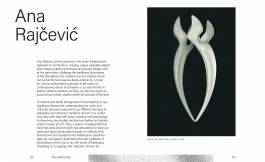
Ana Rajčević’s work questions possible “new beginnings”: her wearable sculptures from the collection “Animal: the Other Side of Evolution” (2013), as well as the most recent ones, evoke both primordial, ancestral and futuristic dimensions. It revolves around the question of post-humanity or alter-humanity. This issue is crucial today, as we see how swiftly science and technology blur the boundary between nature and culture. Head-adornments in the form of long horns imply a beginning of the new stage of humanity, a stage in which processes of involution and evolution might be changing places.
In this contradictory intersection between past and future, between destruction and creation, can also be situated the work of Christina Dörfler-Raab. In collections Wondering Tribes (2012) and Excuse My Dust (2016), she experiments with different dying processes using destructive and corrosive substances. Yet, the visual effect of patterns is stunning and brings to mind “the beginning of times”, when everything was closely related to earth, to soil and to the cyclic rhythm of nature. The process of dying itself, which occasionally involves the use of mellow, mushy materials, generates forms and structures that associate with Art Informel, a post-WW2 artistic movement characterised by improvisatory methodology and highly gestural technique. Once again, through these associations, an echo of something primordial, almost primitive and precognitive can be sensed. These processes, which, on the occasion of the “Transfashional” exhibition at the Centre of Contemporary Art in Warsaw, also included the intervention of artist and performer Jasmin Schaitl, incorporate elements of randomness and the author's lack of control. The outcome of these unorthodox experimental procedures is a pattern, a trace on the fabric, which is unique and impossible to replicate. Just as in the Lara Torres’s film, An Impossible Wardrobe for the Invisible, also in this work, the process that incorporates destruction, corrosion, dissolution, brings the creation of something unique, and its irreproducibility becomes, metaphorically and concretely, a symbol of what should be considered as a value or a paradigm now, in a time of automatic and accelerated reproduction of almost anything.
Christina Dörfler-Raab’s manual, low-tech work, can be seen as a counterpoint to another piece created especially for the “Transfashional”.
Graphic designer Maximilian Mauracher, in collaboration with software engineer Bernhard Eiling, created an AI project titled “NOUS001,” an artistic experiment over which the creators have no complete control. “NOUS001” is an AI capable of learning and associative reasoning. It was created for the exhibition at the ACF in London, and over the months of development and touring of “Transfashional”, it evolved from the initial stage of randomly collecting visual data to the final stage, when its neural network became capable of generating patterns and textile sketches.
Getting back to basics and starting up with elementary and primary forms can also be recognised in the “collections” by Afra Kirchdorfer and Kate Langrish-Smith. Afra Kirchdorfer creates modular systems composed of ribbons and geometrically cut pieces of cloth, which can be endlessly combined and recombined around the body. Assembling these elements becomes a playful act of redesigning and rethinking the very notion of ready-to-wear.
The collection of accessories “Embody” by Kate Langrish-Smith pushes the notion of wearability and functionality even further. More than wearable, her body-related sculptures function as enigmatic performative devices that create a specific choreography of movement and posture, inviting and teasing spectators to interact with them.
Fashion designer, artist, and model Anna Schwarz and photographer Lisa Edi collaborated on several occasions, engaging in a creative dialogue and willing to explore the dialectical relation between the “eye” of the camera and the object of its focus, which, in this case, is the body of the model or mannequin. The outcome of this collaboration is a video loop entitled “Things Will Change”, composed of already existing image material from Anna Schwarz’s recent “Ready-to-Carry” collection, shot by Lisa Edi. After realising together a lookbook for the collection, Lisa and Anna continued their creative dialogue, making the video “Things Will Change” using existing fashion photographs as material to be newly re-edited, manipulated, and multiplied. Through the re-elaboration of images, Lisa Edi and Anna Schwarz question the idea and need for the “New” which is one of the main fashion imperatives.
Since “Transfashional” was conceived as an exhibition-in-progress, designed to stimulate collaborations between its participants, professors Janusz Noniewicz, Dominika Wirkowska, Wojciech Małolepszy and Robert Pludra, together with a group of students from the fashion and product design departments of Warsaw Art Academy, worked on a year-long seminar which brought to realisation various artworks and performative events in response to the given theme. They took Robert Musil's novel “Die Verwirrungen des Zöglings Törleß” as a point of departure and debated the question of the state of activity or passivity as both a citizen and a creative individual, in relation to one’s social, political, and cultural surroundings.
Moving from this macro dimension, through the work of Manora Auersperg, we return to the micro dimension of the exhibition itself, which, through this work, becomes both the subject and the object of artistic analysis. The artists made performative and sculptural works that began with the very structure of the exhibition, its spatial display, and its potential web of meanings that connect different artworks created by all the participants. The prefix ‘trans’ stands for crossing, overpassing, or shifting from one position to another. Implicitly, it contains a demarcation line, a border which can or cannot be trespassed. As an artist working with textiles, Manora Auersperg created a blueprint of the exhibition stages of “Transfashional” using the technique of bordure, a weaving technique which already in its name contains connotation to the boundary, to that mental and physical space which can be both a point of contact and a point of division. It’s also a technique based on the removal of threads, a gesture of unweaving, which in this work gains sculptural dimension, if we consider that sculpture is traditionally defined through the process of scraping away portions of material. On the other hand, through her work, Manora Auersperg marks the very process of transition from one artistic position to another, questioning the very possibility of using the exhibition as a tool to produce meaning. In this case, it might also refer to potential meanings of the term ‘transfashional’.
After a year-and-a-half-long journey, a term that initially appeared as a floating signifier began to outline its potential meanings. Within this context, “Transfashional” might refer to practices that address the notion of fashion from a conceptual and ontological perspective. They aim to remark on discursive, critical and engaged positions, using different forms of visual language as tools, built on the intersection of several creative disciplines. Traditionally, fashion, as well as design, or any other form of applied art, would be focused on the production of something that is not only material and palpable but also functional and usable. Materiality and functionality are now juxtaposed or supplanted by categories that question, or even negate, their very raison d'être.
Terms such as “undesign”, “unmaking”, and “post-producing” are becoming part of the agenda, animating those more progressive and critical creative communities to find responses not only to what should be produced, but also to how and, most importantly, why? In this sense, fashion and design are claiming the same prerogatives which are attributed to art: to raise awareness, to affect behaviour and to set standards of values, most of all, those ethical ones.
“Transfashional” might also stand for that terrain vague where creatives still have a chance to exercise intellectual freedom, or where they seek to find a refuge from industry’s Pantagruelic appetite for novelty and profit, or where they go to temporary exile as an ultimate gesture of resistance.
¹ Claude Lévi-Strauss, "Introduction à l'oeuvre de Marcel Mauss" in Mauss, Sociologie et Anthropologie, Paris, 1950.
² Alexis Vaillant, “On Things as Ideas”, in “On Things as Ideas”, edited by Robert Stadler and Alexis Vaillant, MUDAM Luxembourg, Luxembourg & Sternberg Press, Berlin, 2016.
³ Joseph Kosuth in: Arthur R. Rose, “Four Interviews,” Arts Magazine, February, 1969.
⁴ Vivienne Westwood in “Vivienne Westwood’s Unruly Resistence” in “Critical Fashion Practice” by Adam Geczy and Vicki Karaminas, Bloomsbury Publishing, 2017.
Pages from Transfashional catalogue