


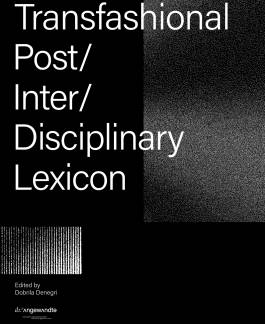
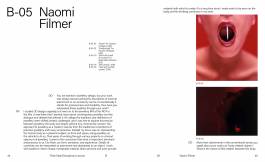
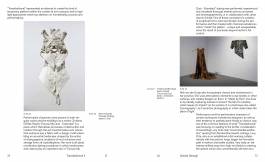
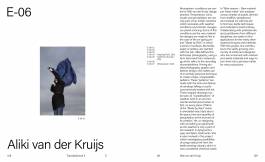
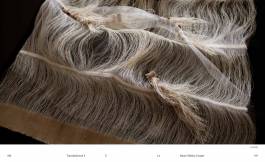
Pages from Transfashional Post/ Inter/ Disciplinary Lexicon catalogue
2019
TRANSFASHIONAL POST/ INTER/ DISCIPLINARY LEXICON
“Transfashional” was initially just a word - an invented word. It was a floating signifier, as Claude Lévi-Strauss defined the term, “in itself void of meaning and thus apt to receive any meaning.”
It was coined by combining the prefix “trans”, meaning across, beyond, through, and the word “fashion”, transformed into an adjective, so that the allusion to something relational, processual and “in-the-state-of-becoming” would be emphasised even more.
As a term without a fixed meaning, it was ideal as a title of an exhibitive project which was conceived as research-oriented, processual and open-ended.
In curatorial terms, “Transfashional” was a decision to make an exhibition about something without exactly knowing what it is. Yet naming it “Transfashional” meant situating its content in the liminal zone between different disciplinary categories, where fashion and fashion-related practices meet art, design, architecture, or the performing arts.
Curatorial research started, following this loose guideline, and after numerous studio visits, encounters with teaching staff, alumni, and students of three partnering institutions (The University of Applied Arts, Vienna; London College of Fashion, University of the Arts London; and The Academy of Fine Arts, Warsaw), a heterogeneous group of creatives was formed.
The fact that they worked in a cross-disciplinary manner did not guarantee a coherent exhibition, so the first step in developing a common project was to organise a workshop on the theme of showing fashion within a contemporary art museum.
Sessions of talks and workshops took place at The University of Applied Arts in Vienna, and they began with a conversation with Hussein Chalayan, certainly the most accomplished artist among fashion designers.
Chalayan was the one who truly made shifts between contexts, introducing the conceptualised language of installation and performance onto the catwalk, and using an art gallery as the ideal space for showing a collection, critically addressing the tendency to present fashion in hyper-accelerated, sensationalist, and opulently spectacular ways.
Chalayan spoke from the position of a practitioner and pioneer in pushing the boundaries of making and presenting fashion, noting that for a designer who wants to remain independent, autonomous and keep high levels of creative integrity, it is becoming almost impossible to survive in the present state of the fashion industry. Museums, galleries and art biennials, as well as theatres, represented a parallel world which allowed him to exercise creative freedom and introduce a higher degree of reflexivity. Through his work, he continuously shifted display codes from one context to another, introducing narrative elements onto the catwalk which seemed to be more appropriate for an art space. Some of his presentations were actually conceived for the static space of a museum and transposed later to the catwalk.¹ Chalayan's fashion shows were described as ‘reinvented rituals’ by Emily King, who testified how these rituals could be received with ecstatic applause, but also with “nervous muttering and confused outbursts” (King, 2011), since they were considered too ambiguous in their meaning, overly intellectualistic and conceptual.
Following this line, “Transfashional” began questioning how an art institution can be used as a platform for creating and presenting fashion-related work.
‘What kind of semantic resonances would fashion acquire within the frame of a contemporary art museum?’ was asked, implying that context always affects reading and interpretation.
It is obviously not taboo to exhibit fashion, and especially experimental fashion, within an art institution anymore, but it isn’t that frequent either.
Looking back at the history of fashion exhibitions, the very first one was actually the most analytical and critical, already implying, through its title, “Are Clothes Modern?”, that fashion bypassed most of the modernist imperatives that design and architecture embraced instead. The exhibition was conceived and installed by visionary Austrian architect Bernard Rudofsky, who, at the time, Alfred Barr engaged to direct the Apparel Research department at MoMA in New York.
Under the guidance of its first director, MoMA was elevated to an international model of what a museum of modern art should be, shaping the canon of modern art, too. In the mid-‘40s, Barr was still pondering whether fashion should have a place in the ‘temple of modernity’. Up to the present day MoMA is not including fashion in its collections, and recently it returned to its history of exhibiting fashion, after seventy-three years and with a tribute paid to the past show of Rudofsky, through the exhibition “Items: Is Fashion Modern?”, organised by Paola Antonelli, Senior Curator, and Michelle Millar Fisher, Curatorial Assistant of the Department of Architecture and Design.
Within the kickstarter “Transfashional” event, focused on fashion exhibited in an art context, two curators, José Teunissen and Susanne Neuburger, shared their curatorial approaches and experiences. José Teunissen co-curated the exhibition “The Art of Fashion: Installing Allusions” with Judith Clark, which draws parallels between avant-garde fashion and contemporary art and addresses the permeability of disciplinary boundaries between the two. Yet, she admitted, even if the exhibition took place at the Museum Boijmans Van Beuningen, which has on various occasions exhibited fashion, polemics would be raised about the ‘rightness’ of showing fashion next to art, one being the expression of ‘low’ culture and the other of ‘high’ culture.
Susanne Neuburger, Chief of Collections at mumok - Museum of Modern Art, Vienna, curated the exhibition “Reflecting Fashion - Art and Fashion since Modernism” with Barbara Rüdiger in 2012. The exhibition focused on artists who, as protagonists of historical or neo-avant-garde movements of the twentieth century, created clothes as a part of their artistic program. So, even though the exhibition featured apparel-related works by artists, Susanne Neuburger revealed that this type of exhibition was added to mumok's program only when a woman, Karola Kraus, became director.
This set of lectures concluded with Beatrice Jaschke and Barbara Putz-Plecko’s presentation of the exhibition “No Liability for the Wardrobe – Resistance and Production in Fashion”, which addressed fashion and social responsibility, realised as part of the Master's program in art curating.
The workshop was also the first encounter between some of the artists/designers invited to take part in “Transfashional”: Manora Auersperg, Christina Dörfler-Raab, Lisa Edi, Jan Kardas, Afra Kirchdorfer, Kate Langrish-Smith, Maximilian Mauracher, Janusz Noniewicz, Ana Rajčević, Anna Schwarz, Radek Smędzik, Lara Torres, and Daria Wierzbicka.
What would become the content of the project was presented and discussed thoroughly, conceived as an ‘exhibition-in-progress’, a format which would engage the same group of participants in several exhibitive events, inviting them to work collaboratively or to show work which would acquire new aspects, in content or in display, in each of the subsequent presentations. The exhibition itself would function as a laboratory, a kind of open space in which articulation of both single artistic positions and their presentation as a whole would occur progressively. The exhibition, as a result of collective and collaborative effort, would be a tool for producing the meaning of the term “Transfashional”.
After a year-long journey and three exhibitions realised in 2017, a term which initially appeared as a floating signifier started to outline its potential meanings.
It relates mainly to practices that address the notion of fashion from conceptual and ontological viewpoints; practices that aim to remark on discursive, critical, and engaged positions, using different forms of visual language, including film, performance, photography, graphic design, and sculpture.
Traditionally, fashion and design, as forms of applied art, would be focused on the production of something that is not only material and palpable but also functional and usable. Materiality and functionality were categories that were questioned, if not completely bypassed, here.
Thus, the “Transfashional” approach shares the same prerogatives attributed to art: questioning and raising awareness, producing knowledge, and discussing values, particularly those that are environmental and ethical.
Conceived primarily as a research platform embodied through the form of exhibition, it kept its frame open over time, changing the group of artists/designers involved and including new ones for two subsequent presentations realised in 2018 and 2019. “Transfashional” up to this point had included Manora Auersperg, Linnea Bågander, Naomi Bailey Cooper, Sonja Bäumel, Anna-Sophie Berger, Martin Bergström, Christina Dörfler-Raab, Lisa Edi, Naomi Filmer, Barbara Graf, Shan He, Milena Heussler, Afra Kirchdorfer, Saina Koohnavard, Kate Langrish-Smith, Ulrik Martin Larsen, Maximilian Mauracher, Janusz Noniewicz & Dominika Wirkowska, Minna Palmqvist, Robert Pludra, Ana Rajčević, Jasmin Schaitl, Anna Schwarz, Konrad Strutz, Lara Torres, and Aliki van der Kruijs in its exhibitive events, while in the discursive events the participants were Leah Armstrong, Hussein Chalayan, Shaun Cole, Frances Corner, Naomi Filmer, Beatrice Jaschke, Ulrik Martin Larsen, Galina Mihaleva, Ute Neuber, Susanne Neuburger, Lucy Orta, Robert Pludra, Barbara Putz-Plecko, Marcin Różyc, Simona Segre Reinach, Jose Teunissen, Monica Titton, Clemens Thornquist, Lara Torres and myself.
In a set of collaborative and propaedeutic sessions, it also involved students from the fashion and product design departments of the Academy of Fine Arts in Warsaw, and students of the Master's course in Fashion Studies at the University of Bologna.
“Trans” in itself stands for movement, both across and beyond, and “fashion” is the epitome of change, alternation, and fluctuation.
This “rendez-vous of words” (Thornquist, 2010) intended to indicate transformativity and process, in both the format of the exhibition and in the singular works presented within it.
Lara Torres’s film “An Impossible Wardrobe for the Invisible” is a video essay about disappearance in six acts: each act shows a scene of a body being revealed, denuded, as garments dissolve in contact with water. The garment, fashion’s subject and object, almost disappears. What remains is a residue, a relic, unique and irreproducible since it is a result of a process beyond the author’s complete control.
Anna-Sophie Berger’s piece “She Vanished” is simultaneously a sculpture and a shirt: when wet, it gains the formal quality of a sculpture, while when dry, it resembles a piece of cloth forgotten on the ground, as if it were a trace of someone’s lost presence. As it dries, “She Vanished” is in the constant process of a slow, but perceptible, alternation which speaks about the instability of categories to which it belongs.
Transformative and processual aspects were common to almost all works presented in the exhibition, which also shared another, more content-based feature: a critical stand towards the current state of fashion - seen as a system and an industry - and towards its mechanisms of overproduction and overconsumption.
Shifting expressive categories from material (garments, collections) to immaterial (film, discourse, artistic activism) was a response by some of the creatives involved in “Transfashional” to the same problem Chalayan pointed out: the (un)sustainability of independent, interdisciplinary fashion-based practices in the long run.
Using creative potential effectively to produce critical discourse about fashion as a form of practice is becoming increasingly common among younger practitioners.
This approach echoes what is known in contemporary art as “institutional critique”, a practice based on the critical analysis of institutions, which discusses or reveals political, economic, or other agendas that are incoherent with their declared cultural agenda.
Here, this term might be paraphrased in “system critique”, a position anticipated already in the late ‘80s by Franco Moschino’s ironic campaigns, which culminated with “Stop the fashion system” in 1990. Throughout the ‘90s, other critical positions emerged, thematising how demanding, both creatively and economically, it is to become a part of the system. Viktor & Rolf, the Dutch duo who initially labelled themselves as fashion “outsiders”, approached this theme, as did Maurizio Cattelan in the art world: taking the role of the jester. With humorous, conceptually brilliant operations, they addressed the inner contradictions, ambiguities, and shams of the fashion system, rapidly gaining visibility and recognition. At the same time, Alexander McQueen also launched bold and provocative statements about fashion’s Pantagruelian appetite for profit, excess and newness, which devour everything, creativity and creatives included.
Criticality as an attitude and creative mark was addressed in the book “Critical Fashion Practice”, where authors Adam Geczy and Vicki Karaminas examined the work of Westwood, Kawakubo, Pugh, Prada, Throup, Hourani, Owens, and Van Beirendonck - all established brands and designers capable of challenging norms from within and using fashion as a tool for making social statements.
Yet what “Transfashional” recognised as referential for the articulation of its meaning was a growing number of younger practitioners who came from a fashion-formative background but oriented their practice towards the production of discourse about fashion, using expressive means belonging to contemporary art.
These are practitioners who define themselves with terms like “editor”, as in the case of Elisa Van Joolen, cultural post producer; “Tenant of Culture”, as in the case of Hendrickje Schimmel; or "fashion experience" creator, as in the case of Adele Varcoe.
The place where they position their work is slightly beyond fashion, or at the intersection of fashion and art, with the outcome of their research often falling more into the realm of concepts than commodities.
Terms like “post-productivist fashion” have been introduced, as well as “critical fashion”, “speculative fashion” (Torres, 2017), “fashion in the expanded field” or “unfashion” (Bigolin, 2012), in order to demarcate this, still slightly vague, creative ground. Also, the term “fashion without industry” was proposed and debated within the “Fashion Matters” master course led by Christophe Coppens at the Sandberg Instituut in Amsterdam.
All these studies and debates underscore the growing need for platform(s) that would enable fashion to re-examine and reimagine itself beyond purely promotional and commercial imperatives. This ‘space’, understood as both physical and mental, would expand the possibilities for up-and-coming designers eager to innovate, and trace alternative ways of conceiving and producing in tune with environmental and ethical concerns.
“Transfashional” represented an attempt to create this kind of temporary platform within the context of art museums and to highlight approaches that lay attention to immateriality, process, and performativity.
Performative characters were present in both singular works and the exhibition as a whole. Christina Dörfler-Raab’s “Excuse My Dust - Extended” is a piece which thematises processes of destruction and creation through the set of performative acts whose final outcome was a fabric with a design motif resembling an ancestral landscape, shaped by the action of drying geysers, eruptions of mud volcanoes and strange forms of crystallisations. Her work is all about unorthodox dyeing procedures in which randomness and chance play an important role. In “Excuse My Dust - Extended”, dyeing was performed, experienced and visualised through several actions conceived and choreographed by, or in collaboration with, artist Jasmin Schaitl. One of these consisted of a creation of sculptural forms, bent and broken during the performance and then treated with chemical substances which “made” the pattern unique and unrepeatable, since the result of processes beyond the author’s full control.
Aliki van der Kruijs also incorporates chance and randomness in her practice. She uses atmospheric elements to dye textiles and other surfaces and to create designs on them. In “Made by Rain”, she does so by literally capturing a transient moment: the fall of a raindrop, which leaves its ‘imprint’ on the surface. It is a technique she called “pluviography”, as it would be photography in which water takes the place of light.
Performance and the performative character of specific techniques invented by designers, as well as their tendency to leave things to chance partially, were one of the common features of what “Transfashional” was focusing on, leading to the further consideration of something Lucy Orta calls “circumstantial aesthetics”, quoting from Nicolas Bourriaud’s writings. Lucy Orta, an established artist who works collaboratively with her partner Jorge, began her formative path in fashion and textile studies. Very early on, her interest shifted away from high-end fashion into a sphere conventionally still seen as part of social work. In 1995, in collaboration with the Salvation Army homeless shelter in Paris, together with residents of Cité de Refuge and a group of fashion students, she realised a wardrobe for imaginary wearers using worn and abandoned clothes. She called this operation “Co-creation”, drawing attention to the process of making in which the creative inputs of several subjects, artistic and non-artistic, were interwoven.
Initially, “Transfashional” meant situating the project’s content in the liminal zone between disciplinary categories and exploring a space already considered to have loose, permeable boundaries. Therefore, its thematic focus inevitably fell on creative approaches that share this aspect of boundary permeability, whether in authorship or in factors that play a role in the design process. Co-creation and co-design, understood as practices which incorporate agency of several elements (both human and non-human) besides the author’s, are terms which can be attributed to the work of almost all the participants of “Transfashional”.
These elements can include technology, artificial intelligence (as in the work of Maximilian Mauracher), science and biological process in Sonja Bäumel’s work, or simply the agency of other subjects involved in the creative act. Afra Kirchdorfer’s “Clothing System” puts the wearer at the centre of the process of creation/construction of the garments, stimulating their/awareness of the proper body and body movement, as well as her/his inventiveness and willingness to interact with modular clothing elements provided by the designer.
Thus, the act of wearing remains just a symbolic conclusion of a much more complex process in which the relation between body and dress is negotiated, and reflection about personalisation and emotional attachment to the created item is triggered. Here, the wearer becomes a constitutive part of the co-design principle.
Afra Kirchdorfer’s “Clothing System” is a set of proto-garments, geometrically cut pieces of fabric which can be endlessly combined and recombined, and its function is predominantly didactic. Her work was born out of an interest in the body in motion as a starting point for garment construction.
This is an interest shared by Rickard Lindqvist, which led him to theorise “Kinetic Garment Construction” principles and to formulate an innovative way of cutting, making, and producing clothes. Together with Jimmy Herdberg, he founded Atacac studio, whose radical rethinking of design principles is grounded in concerns about the comfort of wear and the reduction of waste from cutting and production processes. Lindqvist’s experimentation and innovation were sparked and encouraged by a formative program conceived by Clemens Thornquist for the Fashion Design department at the Swedish School of Textiles, Borås University.
The program is based on an interdisciplinary approach which channels theoretical concepts through highly experimental design practice. What motivates Thornquist, as he states, is “to identify new methods and ways of working within art and design, and to demonstrate theoretical principles both materially and visually.” Rickard Lindqvist’s work testifies to how rethinking the fundamentals of fashion design can yield both innovative and functional solutions that also find their way to market.
Yet, in the context of “Transfashional,” what emerged as topical were the experiments of several other researchers from the Swedish School of Textiles, such as Ulrik Martin Larsen and Linnea Bågander, who explore movement, its effects on what is worn, and how it shapes the space between the body and the garment.
Linnea Bågander explores how movement becomes materialised and how this materialisation produces aesthetic effects, transforming materials which enwrap and encapsulate the body into live and animated entities.
Formally, these experimentations evoke Oskar Schlemmer’s costumed, masked dancers who are transformed into “art figures,” as well as Nick Cave's performative “Soundsuits,” and even Vito Acconci Studio’s wearable architectures. But in Linnea’s work, the level of abstraction of the body and the form which encapsulates it is brought to the extreme, as extreme as her notion of what fashion is or could be.
Being a research-oriented project, “Transfashional” attempted to map these kinds of practices which are able to challenge or radically subvert prevailing assumptions of what fashion is. These practices couldn’t thrive except in the context of an academy where creative freedom, experimentation, criticality and the search for innovation are stimulated, as the programs of Clemens Thornquist, Naomi Filmer, Lucy Orta, Ute Neuber, Robert Pludra, and other professors involved testify.
Through exhibitive and discursive events which took place within universities, art institutions such as the Centre of Contemporary Art Ujazdowski Castle in Warsaw, Museums Quarter in Vienna, Art Museum in Kalmar, or within manifestations like “Searching for the New Luxury” organised by the State of Fashion in Arnheim, “Transfashional” aimed to connect artists/designers whose work adds new layers to the notion of fashion, not only through visual productions, but also through verbal and theoretical articulations.
So, if the first part of the project treated the exhibition as a tool for formulating what “Transfashional” might mean, the second paid close attention to the specific terminology used to define and describe the fashion-related practices shown. Proposed as a signifier which had to articulate its meaning and potential field of references, the term “Transfashional” acted as a trigger for questioning the existing vocabulary, which often appears limited or inaccurate in front of fashion/design productions which intentionally challenge the notion of functionality, wearability, or even categorisation and recognisability. These productions sometimes appear as enigmatic, body-related objects, or as visualisations of fashion-related concepts, and share a way of thinking inherent to art, architecture or performing arts, but don’t fit into any of these categories alone.
Being somewhere “out of” conventional disciplinary boundaries, these productions not only require contextualisation, naming and defining, but also support, in order to thrive not only within but also beyond the academic frame.
Contextualisation and lexical articulation represent the significant precondition for expanding the range of platforms and sources of support for these forms of expression and research. Thus, a collaborative, collective effort was made to create a lexicon of terms used by participants in the project to describe/define core aspects of their work. This tentative lexicon included terms which relate to the context within which certain practice is positioned, as well as methodological and conceptual principles behind this research. Of course, it is an initial step in a potentially wider attempt to invent more accurate terminology for post/inter/disciplinary practices and their specific fields/subjects of research.
Therefore, this book is both an archive of what “Transfashional” has been, and the nucleus of a future lexicon of what it could become.
From its beginning to its final stages, “Transfashional” unfolded as a rhizomatic structure around several interrelated points, first outlining what “beyond fashion” might mean.
In the works of Naomi Filmer, Lara Torres, Anna-Sophie Berger, Lisa Edi & Anna Schwarz, that which symbolically represents “fashion” - understood as both a material object or an image - is presented in the state of dissolution, disappearance, and transformation into something else, triggering reflections about notions such as dematerialisation, deconstruction, undoing, and unmaking.
Some of these notions were addressed in the writings about art of the ‘60s and ‘70s by Lucy Lippard and Rosalind Krauss, which provided a referential field in the process of the theoretical articulation of their practices, along with connections with the tradition of social design (Victor Papanek) and critical and speculative design (Dunne & Raby). Transposing Dunne & Raby’s reflections on design which produces ideas and affects behaviour, terms like “Critical fashion” and “Speculative fashion” were introduced, differing from terms like “Radical Fashion” (Wilcox, 2001), “Experimental Fashion” (Granata, 2016), “Critical Fashion” (Geczy and Karaminas, 2017), used in writings by curators and scholars who addressed work by designers like Rei Kawakubo, Junya Watanabe, Martin Margiela, Alexander McQueen, Hussein Chalayan, Helmut Lang, Yohji Yamamoto, Jean Paul Gaultier, Issey Miyake, Azzedine Alaia and others.
Here, the main accent is on the shift towards the “immaterial” or productions which challenge the notion of functionality and wearability, both in fashion and adornment design. They also implicitly take a critical stand towards accelerated rhythms of fashion production, promotion and consumption.
To move “beyond” doesn’t mean negation, but rather the need for revisiting and reimagining what fashion is or should be, starting from its values and rethinking the system as a whole.
The question of values was a second point, highlighted through the works of Lara Torres, Christina Dörfler-Raab, and Aliki van der Kruijs. Even if conceptually and technically different, their work shares a component of uniqueness and irreproducibility, a quality which can be interpreted as a supreme value in the age of the fast and easy reproduction of almost anything.
The third point focused on the methods of making, which would incorporate the agency of elements slightly beyond the author’s control. This brought in terms such as “co-creation” and “co-design”, which in this context were connected with the early work of Lucy Orta and its inclusive and participatory character.
These terms themselves originate from strategies of participatory or co-operative design practised in Scandinavian countries in the ‘70s, but since then have been used in a wide range of areas, from business to digital communities. Yet “co-creation” here acquired a more specific meaning, leaning on Sandy Black’s writings about approaches in which science, technology and fashion interact. Generally, these terms indicate a sense of community and a more egalitarian, open and ethical approach to making, as well as to using/consuming. It also puts a person in the centre of the creative process, and this position was emphasised through a variety of works that revolved around the body as a central and catalytic element.
Body and movement, or the body in movement, is one of the fundamental points of the research carried out by Ute Neuber, Linnea Bågander, Naomi Filmer, Barbara Graf, Milena Heussler, Afra Kirchdorfer, Kate Langrish-Smith, and Ulrik Martin Larsen, which stresses the very basics of the relation between the clothes and the wearer. This generated set of terms tries to articulate the methodological and conceptual outlines of a proper practice, addressing the act of wearing (as different from dressing), implying that fashion should be less about imposed ideals of self-image and more about the physical and emotional relation with what is worn.
All these points correspond to the present moment when technological shift, a crisis of capitalistic paradigms and environmental urgencies are dictating social and cultural agendas - to be a practitioner in any creative discipline pushes you to ask what should be new, the “whys” and “hows” of creating and producing.
Among this “Transfashional” group of artists/fashion designers is a present high consciousness that new paradigms are needed. The condition of our contemporary world, with its climatic, energetic and economic urgencies, requires not only reflection but also a profound revision of the principles on which processes of production are grounded and the social relations that derive from them.
The condition of the fashion industry and mainstream fashion system is such that for an increasing number of creatives, the main priority is to search for alternative ways of conceiving, creating and producing fashion. It’s this need for revision and quest for alternatives that became a creative drive which inspires new productions - not of commodities but of ideas. Indeed, more than wearable and functional, most of these productions are critical, engaged, and conceptual, and, as such, they can be seen as symbols and symptoms of the present zeitgeist. It is the moment when we can ask, together with Madeline Schwartzman: “Can we also do fashion without knowing what it is?”
¹ e.g. “Kinship Journeys” showed at the Paris Fashion Week “was initially conceived as an installation, to be presented within the exhibition curated by José Teunissen at the Centraal Museum in Utrecht. The piece became part of museum’s collection after the exhibition” stated Chalayan during the talk in Vienna.
Literature
Bigolin, Ricarda. “Undo Fashion: Loose Garment Practice”, School of Architecture + Design, College of Design and Social Context RMIT University, Melbourne: 2012
Denegri, Dobrila. “Transfashional”, Vienna: Die Angewandte, 2017
Black, Sandy and Joanne Entwistle, Amy de la Haye, Agnès Rocamora, Regina Root,
Helen Thomas. “The Handbook of Fashion Studies”, London: Bloomsbury, 2013
Fredriksson, Lena M., “The philosopher of fashion”, https://www.hb.se (28.07.2018)
Geczy, Adam and Vicky Karaminas. “Critical Fashion Practice”. London: Bloomsbury, 2017
Geczy, Adam and Vicky Karaminas. (Eds.) “End of Fashion. Clothing and Dress in the Age of Globalization”, London: Bloomsbury, 2019
Granata, Francesca. “Experimental Fashion: Performance Art, Carnival and the Grotesque Body”, New York: I.B.Tauris & Co Ltd, 2016
Lévi-Strauss, Claude. “Introduction to Marcel Mauss”, London: Routledge, 1987
Malzacher, Florian and Joanna Warsza. (Eds.) “Empty Stages, Crowded Flats. Performativity as Curatorial Strategy”. Berlin: Alexander Verlag, 2017
Thornquist, Clemens. “Artistic Development in [Fashion] Design”. Borås: The Swedish School of Textiles, 2010
Van Bogaert, Pieter, Martine Zoeteman and Christophe Coppens. (Eds.) “Eternal Erasure: On Fashion Matters”. Amsterdam: Sternberg Press, 2017
Violette, Robert. (Ed.) “Hussein Chalayan”, New York, Rizzoli, 2011
von Bismarck, Beatrice, Rike Frank, Benjamin Meyer-Krahmer (Eds.) “Timing: On the Temporal Dimension of Exhibiting”. Berlin: Sternberg Press, 2014
Pages from Transfashional Post/ Inter/ Disciplinary Lexicon catalogue