


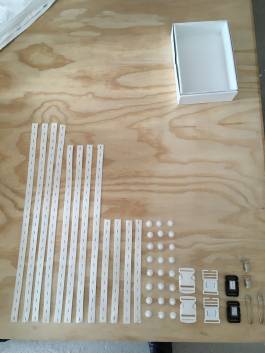
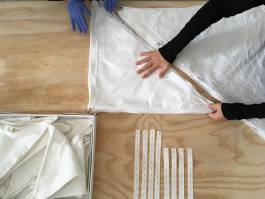
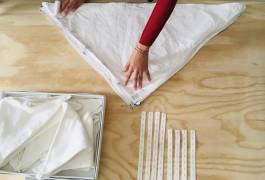
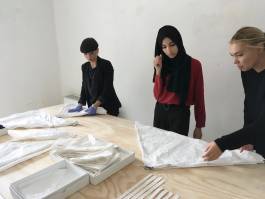
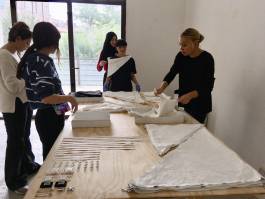
Installing “Modular Clothing System”, exhibition “Transfashional - Nuovo lessico post-interdisciplinare tra arte, moda e design”, Ala Moderna del Museo della Città di Rimini, Photo: Szymon Owsiański.
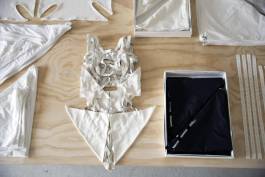
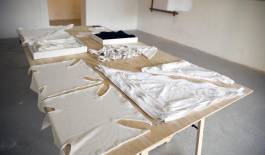
“Modular Clothing System”, Installation view, Ala Moderna del Museo della Città di Rimini, Photo: Giulia Ripalti.
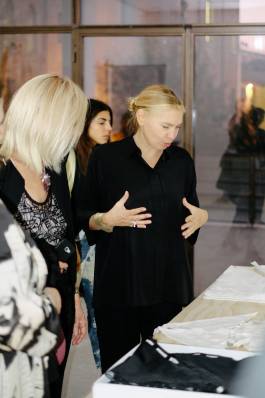
Opening of the exhibition “Transfashional - Nuovo lessico post-interdisciplinare tra arte, moda e design”, Ala Moderna del Museo della Città di Rimini, Photo: Tessa Chung (Yingntao Zhong).
2019
AFRA KIRCHDORFER “MODULAR SYSTEM CLOTHING”
A combination of methodologies of professors Ute Neuber and Barbara Graf, who teach at the department of Textiles - Free, Applied and Experimental Artistic Design at the Vienna University of Applied Arts, resulted in a unique synthesis in Afra Kirchdorfer’s practice.
The belief that “Lavigne bust” is obsolete and restrictive pushed Afra to focus her design process on the living body, radically changing the perspective and the conventional principles of the design process. The body of a wearer is at the centre of her practice; ideally, it is a body set free from fashion imperatives about shape and fit. Furthermore, it is a body in motion, active and engaged in a creative process which ultimately should result in “getting dressed”.
What Afra offers is a collection of modular items, crafted in simple geometric shapes, that can be endlessly combined and recombined depending on the wearer’s imagination and willingness to experiment during dressing. Imagination is definitely a key element of her work, which mainly draws inspiration from nature, especially from the micro-geometry present within it. She highlights that a major source of her inspiration is “fractal objects and regulatory structures”, explaining that “a fractal object is an object that has self-similarity at lower scales. Multiplication of two fractal objects results in a new fractal object that has the same shape as the original ones. As well as other objects that repeat themselves over and over again in their building components, or that follow other regulatory structures.”
Based on the idea of replication of similar shapes, she developed “Modular System Clothing”, which is a creative tool for reimagining the way clothes are made. Besides the DIY principle, this approach offers an alternative for rethinking the entire production and consumption cycle.
A theme creatively addressed by designers like Yamamoto and Chalayan, who proposed “transformative” garments in collections from 1999 and 2013, respectively. A step further was Yuima Nakazato with his interpretation of modular fashion, initiated in 2018 with the “Unit Constructed Textile” system, which aims to extend the life of a garment over generations by enabling the fabric to be replaced with modular parts.
Tendencies that younger generations, like Afra, began to explore more radically, fusing creative and educational approaches to change consumers' habits, stressing the need for responsibility and an imaginative way of fashioning ourselves.
Afra Kirchdorfer became a master tailor in 2009 and devoted herself to her own fashion label from 2008 to 2011. In 2010, she began her studies in the Art Education programme at the University of Applied Arts Vienna, focusing on Textiles – Free and Contextual Artistic Practice and Material Culture, Art and Communication Practices, and Design, Architecture and the Environment, and graduating in 2016. Since then, she has been active in art teaching at the post-secondary level. Her artistic practice and research are mainly concerned with the processes of work and form-finding as well as autonomous production structures.
Installing “Modular Clothing System”, exhibition “Transfashional - Nuovo lessico post-interdisciplinare tra arte, moda e design”, Ala Moderna del Museo della Città di Rimini, Photo: Szymon Owsiański.
“Modular Clothing System”, Installation view, Ala Moderna del Museo della Città di Rimini, Photo: Giulia Ripalti.
Opening of the exhibition “Transfashional - Nuovo lessico post-interdisciplinare tra arte, moda e design”, Ala Moderna del Museo della Città di Rimini, Photo: Tessa Chung (Yingntao Zhong).