


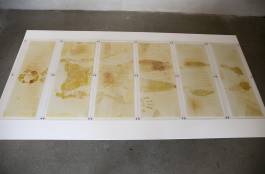
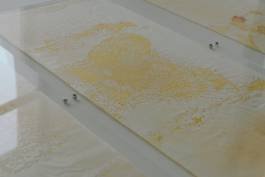
“Cartography of the Human Body”, 2010 / ongoing, installation view, City Museum Luigi Tonini, Rimini, Photo: Giulia Ripalti
2019
SONJA BÄUMEL “CARTOGRAPHY OF THE HUMAN BODY”, 2010 / ONGOING
Sonja Bäumel’s interest lies in the microbial layer, a second layer found on the surface of all bodies. It is an in-between layer, full of life, which serves as a fluid layer for exchange. The human body does not end with skin; it continually, invisibly expands into this fluid in-between. The in-between is full of entanglements, and our human body is just a tiny part of these microbial relations. For more than ten years, she has been collaborating with scientists, artists, designers, cultural historians, anthropologists, philosophers, and filmmakers to learn more about this ‘in-between’.
Her artistic research also explores the subsequent evolving perception of what bodies are made of. She is investigating the influence that scientific knowledge has had on how we have perceived and interpreted the human body historically, and how this affects our current society and the cultural contexts in which we act. Sonja is particularly interested in how our understanding of what it means to be human is fundamentally changing in the 21st century.
The critique of human exceptionalism and the democratisation of scientific knowledge are at the core of her work and its investigations into the curious relationship between (human) bodies and microbes. Based on current scientific theories and discoveries, her work stages encounters with these beings living inside and on us to explore possible futures for further coexistence.
“Cartography of the Human Body” explores skin bacteria on the human body and the bacteria absorbed on November 11, 2010, in a specific area of Vienna, Austria.
Over a period of 8 months, skin bacteria were collected on a specific day, analysed, and documented. The bacteria were bred, partially reanimated and kept alive at -70°C. In the framework of an interaction study, experiments were made to study the bacteria’s hierarchies. Weak bacteria were applied first to the body to ensure their unhindered growth and to achieve the desired colours in the bacteria image. The natural layer of bacteria on the protagonist’s skin was removed and then, with an especially developed technique, replaced by the studied layer of bacteria. After applying the invisible bacteria colour to her body, the body was imprinted on the textile and on agar, a nutritious medium that encourages bacterial growth. As soon as the bacteria visibly grew, their growth was stopped, and the actual state was documented with a body print. Every visible point on the bacteria image has special significance and represents a thought process or experiment.
Through this work, Sonja Bäumel, in collaboration with Erich Schopf, creates an image of a real, invisible moment and wants to highlight the existing invisible infrastructure surrounding all of us.
Sonja Bäumel studied Fashion Design at the Fashion Institute of Vienna and holds a Bachelor of Arts from the University of Arts Linz, as well as a Master's in Conceptual Design in Context from the Design Academy Eindhoven. In 2012, she received the Outstanding Artist Award in Experimental Design for her project Textile Anatomy from the BMUKK Federal Ministry for Education, Art and Culture of Vienna. Sonja heads the Jewellery-Linking Bodies Department at the Gerrit Rietveld Academie in Amsterdam, and also lectures and conducts workshops at various national and international academies and universities.
“Cartography of the Human Body”, 2010 / ongoing, installation view, City Museum Luigi Tonini, Rimini, Photo: Giulia Ripalti