


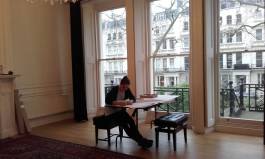
Making of “Transcription – untitled”, 2017, ACF London, Photo: Dobrila Denegri
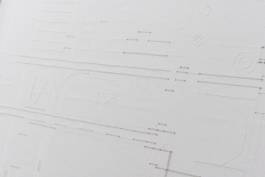
“Transcription – untitled”, 2017 (detail)
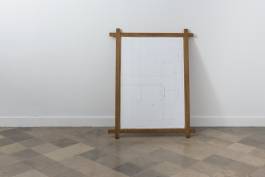
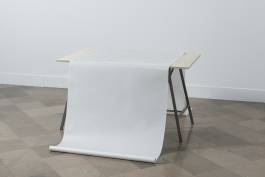
“Transcription – untitled”, installation view, Ujazdów Castle Centre of Contemporary Art, Warsaw, 2017
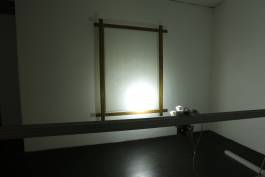
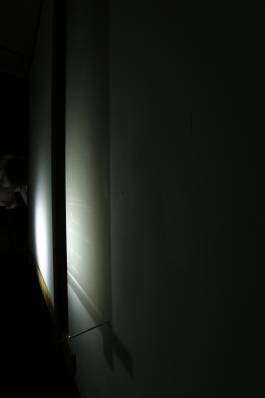
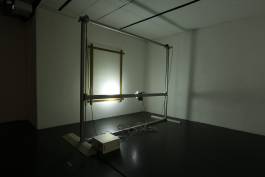
“Transcription – untitled”, 2018, in collaboration with Konrad Strutz, MuseumsQuartier, Vienna, Photo: Konrad Strutz
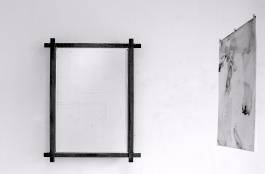
“Transcription – untitled”, 2019, Installation view, Ala Moderna del Museo della Città di Rimini, Photo: Giulia Ripalti
2019
MANORA AUERSPERG “TRANSCRIPTION – UNTITLED”
Like texts, textiles function as a medium for the transmission of concepts, metaphors, and cultural constructs. The words “text” and “textile” are etymologically related, sharing the Latin root “textus”, meaning woven fabric, cloth, structure, and framework. Similarly, text and textile substrates are inherently related. Relations between these two types of manual and creative activities - writing and weaving - and possible interconnections between their outcomes - text, texture and textile - pervade the work of Manora Auersperg.
On the occasion of the “Transfashional” exhibition-in-progress presented in several venues, Manora developed processual work which incorporated new elements, “signs” and “traces” of each new display which took place in London, Warsaw and Vienna.
The work, entitled “Transcription – untitled”, initially related to the exhibition site and display. It was created as a blueprint of the exhibition floor plan, designed on the surface of linen textile using the embroidery technique called “bordure”, which involves removing threads. Bordure here underlines the sense of a border, a demarcation line to be crossed, transcended, or trespassed to reach what lies beyond.
In the context of the exhibition, it can be interpreted as a field beyond disciplinary boundaries, but also as the zone of artistic interaction and collaboration, moving toward collective creativity fostered by this project.
“Transcription – untitled” consisted of a subtle action of removing threads to create a design with the void, outlining the floorplan of the London show, followed by the action of sewing and annotating how the Warsaw display looked, overlapping in this way two spatial structures on the same piece of textile. Thus, this surface began to function as a layered spatial memory of the exhibition as it progressed and changed. This abstract map gained a new “layer” with the exhibition in Vienna, when she collaborated with artist Konrad Strutz, who works with photography and the notion of time inherent to it. Konrad constructed a device called “Orthogonal Projector,” which creates a photographic image over an extended time-lapse, thus incorporating the passage of time as part of image construction.
Manora’s gestures of unweaving and sewing were already like temporal layers “inscribed” in the texture of the surface of the fabric. Now, together with Konrad, she added another layer to the work by slowly scanning the textile's surface with a micro-camera and transferring the process to the screen. The texture of the textile would appear on the screen, line after line, as if it were a text in the moment of writing. The photographic transposition of the textile on the screen, entitled “Texture in Translation”, functioned as a transposition of a manual operation into another, digital and dematerialised.
Text is one of the recurrent elements of Manora’s work, as much as texture and textile. The meaning of these terms, which implicate joining and connecting, resonates through Manora’s attitude to work collectively and relationally. Texture, which she created with her “Translation” piece, is not only related to the materiality of the work, but it is a symbolic transposition of different states of time and space through which artists, participants of “Transfashional”, became interwoven.
Manora Auersperg is a Senior Lecturer at the University of Applied Arts, within the Institute of Art Sciences and Art Education. She studied Art Education and Textiles at the University of Applied Arts, Psychoanalytic Pedagogy at the University of Vienna, and Stage Costume Design at HdK Berlin. In her role as a researcher, teacher, costume designer, and artist, she frequently adopts an interdisciplinary approach and collaborates with others.
Making of “Transcription – untitled”, 2017, ACF London, Photo: Dobrila Denegri
“Transcription – untitled”, 2017 (detail)
“Transcription – untitled”, installation view, Ujazdów Castle Centre of Contemporary Art, Warsaw, 2017
“Transcription – untitled”, 2018, in collaboration with Konrad Strutz, MuseumsQuartier, Vienna, Photo: Konrad Strutz
“Transcription – untitled”, 2019, Installation view, Ala Moderna del Museo della Città di Rimini, Photo: Giulia Ripalti