


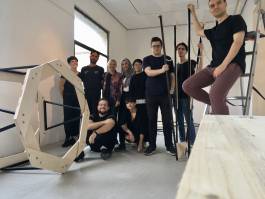
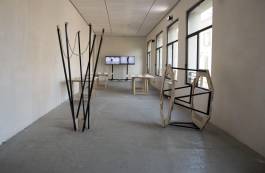
Installing the exhibition “Transfashional”, City Museum Luigi Tonini, Rimini, Photo: Szymon Owsiański
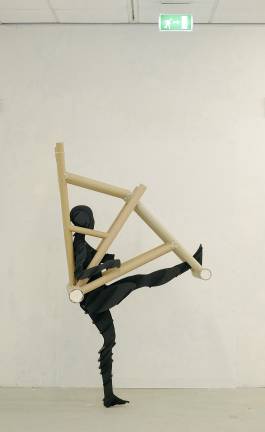
“The Ministry of Silly Walks”, 2011, installation view, City Museum Luigi Tonini, Rimini, Photo: Tessa Chung (Yingntao Zhong)
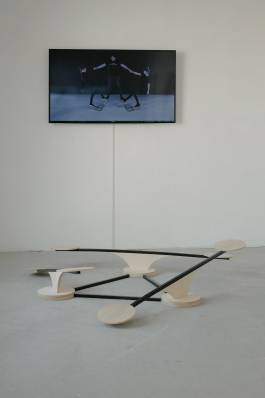
“The Dynamic Balance” 2017, installation view, City Museum Luigi Tonini, Rimini, Photo: Giulia Ripalti
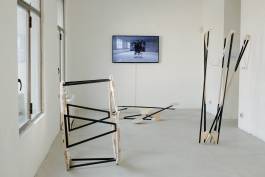
2019
ROBERT PLUDRA + PP2 (DESIGN STUDIO 2)
Robert Pludra’s work and teaching fall within the sphere of social design, a vision of design practice that seeks to be instrumental in bringing about social change and improving the social and environmental conditions of communities, especially those of the marginalised and underprivileged.
It resides in the conviction that users should be part of a co-creative process and that not only the product, but also the quality of relations which designed products can generate between people and the environment, are central to design. Thus, it is critical to the logic of planned obsolescence and the pure market-orientation of conventional design practice.
Pioneering figures of this ethically charged vision of design practice are Victor Papanek, with his seminal book “Design for the Real World: Human Ecology and Social Change,” published in 1971, and Victor Margolin, who wrote extensively about similar issues in the academic design journal “Design Issues” and in numerous other books. These, together with Buckminster Fuller, Krzysztof Wodiczko, IDEO studio, the Bauhaus curriculum, the anthropomorphic shapes of Henry Dreyfuss, the educational program of the Ulm School, the work of the A&E Design studio and Ergonomi Design Gruppen, are fundamental references for Pludra’s design practice and teaching programs.
He is co-leader, together with Professor Wojciech Małolepszy, of PP2 (Design Studio 2), the second year curriculum at the Faculty of Design, Academy of Fine Arts in Warsaw. Within this program, he engages in creative and collaborative work with students, resulting in the realisation of devices that trigger body movement and interaction, as well as in discussions of the relations between the body and the object in a playful manner.
Robert Pludra is an industrial designer and Deputy Head of the Faculty of Design at the Academy of Fine Arts in Warsaw. He runs his own studio focused on product, social and exhibition design, as well as leading design workshops. Robert graduated from the Faculty of Design of the ASP in Warsaw in 2010. In 2013, he wrote his PhD thesis in social design, and in 2016, he became a Deputy Dean. He is a co-leader of the Fundamentals of Design Course (PP2) and coordinator of research and development projects.
Wojciech Małolepszy is Design Professor at the Academy of Fine Arts in Warsaw and Deputy Dean of the Faculty of Design. He is well known as a designer of medical equipment, electronic devices, and domestic appliances. He is a winner of the Institute of Industrial Design Prize for designing a juicer for ZELMER SA. He is focused on simple forms, timeless design and high-quality materials.
Design Departament students: Halina Wierzbowska, Anna Gwiazda, Antonina Bylinka, Aleksandra Jankowska, Kacper Kunicki, Adam Szpil, Agnieszka Cieszanowska, Dorota Chwedoruk, Ada Krenz, Katrzyna Brągiel, Agnieszka Renes, Olga Darwaj, Julia Sulkowska, Natalia Gil, Brunon Kowalski.
Installing the exhibition “Transfashional”, City Museum Luigi Tonini, Rimini, Photo: Szymon Owsiański
“The Ministry of Silly Walks”, 2011, installation view, City Museum Luigi Tonini, Rimini, Photo: Tessa Chung (Yingntao Zhong)
“The Dynamic Balance” 2017, installation view, City Museum Luigi Tonini, Rimini, Photo: Giulia Ripalti