




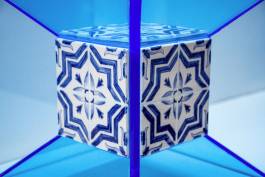
Ignasi Monreal, “Mi manchi come il Wi-Fi”, 2019, Studio Stefania Miscetti, exhibition view
2019
IGNASI MONREAL WITH JACK WOOLEY AND BERNARDO MOLEÓN “I MISS YOU LIKE WI-FI”
“Frictionless” is one of the most used words in Silicon Valley. According to Web giants, our experience of using the internet must be “frictionless.” Without friction, without problems, without us even realising we are connected, because the network is now so much an integral part of our daily life that it seems to us to be as indispensable as water or air. This word conjures the idea of a perfect, comfortable and smooth service, but its meaning does not end there. “Frictionless,” as in without friction, must also be all those actions that follow our every click and mark all our browser searches, but which simultaneously remain concealed, hidden, and invisible to us. In the shadow of this seemingly perfect supply of a public service, something occurs that requires attention and transparency, both of which are still largely missing; something that marks the transformation of the Internet into something ‘alive’ that opens a path onto a new face of capitalism – namely, surveillance. This is what people who decades ago glorified the network as a neutral space, free and accessible to all, call it. Now, they warn us by making us understand that we are not the ones using the Web, but rather, we are the ones being used by the Web. More than a space allowing for a democratic sharing of knowledge, as Richard Buckminster Fuller described it even before its dawn in the late 60s, the Internet has today become a saturated space of commerce of all kinds. And the most precious commodity is us, the users, and our interests, research, positions and desires. Our data are used for profiling and to complete the “social graphs” that transform us into perfect targets for advertising. It is no coincidence that there has been a call for resistance and transparency to safeguard our own privacy. In fact, one of the Internet’s prophets of its first hour, the inventor of the World Wide Web, Tim Berners, today propagates the need for the re-decentralisation of the Internet. But his is a mere voice in the desert, because most of the giants of the web operate in areas that we do not see or hear and which we cannot control. The paradox is that even in our private spaces, those in which we live “enveloped” by waves and frequencies, we tend to remove from sight equipment and devices, first and foremost of which is the very Wi-Fi router. An object that plays a fundamental role, but that remains on the margins, both in terms of design and visibility at home. At least, up until now.
Ignasi Monreal, together with Jack Wooley and Bernardo Moleón, has created a device that should ideally occupy a place of importance, or rather, be at the centre of a carefully and tastefully furnished house. A “smart” home where everything is connected, controllable from a distance and via the Apps. This new Wi-Fi router thus demands the place once occupied by a fireplace; it symbolises the place of gathering and stands as a contemporary totem that emanates an energy capable of transforming a group of individuals into a community.
Dobrila Denegri: Does it push us to ask authors how they came up with the idea of creating a DIY Wi-Fi 5G router and transforming it into a design object?
Ignasi Monreal: A simple fixation shared between friends - the role of the Internet in our lives - became the basis for this project. Long conversations slowly led us to the WiFi router as an opportunity for an intervention. From there, layers of meaning relating to religion, ritual, craft traditions, and connectivity accumulated, eventually resulting in the work presented here.
With all the tributes to Steve Jobs, one thing that tends to get forgotten is that the man helped us write. Jobs was the first to give us a real choice of fonts, and thus the ability to express ourselves digitally with emotion, clarity and variety. Following the Jobs approach, we wanted to reconnect technology with the 'human touch’, but instead we focused on one of the fundamentals of the human condition: the ritual.
Rituals motivate and move us. Through ritual, we build families and community, we make transitions and mark significant events in our lives, we express ourselves in joy and sorrow, and perhaps, most importantly, we create and sustain identity. Rituals form structure and hierarchy and help define our place in the world, which historically led to early forms of worship such as totemism, animism and paganism. We wanted to build a sort of altar to the internet, a totemic sculpture that occupies a central role in the home, like a fireplace of endless data.
DD: What I think you have achieved with this object is the materialisation of that new approach in design that is called "merged metiers", the united trades, in which the perfect combination between tradition ("heritage") and radical thinking, craftsmanship and new technologies occurs. How did you work collectively, and who did what?
IM: The art piece was conceived over 5 years ago by Ignasi from an original idea by Bernardo, which was then developed with Jack over a year between three cities - London, Rome and Madrid.
The main sculpture is a functional WiFi router, placed atop a cube of volcanic stone sheathed in 528 hand-painted tiles in 7 distinct patterns, each referencing both traditional and contemporary decorative symbols, and made out of porcelain, a good conductor of WiFi waves.
These tiles are the result of over a year of research and development of tile production, decorative techniques, ceramic pigments, and pattern development. The final pieces utilise a proprietary technique that blends transfer printing and hand-painting, thereby offering a model of production that bridges traditional techniques and contemporary digital methods.
Ignasi designed the tiles and sculptures together with Jack, who was also in charge of production, while Bernardo focused on the technology.
DD: Where does the inspiration for that type of decoration that you applied come from, and how did you "contemporaneously" a type of classic ornament that pervades monuments and sacred objects in the Middle East?
IM: Visually, the work takes its inspiration from a variety of sources, but perhaps most consequential is Aziziye Camii, a mosque located in Stoke Newington, London. Originally built as a cinema in 1913, the building has had a rich history before its current incarnation as a mosque founded by the UK Turkish Islamic Association in 1983. Today, it contains a halal butcher, a weekend school, a wedding hall, and a restaurant. The facade of the building is covered in patterned tiles, and at seemingly random intervals, a neon strip light around the edge of the building illuminates it. Sitting together on Ignasi’s sofa, just across the road, the experience of watching this had a profound effect, moving us to ponder not only its visual power, but the relationship between religious and secular activities and iconographies. The tiles themselves, related closely to Jack’s own craft, became a medium for exploring craft traditions.
DD: Why the name and shape of Tesseract? What does it mean in this context?
IM: In geometry, the tesseract (or Hypercube) is the four-dimensional analogue of the cube; the tesseract is to the cube as the cube is to the square. Just as the surface of the cube consists of six square faces, the hypersurface of the tesseract consists of eight cubical cells. Therefore, working with square tiles seemed an appropriate choice.
The hypercube became enticing as it contained, in a fixed form, a certain amount of incoherence. The implied space - lost in condensing a four-dimensional shape into three dimensions - spoke to the non-physical presence of the Internet.
DD: The hypercube motif can be found in art history, cinema, and beyond... So, from Salvador Dali and his famous painting "Corpus Hypercubus" of 1954, in which he depicts the crucified Christ rising in space before a female figure (Dalí's Gala) in adoration, to the fascinating cinematic transposition of the hypercube in Christopher Nolan's film "Interstellar" of 2014. Have these references played any role in your creative process?
IM: Dalí’s ‘Corpus Hypercubus’ became a source of inspiration later in the game. We found the same conceptual appeal in this geometric shape, so it became an assertion that we were going in the right direction.
DD: Your Tesseract references the "Cosmic Cube" from the Marvel comic book universe created by Jack Kirby and Stan Lee. Their Tesseract was a cubic device containing immense energy that could make every desire of its owner come true. And yours, what power does it have?
IM: We also realised later in the game about the Marvel reference, that’s why we decided to change the name from Tesseract to Hypercube.
Ours makes the internet ‘present’ and provides a fabulous 4G or 5G connection.
DD: Moving attention from what is conveyed through the internet to the device itself, thanks to which we can access it, can trigger a reflection on the intrinsic, and not at all neutral, mechanisms in which the use of the net involves us?
IM: The hypercube is a large, assertive, and attention-demanding manifestation of the Internet. By moving from the virtual to the physical realm, we acknowledge the internet’s constant presence in our lives.
While it can be challenging to understand and respond to our virtual environments, humans are well-equipped to react to the objects around us and to take active roles in shaping the physical environment to provide comfort, ease, efficiency, and a sense of home. The hypercube allows these same processes to be applied to the presence of the internet. Its form and the light it emits do not allow the Internet to be taken for granted nor to fade into the background, but to remain in the forefront of our consciousness. This, in turn, prompts reflection on the specific ways we use the internet and how it impacts our lives daily.
Ignasi is a multidisciplinary artist from Barcelona.
He works in various media, including painting, design, creative direction, ceramics, animation and film. He is the creator of the widely celebrated Gucci’s Spring / Summer 2018 campaign, the first of its kind to be entirely digitally painted, for which he was short-listed for a Beazley Designs of the Year award from the London Design Museum and The Design Prize in Milan. Ignasi is also known for his murals, which have been installed in New York, Chicago, London, Paris, Milan, Shanghai and Hong Kong. In the music scene, Monreal has directed a music video for the Spanish flamenco artist Rosalía and has collaborated with FKA twigs and Christine & the Queens.
His first solo show, Plats Bruts, opened in February 2019 at La Fresh Gallery in Madrid, and he has been the artist-in-residence at Galleria Stefania Miscetti since October 2018.
www.ignasimonreal.com
Jack is a ceramic artist and designer currently based in London.
He works primarily with porcelain, creating tableware and decorative objects for residential and hospitality clients.
A 2019 graduate of Central Saint Martins, his Banquet Collection was recently featured in the July issue of Vogue Living Spain. He works with the New York restaurant Estela, part of the San Pellegrino World’s 50 Best List, developing custom tableware alongside chef Ignacio Mattos.In addition, he collaborates with artists and designers, most recently with Coco Capitan, Frances Wilks, and Paula Canovas del Vas.
Bernardo has always been passionate about technology. After graduating in Advertising & PR, he created a production startup focused on developing new narratives and worked with video artist Maria Forqué. Eventually, he joined TBWA, an advertising agency, and Apple’s international team as a Strategic Planner. Currently, he’s focused on digital strategies, helping brands to achieve cultural relevance through phygital activations.
Ignasi Monreal, “Mi manchi come il Wi-Fi”, 2019, Studio Stefania Miscetti, exhibition view