


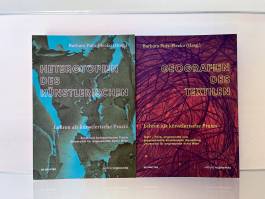


Pages from “GEOGRAFIEN DES TEXTILEN”, edited by Barbara Putz-Plecko (Hrsg.)
2021
TRANSFASHIONAL X GEOGRAFIEN DES TEXTILEN
“Transfashional” was initially just a word - an invented word. It was a floating signifier, as Claude Lévi-Strauss defined the term, “in itself void of meaning and thus apt to receive any meaning.” It was coined by combining the prefix “trans”, meaning across, beyond, through, and the word “fashion”, transformed into an adjective, so that the allusion to something relational, processual and “in-the-state-of-becoming” would be emphasised even more. As a term without a fixed meaning, it was ideal as a title for an exhibitive project conceived as research-oriented, processual and open-ended.
In curatorial terms, “Transfashional” was a decision to make an exhibition about something without exactly knowing what it is. Yet naming it “Trans-fashional” meant situating its content in the liminal zone between different disciplinary categories, where fashion and fashion-related practices meet art, design, architecture, or the performing arts.
Through its realisation, “Transfashional” became an exhibition-in-progress, accompanied by numerous discursive and workshop sessions, developed between 2016 and 2020 in two consecutive editions, summarised in two books edited by The University of Applied Arts in Vienna.
The first edition of the project, which was subtitled “Experimental Fashion in the Context of Contemporary Art”, treated the exhibition as a tool for the formulation of what “Transfashional” might mean, while the second, through the subtitle “Post/Inter/Disciplinary Lexicon” laid significant attention on the specific terminology used for defining and describing the fashion-related practices which were shown.
Initiated through the partnership between three institutions: the University of Applied Arts in Vienna, London College of Fashion - University of the Arts London and the Academy of Fine Arts, Warsaw, “Transfashional” in its second edition enlarged the range of partnerships, including Swedish School of Textiles, Borås University and the Master in Fashion Studies of the University of Bologna.
Throughout both editions, it kept its frame open, continually expanding the group of participants. Artists/designers who took part in various exhibitive events were: Manora Auersperg, Linnea Bågander, Naomi Bailey Cooper, Sonja Bäumel, Anna-Sophie Berger, Martin Bergström, Christina Dörfler-Raab, Lisa Edi, Naomi Filmer, Barbara Graf, Shan He, Milena Heussler, Afra Kirchdorfer, Saina Koohnavard, Kate Langrish Smith, Ulrik Martin Larsen, Maximilian Mauracher, Janusz Noniewicz & Dominika Wirkowska, Minna Palmqvist, Robert Pludra, Ana Rajčević, Jasmin Schaitl, Anna Schwarz, Konrad Strutz, Lara Torres, Aliki van der Kruijs, as well as students from the fashion and product design departments of the Academy of Fine Arts in Warsaw and students attending the Master in Fashion studies of the Rimini campus of the University of Bologna. In equally numerous discursive events organised within the two editions, scholars, curators, designers, artists: Leah Armstrong, Hussein Chalayan, Shaun Cole, Frances Corner, Naomi Filmer, Beatrice Jaschke, Ulrik Martin Larsen, Galina Mihaleva, Ute Neuber, Susanne Neuburger, Lucy Orta, Robert Pludra, Barbara Putz-Plecko, Marcin Różyc, Simona Segre Reinach, José Teunissen, Monica Titton, Clemens Thornquist, Lara Torres and myself.
In trying to frame what “Transfashional” became over time, a helpful suggestion came from the comment of renowned anthropologist Sandra Niessen, who remarked that it could be seen as yet another example of the commons. Commons, as theorised by David Bollier, sociologist and author of “Think Like a Commoner” and many other studies, are social processes that put in practice alternative ways of producing, organising and sharing material and immaterial goods. Sandra Niessen noticed that the inner dynamic of “Transfashional”, as a curatorial project and open-ended research platform, had a lot in common with the notion of commons. Indeed, “Transfashional” was a way to create new productions, articulate their meanings, make ideas emerge and spontaneously organise knowledge. Still, most of all, it was a journey that formed a sense of community between its participants.
Yet, this journey would never have taken off without the trust and initial support of Barbara Putz-Plecko and Martin Meisel, the former director of the Austrian Cultural Forum in Warsaw. For me, as a curator, this sense of trust and openness was crucial, as it allowed me to conduct research, become acquainted with numerous creative practices, and experiment with an exhibition format based on processuality and changeability, and thus unpredictable in its outcomes.
As mentioned above, “Transfashional” began with a term intended to find its meaning through the process of the project’s realisation. This premise could have led us in any direction, but as soon as I started with studio visits in Vienna, meeting students and alumni of the Department for Textile Arts, I got a sense of the path to take. The first point signed on my mind-map was the centrality of the body in the process of creating through wearing. It was implied by the work of Ute Neuber, as well as by the performative projects “A.Part” by Manora Auersperg and “Modular Clothing System” by Afra Kirchdorfer. The process of creating through a ritualised, ritualistic act of wearing was a notion I continued to explore throughout the project, involving, in the second edition of “Transfashional”, a group of creatives from the Fashion Design department of the Swedish School of Textiles who shared analogous interests and approaches.
Similarly, some of my initial mental notes, which started to emerge during those early encounters and studio visits in Vienna, continued to resurface as guidelines for all subsequent phases of the project. Encountering the work of Christina Dörfler-Raab was also very inspirational, as it triggered reflections on the process of co-creation, which involves elements of chance and uncontrollability. Through very different procedures, Christina, Lara Torres, and Aliki van der Kruijs made me reflect on what it means to create something that cannot be replicated in this time of fast, accurate reproducibility of almost everything. I understood it as a quest to outline and prioritise values in these times of severe environmental and economic urgency.
On the other hand, although the project was initiated through the collaboration with the Department for Textile Arts, the spirit of openness that Barbara Putz-Plecko showed, enabled me to get in touch and involve alumni, students and teaching staff from other departments of the University of Applied Arts: Fashion design (Hussein Chalayan, Monica Titton, Anna-Sophie Berger, Anna Schwarz), Design History and Theory (Leah Armstrong), Graphic design (Maximilian Mauracher), Applied photography (Lisa Edi) as well as curatorial master (Beatrice Jaschke). Barbara’s spirit of openness went beyond the university itself, widening the range of participants of “Transfashional” through the involvement of Galina Mihaleva (School of Art, Design and Media, Nanyang Technological University, Singapore) and Sonja Bäumel (Gerrit Rietveld Academy, Amsterdam).
Now, as I recall the thoughts and memories of this truly unique and exciting project, I wanted to go back and see what I had written in my initial project proposal. I found this paragraph: “As an exhibitive format, 'Transfashional' should be an involving visual journey through a variety of imaginary worlds. It aims to bring to the fore some of the most innovative positions that transcend conventional definitions of fashion in favour of creative processes that, as outcomes, encompass a much wider range of elements than just a garment. In certain cases, these outcomes can be defined as hybrid objects that evolve and revolve around the body; in others, they can be simply visualisations, concepts and processes which spread the notion of fashion in different directions, such as art, design, architecture, performance and all other forms that come out of the meeting between these disciplines.” Now, these lines look like an anticipation of something that became real, experienced and lived. It wouldn’t be so without the engagement and support of the University of Applied Arts and all the friends and collaborators with whom we built this temporary set of “imaginary worlds.”
Published in “GEOGRAFIEN DES TEXTILEN” - Lehren als künstlerische Praxis Textil - Freie, angewandte und experimentelle künstlerische Gestaltung - Universität für angewandte Kunst Wien, edited by Barbara Putz-Plecko (Hrsg.)
Pages from “GEOGRAFIEN DES TEXTILEN”, edited by Barbara Putz-Plecko (Hrsg.)