



Radical Chic Kleid, 1997
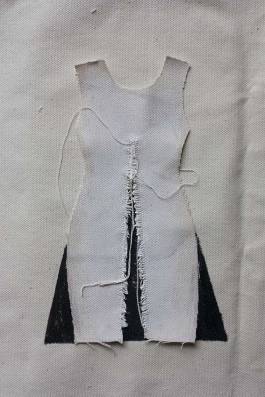
Torndress, 2015

Girl Noir - Bonjour Tristesse, 2001

Girl Noir - Case X, 2001

Selbstportrait mit CMG, 2004

Kuenstleranatomi, 2012
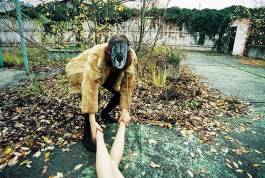
Factoryland - Animal, 2000

Factoryland - Bauch und Banane, 2000

Factoryland - Green Glasses, 2000

Factoryland - Hats and Cats, 2001

Boopoobiduu, 2017
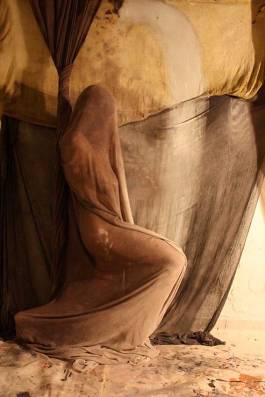
Curtain Series, 2012
2024
ANITA FRECH "SOMETHING SOFT AND DARK"
I am flicking through the mock-up of Anita's book over and over again, going through drawings, photos, collages, sketches, paintings, aquarelles, and more drawings and shots... I feel captured in a kaleidoscopic loop of images... faces, eyes, lips, legs, and body fragments revealed and concealed. Suddenly, I realise that I am thinking of Dorothy Vallens; I can almost hear her singing… a song about wearing... something soft and dark... Blue Velvet. Dorothy, played by Isabella Rossellini in David Lynch's film, embodies antithetical models of femininity. At once desirable and fragile, seductive and tender, in control and surrendered, she is sifting between love, lust, fear and violence. She alludes to an image of femininity explored in Anita Frech's early 2000 works, which bear references to Hollywood's films Noir from the Fifties, stories of women trapped between the lights of the stage and the dark of annihilation. It is a series of black and white drawings and paintings entitled "Girl Noir", where movie icons, starlets and anonymous victims of femicide are rearranged together as in a hall of mirrors, suggesting a question: in which of those do I identify? Some portraits recall features of Jean Seberg, Jeanne Moreau, or Elizabeth Short, known as the Black Dahlia, while others appear unknown. They merge with a subsequent series entitled "My Angel", where the identification game is pushed further since the traits of the portrayed woman recall still ubiquitous Nineties supermodels Christy Turlington, Linda Evangelista, Stella Tennant and others. Their poses are reminiscent of Peter Lindbergh's spreads... Their eyes are heavily made up with kajal; their gaze direct and inquisitive. This series leads to a "Self-portrait with Colour Me Green" from 2005, a photo presenting Anita in a white T-shirt in front of her naked self-portrait painted in green and dark red. In both pictures, I meet Anita's gaze, which is also direct and inquisitive. It is so intense that it makes me forget that there is a filter between me and those eyes in the portraits—a "filter" of the lens of the photo camera.
This picture synthesises Anita Frech's artistic process, suggesting her tendency to shift between media and disciplines.
Thematically, her work is constructed as a constant interplay between Self and its Double; structurally, it is a continuous crossover between the different disciplinary fields: painting, photography, fashion, and architecture. The discipline in which some of these modes of expression may come together is performance, and Anita, in fact, is a performer.
She performs for the camera.
Performing for the camera has a long history, as long as the history of the photographic medium itself. Simon Baker asserts: "Photography has always been performative, and since its invention, performance, whether in the practices of actors, choreographers or artists, has to depend on photography. But what complicates the relation of performance to the camera is the degree to which photography is properly recognised for its translation of performative acts beyond the limited sense of its being just documentation"¹.
There is a fascinating story about one of the fathers of photography, Hippolyte Bayard, who remained uncredited for his invention, unlike Fox Talbot or Daguerre. Frustrated with the lack of recognition, in 1840, he portrayed himself as a drowned man, executing what might be considered a first performance for the camera.
Anita Frech performs without an audience as well, and her acts are captured with a self-timer. More than a photographer, though, she acts and appears as a model in sets of visual narratives resembling film sequences or contact sheets of a fashion photo shoot.
In photos of "Factory Land" series, "Anatomy of the Artist", or "Boopoobidou in the Augarten", she performs the act of posing, immersing herself in the role of countless young and beautiful girls in front of the male eye of the camera. Acting out fantasies or alternative realities through her self-image, she creates a lexicon of femininity suggested/imposed through powerful communicational machines such as cinema and fashion. The aesthetic register she uses is not the glossy stock fashion photography, though, but rather that casual, dirty, DIY style of the Nineties, popularised by i-D, Dazed and Confused, and explored later by intentionally ambiguous fashion/art provocations, as the collective Bernadette Corporation and similar.
Through her work, Anita Frech puts herself on the scene as well as behind the scenes, acting as a subject writer, a stylist, and a cameraman, making barriers between authorship and identity collapse.
"Identity ... what is identity?"- asks Wim Wenders in his "Notebook On Cities & Clothes" - "To know where you belong? To know what you are worth? To know who you are? We create an image of ourselves, and we attempt to resemble that image. Is that what we call identity: the accord between the image we have created of ourselves and ... ourselves?"
He asks these questions in a documentary about Yohji Yamamoto. In this film, Wenders moves back and forth between places of conceiving and making fashion: studio, atelier, backstage, and those places where fashion lives: the streets of a metropolis. "Urban identity is 'being for others'." asserts Patrizia Calefato, continuing, "Urban identity is a question of image, of identity in and with the crowd"².
Anita Frech chooses, as sites of her performative photo sessions, places of collective rituals: a disco club in "Factory Land", a park in "Boopoobidou in Augarten", and a chapel in "Prayin". Yet, in all of this series, there is no crowd. The scenery is empty, desolate, and alienated, and as such, represents a perfect frame for playing out her persōnas, her masks, her fashioned selves.
The relation between the subject and the scenery apostrophises the mechanisms of the fashion as an image. Frech deals with fashion as a semiotic construct, a set of signs. Her outfits are carefully styled, each fitting "naturally" in the storyline. In some of the "FactoryLand" series, she wears a dancing suit and original boots from the beginning of the 20th century with red ribbons as shoelaces. This fashion-conscious attitude comes from her formation as a fashion designer, as she studied fashion design at the University of Applied Arts in Vienna under Helmut Lang and took a bachelor's degree at Herbststraße Fashion College. But fashion, as well as architecture, played a significant role in her upbringing from early childhood. Her father, a civil engineer, worked in his father's architectural firm, which collaborated with Otto Wagner in some projects in the 1910s and 20s. Her mother had a textiles shop, and Anita recalls spending countless hours there sewing and knitting creative clothes for herself together with her grandmother. Between 1994 and 1997, she attended fashion school, but she soon realised she was more interested in art than design. Yet, her artistic practice is strongly fashion-related since it thematises fashion as an image and a form of material creation. Material creation, understood here as a process of questioning how clothes are made and what is the relationship between the fabric and the body.
These two elements, the body and the fabric, are the very essence of fashion-making. At the same time, they are essential in the painting, too.
When I came to Anita's studio, the first piece I saw was the easel on which the raw canvas was draped. With a simple gesture, Anita created a sculptural piece in which the easel became the body and the canvas, tautologically, turned into what it is: a piece of cloth. Interestingly enough, the very first self-performing photo, Anita realised, in 1991, pictures her lying body covered with draped fabric resembling a white canvas.
This interplay between the body and the cloth will come over and over again in her work, as in the series "Grey Curtain - Painted Flowers", "Curtain Series - Cocoon n° 5", "Curtain Series - Source", "Curtain Series - Worn Dress", all from 2012. Body and drapery become one in those photos. The effect they create brings to mind the dynamism of ancient Greek reliefs, or even more, the take on the classical motifs by Surrealists, as can be found in the works of Jean Cocteau, Man Ray, Horst P. Horst or in Grecian-inspired shoots of Madeleine Vionnet’s dresses by George Hoyningen-Huene. As in some of these Surrealist works, also in Anita's photos, the classicist aesthetic is charged with eros and seductive allusions that a veiled, concealed, almost abstracted nude body can provoke. Again, this is a legacy of the fashion narrations and their inclination towards idealisation, aestheticisation, and the illusion of perfection.
RADICAL CHIC … NONCONFORMIST … OBSESSIVE ... ENTHUSIASM ... ARTIST
These are the terms Anita impressed in her "Radical Chic Dress" from 1997, the same year she ended her fashion education. The dress is made from the painted canvas, and it is a flat-shaped A model that evokes the famous YSL's Mondrian Collection.
It is interesting to put this early piece in relation to the two gouaches on textiles from 2015 entitled "Torn Dress I & II". Also, these two works are made with canvas, which serves both as a painterly surface and as the "body" of the painting. The canvas presents its inner weaving structure as slightly damaged, alluding to a wound, a scar. This cut evokes a sense of pain when observing this small-scale artwork. As if the canvas took the role of the body.
In 1998, Anita made another work which resonates with those two mentioned earlier. It is a C-print entitled "Pattern / Symbolic Wounds", and it pictures a naked torso with traces of erased drawings impressed on the lacerated skin, as well as a drawing of a pattern-cutting form on the print. The body and the image of how the body gets fashioned through the clothes are superimposed here, creating a strange tautological effect.
This picture makes me recall my first associations when encountering this book and Anita's oeuvre, which in its whole appears as a constant interplay of fragility and sensuality, tenderness and seduction, of being surrendered and in control...
Her work is like a song about wearing... something soft and dark...
¹ Baker, S. Performing for the Camera, Tate publishing, London, 2016, p.15.
² Caleffato, P., The Clothed Body, Berg, Oxford, New York, 2004, p. 100.
Published in “Anita Frech”, the artist's book in a limited edition
Radical Chic Kleid, 1997
Torndress, 2015
Girl Noir - Bonjour Tristesse, 2001
Girl Noir - Case X, 2001
Selbstportrait mit CMG, 2004
Kuenstleranatomi, 2012
Factoryland - Animal, 2000
Factoryland - Bauch und Banane, 2000
Factoryland - Green Glasses, 2000
Factoryland - Hats and Cats, 2001
Boopoobiduu, 2017
Curtain Series, 2012