


YUIMA NAKAZATO: HOW CAN WE MAKE ETHICS AND AESTHETICS CONVERGE IN FASHION MORE?
Dobrila Denegri: We got in contact for the first time ten years ago! It was for “Wonderingmode”, the exhibition that I curated at the Centre of Contemporary Art in Torun, when I was the artistic director there and keen on making the first show about emerging and experimental fashion in a Polish museum of contemporary art. We showed pieces from your “Heaven” S/S 2013 collection.
I discovered your work even before, though ... at the time you were studying at the Royal Academy of Fine Arts Antwerp’s Fashion Department. I was fascinated by your diploma collection and your accessories collection, inspired by Leonardo Da Vinci and his futuristic designs, which I saw at the International Talent Support (ITS) in Trieste in 2008. So, talking about those early times and your beginnings... how much has changed in your design process?
Yuima Nakazato: I always think about the future. It is a very starting point for my creations and actually, it was the main question of my graduation collection, too. Indeed, it was a collection of transformative garments that could open up like an origami. These designs were very futuristic, yet at the same time, they were based on a traditional item: the kimono. Japanese kimono is made with a rectangular pattern, so it's an entirely different shape from the human body.
I departed from the tradition of the kimono and its various ways of being worn, transposing it into these sculptural garments, which were dynamic and shapeshifting. After the graduation collection, I was commissioned to create a costume for Fergie from Black Eyed Peas. It was a huge breakthrough! It also led to my entrance into the world of haute couture. I started showing at Haute Couture Week in 2016, and since then, my career really took off.
DD: What does it mean for you as a designer to know for whom you are designing?
YN: I value a process in which there is a human contact. I enjoy having a direct relationship with the wearer. It is an antique way, but to me, the human touch is important for the future.
DD: From the very beginning up to now, you pursued this line of research in which the future and questions about the future play a significant role. What concerns do you have regarding the future of fashion and how you position yourself as a designer now?
YN: I'm very interested in how the clothes are ending. I’m also posing a question about where clothes are ending. That’s why I am doing research on recycling. To see how clothes are ending gives so many hints and inspirations. The complicated design, like garments made by stitching different types of fabrics, makes it very difficult to open them, and therefore makes recycling them very challenging. This is very inspiring for the future of fashion design for me. Or clothes thrown away, almost new clothes, like those that we find at the immense landfills in Africa, Latin America, or elsewhere... This is why I travelled to Kenya. I wanted to see, feel, smell these garbage mountains. The smell is impressive, as is the smoke... impossible to breathe. Unbearable! Millions of kilos of thrown-away garments are burning in the sun. I wanted to go there and experience the situation physically. I feel that as a designer, it is my responsibility. I think I'm part of the problem, too. Additionally, I wanted to take photos, as photography is where I actually start my design process.
DD: You went to where in Kenya?
YN: To Mitumba. The amount of garbage made of clothes there is such that you are immersed, covered, and you literally walk on them. Everything around you is colourful... bright colours like red, yellow, mixed with a lot of dust... so everything is really overwhelming and shocking. Next to the market runs a river... I never saw such black water. I decided to do something with these dumped clothes, so I bought around 150kg, brought them to Japan, and asked the Epson company to do something together: try to make a new material out of this mass of low-quality textiles. Epson is primarily a printing company, but since everything is becoming more digital, the production of paper has decreased. I wanted to use their technologies to upcycle these clothes.
DD: If this idea functions, it would be a revolution! Just imagine all that surplus of clothes transformed into new fabric! How does it work?
YN: The quality is not really there yet. We are at the beginning of a long process of trial and error. But I’m confident that in five, maybe ten years, we'll get there. What we do is basically create the powder from discarded garments, then treat it so that it becomes a kind of sheet of non-woven fabric. The process is similar to making paper, but these sheets are still fragile and not strong enough to be washed. But, the discovery we made is very valuable: compared to other conventional processes of making woven or knitted fabric, this is a relatively cheap, low-energy, simple and fast way of obtaining non-woven fabric. Besides being fragile, the weakest point of this fabric is that it still looks like dust. It is not beautiful, really. It has a grey colour that is a result of a mix of colours of different materials, mainly cottons, polyesters, and other common mixes found in fast fashion production.
DD: You created designs using this fabric anyway, in your “Inherit” spring/summer 2023, 13th couture collection, right?
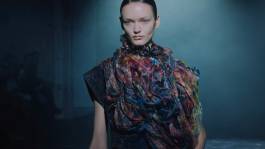
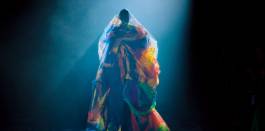
YN: Yes, I treated this dull grey surface by printing on it, obtaining a kind of colourful, wet-looking surface. I tried to add some beauty to this dusty feeling of the fabric. It’s been two years since we started experimenting, and it will take some more time, but it is very challenging. Just think of a circle that this new material represents: the production of low-quality materials used in fast fashion, which is then massively deposited in the second-hand markets and landfills of Kenya, brought to Japan for treatment with innovative technologies, and finally presented at the Haute Couture Week in Paris!
DD: I find it fascinating also because you combined this innovative tech research with the experience you had in Kenya, facing both the ecological disaster as well as the life of tribal people who are primary victims of this shameful practice and an exploratory economy. In the statement about the collection, you were narrating the encounter with a population that, despite all, still maintains great beauty and dignity in the way they are fashioning themselves.
YN: Travelling to the hinterland of Northern Kenya, I encountered tribespeople who live in the desert. I was particularly captivated by their clothing: against a backdrop of reddish-brown desert sand, I saw the tribespeople wrapping their bodies in many colourful fabrics— utilising oranges, greens, and purples—and wearing beaded necklaces and earrings. I was moved to realise that people still strive for decoration even when living in such perilous environments.
Handcrafted beaded decorations, which require considerable time and effort to create, are handed down from parent to child amongst the tribespeople, and in a sense could be said to embody the opposite of modern approaches to clothing. I wondered, suddenly, how long the beautiful beaded decorations I saw in the desert would continue to exist.
The title “Inherit” comes from the experiences I had meeting the tribespeople and witnessing their traditional way of life in the midst of an extreme drought environment. Rather than allowing myself to be overwhelmed by the many issues we all face, I wanted to represent my determination to continue searching for ways to make our world a better place through this collection.
DD: You came back to the Kenya experience in the “Magma” A/W 23/24 collection, so this encounter with a kind of “end of the world” image continues hunting you?
YN: The mountains of garbage I saw are particularly hard to forget... the spontaneous flames, the reeking odours... I kept going back to the photos I took in the northern areas, where, due to climate change, there is no longer any rain but rather frequent cold desert storms.
In “Magma”, I focused on this particular shade of beautiful pink-orange colour of Kenyan mountains, which I associated with Hokusai’s “Aka-Fuji”, where we also see a red volcano... I used Kenyan stones, which, with the latest technologies, we reduced to nano-level powders that we used to dye the fabrics. I also wanted to convey a message of sublimation and resilience through this project, transforming something terrifying into something poetic. With this colour, I want to express my conviction that there is a way for us to change the future.
DD: This, we talked about, is just one of the innovations you are working on. Could you tell us more about the other researchers you are working with?
YN: I was wondering what I could make without a needle and thread, the tools that we have been using for more than 50.000 years. Maybe going beyond these tools could bring a groundbreaking idea, and that was the starting point of this new technique called Biosmocking. It is a fabric made using artificial protein fibre by Spiber.Inc, the company, which gained recognition for creating a fibre by mimicking how spiders produce their silk threads. Spyber reproduced the way spiders create the thread, including the fact that this thread in nature shrinks in contact with water. The synthetic fibres shrank by about 40% as soon as they were immersed in water, which obviously was not good for garments. But I discovered this material, this rubber-to-rubber paste, and I thought it was such a unique fibre because it shrinks when wet. And then I found, by accident, a possibility to print this fabric using UV printing. And I discovered that UV prints can stop the shrinking. After numerous trials and errors, we found a method to control the shrinking.
What is fascinating about Biosmocking is that you can put this fabric in 70 degrees hot water for just a minute, and then dry it with an air jet and mould it as if it was a sculptural material.
I find all this material incredibly interesting because our bodies produce proteins too; just think of hair or nails. We have the protein materials on top of the human body, and a kind of encounter between species: humans and insects. It’s so futuristic!
DD: Was this project with synthetic protein material (Brewed Protein™), finalised in the “Atlas” S/S 21 collection? You worked with Lauren Wasser, an athlete and model whose life was turned upside down when she suffered from toxic shock syndrome (TSS) in her twenties and lost both her legs as a result. How was to create this collection with her?
YN: We worked on distance, getting information about her body shape and measurements. From there, we went on to create complex three-dimensional shapes that embody the physical details of Lauren’s body. This project served as a demonstration of our ability to create individualised pieces despite the physical distance between me, as a designer, and her as the wearer, since we were in the pandemic. The garment had a very organic form, which is impossible to create using a needle and thread. Rather, it was made by shrinking and calculating the percentage of shrinking related to the body.
DD: Did you continue to work with Biosmocking technology?
YN: Yes, especially in “Evoke” A/W 21, which was still in the pandemic time. We continued experimenting with Brewed Protein™, which we incorporated into Nishijin-ori, the traditional kimono textile from Kyoto, producing a new fabric with a metallic blue shade that was a true novelty.
In this collection, I worked a lot with square patterns, like a kimono, provoking the form that covers all genders, body shapes and ages. I also took inspiration from the traditional Ukiyo-e printing, adding to the collection a sense of Japonisme. So, try to mix the traditional craftsmanship and latest technology, fuse them, and make something new. For me, it’s the curiosity to see what's happening in the end.
DD: Kimono is such a recurrent motif in your research...
YN: In Japan, we used to wear a kimono for over a millennium, but today, Japanese people don't wear it anymore. The silk industry is currently in a very difficult situation. Out of this, I try to gain something positive, going local and collaborating with masters of this tradition. It is also something that I’m doing through my educational initiative, Fashion Frontier Program. It’s striking data that today almost 80% of environmental impacts come from the design process. There are so many decisions in a design process. This gives us a lot to think about what can be done.
DD: Indeed, it is really important to start from education and the young generations. How are you doing that?
YN: If we're able to change the mind of the designer, we could change this number. We try to do this action to change the future and combine it with education.
Fashion Frontier Program was established in 2021, under the belief that searching, praising, and educating future fashion designers who have the courage and ambition to overcome these situations will lead us to a better society. Anyone with a passion can apply to take a step toward becoming a fashion designer. Those chosen as the finalists are required to realise a garment design which combines both social responsibility and creativity.
For example, Hiroto Ikebe came up with a leather alternative in the form of rewoven silk cocoon waste. He made a project entitled “Cocoon Anatomy”, exploring how the silk cocoon waste may be an alternative to leather, and how it can help reduce the discarding of shells in landfills. He searches for new techniques and approaches in sericulture, which involves the production of raw silk and the rearing of silkworms.
DD: It is interesting that you are talking about a designer’s responsibilities and design decisions. It really resonates with the postulates of Critical and Speculative Design, and can be applied to the field of fashion as well.
On the other hand, I’m fascinated by the duality that runs as an undercurrent throughout all your work. Tradition is combined with innovation... ancient with futuristic. Haute couture is intertwined with social concerns and democratising intentions. How do you navigate these dichotomies?
YN: I’m fascinated by both, discovering something very old and also very new. I like new materials and their limitations. Limitations are actually a drive to keep on experimenting and finding something that doesn’t exist yet.
It can happen rapidly, but most probably, all these experiments will take years before we come up with solutions that can really be a game-changer. Maybe it will take a decade or more, but some of the things we see as innovations today will become a standard, and we’ll all move in a less toxic fashion industry. I think a lot about how something negative can be transformed into something positive.
Also, I work indeed in the field of haute couture, luxury, and expensive goods, but at the same time, I’m interested in the principles of ready-to-wear and how these two opposites can be bridged. How can a garment be always the same and different? Or, what is beauty today? The concept of beauty is so important in the culture. So, how can we make ethics and aesthetics converge more?
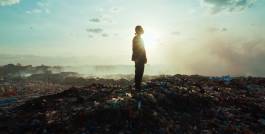

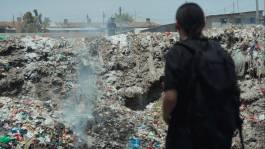
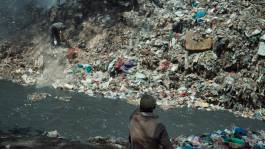
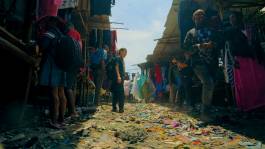


Dust to Dust film stills