


LUCA LO PINTO: ULTIMATELY, FASHION, AS AN ART FORM, IS A SYSTEM OF SIGNS
Dobrila Denegri: Since you were appointed director, MACRO has become one of the few institutions in Rome to pursue an interdisciplinary program that provides a platform for fashion-related artistic practices, in addition to various other forms of research. Within your curatorial program, “Museum for Preventive Imagination,” several exhibitions touched upon what we can call “critical fashion” or “fashion in the expanded field”. Can you tell me how your interest in this type of practice began?
Luca Lo Pinto: I've always been fascinated by the specific tools or apparatuses fashion uses. For instance, many years ago, when I co-founded NERO magazine with others, I recall that we paid close attention to certain fashion magazines. We found it tedious to see how art magazines handled images, so we opted not to document works and instead attempted to utilise images like fashion magazines. And today, this is quite common. Also, you see from the number of fashion advertisements in art magazines that they finally realised that no one is interested in such thematic, self-referential magazines. It's vital not to make the museum experience passive or merely thematic, like a magazine.
Years ago, I saw Carol Christian Poell's presentation of a collection with almost dead models on the Navigli, and I said, 'Wow, that's amazing.’ I liked that this was not art but fashion. Here in Rome are Maurizio Altieri and Fabio Quaranta, with whom I began to collaborate very spontaneously and eventually became friends.
Ultimately, fashion, as an art form, is a system of signs. It's a language, and it's a medium. And you have many formats under that umbrella.
For the last five years, the way MACRO has operated has enabled us to see what can happen if we mix up particular contents that seem a bit chaotic, but they're not. It's as if there's a precise score around the frame, but then the frame is intentionally removed to allow the score to work.
DD: At MACRO, we could see several exhibitions/events that dealt with fashion more straightforwardly. Let’s start by introducing the retrospective dedicated to Cinzia Ruggeri. How did you decide to devote a show to her?
LLP: I saw a show of Cinzia at Corso Como in Milan by chance. And, at that time, I wouldn't say I liked it a lot. It looked too colourful and playful to me. But it stayed in my memory. Cinzia’s epiphany was in the art. Her debut was in art, and although she worked mainly within the fashion system between the late 1970s and late 1980s, she remained an outsider there. She left it, and she left Milan too, moving to Puglia. Unfortunately, she died before we could celebrate together the exhibition I curated at MACRO.
To me, fashion exhibitions, like architecture exhibitions, tend to be a bit of a trauma because they usually look very static.
When we began to work on Cinzia’s show, we also considered using many mannequins, but I quickly realised that it would look horrible. So, I removed them and decided to hang everything straightforwardly, on the wall or in the air, simply placing each model at a different height. Because we were showcasing fashion, we had to allow people to see the details, so positioning each garment at a different height made it possible to create a rhythm and dynamism, constantly changing the perception of each object.
I was fascinated by how Cinzia dealt with the exhibition language and how she opposed different media and languages. I decided to go in that direction when setting up her show.
DD: You also mentioned other exhibitions, like “In First Person Plural,” through which you were confronted with the language of fashion again. I remember this show as a sort of film set, filled with different elements—artworks, music, artefacts, costumes, mirrors, performers—interacting with one another and with the viewers as well. What was the fashion-related component of this show?
LLP: I'm not going to talk about the show in general, but to say that for this exhibition, I worked with a makeup artist, Lucia Pica. I asked Lucia, who usually works for cosmetic brands and commercial campaigns, to imagine the exhibition space as a body. So she was supposed to do makeup on the space, on the walls, as the walls would be the face. She applied different layers of resin, PVC, and glitter to the walls, just as you would when applying makeup to your skin.
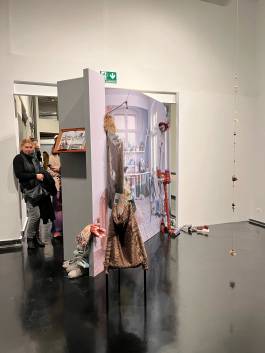
DD: MACRO made a retrospective, “25 Years of Always Stress with BLESS,” dedicated to the work of Desiree Heiss and Ines Kaag, who operate under the name BLESS and work on the edges of fashion, product design, and gestural.
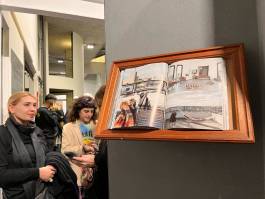
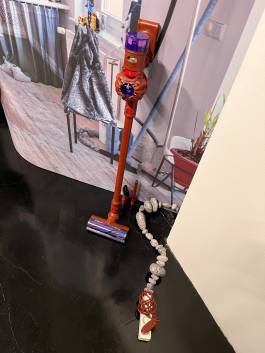
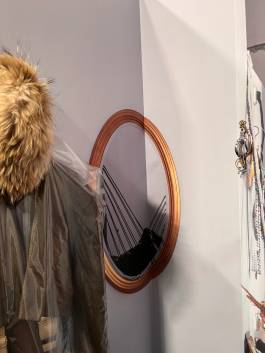
LLP: The exhibition was curated by Chiara Siravo. BLESS is an excellent example of this approach, of the kind of in-betweenness I like. Their 25-year retrospective was installed in just one room, which appeared almost empty except for the banner/flag at the very end of the space. The entrance was nearly obstructed by a structure resembling a library, mixed with a dividing space screen. On the front, the library displayed an anthology of publications about their work and look-books; on the back was a wall-scape with displayed objects and samples from their collections. They wanted to place their “retrospective” in a liminal space, marked by the library/screen at the entrance of the exhibition hall. For the opening, visitors weren’t allowed to enter the space, so Ines took cell phones and photographed the “show” for them. Now, many people have their photos taken by the artist on their phones rather than taking them themselves.
DD: Additionally, the uniforms for the guards and staff of MACRO exemplify this attempt to bring a fashion designer and a museum into the dialogue.
LLP: I worked with Fabio Quaranta on different occasions. In Vienna, he was part of a group show, “Time is Thirsty,” and created uniforms inspired by Helmut Lang.
When I started working at MACRO, I wanted to do something similar, so I asked Fabio to design a uniform. On the back of the T-shirt, he put the museum's logo and a patch of our symbol, an octopus in different colours, on the front. So, when the “Museum for Preventive Imagination” project ends, these T-shirts will still be functional because the patch can be removed.
Luca Lo Pinto, Curator and Artistic Director of MACRO - Museum of Contemporary Art, Rome (2020-2025)
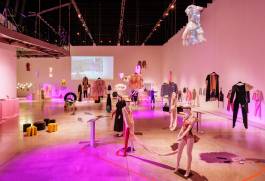
Exhibition view: Cinzia Ruggeri, Cinzia says…, MACRO – Museum of Contemporary Art of Rome
Ph. Piercarlo Quecchia, DSL Studio.
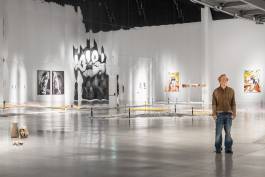
Exhibition view: In First Person Plural, MACRO – Museum of Contemporary Art of Rome
Ph. Piercarlo Quecchia – DSL Studio
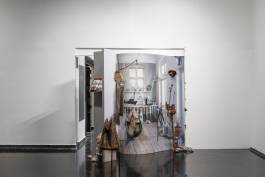
Exhibition view: BLESS, 25 Years of Always Stress with BLESS, MACRO – Museum of Contemporary Art of Rome
Ph. Agnese Bedini – DSL Studio
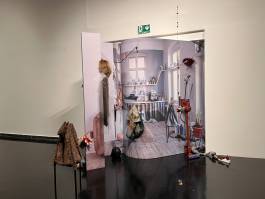

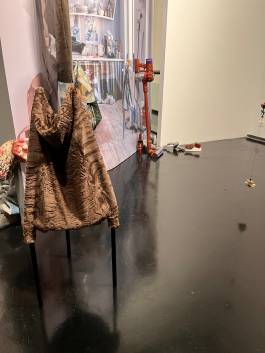

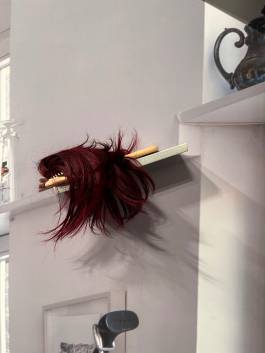
Series of BLESS
Exhibition view: BLESS, 25 Years of Always Stress with BLESS, MACRO – Museum of Contemporary Art of Rome
Ph. Ines Kaag