


IRIS RUISCH: BECAUSE WE WANT TO BE RELEVANT, THE FORMULA OF COLLECTIVE CURATING OFFERS A VARIETY OF PERSPECTIVES AND VOICES
Dobrila Denegri: Iris, we met during the second edition, called “Ways of Caring,” which was very engaging, especially in its intent to involve communities, create moments of collective experience, and support the projects of invited creatives, who were mainly from the Global South.
Iris Ruisch: Indeed, “Ways of Caring” was curated by two teams: Fashion Revolution, led by Orsola de Castro, and Not Enough Collective, a collective of young South American curators who studied at ArtEZ in Arnhem and had a very critical postcolonial perspective. The seven curators focused on their proposal for the Biennale on the backside of the fashion system, specifically examining the makers and the production system. Not Enough Collective curated the exhibition, and Fashion Revolution developed the public program.
Fashion often has an exhibitionist nature, presenting visions of new trends, style designers, and quick solutions. We wanted to show the opposite. Respecting your clothes is the first step in paying homage to the people who make them and to the nature from which textiles and materials come.
DD: The third edition, “Ties That Bind,” also focused on the Global South, but the attempt was to expand and include other localities besides Arnhem. What was the process of preparing the last edition?
IR: The “State of Fashion” formulated one central leading question in all its activities, both as a platform and Biennale: how can fashion and textiles contribute to a better world? We opened the call for curators in January 2023, during which we formulated several key focus points and questions for the applicants. We asked them to reflect on the most important findings of the previous edition, “Ways of Caring”. We invited the applicants to reflect on this within their proposal. The central question was: How can prevailing perspectives challenge the Biennale? How can we define the unequal power relations between the dominant global north and the global south, and how can we share and disseminate non-Western knowledge? Could the concept of the ‘exhibition’ be challenged and enriched so that it invites and inspires the visitor? We call upon the new curator (team) to provide direction and shape a vision for new forms of presentation.
Finally, we received over 60 applications from 24 countries. Our international creative advisory board reviewed all applications. Finally, we selected two curators: Rachel Dedman, an art historian and currently the General Curator of Contemporary Art, specialising in the Middle East, at the Victoria and Albert Museum in London, and Louise Bennetts, who has a background as a fashion designer but has developed into a fashion researcher. She is also working on issues related to censorship, future fashion markets, and sustainability. Together, they created a new concept for us as a Biennale, which provides us with the opportunity to upskill and reflect on racial parity.
We needed to work with curators, artists, and makers from the Global South when developing an exhibition about the region. That led us to decentralise the Biennial itself. The home site of Arnhem is, for this edition, just one of several international locations across which the Biennial unfolded. The curators invited three interlocutors from across the Global South, in three sister sites, to create projects as part of the State of Fashion that respond to urgencies in their local contexts. These three sites were located in Bengaluru, India; Nairobi, Kenya; and São Paulo, Brazil. This was an ambitious yet incredibly valuable learning experience for our organisation, enabling us to develop a program in collaboration with these interlocutors and makers within their local context. Afterwards, we brought a selection of the new works—created by local fashion designers, makers, and researchers—to Arnhem, where they were exhibited to a broad audience during the seven-week run of the Arnhem Biennale.
DD: How did it function conceptually and logistically to make this decentralised edition?
IR: For the first time, we hosted an international “State of Fashion” program, running from March to the first week of May, starting in Bengaluru, then moving to São Paulo, and finally to Nairobi. At each sister site, the interlocutors – Sunny Dolat, Kallol Datta, and Hanayrá Negreiros – were invited to develop a specific State of Fashion project in their local context, responding to the Biennale's themes as they relate to the urgencies and experiences of their cities and communities. They discuss political parties, modern traditions, and the needs of the communities they work with. Therefore, they developed a new program specifically for these three sites.
DD: How was Arnhem’s part of the project structured? What were the key topics and artists/designers involved?
IR: “Ties that Bind”, the part that Louise and Rachel curated, examined critically the notion of tradition, explored the political power of clothing, and spotlighted alternative approaches to the dominant fashion system through the work of artists and designers from all over the world Buying clothes is a very universal experience; we all wear them, and we all have our way of life, so it’s a process that spans from companies to customers to creators. Because changes don’t happen overnight, nor can you achieve them on your own, we have to work together to move forward.
For example, Melati Suryodarmo created a site-specific work, “Clothes Ape”, using locally donated secondhand garments.
DD: Melati is a former student of Marina Abramović, and she is very engaged with performance practice.
IR: Yes, she made hours-long durational performances, writing about our excessive consumption of fast fashion and the industry’s harmful impact on natural resources. This installation represents well the spirit of the Biennale. At the Cultural Centre Rozet, several locally based designers and collectives presented projects exploring food migration, mental health, and the refugee experience in the Netherlands. Lebanese graphic designer Farah Fayyad presented work that initially stemmed from the 2019 protests in Beirut. She dragged her printing press out onto the streets and printed the slogans of the revolution onto whatever people were wearing there. She has since moved to the Netherlands, bringing the printing press with her and continuing to use it in public spaces, such as on this occasion.
DD: How do you cope with the local audience in Arnhem, considering that a lot was going on elsewhere?
IR: It was imperative to develop an extended public program, and we collaborated extensively with local partners, designers, makers, and institutions such as ArtEZ, as well as with young designers from the Amsterdam Fashion Institute, for instance. We involved Ruben Jurriën, an AMFI alumnus and one of the winners of the Dutch fashion contest ‘Lichting’, which involved several fashion schools in the Netherlands. As a social designer, he has worked extensively with various local communities.
DD: I remember that you approached the previous edition, “Ways of Caring”, similarly, with a substantial public program, workshops, and collaborative initiatives involving designers like Duran Lantink, for example.
My impression is that, through the three editions, “The State of Fashion” has changed, both structurally and curatorially. Jose, as a single curator, curated the first. It presented side-by-side designers like Stella McCartney, Vivienne Westwood, Viktor & Rolf, and Iris van Herpen, younger or more “alternative” ones like Vin and Omi, Yuima Nakazato, threeASFOUR, and independent researchers and artists who are working beyond the realm of the fashion industry, like Lara Torres, Apparatus 22 or Tenant of Culture, which is the moniker of Hendrickje Schimmel.
The following two editions promoted the idea of choral curating, with collectives and curatorial teams chosen. In this sense, it reminds me of Documenta, the most important contemporary art manifestation, which also proposed different forms of decentralisation and shifting focus on the Global South. It also proposed the formula of collective curating. What kind of perspective does this bring?
IR: We are constantly pushing, thinking, and exploring boundaries that haven’t been explored. Because we want to be relevant, the formula of collective curating offers a variety of perspectives and voices: Rachel, for instance, is a highly institutionalised and experienced curator. At the same time, Louise, with her background in design and research, brings additional knowledge. Having both of them working with three interlocutors (co-curators) from the Global South has brought us a truly global perspective for this 2024 edition. Besides our curators, a significant role is also played by the entire State of Fashion team of project managers, exhibition designers, graphic designers, producers, educators, and volunteers. The idea of asking Farah Fayyad to create the graphic layout for the entire event was to ensure coherence.
DD: Was this edition putting a focus on activism as well?
IR: Our Biennale editions always take a highly critical approach, but from a positive perspective: how can fashion and textiles contribute to a better world? Within this framework, we celebrate fashion and textiles through our Biennales, where we collaborate with our (each edition different) curatorial team to examine current issues in fashion in unique ways.
In our “State of Fashion” exhibitions, we showcase (Indigenous) crafts, designs, and objects and bring together the outcomes of various research projects. Through our Biennale public programme, we explore alternatives to the dominant industrial fashion system and global inequality together with our audience. We aim to reach diverse target groups with a wide variety of programme elements, including activist performances, shows, critical talks, our “Whataboutery” discussion series, workshops, masterclasses, and more.
In collaboration with our main local partners, ArtEZ and New Texaco, we develop symposia as a structural component of the Biennale. These symposia always focus on thematic topics and urgent issues, bringing together visionary ideas from around the world.
Looking back at the 2024 edition, it was especially engaging to develop and organise exhibitions at the three Sisters’ sites for the first time. We learned a great deal from this experience and were delighted to bring some of the co-created works to our home site in Arnhem for the final “Ties that Bind” presentation. This direction is something that we would like to continue in the coming years.
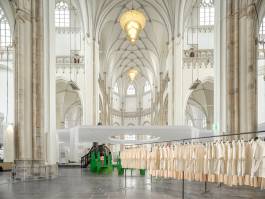
Exhibition overview State of Fashion 2022 | Ways of Caring. Exhibition design by Studio LA. Photo by Jeroen Verrecht
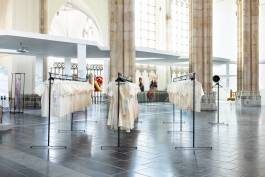
Installation Bodies that Make, Bodies that Consume, by Santiago Útima, Siviwe James, Widi Asari & Riyadhus Shalihin for State of Fashion 2022 | Ways of Caring. Photo: Eva Broekema
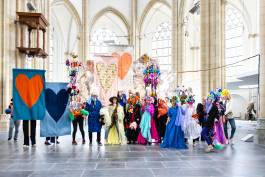
Love Yourself Procession by Tom van der Borght, State of Fashion 2022 | Ways of Caring. Photo: Eva Broekema
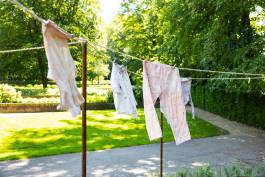
Recovery Garden, in collaboration with Hul le Kes, for State of Fashion 2022 | Ways of Caring. Photo: Eva Broekema
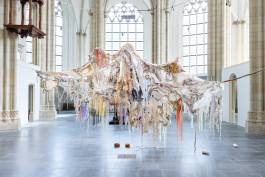
Collaborative textile work Does It Have An End? by Wei-Chi Su, Ateliê Vivo and Danayi Madondo for State of Fashion 2022 | Ways of Caring. Photo: Eva Broekema
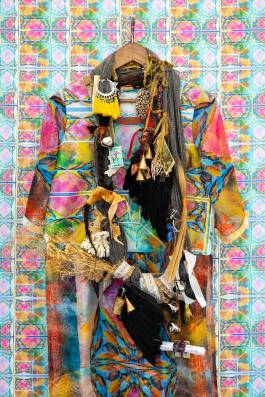
Molly Jae Vaughan during State of Fashion 2022 | Ways of Caring. Photo: Eva Broekema
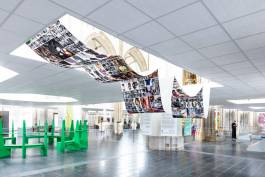
Exhibition view of Fashion as Encounters, part of State of Fashion 2022 | Ways of Caring. On the foreground work by Fundación Amor Real. Photo: Eva Broekema
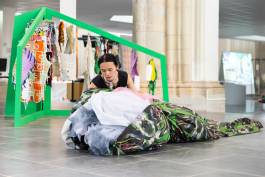
Performance by Molly Jae Vaughan, with Matthew Wang, during State of Fashion 2022 | Ways of Caring. Photo: Eva Broekema
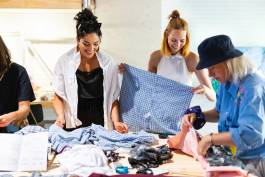
Workshop by GARCIA BELLO, during State of Fashion 2022 | Ways of Caring. Photo: Eva Broekema
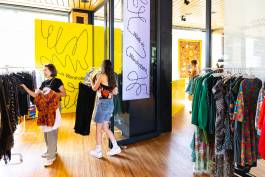
Clothing Swap event for Walk In Wardrobes during State of Fashion 2022 | Ways of Caring. Photo: Eva Broekema
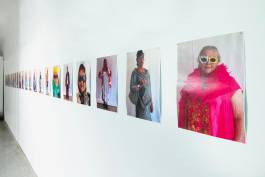
Workshop The Age of Consent by Duran Lantink; a workshop that took place in a nursing home for the over 80’s during State of Fashion 2022 | Ways of Caring. Photo: Eva Broekema
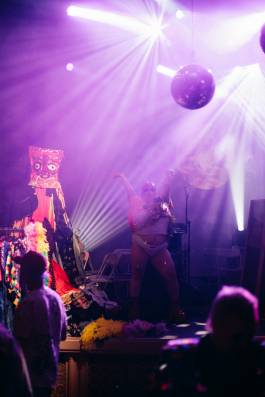
LOVE.JOY.NOW, opening party for State of Fashion 2022 | Ways of Caring, curated by Bas Kosters. Photo: Cecile Bok
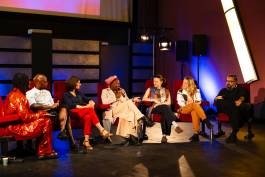
VPRO Meet-Up during State of Fashion 2024 | Ties that Bind, from left to right: moderator Jean-Paul Paula, Sunny Dolat, member of the European Parliament Lara Wolters, Hanayrá Negreiros, Rachel Dedman, Louise Bennetts, Kallol Datta. Photo: Eva Broekema
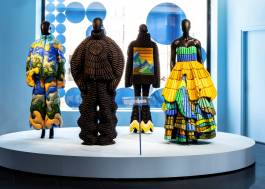
Christopher Raxxy, part of State of Fashion 2024 | Ties that Bind. Photo: Eva Broekema
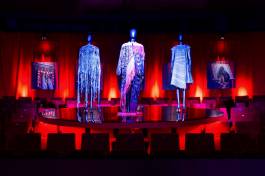
NKWO, part of State of Fashion 2024 | Ties that Bind. Photo: Eva Broekema
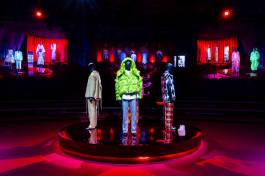
Exhibition overview of the sub-theme Dismantling Tradition, part of State of Fashion 2024 | Ties that Bind, with from left to right work by Lukhanyo Mdingi, Maison ArtC, Mohammed El Marnissi, NKWO, Karim Adduchi, Nous Étudions. Photo: Eva Broekema
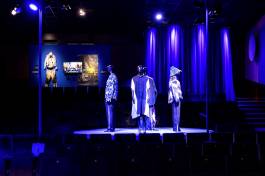
Exhibition overview of the sub-theme Designing Integrity, part of State of Fashion 2024 | Ties that Bind, with from left to right work by TMS.SITE and BUZIGAHILL. Photo: Eva Broekema
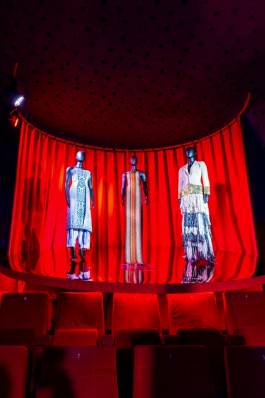
Karim Adduchi, part of State of Fashion 2024 | Ties that Bind. Photo: Eva Broekema
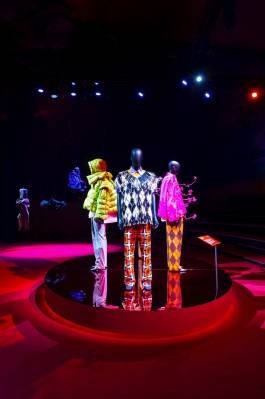
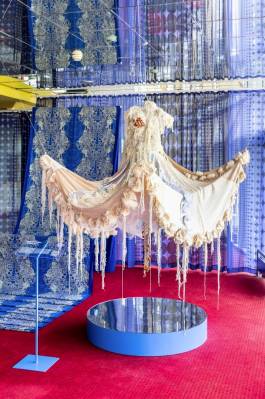
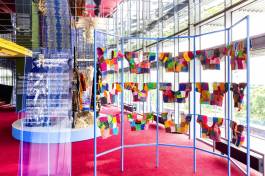
Indu Anthony, Without Water How Will I Wash the Blood Off, 2024, installation of 15 embroidered saree blouses made of existing textiles, part of State of Fashion 2024 | Ties that Bind. Photo: Eva Broekema
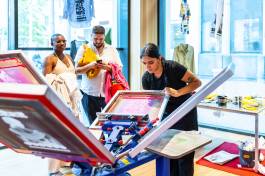
Screen print installation by Farah Fayyad and Tal G, part of State of Fashion 2024 | Ties that Bind. Photo: Eva Broekema
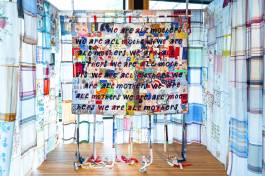
Installation We Are All Mothers by Bas Kosters, part of State of Fashion 2024 | Ties that Bind. Photo: Eva Broekema