


JOSÉ TEUNISSEN: WHAT IT MEANS TO RETHINK LUXURY THROUGH NOTIONS LIKE REUSE AND REPAIR
Dobrila Denegri: José, we first met at a conference in Vienna in 2016, when we were initiating “Transfashional,” and we discussed your curatorial approach. It was precious to hear about your work at the Centraal Museum in Utrecht, which has a significant historical collection of costumes and where the museum’s policy allowed you to invest in then-young designers like John Galliano, Viktor & Rolf, Hussein Chalayan, Ann Demeulemeester, and Martin Margiela, through exhibitions, new productions and inclusion of their work in the collection. You also curated several exhibitions in which, even though you didn’t explicitly use the term “critical” fashion, you dealt with the notion of hybrid productions that look like fashion-related art or forms of experimental fashion. A notable one was “The Art of Fashion: Installing Allusions”, co-curated with Judith Clark, at Museum Boijmans Van Beuningen in Rotterdam in 2009, or “The Future of Fashion is Now”, made with the support of Han Nefkens, which toured various museums across the Netherlands and Germany. The exhibition “Future of Fashion is Now” (2014) at Boijmans van Beuningen Rotterdam was also supported by Han Nefkens and showcased in Shenzhen and Shanghai, China.
Our “Transfashional” project interacted with the first edition of the “State of Fashion” in 2018 in Arnhem, Netherlands. This and subsequent biennial editions made me realise that this is a new and vital platform for supporting experimental, fashion-related artistic research.
Could you tell us more about the “State of Fashion” and its origins, including how it started and its connection to the Fashion Biennial?
José Teunissen: I have collaborated (in my role as professor in Fashion and Identity at ArtEZ) with the Biennale since the start and throughout the years. At the initiative of the municipality of Arnhem and ArtEZ, the Arnhem Fashion Biennale Foundation was established in 2003 to promote Dutch fashion to a broader (inter)national audience. While organisations abroad mainly focused on the economic side of fashion, this Biennale concentrated on the cultural, social and societal influence of fashion. After four editions curated by pioneering curators such as Piet Paris, Joff and Lidewij Edelkoort, the last edition took place in 2013.
“State of Fashion” is a follow-up to the Arnheim Fashion Biennale, with the new concept announced in 2016.
When thinking about restarting this manifestation, it was clear that the times had changed. It wasn’t possible to celebrate fashion, as seen through the filter of glamour, luxury, and excess, anymore.
We needed to rethink fashion. Most of all, we needed to restore its artistic side, including innovation and sustainability, and get to the fundamentals, so to speak. We had to ask how it could be meaningful, relevant, and even critical.
Christine de Baan (quartermaster) and I, as a curator, developed a new approach to the Biennale, highlighting the problematics of celebrating conventional fashion and the need to rethink the system critically. As a result, the Biennale was renamed “State of Fashion,” and it was intended to serve as a platform for showcasing alternatives to the current fashion system, explicitly connecting fashion with the societal questions and challenges of our time. The leading question is how fashion can contribute to a better world.
Bringing together visionary ideas from local and global perspectives, “State of Fashion” explores alternatives to the dominant industrial fashion system, which causes pollution and inequality worldwide. I was involved in developing this new format and was eventually appointed curator of the first edition in 2018. We established an advisory board, inviting Linda Loppa and other colleagues.
Since 2018, “State of Fashion” has organised a significant public event every two years: the State of Fashion Biennale, featuring a new team of curators who uniquely examine current fashion issues and engage the public. “State of Fashion” is structurally supported by the Municipality of Arnhem and the Province of Gelderland. Since 2021, it has been included in the Ministry of OCW's national basic infrastructure (BIS). Since 2018, I have been a member of the “State of Fashion” board, assuming the role of chair in 2023.
DD: The title of your exhibition was “Searching for the New Luxury.” What did you mean by this notion of the “new luxury”?
JT: We wrote a manifesto asking what it means to rethink luxury through notions like reuse and repair. We also incorporated sustainability and technological innovation, exploring new ways to narrate fashion, adopt new practices, and engage with diverse communities.
DD: How was this first edition received?
JT: It was received very well by the Dutch government. We were invited to apply for structural funding. Until that moment, the local government of Arnhem supported a tiny team, and we were working on a project-based level. However, when a call for structural support for institutions such as museums and similar institutions was issued, we applied. In 2019 and 2020, we received structural support, among others, including the Dutch Design Week.
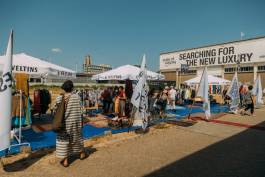
Close to You clothing swap, State of Fashion 2018 | searching for the new luxury. Photo Eva Broekema
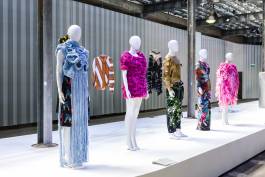
Autumn/Winter 2017-18 ‘WE ARE NOT SHEEP’ by VIN + OMI, State of Fashion 2018 | searching for the new luxury. Photo Eva Broekema
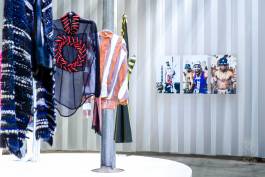
Left; ALL THE NOTHING THAT WILL REMAIN (2017) by Rafael Kouto. Right; Our Tribe (2015) by The Sartists, State of Fashion 2018 | searching for the new luxury. Photo Eva Broekema
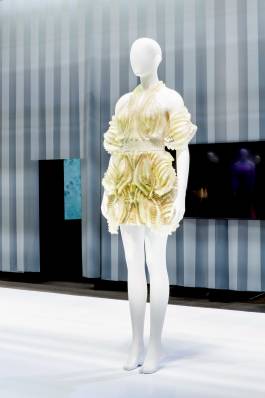
Spring 2018 Haute Couture collection ‘Ludi Naturae’ by Iris van Herpen, State of Fashion 2018 | searching for the new luxury. Photo Eva Broekema
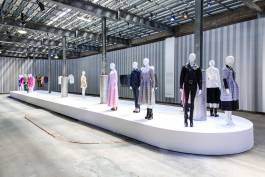
Autumn/Winter collection 2017-18 ‘Freedom’ by Yuima Nakazato, State of Fashion 2018 | searching for the new luxury. Photo Eva Broekema
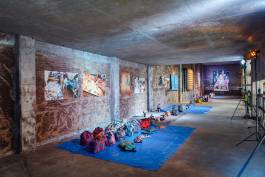
Autumn/Winter 2011-12 ‘Handmade with Love’, in collaboration with Ethical Fashion Initiative and the United Nations by Vivienne Westwood, State of Fashion 2018 | searching for the new luxury. Photo Eva Broekema

Interdisciplinary approaches exhibition part of the State of Fashion 2018 | searching for the new luxury. Photo Eva Broekema
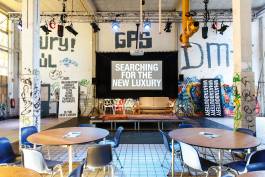
Whataboutery series, State of Fashion 2018 | searching for the new luxury. Photo Eva Broekema