


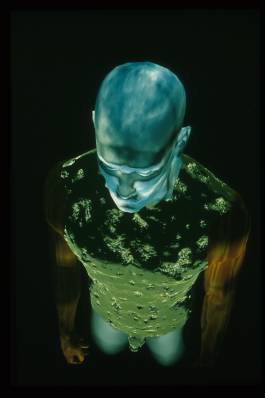
Bodies INCorporated
1997
VICTORIA VESNA “AVATARS ON WORLD WIDE WEB: MARKETING THE DESCENT”
Participation/interaction
With the emergence of artistic tendencies during the 1960s and 1970s, such as happenings, performances, and body art, new ways of approaching artistic work are developing that emphasise the active participation of the audience in given actions. In this way, not only the relationship between the artist, the work, and the observer changes, but, in certain situations, the very character of the artistic work changes, the outcome of which is no longer predetermined or controlled by the artist, but depends on the reaction and level of audience participation. Therefore, during the 60s, audience participation, with all its political and social implications, was an important element in the process of realising artistic work. Since the mid-'80s, and especially in the '90s, with the development of techno art, the process of involving the audience has changed in character and has mostly lost its direct political connotations.
The term "interactivity" is increasingly used to denote the network of multidirectional relationships among the audience, the work, and the artist. In the book "Art of the Electronic Age", Frank Popper points out precisely the distinction between these two terms, defining the concept of interactivity in the context of recent artistic research based on the use of electronic media.
Unlike the first definitions of interactivity, which treated the relationship between the artist and the medium/instrument with which she/he operated, today this term can be understood as a much broader spectrum of relations in which the artistic work figures as a medium of connecting individuals (author, audience, etc.), and at the same time as a field in which the processes of perception, communication and creation constantly alternate and merge. The phenomenon of interactivity is directly related to the new electronic communication systems and thus was one of the main topics that many artists and theoreticians of new media dealt with, starting with Peter Weibel, who paid attention to interactive art in the mid-'80s, at the Ars Electronica Festival in Linz, through the conference held in Paris in 1988. “Languages and new images, or the way they modify cultural practice”. During the conference, this topic developed in two directions: on the one hand, the question of interactivity in relation to scientific and technological culture was discussed, and on the other hand, interactivity was viewed as an instrument with great creative potential in the service of artists and audiences.
Theoretical aspects of technological art and culture developed in parallel with new scientific achievements, so that many of these interrogatives have been defined and redefined several times in the last ten years, and analogously to changes in the global social context, new and complex issues have come to light.
A brief history of electronic art and new directions
Before we turn to contemporary topics, it would be interesting to once again refer to Frank Popper, and look at the development and classification of electronic and multimedia disciplines in a historical perspective.
This author sees the roots of electronic art in progressive design movements from the end of the last century (Arts and Crafts, Art Nouveau, Jugendstil), when after the industrial revolution there was a more direct connection of art, science and technology; they were followed during the 1920s by historical avant-garde movements (especially futurism, dadaism and constructivism) and then by trends that developed in the period between the two wars, or after the Second World War: kinetic and luminokinetic art, mobiles, Op Art, Neon and Light Art.
Popper categorises artistic research in the field of electronic media, which began in the 1960s, into four groups: 1) laser and hologram art, resulting from early experiments with light and electricity to create artworks; 2) video art and video installations, which develop experimental film experiences; 3) computer art, with roots in programmed and conceptual art; and 4) the art of communication (telematic art), involving various audience interactions via phone or fax during the creative process.
As technologies become more sophisticated, artists today are offered increasingly complex possibilities for their use and integration, thereby creating new multimedia forms and disciplines. For example, about the categories that Popper defined as computer or telematic art, in the contemporary context, it becomes more appropriate to talk about digital art (which uses computer graphics software to create images) or "online" art (that is, works and projects specifically created and broadcast over the Internet).
Through the "virtual" exhibition "Aperto" realised on the Flash Art Web site (where, among others, Victoria Vesna's "Virtual Concrete", 1995, is presented), the new tendencies in using interactive media as part of installations in physical space are highlighted. In these works, information is stored or manipulated by a computer, but as Christine Paul states, the computer becomes "invisible"; that is, the structure of the database becomes a "media", and even the observer/user can be seen as an integral part of this media.
Berta M. Sichel discusses these alternative networks of databases, hypertext, and/or hypermedia as new systems for connecting text and images, which symbolise, in a specific way, the latest achievements of information technology.
Through the mentioned work of Victoria Vesna, "Virtual Concrete", and the more recent project "Bodies INCorporated", as well as through the works of other artists who operate with these media, we are faced with the idea of expanding the framework of artistic work in several directions. In this sense, the phenomenon of interactivity is particularly interesting, as it contributes to the modification of existing attitudes toward the status of artists, the question of authorship, and the role and presentation of art in general.
In contrast to the art of the '80s, when individualism and subjectivism prevailed, in the '90s, one can speak of the tendency of "collective, anonymous authorship", and the artist increasingly takes on the role of programmer.
In the era of computerisation, internet, connection, information flow, the work of art functions as a kind of mediator for establishing contact between distant and alienated individuals, or on the other hand as a nucleus around which new forms of "group" belonging are formed (eg "Bodies INCorporated").
Through the phenomenon of interactivity, one more important question that preoccupies contemporary art is implicitly raised: what is the position of the body in technological environments?
Flesh Factor
“Flesh Factor” was the name of last year's Ars Electronica, a festival held in Linz that carefully followed the development of new technologies and their impact on contemporary culture since its establishment.
Until recently, attention was primarily paid to the sociological, economic, and cultural aspects of technological development; however, after discoveries in the field of neurology, biotechnology and genetics, questions related to the body and the relationship between two antipodes: man and machine, are given a central position.
The festival in Linz was dedicated to questioning the status and future of the individual within technologically advanced "intelligent" systems, in its edition titled “Flesh Factor”.
"Flesh Factor" means the human factor, the factor of the body, of identity, in the context of a reality in which technology plays an increasingly dominant role, and in which the consequences of scientific-technological distinctions appear both fantastic and apocalyptic. In the current process of profound transformation and instability, one of the burning questions is precisely the relationship between man and the technology he created, because suddenly it seems as if we are in a situation in which the roles have changed, that is, in which man appears to be losing control over his own creations.
It is undeniable that the digital revolution has brought about many significant changes in reality that no longer align with the dualistic models on which our culture is based. Therefore, perhaps the only solution lies in overcoming the oppositions, natural/artificial, male/female, self/other, and in the formation of new models of defining reality within which existing complexities and contradictions can be integrated.
What is "Avatar"?
Vesna Victoria participated in the “Flesh Factor” debate with the text "Avatars on World Wide Web: Marketing the Descent", in which she analyses the phenomenon of the possibility of creating alternative identities in cyberspace.
"Avatara" means the "descent" of a deity to earth, according to the dictionary of Hinduism. Avatara is also an incarnation, or an exceptional form of the divine emanation of Vishnu and Shiva.
According to Webster's dictionary, an avatar is the manifestation or embodiment of a concept or philosophy in a person (1989). The Random House dictionary describes an avatar as "the embodiment or concrete manifestation of a principle, attitude, way of life, and the like" (1995).
It is interesting that, over the years, this term has taken on different definitions; that is, it has moved away from its original "sacred" meaning rooted in the Buddhist tradition and has become more and more "secular".
For connoisseurs of multi-user environments, an avatar signifies an acquired identity in cyberspace.
The founder of "Avatar Software" and "Avatar Partners", Peter Rothman, admits that he was inspired by the meaning of this term, which he found in Webster's dictionary in 1982.
Today, this term is very popular, and an increasing number of companies sell software to create alternative identities in cyberspace (e.g., Avatar Holdings, Avatar Systems, Avatar Financial Associates).
The idea of avatars finds application on the web through various forms of marketing, trade, and, above all, entertainment (interactive games, MUD - "Multiple-User Dimension", MOO - "MUD Object Oriented", and the latest GMUK - "Graphical Multi-User Conversations").
I was particularly interested in that aspect of interpersonal communication on sites like "The Place" (so far the most popular GMUK), which is owned by the multinational corporation Time Warner. "The Place" is a client/server program for creating visual and spatial chat environments created by Jim Bumgardner and Mark Jeffrey, in 1995. Since then, "The Place" has more than 300,000 clients, and more than 1000 new commercial and private “Place” communities have been established.
The members of "The Place" are divided into two main categories: "Smileys", which are available to all new users and guests (considered a lower class of the Place population), i.e., those who have not paid the registration fee, and the category of members who have paid the registration fee and therefore have access to software for creating avatars.
Avatar members, regarded as the upper class within the group, can choose their identity within predetermined groups: animals, cartoon characters, celebrities, evil, real, powerful, seducers, and others.
It is interesting that "The Place" and similar communes take the model of social structure, with all its hierarchical aspects, and transpose it into cyberspace. On the other hand, they offer already defined and accepted models of alternative identities, that is, they continue to exploit the stereotypes of pop culture and the entertainment industry.
The biggest problem facing the industry of multi-user avatar environments is that users can have an unlimited number of identities. The reason is that there are no standards that allow avatars to move between virtual worlds.
However, as Victoria Vesna states, when standardisation systems are perfected, meaning fixed links are created between users and their bank account numbers, there will be no more confusion that reigns today.
The only confusion will perhaps arise regarding the status of the avatar's power; that is, the question will be who is really the "user" and who is "used".
Vesna ends her presentation with the sentence: "When Internet2 is put into circulation, avatars are standardised, and cybercash is perfected, we will find ourselves in front of a world that we will not even be able to imagine, because that world has already been imagined for us”.
Bodies INcorporated
I considered it important to pay attention to the phenomena that Victoria Vesna analyses in the mentioned text, because in some way they represent the contextual framework of her project "Bodeis INCorporated".
Phenomena like "The Place" represent the "industrial" aspects of alternative identities in cyberspace, which expose how the same relations of manipulation, control, and domination that rule modern society are instituted in this new dimension.
On the other hand, artistic projects like “Bodies INCorporated” reflect the potential and characteristics of the cyber dimension, in their alternative, innovative, fantastic and paradoxical aspects.
Through the very name "Bodies INCorporated," which plays on words, Victoria alludes to the contradictions among the categories of body, embodiment, and corporation, and to the different meanings these terms take on in the material and virtual world.
“Bodies INcorporated” is a program that allows users to create their own virtual body and become members of the avatar commune.
The first web pages of this online project were formulated as a long, almost absurd procedure of "buying" a body and accepting the "laws" that rule the commune.
The visitor is forced to answer positively or negatively to a series of questions before finding himself in front of the form for ordering a virtual body, and then goes through different stages of construction of his new identity: 1st stage: personal information; 2) name of the body; 3) gender; 4) sexual affiliation; 5) texture (12 options: lava, chocolate, concrete, water, sky, plastic, rubber, glass, etc:); 6) old age; 7) external constitution; 8) selection of internal organs 9) definition of the owner's relationship to the virtual body; etc.
The construction of a virtual body, in this case, represents the possibility of freely choosing characteristics that are naturally given to us in reality, thereby opening up a wide range of options for self-definition and psychological projection.
The new, virtual body has an almost esoteric character, since it can be composed of concrete materials with varying tactile values and elements with multiple symbolic meanings. In the first stage, “Bodies INCorporated” focuses primarily on the individual plan, while in subsequent stages it examines aspects of social psychology and group dynamics.
It is composed of three environments within which different activities are carried out, so that participation in this project serves as an imaginary journey into spheres that are realistically inaccessible to us and largely part of collective mythology.
LIMBO INCorporated is a grey, undefined zone where information about inert bodies or bodies abandoned by their owners is stored.
NECROPOLIS INCorporated is a zone of rich textures and baroque atmosphere, where members can only visit or choose the way they want to die. Suppose the participant decides on the option of death after the possibility of organ donation. In that case, he will be faced with a long list of possible ways of dying (about 2000), from the simplest to the cruellest and most perverse.
If he decides to live, he will find himself in SHOWPLACE!!! INCorporated, the only active zone where discussions are held on topics related to online communities, news in the field of new technologies and art, chat sessions, or the choice for the most beautiful body of the week.
Events in each of these three zones elicit different emotional and rational reactions from participants and, conversely, raise other questions about the dynamics of online communes. Since this is a project in progress that experiments with entirely new ways of creating art and new forms of interpersonal communication, it is simpler to define the questions it raises than to draw conclusions.
One of the key questions is certainly the relationship of the individual towards his virtual body/identity: how does the graphic representation of the body affect the relationship towards it; what kind of psychological dependence is created towards the virtual body, and what can be the reactions of people when they see that their virtual body has been changed and manipulated by others, in what way the virtual body is a source of pleasure or concern, etc.
Through the work of Victoria Vesna, many contradictions and paradoxes related to our culture and our relationship to the body come to light in an exciting and often humorous way.
Thomas Meldonado, in the book "Real and virtual", analyses the phenomenon of de-corporeality characteristic of cyberspace, which he also connects with the ancient tradition of Platonism and, above all, with Neo-Platonist philosophy.
Namely, it recognises analogies (in very general terms) between cyberideology and neoplatonistic mysticism: through the understanding of virtual reality as an escape from material reality, that is, as a process of elevation from the sensory to the immaterial world of ideas. However, continues Meldonado, today de-corporeality is still a problem, insofar as the body, although illusory, in this post-body age, still reacts as a real body, with the same desires, needs, pleasures, sufferings and frustrations.
Vesna Victoria's work can be closely related to this type of consideration, as she actively re-examines the emotional and rational relationship to our virtual projections.
On the other hand, through her work, as well as the works of other artists who use the computer as an instrument that really encourages fantasy and imagination, certain affinities can be recognised towards the ideas developed by the surrealists in the 20s.
I would like to point out the (probably completely coincidental) analogy between her work and René Magritte's visionary painting "L'avenir des statues" (1936), as a fascinating example of the circulation of artistic ideas.
The idea of dematerialisation of the work of art, anticipated by Magritte's painting, found its concrete formulation in the artist's works of the 60s and in the theoretical assumptions of the American critics Lucy Lippard and John Chandler.
Artworks on the World Wide Web not only call into question the material status of the work but also the material status of the exhibition space itself, since they open alternative ways of diffusing art outside the existing institutionalised systems.
Victoria also realises "Bodies INCorporated" installations in the physical space of galleries and museums, which consist of digital prints and image projections.
Here we return to the topic with which I started this text: audience involvement, given that her idea is to display virtual bodies of people from that place in every city where she realises the exhibition.
Thus, it closes the circle, placing the observer in the role of an art object at the same time.
Biography
Vesna Victoria Bulajic is a Yugoslav-born artist born in Washington in 1959. She began her career as a singer in the punk band "Crazy Hearts", in the explosive atmosphere of the East Village at the beginning of the 80s. Then he returns to Belgrade, where he graduates from the Academy of Fine Arts, and realises the first installations in the gallery of the Student Cultural Centre. From the very beginning, she has used different media in her work, from painting to video and performance. In the second half of the '80s, she returned to New York and continued to make videos, video installations and performances. The book and video installation "A Cigar is Only a Cigar (Freud)" dates from that period, in which she dealt with the study of ritual smoking of cigars by women, in religious sects such as Santería, and in general, the historical, mythological and anthropological aspects of the use of tobacco in religious ceremonies.
She started working with computers in the early '90s, when he moved to California. Staying near Silicon Valley did not leave a mark on her work, so she realised the video installation "Another Day in Paradise," in which she addresses the issue of "artificial nature". Only after the first courses in computer graphics did her work increasingly focus on the use of computers and the Internet, and on questioning the theoretical aspects of online society.
Since 1993/94, when she started teaching computer graphics courses in the art department at UC Santa Barbara, she has transformed the original 5 Macintosh labs into a highly equipped computer studio where students can work with the latest software.
Today, she teaches at UCSB Electronic Intermedia, and in parallel leads a series of projects: from "InterCampus Art Links", which provides information about art events at UCSB, through F-e-mail, programs for introducing women to work with computers, through various CD-ROMs and WWW projects dealing with theoretical and practical aspects of connecting art, science and computers: "Computers and the Intuitive Edge", "History of Art and Computing", "Life in the Universe" with Stephen Hawking. She has also recently been working on an online conference and exhibition, held between several campuses of the University of California, called "Terminals", which deals with the cultural production of death.
1996/98, he works on his doctoral thesis at the University of Wales, CAiiA - Centre for Advanced Studies in Interactive Arts, on the topic "Online Public Spaces: Exploration of Incorporated Identities".
Bibliography
Frank Popper, "Art of the Electronic Age", 1993, Harry N. Abrams Inc., Publishers
Berta M. Sichel, "Antilinear, Redefining the Text with Technology", 1997, Flash Art International (March/April)
Gerfried Stocker, "FleshFactor", 1997, catalogue Ars Electronica 97, Festival of Art Technology and Society
Vesna Victoria, "Avatars on the World Wide Web: Marketing the 'Descent'", Ars Electronica Catalogue 97, Festival of Art Technology and Society, and Intelligent Agent (Fall 1997)
Vesna Victoria, "Bodies INCorporated", 1996/98, CD-ROM and WWW pages
Tomás Meldonado, "Reale e virtuale", 1992, Feltrinelli
Catalogue of the exhibition "Retrospective Magritte", Palais des Beaux-Arts, Brussels, 1978, Musee National d'Art Moderne, CNAC Georges Pompidou, Paris, 1979, organised by Pontus Hulten and Francis De Lulle
Bodies INCorporated