


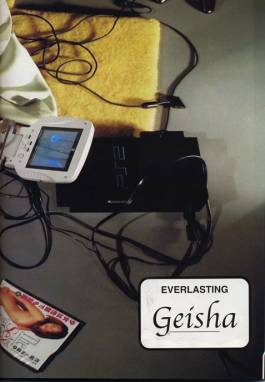
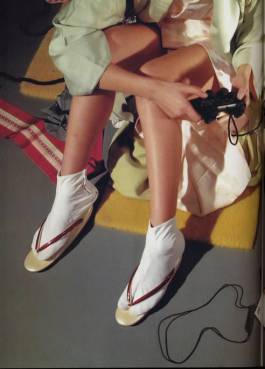
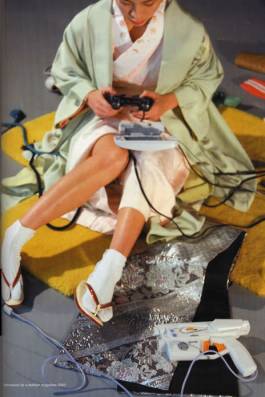
“Performance for Vogue”, 2002
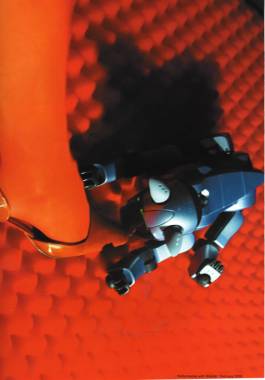
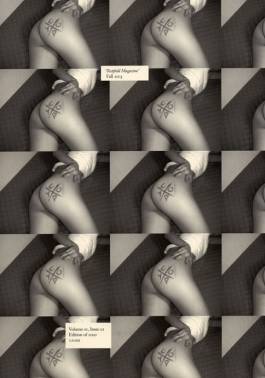
“Textiled cover”, 2002
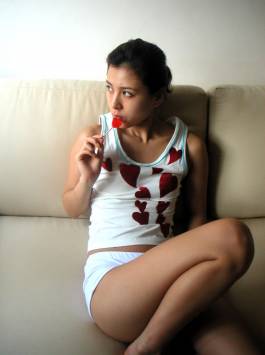
Mai Ueda
2004
MAI UEDA: I WANNA BUY SOME CLOTHES... MORE CLOTHES FOR ME... CLOTHES MAKE ME HAPPY...
Dobrila Denegri: My first question would be about your artistic formation: where you did your studies and what were the important influences on your work.
Mai Ueda: My first influence starts with my family. My father's side of the family owns an advertising company in the industrial town of Imabari, Japan. They create concepts for signs using statements and symbols. I would go around with my grandparents in a car, and my grandmother would tell me, "That sign over there is your father's work, look how beautiful it is”, and I was proud to have the entire town as an exhibition of my family. That is how I developed my ability to poeticise everyday life. As the first child, my mother was excited about educating me. I would go to ballet, swimming, piano, and drawing lessons every day after kindergarten. For ballet, my mother made me practice at home after my classes, even though I was crying, so I would get a good part in the recitals. The ballet teacher was very scary, she was hitting kids too, so I would pretend that I had stomachache and try to skip the lessons. I was travelling every summer to different countries, pretending that I was studying English, then I would go clubbing in London or something just to see things. I attended an Art school in Kyoto, my major was film and media art. But I thought it was boring. All the videos I made were too simple for the professors; they said it was a good idea, but I needed to refine them. I only like to see one idea presented simply, so I was not a good student. Instead, I was more interested in making some electronic music with friends.
I had a rap band called Naughty Sound Bites, three girls singing random words in different languages.
After I finished school in 1998, I didn't know what to do in Japan, where people give extra credit for endurance and patience. I decided to come to the US. I lived in NY, LA and back in NY again. I like having no base, being everywhere and living on the internet. In the year 2000, I met Miltos Manetas in New York, just about the same time he was coming up with a name for a new Art Movement, which later became NEEN.
At the time, I was studying fashion design at F.I.T. just to be busy with something, so I immediately jumped into this new thing and decided to be a NEENSTAR. I wanted to do everything, but didn't want to become too much of something. NEEN was a good excuse to create a category for people like me.
DD: Could you tell me more about NEEN and TELIC - and how do you feel your work fits into these movements?
MU: We didn't present the word TELIC when NEEN first came out, so people were confused. They would think that everything related to digital was NEEN, but that is not true.
We decided to present TELIC to clarify NEEN.
NEEN usually comes out accidentally, while TELIC is a workaholic.
NEEN is easy to turn into TELIC when it starts being self-conscious. Some artists begin as NEENs, then, as they start getting attention, they become TELICs.
I usually like to make pieces just for beauty or fun. I think when it is beautiful, people would want to interpret it, so the concepts come by themselves.
Instead, TELIC people are the opposite. They would think too much before making pieces or work too much on them, so the pieces usually end up neither very powerful visually nor very spontaneous.
There are some TELIC works that I love, or I tolerate, but I prefer to be NEEN.
Names and words are useful; by knowing them, we can try to control our position.
DD: Could you tell me whether NEEN represents an artistic group or movement (and, if so, who is part of it), or whether it is more about subtle values related to creativity?
MU: It's both...we think of NEEN and find NEEN from worldwide, collect around us
(*www.electronicorphanage.com, www.neen.org). At the same time, it's not only about us, but it's also a situation that is happening everywhere.
DD: Let's go more closely to your work: your first performance was in Paris. What did you mean by your experience of performing, and how did this influence your future work?
MU: I started performing because I found that it was a fast way to travel around, so I don't have to get bored from staying in one situation, and have an excuse for shopping in Paris, which is important.
Then people liked my performance, and I kept on doing it. Artists are like actors and actresses – they play parts. I thought that it was time to play my part, because my performance takes place in the timeframe after contemporary art, as we enter media art.
DD: I agree about shopping, it's a great thing... tell me how much fashion is involved in your work, and in general, how do you see the relationship between art, your own art, and fashion?
MU: Fashion is essential to my art. When I do a performance or a video piece, I use clothes as colours to give an impression and beauty. I made IWANNABUYSOMECLOTHES.COM and a screensaver that goes with it as a project for Art Production Fund; I composed a song and sang for it. "I wanna buy some clothes more clothes for me, clothes make me happy".
Also, I am interested in fashion because of its ability to propagate, marking territories, as you can see with Louis Vuitton or Hermes with their bags. I made colourful badges, which say IAMMAI (www.maiueda.com/iammai) and put them around people whenever I go. I enjoy meeting them again. I hope somewhere someday people will start reproducing them using the same logo.
DD: So, tell me more about how you interact with these technological devices in your performances?
MU: I use technology as my partner - I like to find the personality in technology and work in collaboration with it. In my first performance in Paris, I used software called Big Brother, where a boy’s face is tiled on a desktop, then moves around controlled by your mouse. I played it on an orange iBook, and the image of it was projected on the wall. I was sitting on the floor, humming stupid classical music next to it, wearing an Emilio Pucci outfit. I did a performance with the Aibo (Sony robot dog). This dog is made to react with red, so he played with the pink ball that comes with him. I wore a red outfit and tortured him. For the Lyon Biennial, I used a flash animation cartoon character that I could make jump with my joystick. It plays sounds according to every movement. Altogether, it sounds like a little piece of electronic noise/music. I played lying on a grey couch. I wore a white mini dress. Then, when I get tired, I go to sleep, and the character goes into "sleep mode" too.
My website works - I create poetic domain names such as togetherness.org, romanticus.com, sentimentality.org, etc, and they are the titles of the environments that I create on each domain. I call it a state of mind. Sometimes it is a loop of moving images, or sometimes it is an interactive music piece. I sell the certificates of them as artworks. The person who buys them decides how they will deal with the piece. Same as paintings in the museums. To keep it public and have the right to the piece, or put a password and keep it as a private collection. It is better than painting because it is unique yet multiple; site specific, you can access it from wherever you are, from any computer, to feel it. One fun part of making web works is that it is a game. Even if you have good ideas about the combination of the name and the content, the domain name could have already been taken, which is pretty much how we relate to things in real life.
DD: Where do you draw your inspiration from, and what kind of effect do you want to achieve with your works?
MU: I like to be able to accept different shapes of miracles when they happen, then interpret them into fresh media that are available to me. I like to present their freshness as simply as possible. I set up my antenna for new gadgets, software, people and situations. I constantly move around. I collaborate with people all the time, because it can take me to places I have never been.
At this moment, Angelo Plesass, Andreas Angelidakis, Rafael Rosendaal and Miltos Manetas are some of my favourite NEEN people to brainstorm with. I like to amaze them with what I do and feel jealousy for the genius ideas they come up with. Besides, I want people to realise a new way of being serious. I do not try to be an artist; instead, I would like to be an icon. Art is a way of living and not a product.
DD: What does it mean to be an icon today?
MU: To be an icon today – to be original.
Mai Ueda (1978, Osaka) is a New York-based digital and performance artist whose work explores sexuality, digital pop culture, and the kitschier side of porn.
https://maiueda.com
Published in Collezioni EDGE
“Performance for Vogue”, 2002
“Textiled cover”, 2002
Mai Ueda