


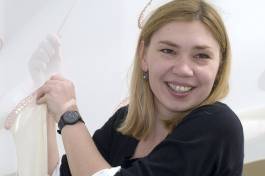
“While Nothing Happens”, 2008, The making of installation at MACRO
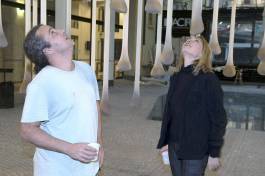
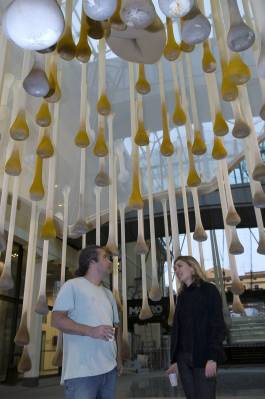
With Ernesto Neto
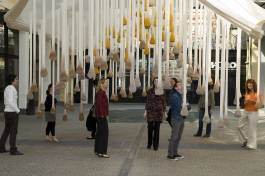
“While Nothing Happens”, 2008, (Elena Scipioni, Barbara Goretti, Costanza Paissan, Tina Cannavacciuolo)
With Ilaria Marotta
2008
ERNESTO NETO: AND INDEED, DON'T WE HEAR THE PEOPLE DANCING AROUND US WHEN WE KISS?!
To a body of infinite size there can be ascribed neither centre nor boundary...
Giordano Bruno, “De infinito, universo e mondi”
… the Self embracing the world, making it one, in agreement and harmony with emotion understood as the only reality of human language…
Pierre Restany, “The Rio Negro Manifest”
A body without a centre and without limits... infinite and immeasurable... this is the image of the universe that has consistently challenged the boundaries of imagination itself. It is a challenge that science continually renews, now putting forward the theory that something called a “multiverse” exists: an immensely larger space, composed of myriad universes potentially similar to our own. If this were true, if the theory of cosmic inflation were verifiable, it would change the very idea of infinity. Science is putting us on this path, allowing us to perceive or intuit some features of the infinitely large and the infinitely small, making us float between the nanoscale of molecular structures and the incalculable vastness of the cosmos, to initiate a new conception of the world in which the non-visible and the non-material will be the main parameters to be reckoned with. Even more than science, it is art that opens up these perspectives for us, taking us to places where our senses and minds can expand, elevate and grasp the infinite. In particular, art such as that of Ernesto Neto, which is based on pairs such as microcosm and macrocosm, primordial and futuristic, organic and synthetic, sensual and spiritual, offers this possibility through a total perceptual experience.
His installations and environments allow us to project ourselves into a cosmic dimension rather than immerse ourselves in an organic one. They stimulate our senses and, once again, subvert the idea of limits and boundaries, which for him are never barriers but areas of contact, union and interaction. It is always a blurred boundary, open to interpenetration between the individual and the world, a threshold as sensitive as the skin, which challenges us to “think through our pores” and recognise that sensations and “emotions are the only reality of human language”. Based on these convictions, Neto's work acts as a strong stimulus to reconsider our position in the world, increasingly driven towards a materialism so extreme that it obscures the meaning of words such as individual, community, freedom and diversity. In fact, his works are not only intended to open channels through which to feel the vital pulsations of nature, but above all to experiment with new forms of communication and relationship. And so sculpture is transformed into architecture, into a spatial structure that functions as the ideal model for new behavioural and community attitudes, becoming an even denser space in which, as in the world, the individual should be the protagonist.
Dobrila Denegri: Let's take a trip back in time... Let's start by recalling the changes that took place in the 1960s and 1970s in the way art was understood and practised, and talk about the fundamental contribution that artists such as Hélio Oiticica, Lygia Clark, Lygia Pape and other leading figures of neo-concretism made not only to Brazilian art, but also to contemporary art in general. On several occasions, you have pointed to this movement as a historical reference for the development of certain aspects of your work. Which part of this heritage do you feel is closest to your sensibility and your ideas about art? And have there been other sources of inspiration and influence for you, inside or outside the visual arts?
Ernesto Neto: We could divide neo-concretism into two, or perhaps three, groups: Amilcar de Castro, Franz Weissman, and I would say that Sergio Camargo also belonged to this tradition, although he pursued a more independent practice; then Willis de Castro and Hercules Barsotti, and finally Lygia Clark, Lygia Pape and Hélio Oiticica.
For me, Amilcar and Franz were fundamental at the beginning, as the structure that would generate a “Brazilian sculpture”, but the two fascinating personalities who really made the difference were Hélio and Lygia Clark. Amilcar and Franz were sculptors in the strict sense, artists with a deep understanding of volume and weight, very important for the beginnings of the neo-concrete movement. They “broke many stones,” and although there was an evolution in their work, they remained faithful to the primary, basic forms and ideas; they finished as they began. And for me, that was fantastic, especially Amilcar, who went so deep into his subject matter!
First, I looked at the sculptural quality of the work of artists from the “first generation” of the concretist movement, and then at the number of directions in which Hélio, Clark and Pape expanded the field of art in the late 1960s. Although they all belonged more or less to the same generation, there is no doubt that Lygia Clark, Lygia Pape, and Hélio Oiticica went much further. Hélio and Clark came from painting, and both made a very interesting transition from the wall to space. Lygia dealt with weight: she condensed the relationship between the limits of the canvas and space in her concept of the “organic line” in sculpture, while Hélio extended the materiality of painting to the structure of space, to architecture. This is why I feel a “skin” closeness to Lygia, while Hélio dances in my mind. Lygia is intimacy, Hélio is movement, the body in space. Lygia created works that people had to touch, feel, fold and unfold; Hélio brought colour into space, the colour that should surround us and in which we should all immerse ourselves.
We touch Lygia, and she touches us; Lygia is blindness, black and white, Hélio is colour. Lygia smells, Hélio speaks; Lygia is sound, Hélio is music. Hélio dresses, Lygia undresses; for me, it is very difficult to think of one without the other. I think of them as one would think of Matisse and Picasso: Hélio was Matisse and Lygia, Picasso... both were true emblems of the explosion of the 1960s, along with many other things that were essential to me: artists such as Walter de Maria, Sol LeWitt, Donald Judd, Bruce Nauman and Arte Povera (the last collective cry of Latin sensibility that I heard); and especially Giovanni Anselmo as opposed to Richard Serra, both of whom influenced me greatly... Through the ideas of Hélio, the two Lygia's, minimalism, Beuys and Arte Povera, the 1960s were in fact the last cultural shock we experienced... A period of profound change, of breaking with traditions and conventions, a time when there was more space for artists and people, in every sense. Fame was not as important as it is today...
I was born in 1964, three months after the military coup, a real catastrophe that suddenly changed Brazil's social and political development. However, from a broader perspective, it was the moment of the last expression of the utopian desire to create something different for Western society. We Brazilians are also Western people, even though Europe does not think so!
We now live in the age of corporate culture, and everything is becoming more rigid. Although echoes of the vigour of the 1960s and 1970s remain, along with a desire to expand individual freedoms, the space for people is becoming more cramped, and as a result, the space for art and artists is shrinking even further. We live in a world of production; companies and producers are at the forefront, and human beings are unfortunately left behind.
Many other things from that period influenced me: first and foremost, the man on the moon!
It had such a big impact on me that I wanted to study astronomy, but I failed the exam, and so I became an artist by chance. Then: Kubrick's “2001: A Space Odyssey”... black music... samba and soul... psychology... Pink Floyd... the collapse of the family... sailing and horse riding... always being the last or second to last chosen to play football... Peanuts... architecture... plants... mountains... the sea... the TV series “Lost in Space” and “Land of the Giants”... buildings and more buildings... destruction and construction... police raids on the streets... animals... smells... children... growing up in the mountains... fights... Brazil, Brazil, Brazil... adventures, fears, nights... the heavy music of Maria Betania and Chico Buarque... Gilberto Gil... Vinícius de Moraes... Guanabara Bay... mosques... Arabic music... tables... hookahs... grandparents... travelling... the idea of infinity... people, people, lots of people... samba schools... long hair, jeans, black and white TV, colour photos... memory games... trees... sand... zebra-striped beanbag chairs... design... simple life... home... nature... lots of nature... old Rio... the beach... the Arpoador neighbourhood... sadness... happiness... dreams... lots of dreams...
DD: In terms of artistic discourse, what was happening in Brazil in the late 1980s, when you began to participate more actively in the scene? Were there other artists, from your generation or others, with whom you felt a connection in terms of the ideas you were developing in your work?
EN: The dictatorship ended in the mid-1980s, and there was a new sense of freedom in the air. By the beginning of the decade, political pressure had eased, and the regime could no longer justify its continued rule. However, the country was in ruins, financially devastated by hyperinflation, and the population was undergoing a profound moral and existential crisis. The push for free elections continued to grow! And finally, change came, but once again in a rather dramatic way: Tancredo Neves, a great politician and true fighter in dark times, was indirectly elected president, but instead of taking office, he ended up in hospital and died shortly afterwards, so it was unfortunately his deputy – linked to the previous military junta and put there only to make Neves' election acceptable – who took power. Despite the political turmoil, from an artistic point of view it was a time of great ferment: painting was back in vogue in Brazil as everywhere else, with a sort of neo-expressionist style reminiscent of the Italian Transavantgarde and the German Neue Wilde, which gave enormous popularity to contemporary art and its contamination with other disciplines; Very interesting contacts were established with experimental dance and theatre groups, as well as with the national rock scene.
In this artistic scene, which was mostly made up of painters, there were artists such as Barrão and Angelo Venosa who were pursuing a discourse on sculpture that I found interesting, but, although there was a great deal of energy, I was decidedly critical of this generation of painters; they seemed very silly to me.
Later, in the 1990s, I began to develop an affection that bound me a little more to them. Still, during that period I discovered the work of artists such as Cildo Meirelles, Waltercio Caldas, Tunga and José Rezende, who I found much more substantial.
Then, in the late 1980s, Iole de Freitas became director of the National Institute of Contemporary Art and, for a couple of years, this public body launched some wonderful initiatives, injecting new energy into the Rio art scene and supporting the new generations. I share artistic interests with Franklin Cassaro and Carlos Bevilacqua, and together we have developed a critical attitude towards cultural leadership and the political and social reality of our country. We talked a lot about transparency, about an “X-ray” effect that lets you see everything, as a symbolic antidote to the corruption flooding every sphere of our society.
We also believed there was a great urgency to rethink our history independently, without copying or replicating First World models and methods. These beliefs were reflected in our works, in our obsession with balance, transparency, and clear connections, and in our desire to engage the public mentally, but above all, physically. We wanted to convey the importance of each gesture, creating works that people could touch, manipulate, and play with… and we attributed a strong educational value to this project. Even when the engagement wasn't physical, there was still the intention to shake and provoke the audience, making it more energetic and attentive.
Each of us developed our own ideas, and our research was formally quite distant, but, apart from that, we were fascinated by the same things: science and astronomy, as well as the artistic legacy of Lygia Clark and Hélio Oiticica, especially after the seminal 1985 exhibition at the Paço Imperial, curated by Paolo Sergio Duarte.
DD: Among your early works, sculptures, and installations, I'd like to mention the one from 1988 entitled “BarBall”. You created an entire "story" using very simple elements: rubber spheres and iron rods positioned in different ways. There's a sense of balance and harmony... but at the same time, there's also the doubt that a simple movement, a gesture separating two elements, would be enough to make the entire piece disappear. However, if the rod were placed against the rubber sphere and then against the wall or the floor, the sculpture would come back to life...
So the questions naturally arise: "Is there a specific point at which the relationship between two different elements becomes sculpture?" and also: "When does action become sculpture?"...
What did sculpture represent for you in this early phase of your work?
EN: I believe a segment of contemporary art is closely tied to the blending of objects and meanings to create a narrative. “BarBall”, represents a very special moment in my early research and, in a way, is also exemplary of my entire oeuvre: it focuses on the problem of relationships at a single point. I believe there really is a specific point where the relationship between two different things becomes sculpture, but, as far as my work is concerned, it's very difficult to capture that exact moment. It's impossible to create a framework to determine whether it will happen. For the artist, art happens every moment; that's the drama! You can't hold on to the moment. Sometimes a “chance encounter” occurs, as the Count of Lautréamont would say.
In pieces like “BarBall”, I played with the idea of “igniting” the sculpture. This exists when the bar meets the ball on the wall… and it no longer exists when, for whatever reason, the work is deconstructed, and all these elements return to being just a ball, a bar, the floor and the wall.
This, for me, was very important because it was precisely the process of bringing the elements together that gave me the feeling of reducing all of planetary time to a single instant. Everything converged in that dramatic moment.
I believe sculpture is about gravity, materiality, and meaning. As in classical art, I believe there must be a relationship between subject and background, and in my case, I would say that the subject is nature and the background is us.
DD: You once said that Italo Calvino's book, “Six Proposals for a New Millennium”, a collection of lecture notes on lightness, speed, precision, visibility, multiplicity, and coherence, all cited as important literary values for this millennium, had a strong impact on your thinking about sculpture and your work.
While you were initially interested in the "dramatic moment," with this book in mind, you then began to think about introducing different, more narrative aspects into your work... When exactly did this happen, and what narratives did you want to evoke?
EN: The first sentence I read when I opened Calvino's book was: “For the ancient Egyptians, precision was symbolised by a feather that served as a weight on the scales where souls were weighed.”
You can imagine the impact these words had, twenty years ago, on a young man working with weight! For a long time, I maintained that this was the best theoretical manual of sculpture I knew. Words like lightness, speed, precision, visibility, multiplicity, and coherence sound like pure poetry to me. Calvino's thoughts on stability and instability... I naturally transposed his reflections into sculpture, because I found them far more relevant than most theoretical writings on the figurative arts. I believe there are no barriers between the different fields of expression, and that the correspondences between them—in this case, between literature and art—arise as a consequence and are highly revealing.
I think that narrative, in terms of meaning, is inherent to sculpture, so, thinking of Calvino's writings, I tried to develop a more structural narrative. I was interested in creating a field in which many dramatic moments and transitions could occur, unlike in “BarBall”, where everything was concentrated in a single point; I wanted to multiply these points, extend and decentralise them, create denser fields. In space, there are stars at the centre of gravitational fields that surround them, and I believe the same thing happens with our existence: we are a mass that generates a field around ourselves. For me, the transition between these fields is important and is reflected in the more complex works I've created since the first phase of “BarrBalls” until today.
DD: There are several installations from the late 1990s, with similar and onomatopoeic titles like “Puf, pif, paf, puf... pif...” in which new elements come into play... not only spatial relationships, tension, and gravity, but also more pictorial aspects: pigments and colours, spices and aromas... all elements that imply a more complex and multisensory experience of your work.
But is there something else, too, in these elements that spread colours and essences beyond their “skin” and allude to forces that cannot be contained... is there perhaps also the element of chance?
What role do the concepts of chance, risk, control, energy, and freedom play in your work and in your vision of art and life in general?
EN: In my work, everything falls. We all fall, the world is falling, but we also try to survive, in the more or less stable conditions of our political, social, and economic reality, and this is the force that drives us forward. The development of these pieces has shown different ways in which chance moves and generates situations. When I began working on these ideas, I wanted to experiment with materials other than textiles and also include more references to psychic dynamics, after encountering Freud's writings. I wanted to create dreamlike sculptures, such as “ComCreta I Dream”.
Later, nature and its rationalisation began to play a central role and constitute the essence of my work, which centres on reproduction, sensuality, growth, and the different dynamics present in nature.
Around the same time, I began playing with perfumes and spices... this “discovery” was also very accidental, and its use in my work came gradually.
I was walking with a friend through S.A.A.R.A., a vibrant neighbourhood near my studio, full of Portuguese, Jewish, Arab, Chinese, and Korean shops. In an Arab shop, I was completely overwhelmed by the colours and scents of the spices; I immediately bought some and was then astonished to see how these powders filtered through the weave of the nylon stockings... how the material intersected and penetrated the “skin” of the stocking.
It was an epiphany, because in all my work, skin is a symbol of our existence over time. The epidermal permeability was very clear in these works... coloured powders oozing from the pores of the different pieces, like sweat... and their aromas... It took a while before I realised I had to mix different spices to break the monotony and give these works a “personality” and a “meaning.” The different fragrances had to converge through the atmospheric volumes, and their combination created a story. Every story must have a fulcrum, something to rest on, and in my case, it was the awareness that a sculpture must have “lips.”
Then came the idea that there needed to be weight and movement: I could drop these stockings full of spices, and the sculpture was born. Finally, I incorporated dance and bodily movement into the work, so all I had left was the title.
What to name these works?
In a used book store, I found a wonderful biology textbook, full of images that resembled my 1992 drawings of “Falling Spinal Drops,” and the figures illustrated chromosomal protuberances, which in English are called “puffs!”
When the piece fell to the ground, it made a sound like “puff,” and so everything began to make sense. The vocabulary of these works is based on four elements of the same kind, which create a melody: for example, in “Puf… paf… pof… pof… pif… pof”, each piece has a shape corresponding to the pitch of the sound after the fall and the scattering of the spices through the pores…
And so, here it is again, the case. I think there are two situations of chance: when you are totally empty and relaxed, completely open to anything, like the day I was at the spice shop, and then when there is a level of concentration that calls for chance, as if we have opened a space for it to enter.
The “Pufs” are simple onomatopoeic titles, and there are also more complex ones like “Gluonlabydenganocabodelalquantica”, which is a distillation of many concepts I've used throughout the creation of the work.
Since the 1980s, I've been thinking a lot about the relationships between sound and form, between sculpture and accident, but in some cases, things take a long time to emerge!
DD: With a series of installations titled “Nave” and “Ovaloid”, you created different environments that give the particular sensation of a total continuum between a sensual or even erotic experience and a spiritual one… This dualism lies at the foundation of Western culture: the opposition between mind and body. With your work, you challenge this concept and open up different perspectives…
EN: From the very beginning of my work, from the first sculptures I made as a student, to the later “A-B-A” and “BarBall” series, up to the weight particles, I have sought to find a continuity between body and environment and, from there, with infinity.
We live in a culture that has gradually undergone a process of fragmentation and specialisation of knowledge, leading us to a situation where everyone is familiar with only a single part. Still, everyone lacks a vision of the whole. This division and specialisation of knowledge parallel the fragmentation of the field of human relationships and generate discontinuity in social structures, so that, in the end, we find ourselves living in a complex world that resembles a colony of separate micro-worlds. The spaces we inhabit, the rooms where we sleep, eat, urinate, and work are structured more or less in the same way: a series of separate cubes, I would almost say closed boxes, which determine not only the dynamics of our interpersonal relationships, but also our relationship with our bodies.
A relationship that is culturally determined and rather distorted, I might add, but there are still those basic moments, like eating and going to the bathroom, that I find important, even if it may seem silly. Symbolically, peeing seems to me to be one of the most important things in life: for me, it's like going to church, and although it's a biological impulse, I see it as a spiritual moment; it's quick, inexorable, and liberating, a mostly solitary and perhaps even introspective moment. Eating is typically a time for sharing, for being in company, but at a certain point we move from the collective energy of the table to the solitude of a bathroom... In short, moments of contact with our bodies, moments of pleasure, the continuity between inside and outside... these are all things that interest me, along with the connections between the outside world, the biological environment of our bodies, and the possibility of developing cultural models and common languages in a more intuitive, immediate, and direct way.
In the mid-1990s, while I was working on the “Paf puf pof” pieces and preparing exhibitions, an old reflection from my art studies came to mind: we spend most of our time in closed boxes, we're always inside a cube. We wake up in a cube-room, go to the cube-bathroom, take a cube-bus to work, stop at a cube-office, pass by a cube-bar, and return to a cube-house! I worked in a cube gallery!
So I decided to create my own architecture to display my pieces, and I came up with the idea of the “Naves”, as a continuum from sculpture to gallery space.
There are many analogies between these sculpture-architectures that I called “Naves”, referring to the idea of a spaceship.
I think of my body as a spaceship, and in fact, the spaceship is a kind of architecture, a prosthesis, an extension of the body; a space that provides a sense of self-sufficiency compared to an inhospitable external environment. It evokes the primary stages of our lives: the foetal stage in the womb, that “magical” or “miraculous” reality we all pass through as we come into the world.
This stage is the fruit of a sexual relationship, of the great intimacy between two people, of the powerful energy that arouses desire in human beings. We cannot live without it, and, curiously, it is the most complex reality, difficult for reason to understand and very dangerous for the social structure. All dominant religions are repressive when it comes to sexuality, and this principle extends to cultural and social structures as well.
The “Naves” express ideas of penetration, topology, and mathematics: being inside and being outside, positive and negative forms, the object and its mould. Among other things, they speak of sensuality, and I truly believe that architecture, the manifestation of our reasoning, is much more interesting when it contains a higher degree of sensuality. Like the monolith in Kubrick's 2001, the “Naves” are geometric forms; their structural fulcrum is a square that curves as it extends, thus demonstrating the eternal and inexorable presence of gravity, that invisible force that reveals to us the existence of our own bodies.
The “Naves” float within the gallery space, creating continuity between the idea of sculpture and the idea of installations, and the people, inside and outside, are simultaneously subjects and objects, appearing and easily disappearing, moving around this "cocoon-like" architecture that is the opposite of the “Particles” and the “Pif pof paf”, with their high degree of density and emotion; the Naves are ethereal, low-density, filters of light and generators of atmosphere.
I was interested in a specific atmosphere for introspection, in a physical-sensual relationship that could open a continuity between matter and spirit, or immateriality... but a material immateriality, because, as an anti-Platonist, I do not believe in immateriality; I believe in the body within time.
DD: In addition to environments that can be entered and immersed, which play with the concepts of inside and outside, of internal and external body, through which people can take a imaginary, visual and tactile journey, you have also recently experimented with new materials and forms, more solid and structured, almost as if trying to make a transition from skin to bones...
What kind of awareness and experience do you want to offer the viewer through this new generation of works?
EN: Last year, I held an exhibition at Artur Fidalgo, a small gallery in Rio de Janeiro, and this new series of works was born from that experience. The idea for the exhibition came to me at home, with my children, their friends, and their parents, new friends the children had brought to us. In the room, there was also a piano, a play instrument and a great instrument for musical improvisation, because we were improvising; it helps create a slightly nonsensical atmosphere. It's interesting when adults and children occupy the same space: there's a cycle of overexcitement that goes from the little ones to the adults and vice versa... In that moment, I was struck by the idea that this was life, that art lay in this meeting of people, in this level of freedom in the intimacy of one's own home. The joy, the happiness of being together, among friends and children playing like crazy, in the dimension of a micro-collective. So I decided to create an exhibition featuring a sort of living room with a child-height drawing table, a sofa-sculpture, and some plants—the piano, of course—plus children's bicycles, some of my drawings and sculptures, and works by other artists. And a wooden floor instead of the gallery's concrete floor, to warm the space. In the second room, we set up a sort of café and a library with books donated by artists. For the café, we needed book shelves, chairs, and stools; so I decided to create special furniture, designing it with interlocking shapes, connected by positive and negative, male and female, key and lock shapes, generated from digital files and then laser-cut without the use of glue, nails, or screws, but only with gravity as a structural element. I wanted to make that old construction set, made of cut rings to connect things together, but I didn't have the time. And after this exhibition, I began to wonder how I could make these elements longer and more organic.
Making the first piece, cutting and assembling the polyplat, I realised that sculpture is “any non-thing that stands”... and this one in particular resembled an animal and also a kind of architectural form; it was made of joints so that one could build and rebuild, but also simply imagine that beyond this there were many other hidden possibilities. Intellectually, this one represented all the others. The first piece came together very quickly, following the idea of joining and composing different elements, so the final result was a piece that certainly had its own expressive and aesthetic value, but any other form and expression would have worked: whether they were beautiful or not is just a matter of taste.
In fact, the final result is not that important, and therefore constitutes a critical reflection on the early modernist abstraction of the mid-20th century: “Any non-object or even an object that stands has an expression; simply standing, without any other kind of classificatory value, generates expression.”
On the other hand, the morphology and structure of these pieces were linked to bones, which are columns. For me, the column is the primary architectural element; if I had to choose a human-made object to represent our identity as rational animals, I would choose the column. A small one can serve as a bench; a large one supports the ceiling: it represents our institutions and our society… Totems are columns: for me, the Virgin in Michelangelo's “Pietà” would be represented by a column… and these “bones” I'm making also become columns.
DD: As an artist, how do you react to collaborative projects? I know about the one with Merce Cunningham, and I imagine that the theatrical stage, body movement, dance, and interaction were natural extensions of the themes already explored in your work. What was this experience like for you, and have you participated in any other interesting collaborative projects?
EN: It was a very special moment. It went like this: while I was developing my work, Merce was developing his choreography, then we put the two together to see what would happen. When he invited me, he was familiar with my work, and I had also studied his; perhaps it wouldn't have worked with someone else. But here, something special happened.
Dance is very important to me. I made my first existing piece after seeing a dance performance in Rio, the “Nicoly Dance Theatre.”
Also, I really enjoy dancing; my work speaks of dance, and for me, dance is a sculpture in motion. I believe we should always live in a state of dance, because it adds a certain fluidity to our movements over time.
We're all compressed by our daily life patterns, and if we could feel our bodies in a state of dance, we would acquire a better balance. Then I collaborated with two other artists, Franklin Cassaro and Carlos Bevilacqua, and let's say it was a beautiful dance! With them, too, it wasn't an intellectual decision; We've only made sculptures together because we share some concepts and ethical practices. Collaborations are fantastic, and I'd love to have more of them...
DD: Brazil lived under a long military regime, and making art implied a strong ethical and political commitment. And although the political situation has changed since the mid-1980s, I believe this attitude still resonates with younger generations of artists, like you. A few years ago, together with Laura Lima and Marcio Botner, you founded an art space in Rio called A Gentil Carioca (The Gentle Carioca), and I was wondering: what does this activity mean to you?
EN: The opening of “A Gentil Carioca” is another thing that happened by chance.
At first, we didn't know what form to give this space, but once it opened, the shape came naturally, and every day we continue to discover its potential and its possibilities for contributing to the dynamism of Rio's art scene. Once we started, we realised how much we and the city needed a space like this... in fact, now we wonder how we ever managed without it... Like most of the things we do, Gentil is also an experiment. We represent a few artists, so it functions as a gallery, but it's also a place where we carry out projects without any commercial objective. The intention is to breathe new life into the art scene, to expand its scope, and to spark a new energy and atmosphere in which we can collectively develop different aspects of cultural practice. Gentil is the union of our voices and, therefore, a more powerful tool; it represents a whole group of critical people who identify with the project. As a public space, we silently or blindly support the talented artists we've exhibited, thus creating a fourth force that drives the entire initiative. Beyond everything else, A Gentil Carioca is a meeting place for people.
It's a very interesting tool, a way to exchange ideas and step outside my own work to think about the work of others, which is a very delicate thing and requires great responsibility. It's also important to observe the art world from a different perspective: we can notice things that were hidden from us, and even discover new things within ourselves that were previously inaccessible. But beyond that, for us, Gentil is a place of joy, and that's our limit: we believe in joy!
DD: Marina Abramovic once told me that "we live on a dying planet." It sounds dramatic, but it could also be true. In your opinion, how can art contribute to shaping new models of relationships between human beings, as well as with nature and the environment?
EN: Well… cool… living in a dying body! Fascinating! It's a very anthropocentric point of view. This is how things appear to the blind eyes of culture, but what is right from a cultural perspective may override us from a natural perspective. What is happening is a reaction to our cultural activity and our intervention on the planet.
We have always been a virus… we are that bizarre species that believes itself to be the children of God or the gods, but perhaps we are the children of the devil (although I don't like this dichotomy).
For nature, compared to others, we are the most absurd and exotic animals; we rationalise what we can and deify the rest.
I don't share the idea that the planet is dying: it is in transformation. If anyone is dying, it is us! We are completely indifferent to nature, and the planet is alive and constantly changing. I agree that some parts of it are dying, but that is the price we pay for our desire for power. Art could create sustainable relationships between individuals, but if we consider the art scene, we see the same madness present in society at large.
Art lacks the educational purity that the question demands; I'm not so sure that, in this society of spectacle, art can push us in new directions, and even if it could, it would ultimately have to negotiate with other political and social forces, and everything would collapse again.
Some improvements can help us progress, but the core remains the same: human life on Earth is very difficult, and we certainly can't live alone; it's also very difficult to live together. We are all interconnected, tied to our histories and cultural identities.... In this complex reality generated by technology, the Internet, and globalisation, we return to a state of total lack of empty space, of time, and to a growing sense of being oppressed by the superstructures we have created. This is the triumph and the catastrophe of the bourgeois revolution and the labour society: businesses are the new feudalism, and human beings are losing the simple, singular, and innocent capacity to be alive simply. I think it would be interesting to find other values in life and to accept our finiteness; this is why I would say that “only animals and amoebas are happy.” It's true that in some countries, societies, and cultures, people laugh more than in others, so perhaps we should find out why this happens. We are all in a laboratory, no one really knows where to go, and ultimately, the world is getting smaller and smaller.
We should think less about teaching and more about learning.
Art, well, that's another thing.
DD: Looking at your sketches and imagining the new piece that will occupy the MACRO Hall, trying to imagine its overwhelming, intoxicating effect, or the undulating, seductive movements that allude to the exchange of masculine and feminine principles, I realise that numerous images are running through my head... Louise Bourgeois's sculptures, Brancusi's “The Kiss”, Matisse's dancers, but also the ancient goddesses of fertility, Shiva's lingams... all these magnificent images of pulsating vital forces...
And your work also seems to derive from that vein...
EN: The principles of masculine and feminine have always been a very important part of my work. It's a relationship that makes us think of opposites and complements; one thing begins where the other ends. These ideas are close to Eastern wisdom, which has had a strong influence on my studies, although they came to me rather intuitively. And perhaps they are even more closely linked to the very origins of Brazil and the mixed-race identity of its people, born from the relationships between colonisers and indigenous peoples. The first Brazilians were called “mamelucos”, meaning “bastards on both sides”. This gave rise to the complex of the “vira lata”, the stray dog: the image with which we Brazilians most identify. Certainly there are similarities between the naturalist philosophies of the “Indians” and the traditions of Eastern thought expressed through Buddhism, Zen, Tao... and on the other hand there is a huge body of cultural influences from Africa, its magic and rhythm fused with Catholic fantasies that echo in our cultural roots, so that this bizarre mixture brings to mind a different idea of time, one that keeps things in an eternal balance and gives more space to contemplation, to the breath of life.
I also find it interesting that my work has often been associated with Louise Bourgeois's, but right now, because of your question, I can't get the image of Matisse's dancers circling “The Kiss” out of my head!
I just can't get it out of my head.
Brancusi's “Kiss” has the power of a "kiss of infinity": it evokes a sense of never-endingness, and, in a certain way, this kiss generates a new person, symbolising a fusion toward a totally hypothetical wholeness. I see Brancusi's “Kiss” as a myth that has no beginning or end: it happens by itself, as if it could concentrate all the energy of the world in a single point, in a single moment... exactly what I was thinking about when talking about the “BarBall” sculptures.
And even more important, for my mythological vision of art, is the imaginary scene in which these two works by Matisse and Brancusi overlap: the dancers dance around the kiss... so we have the image of something totally static and compressed like the energy of Brancusi's “Kiss”, which is like a totem, and something very light like the dancers circling it naked.
What a primitive structure, what a symbol!
The kiss as the nucleus of an atom, with the cloud of electrons dancing around it... the tribe and the totem... the people and the institution... the kiss and the music...
And indeed, don't we hear the people dancing around us when we kiss?!
Published in the catalogue of the exhibition “While Nothing Happens” at MACRO - Museum of Contemporary Art in Rome, 2008, edited by Electa, and republished in the catalogue of the exhibition “Dengo”, edited by Museu Arte Moderna De São Paulo, 2009.
“While Nothing Happens”, 2008, The making of installation at MACRO
With Ernesto Neto
“While Nothing Happens”, 2008, (Elena Scipioni, Barbara Goretti, Costanza Paissan, Tina Cannavacciuolo)
With Ilaria Marotta