


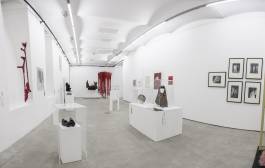
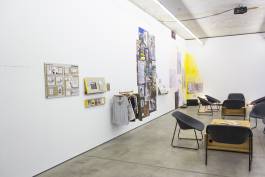

No Liability is Taken for Wardrobe / Forms of Resistance in Fashion and Production, Exhibition view, Angewandte Innovation Laboratory (AIL), Vienna, 2016, Photo © Josip Jukić-Sunarić.
2016
BARBARA PUTZ-PLECKO & BEATRICE JASCHKE: ABOUT RESISTANCE AND PRODUCTION IN FASHION
Dobrila Denegri: Barbara, I would like to start by asking about the profile of the textile department that you are running. Your background is in art, so I’m interested in how this is reflected in the program and the department's teaching methodology.
Barbara Putz-Plecko: The textile department focuses from an artistic perspective on potential development, communication and the role of textiles in society.
One could understand it as a more theoretical approach, but it isn‘t. There is a more theoretical approach from the cultural studies, art history, or costume theory departments, but textile is basically an artistic department.
In artistic projects, textiles are investigated as a medium of self-expression and of cultural localisation. They are thematised both as a dynamic, widely distributed element of our material culture and as a potential networking model. Textiles are employed in diverse work formats as both artistic and technically functional design elements.
Our program is interweaving theory and practice.
Theory is part of our work; we also do it in collaboration with all our colleagues with a scientific background. It‘s part of the research we do, and it‘s part of every artistic concept. For me, artistic practice always has a theory-related approach, but I am an artist who runs the class and does not come from theory.
So this department is characterised by the interweaving of theory and practice, which unveils multi-layered experimental and cognitive dimensions as a requirement for the investigation and deconstruction of the constituent principles and contingencies of textiles in their aesthetic manifestations.
DD: Besides this strong artistic input, what might be other important features of your work with students?
BPP: Another focus of the department is cross-disciplinary, transcultural work and artistic research. For many years, the department has been developing projects with international partners in Morocco, China, Uganda, and, currently, Ghana.
In Ghana, we are collaborating with the Nubuke Foundation in Accra and, together with local artists, developing workshops and research structures for weavers in the savanna, near the border with Burkina Faso.
This project was initiated when artists representing Nubuke Foundation visited Vienna and asked if we would be interested in collaborating with them. It‘s something I really like to do, but I also have a very critical approach. I don't think we should go to these countries to impose our models for setting research structures, for example. For me, it's very exciting to find out what can serve as a supportive structure for people living in the savanna, rather than simply transferring our models of archives and research to Ghana.
DD: Beatrice, you are one of the founding directors of /ecm - a Master’s course for educating, curating, and managing that the University of Applied Arts Vienna has been running for some years. I want to ask you about one of the recent projects your department has developed involving students or alumni from the textile and fashion departments. It was called “No Liability for the Wardrobe - Resistance and Production in Fashion”.
Beatrice Jaschke: /ecm is a two-year postgraduate university program that teaches core competencies for working in the expanded field of museums and exhibitions. This part-time study program aims to lay a foundation for research and professionalisation within the field of arts and culture. An integral part of the program is completing a group project that links theory and praxis. So the collaborative curatorial research processes lend themselves to learning these skills and provide a field of experimentation for applied curatorial studies.
The discourse project and exhibition you mentioned took place at the Angewandte Innovation Laboratory (AIL) at the beginning of 2016.
The curators understood the topic of fashion and production on several layers. Fashion, viewed as the nodal point of a complex mesh of material, historical, economic, sociological, and political interrelations, was examined from activist, artistic, queer-feminist, and urbanist points of view.
The common denominator for all these perspectives was the contentious character of fashion. A red thread ran from there through a course of utopias, disruptions and norms, appropriation and re-appropriation, until finally arriving at present options for handling the entanglement of fashion and industry. Also, the potential of collective practices and alternative organisational structures was contrasted with an individualised capitalist logic of manufacture.
DD: What triggered interest in working with the topic of fashion and fashion systems? How did you approach research, and what were the theoretical references relevant for the development of the project?
BJ: The three main questions: “How is fashion produced?”, “How does fashion produce us?” and “What can we do?” triggered us a lot.
The project was organised in cooperation with the collections and the textile class of the University of Applied Arts Vienna.
For more than a year, we worked on the exhibition and had time to ask many questions:
How is it possible to become a space of agency?
How can you expose fashion without using mannequins?
How can you show different layers without using too much text?
How can you ask urgent questions without getting moralistic?
To be honest, I am very happy about the outcome and learned a lot.
DD: What are, in your opinion, the perspectives for the development of fashion curating, and what are the areas in which these competences might be needed today, in both art and fashion contexts?
BJ: I think fashion curating has a lot of potential. There are so many questions that go beyond classical curating that need to be asked. First of all, which fashion and dress can be collected and displayed today and in the future? In our research, we investigated and analysed many fashion exhibitions. Fashion exhibitions have also become increasingly visible in department stores, galleries, and museums. This shift reflects the curator's growing status as a central cultural mediator. There are many theoretical discussions and debates, as well as practical questions, in this growing discipline, along with a large potential audience.
No Liability is Taken for Wardrobe / Forms of Resistance in Fashion and Production, Exhibition view, Angewandte Innovation Laboratory (AIL), Vienna, 2016, Photo © Josip Jukić-Sunarić.