


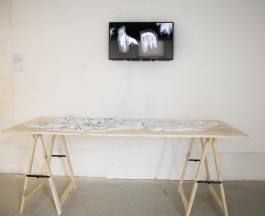
“Large Glove in Motion (Glove as a Garment)”, 2016-2019. Installation view, Ala Moderna del Museo della Città di Rimini, Photo: Giulia Ripalti
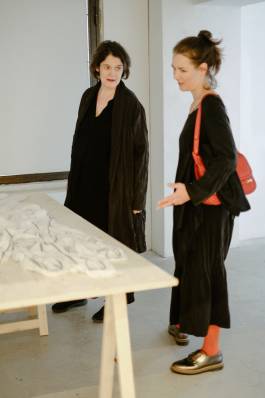
Opening of the exhibition “Transfashional - Nuovo lessico post-interdisciplinare tra arte, moda e design”, Ala Moderna del Museo della Città di Rimini (Barbara Graf, Milena Heussler), Photo: Tessa Chung (Yingntao Zhong)
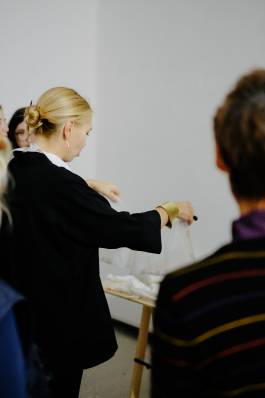
Opening of the exhibition “Transfashional - Nuovo lessico post-interdisciplinare tra arte, moda e design”, Ala Moderna del Museo della Città di Rimini (Dobrila Denegri), Photo: Tessa Chung (Yingntao Zhong)
2019
BARBARA GRAF “LARGE GLOVE (GLOVE AS A GARMENT)”
The work of Barbara Graf, “Anatomical Garments”, could be described as body coverings made from textile or cardboard that appear to turn the body inside out. They symbolically and abstractly mimic parts of the body's internal anatomy, transforming them into wearable items like a second skin or a dress.
It is an artistic object which can be worn and animated through the movement of the body.
In the words of Cathrin Pichler, who wrote extensively about Graf’s work, it is “conceptual art based on an investigation of the human body, interjecting corporeality into the investigation, while continually imagining new representations and forms.”
With these imagined representations and forms, Barbara Graf created an entire atlas of body parts, rendering their inner structure, their anatomic construction, and their functionality. She makes them with profound knowledge of human anatomy and a fascination for scientific and medical depictions, such as the famous drawings and prints by French anatomist Jacques Fabien Gautier d’Agoty from the 18th century. Not by chance, Cathrin Pichler describes them as forms of “mimesis of real corporeality in an imagined or fantasised materiality.”
Within a larger project, “Performing Surgery,” Barbara realised a wearable piece, “Large Glove (Glove as a Garment)," along with a photo series and a short film, “Large Glove in Motion (Glove as a Garment).”
Regarding this work, the artist states: “The glove is enlarged so that a finger corresponds to an arm or a leg. The fabric is slightly transparent. When unsupported, it collapses, forming a pile of folds. These material qualities are utilised in the subsequent enactments. The “Large Glove” was set in motion and photographed with a stroboscopic device, with the operating hands and the body to be operated upon merging into one. The entire body becomes a movement, or it completely transforms into an internal organ. It is a movement that can be fleeting, but also a movement that can penetrate deeply. By veiling, overlaying, employing transparency and opacity, and introducing motion, it was possible to generate a corporeal expression without revealing the real body. The body appears only for a brief moment, yet it is always present in the textile glove's performative motion. The fabric envelops the body, but simultaneously creates a body of its own: a moving drapery.”
Barbara Graf is an artist and lecturer at the University of Applied Arts Vienna, in the Department of Textiles - Free, Applied, and Experimental Artistic Design. Between 1985 and 90, she studied Experimental Art and Painting with Professor Maria Lassnig at the University of Applied Arts Vienna. Since 1989, she has been working on the Anatomical Garments she created. In her work, she explores body representations, medical visualisations, and develops flexible sculptures as a second skin, and garments as living sculptures. From 2003 to 2009, she was a guest lecturer at the Academy of Art and Design - Fashion Design in Basel. Her artistic doctoral thesis is titled “Stitches and Structures on the Visualisation of Body Perception”.
“Large Glove in Motion (Glove as a Garment)”, 2016-2019. Installation view, Ala Moderna del Museo della Città di Rimini, Photo: Giulia Ripalti
Opening of the exhibition “Transfashional - Nuovo lessico post-interdisciplinare tra arte, moda e design”, Ala Moderna del Museo della Città di Rimini (Barbara Graf, Milena Heussler), Photo: Tessa Chung (Yingntao Zhong)
Opening of the exhibition “Transfashional - Nuovo lessico post-interdisciplinare tra arte, moda e design”, Ala Moderna del Museo della Città di Rimini (Dobrila Denegri), Photo: Tessa Chung (Yingntao Zhong)