


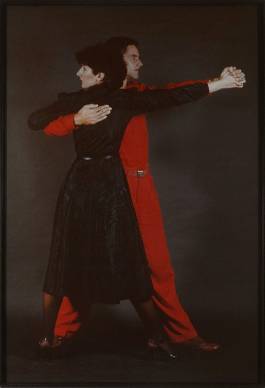
“Gold found by the artists”, from the series “Nightsea Crossing” 1981-1986, 1981
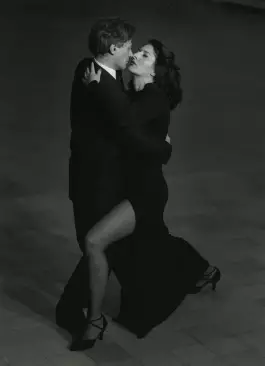
Marina Abramović & Jan Hoet, “The Urgent Dance”, 1996
1996
MARINA ABRAMOVIĆ “THE URGENT DANCE”
Museum of Contemporary Art, Ghent, the forerunner of S.M.A.K.
I have received many exhibition invitations, but I have never been sent one for the dance, to be precise: The Argentinian Tango.
On 30 November, her fiftieth birthday, Marina Abramović opened her retrospective with a glamorous happening entitled “The Urgent Dance”.
Contrary to her previous body performances in which she examined physical and mental limits, this evening Abramovic performed a very special evening: a series of “living pictures” demonstrating the basic movements of the Tango together with Jan Hot.
She also danced Tango with her instructor, Wolter Brava, and remade a performance, “Anima Mundi: Standing,” from ’81 with Ulay.
This was their first mutual work after their separation seven years ago. The intensity of this performance was not within the energy-tension caused by real danger, but rather from the dramatics, passion and sensuality of the dance in itself, from the immediate contact between the female and male bodies.
The entire work of Marina Abramović - performances, objects, installations, videos, films - examines the interplay and questions the interface of physical experience and spiritual development. The aspect of authentic experience within the extreme body conditions has been important for Abramović from her very beginnings; the way to confront the basic human fear of death, pain, vulnerability, and physical limitations directly, but that leads to higher spiritual and mental levels.
The series of works which she calls “Transitory” and “Power Objects for human and non-human use” (tables, chairs, mirrors, beds made from natural materials like iron, copper, wood and crystals) function as a kind of instruments, catalysers enabling audience to transit specific experiences and, above all, to face their own, assimilated, cultural hinderances.
Performances and video installations like “Becoming Visible” and “Cleaning the Mirror” are a form of memento mori, reminding us that, in contemporary technological civilisation, man has alienated himself from his inner and natural sources of energy.
A constant balance of extremes makes Abramović's show a theatre of cruelty and contemplation, but it is precisely this element that opens channels of perception and cognition.
Contemporary society has been characterised by a frantic need to overcome the limitations of the body and consciousness, and to alter perception and communication through instant means of techno culture. From this aspect, Abramović's work assumes power because it doesn't express a romantic conviction that art can change the world, but rather the actual possibility of opening channels for individual cognition of the world and of the human being.
Review of the exhibition published in the magazine Vreme, Belgrade.
“Gold found by the artists”, from the series “Nightsea Crossing” 1981-1986, 1981
Marina Abramović & Jan Hoet, “The Urgent Dance”, 1996