


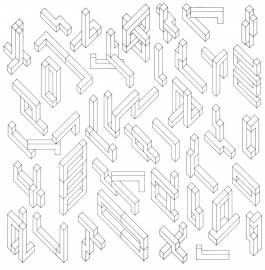
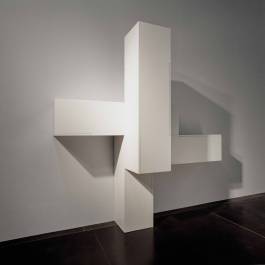
Isotropo modular containers, 1997. Produced by Acierno
1997
CLAUDIO LAZZARINI & CARL PICKERING “TRANSFORMATIVE DESIGN”
Claudio Lazzarini was born in 1953 in Rome, where he graduated from the Faculty of Architecture. Carl Pickering was born in Sydney in 1960, came to Italy in 1980, and studied architecture in Venice under professors Gino Valle, Massimo Scolari and Peter Eisenman.
Although the formation and background of the two architects and designers are quite different, the affinities they both shared for the architecture of Louis Kahn and Le Corbusier, and for the design of Eileen Gray and Pierre Chareau, contributed to their decision to embark on the adventure of working together and creating a homogeneous style and formal language, based on clean lines and minimalist geometric structures. Their collaboration is also underpinned by an interest in contemporary art and collecting, particularly their shared affinities for artists such as Lucio Fontana and Anish Kapoor, as well as for younger Italian authors.
The collaboration between these two authors dates back to 1985. They opened a joint studio in Rome, where they have worked on numerous projects, including the restructuring of houses and villas in Rome, Tuscany, Venice, Sicily, and Monte Carlo, a 16th-century building in Prague, and the interior design of showrooms and boutiques for the fashion house Fendi, as well as restaurants in Milan, Rome, and Venice.
From their very first architectural projects, which were mainly concerned with interiors, Lazzarini and Pickering were driven by the idea of creating total design, encompassing spatial interventions and the design of furniture whose stylistic and formal characteristics would be appropriate to the given environment. Thus, a series of sketches for all the basic furniture typologies was created, through which the two authors would transpose their ideas about architecture, its functional character, and its ability to be modified and adapted to the various everyday needs of the people for whom it is intended. As they state, they like to think of furniture “as dividers whose function is to define the relationship between two spaces. It is particularly important to them that the relationship created is dynamic.”
Therefore, they design furniture that can be used in different configurations and folded and unfolded, so that it constantly changes not only its form but also its functions.
The first project, titled “Dormusa” (1994), fully reflects this concept of furniture that articulates the given environment whilst simultaneously changing its character: the bedroom becomes a living room or a study depending on the arrangement of the elements; minimal interventions achieve the effect of constant change, mobility and dynamism.
“Dormusa” is an object conceived for people who “live in bed”, composed of one wide horizontal element and three sliding elements of different heights, shaped like the Cyrillic letter p. It is a bed that takes on various forms and functions depending on the arrangement of the three sliding elements: the tallest can serve as a headboard, the middle as a surface for eating or working, and the lowest as a bench or shelf. These sliding elements can also be arranged and used as a table, a bench, a backrest, or in any way that suits the client's space and daily needs. The basic idea behind this type of furniture is to modify and adapt to the activities a person undertakes throughout the day, in other words, to “follow” the daily rhythm of life.
“Dormusa” is also the first in a series of projects realised in collaboration with the Italian company Acierno, which manufactures furniture from the finest types of wood, as well as designs by renowned contemporary designers and architects.
Through subsequent projects, the two architects continue to explore the idea of polifunctionality and the combinatorial structure of objects, designing “Tric-Trac”, a set comprising a table and chairs with a specific system of dismantling and reassembling (one chair can become two), then in 1996 they design “Plateau”, a set of tables, a screen and a partition called “Sesamo”.
When working on developing an idea for a piece of furniture, Lazzarini and Pickering proceed according to architectural principles, so that each object is conceived as an architectural element, or as a “figure without any spatial boundaries”, as the authors themselves explain.
“Isotropo” (1997) is the best example of this concept, as evidenced by the name itself, which in scientific terminology means “a body that retains its physical properties in relation to certain forces and develops them in all directions”. This piece is composed of three autonomous elements/boxes, named X, Y, and Z, which can be arranged in various ways: horizontally, vertically, high, low, or sliding; they can be rotated, tilted, laid down, or suspended in space. They can also be mounted to create complex geometric figures and structures.
“Isotropo” is conceived for people to create new typologies of forms based on their own preferences, using three extremely simple elements. As a modular system, they offer unlimited possibilities for combination and variation, and thus for the artful blending of functions: from a drawer and a bench to shelves, a sideboard, a wardrobe, or simply a column, an object, or a piece of interior architecture.
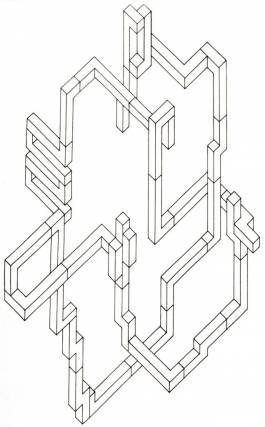
The antithesis to this object, which represents the highest degree of combinatorial virtuosity and utility, is the latest project by Lazzarini and Pickering, entitled “Anisotropo”, which stems from a purely formal investigation. “Anisotropo” begins where “Isotropo” ends; its mysterious crystalline form is the result of the projection and virtual superposition of the three basic figures (X, Y and Z) of its predecessor.
Unlike all previous pieces, this one has no predetermined function; it does not require inventiveness but instead stimulates the imagination, and for Pickering, it is at once like a “big bang and a black hole”, as the beginning of everything and an undefined space, and in a way, a sublimation and antithesis of their entire architectural/design vision.
Coherence and continuity in their work are reflected, on the one hand, through a constant search for typological innovations and reinterpretations of function, and on the other, through a rigorous and restrained formal language based on regular geometric structures.
In recent years, with the revival of the sixties and neo-minimal tendencies of London and New York designers, this kind of minimalist and linear design has become very trendy; however, in the work of Lazzarini and Pickering, we find references to the traditions of historical modernism combined with the techno aspects of the nineties, rather than fashionable quotes from the current international style.
The reductivism, geometry and elegance evident in their work act as a counterpoint to the stylistic and decorative richness, layering and, above all, the baroqueness of Rome.
Isotropo modular containers, 1997. Produced by Acierno