


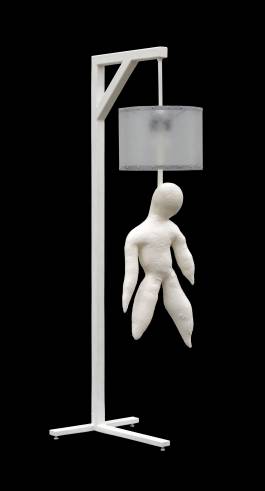
“Hanging Lamp”, 2009
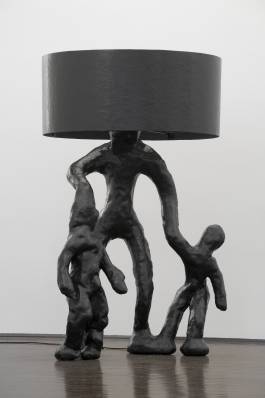
“Familly Lamp”, 2008
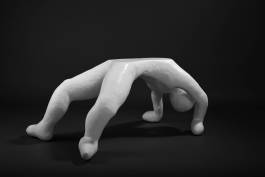
“Woman", 2009
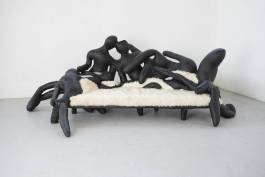
“Corps Sofa”, 2009
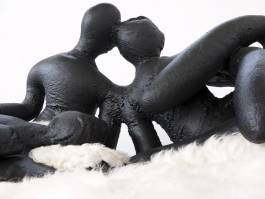
“Corps Sofa”, 2009
2003
JOEP VAN LIESHOUT: HERE, WE DON’T HAVE ANY LAW. IF YOU WANT TO HAVE SEX WITH A DOG, THERE IS NO PROBLEM WITH ME
Dobrila Denegri: Conceptually, the range of your work is very wide, and it embraces fields of art, as well as architecture and design. In a way, it is both an individual and a collective creative adventure. Before we start talking more in detail about AVL production, I would like to ask what contributed to the foundation of Atelier Van Lieshout?
Joep van Lieshout: From the very beginning, everything I made had something to do with functionality; my first sculptural works could actually be used, whether they resembled something that could be used. Gradually, they became bigger and bigger, so I needed more people involved in the realisation process.
I thought it would be a good idea to change the name in Atelier Van Lieshout for several reasons: the first is that I wanted to show that there are other people involved in making of an art work and the second, more conceptual reason, regards the traditional role of an artist: I don’t consider myself as an artist - a unique genius; the artwork is a result of a collaborative and group effort.
AVL involves many people: most are designers, architects, or artists with a creative background, while others are more involved with the material side of production. We collaborate a lot, but I’m primarily involved in the ideation. I design and decide how the work will look, but for the other things, we do collaborate. So, actually, it is a mixture of collaboration and individual work.
DD: One of the most amazing art adventures was AVL ville… could you tell me how you came up with the idea of making your own free state…
JVL: It all actually started with a request I got from Almere to make an urban plan for this very particular city. It is an island about 60 km by 20 km, which was taken entirely from the sea. Years ago, there was nothing, no trees, no houses, no land, only water. Now there is this completely new city with about 150.000 inhabitants. Authorities asked some renowned architects, urban planners, and us to prepare a plan for 30.000 new houses to be built in the coming years. They wanted ideas for what to do, down to the smallest details, including design, colours, everything. I don’t like urban plans because they are too much of an organisation, too much of a dictatorship about how things should look. My idea was to make 30.000 mobile homes, so the city could start its own economy, since there wasn’t any activity of this kind. People who would buy mobile homes could put them anywhere they wanted: on the beach, in the forest, in the city, or even in front of their neighbours. They could decide to place totally freely, without rules, so the configuration of the city would be the result of this free, random and organic process.
DD: You made a design for the mobile homes, though?
JVL: Yes, they were based on the idea of “Autocrat”, a piece that we did a few years before as a housing unit to survive in remote areas, in places far away from the civilised world. We also made plans for a farm with the dormitory, the communal space, the furniture factory, the storage for agricultural equipment, and the watermill for energy production. There was also the workshop for the weapons that was supposed to indicate that people living in this kind of place are very idealistic, even ready to die for their ideals.
I presented all this to the mayor of Almere, saying: “Don’t design anything; leave the space for organic development. The land is completely empty, and people could finally have the opportunity to experiment.”
The major said it was very interesting, but they are not going to make it. It was reasonable, of course. But I liked the idea so much that I decided to build it by myself.
DD: So, what did you build first?
JVL: We started with weapons. We built cannons, a workshop for weapons and bombs, and rooms for freedom fighters. The second unit that we built was called “Workshop for Alcohol and Medicine”, and it was basically a sugar adaptor. There was also a distillery for alcohol, which could be mixed with spices and herbs to make sedatives and medicines.
In those five years, we were making these kinds of things: houses, farms, factories, hospitals, all we needed to have our own state.
DD: Then you proclaimed a free state in 2001?
JVL: Actually, I went to the mayor of Rotterdam and said, “Give us a piece of land because we want to make our open-air museum / free state.” The major agreed, and we got a piece of land in the harbour of Rotterdam. The idea was to have a place in Holland where there are no rules, no laws. In a place like that, there would be more space for experimentation and creativity.
People working at AVL Ville would build their own houses without any technical or aesthetic rules. We made a restaurant in which people outside of AVL ville could also eat. It was our way to finance the project. We didn’t have the restaurant license, of course, and immediately we started having problems. Soon, the project became too popular; it got incredible media coverage and criticism, ‘cause we didn’t have any rules.
Once I said to a journalist: “Here we don’t have any law. If you want to have sex with a dog, there is no problem with me.”
Immediately, the police, fire brigades, animal rights activists, and more problems came. I started spending much more time with lawyers than in my studio.
DD: Despite all, did you manage to function and be self-sufficient?
JVL: All our infrastructures were independent. We had our way of generating energy, heating the whole town. We also have a system for cleaning dirty water. We also had a farm, we were growing fruits and vegetables, and we were also keeping the animals that we had to slaughter once we were obliged to close the place.
We had our constitution, our flag, and, of course, our money! It was just in time when the worst money in the world was introduced: the euro!
We had a better idea for our currency, the AVL, whose value was not related to gold but to the price of beer.
Design of 1 AVL was dedicated to weapons and bombs, 5 AVL to alcohol and energy, 25 AVL to sex and mobile homes, 100 – the most important one –to food and farming.
DD: What led to the closing of AVL Ville?
JVL: The Police were informed that in AVL ville, some weapons were kept, so they came, took the weapons and closed the place.
Funny thing is, while I was in my free state, I spent much more time with journalists and lawyers than making art. In the end, it was very frustrating and annoying.
After the closing of AVL Ville, I asked Boijmans Museum for help, and luckily, they and a few other institutions bought some pieces from us. There was a good headline in the newspapers about this: “The Boijmans saves the artworks from the police”. So after one year, we stopped the free state and started franchising. We were selling the concept of the free state.
DD: As every respectable utopia, your free state failed… and so you moved on, inventing “New ways of exploiting people”…
JVL: This series of works was developed around the idea of efficiency and rationality, which is very important as well as its opposite, the irrationality.
So one of the pieces, “The Disciplinator”, is actually a miniature concentration camp in which everything is designed in a very rational way: it's about how to exploit 72 people in the best way without much waste.
Already during the construction of AVL ville, I mainly was interested in infrastructure, in solving problems of energy production, water cleaning, and shit recycling.
In that time we did “Composttoilette”, but my big idea was to make a bio-gas installation for the production of energy using the excrements, bacteria and gas. To make this work properly, excrement and urine should be divided. For this, we needed special toilets (only for shitting), and we designed them with cameras that monitor whether someone is defecating illegally. You see, control and recycling are very close!
Finally, we built a large biogas installation with a highly sophisticated system for recycling shit, which unfortunately will never function perfectly because we need a thousand people to go to the toilet every day.
That’s why I started thinking about prisoners or slaves to produce excrement. Then the problem is, to produce excrement, they have to eat, so we designed another installation that produces food and feeds them.
We consulted scientists to suggest the ideal diet, which will also be the cheapest to produce the largest quantity of excrement. Another very important moment is that we have to keep these people happy, so we designed a part of the installation called “Alcoholator”, which produces 2000 litres of alcohol a day.
All this is controlled by the master mind, of course. That’s how “The Technocrat” was born. In a way, it is a kind of mini-cosmos, a mini-world in which humans are reduced to the smallest part of these complicated machineries. In my opinion, it is a mirror of the society in which we are living.
DD: It is interesting how, after constructing such a complex “machine” that mirrors contradictions of our society based on rationality and efficiency, on progress that turned out to be the worst kind of oppression, you started making sculptures/architectures in the shapes of the human body and inner organs. Again, it is about the perfect system, but this time organic and really functional…
JVL: While doing parts that in the end got together in this huge work that I entitled “The Technocrat”, I became utterly obsessed with the idea of making this system functional, and at the same time, I was concentrating on the human digestive system, which is very personal and in contradiction to the one we talked about before.
I realised that our organs have very beautiful shapes.
If you look at them, you think about their functions and their forms. Just perfect relation between form and function! Who made all these things? I was involved in these profound questions, which triggered a new generation of works on the anatomy of human organs and the digestive and reproductive systems.
Once in Amsterdam, I exhibited “Womb”, and a Belgian collector, a retired gynaecologist, approached me saying: “This is fantastic! Now I have the possibility to have my personal womb! It is perfect, but a little bit too small. Can’t you make a bigger one, so I can go inside with my wife and my family?” We accepted this challenge and made a super-womb that I called “Wombhouse”. Inside was a bed, a kitchen, in one of the rooms the mini-bar, in the other one the toilets. So it was a really functional object. It was what in architecture is called the central core - the place where all the complicated technical things are concentrated: heating, kitchen, sanitary, ventilation, air conditioning. So the womb is the machine that makes the house work. In a way, it is a statement about architecture: form follows function. I think design should do something with passion and with art.
DD: Your latest project, called “SlaveCity”, is developed out of the initial idea of “Call Center”, so again you are involved with a mega-system that combines experiences of AVL ville, “The Technocrat”, inner-organs shaped architectures and aspirations to make “a perfect new world” that somehow again turned to be very threatening, dark and dystopian. How will your “SlaveCity” look and function?
JVL: It is a concentration camp. The idea is to create an ideal concentration camp, or an updated one, using today's technologies. It will be very rational, efficient, and profitable because, according to our business plan, it will generate 8 billion euros in net profit per year, which is more than Microsoft. With this amount of money, the owner of the “SlaveCity” could have a very influential role in world politics, too. The city is designed for 200.000 inhabitants.
The nucleus of this new city is a “Call Centre”: a prominent building in which people do telemarketing. Then other segments make it function perfectly: universities, workshops, large hospitals for organ transplantation, sports centres, brothels, residential and public areas, parks, and, of course, the museum. The museum budget would be 1% of the overall profit, amounting to 8 million euros a year. I think it could be the richest museum in the world, so that the best exhibitions would be made in a concentration camp!
It is planned as a perfectly self-sufficient city, with no energy needed from outside because everything is recycled.
It is torturing humans, but at least it is not damaging the environment...
The interview was published in the DIID - URBAN LANDSCAPES I, n° 45, 2010, edited by Massimo d’Alessandro, Claudia Clemente, and Susanna Mirza.
“Hanging Lamp”, 2009
“Familly Lamp”, 2008
“Woman", 2009
“Corps Sofa”, 2009
“Corps Sofa”, 2009