


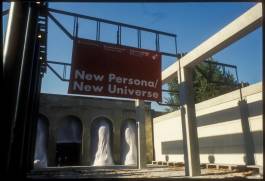
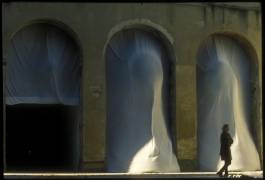
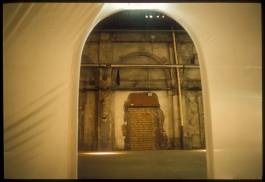
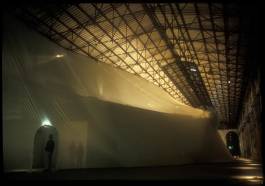
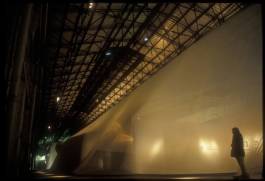
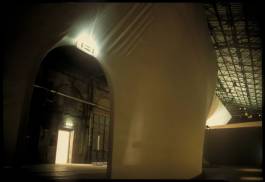
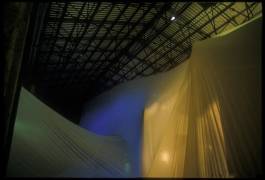
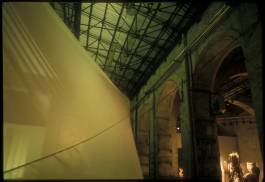
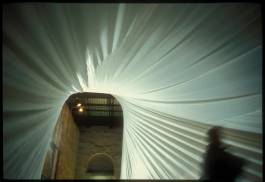
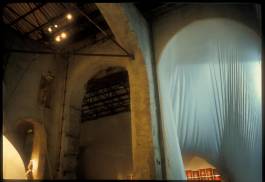
“New Persona / New Universe” exhibition design, Stazione Leopolda, Florence Fashion Biennial, 1996, Photo: Orlando Caponetto.
2004
DENIS SANTACHIARA: MY BACKGROUND IS HYBRID, STRADDLING THE BOUNDARY BETWEEN ART AND DESIGN
Dobrila Denegri: I would like to begin our conversation by talking about your early days as an artist and designer. It was a gradual transition from art to design, but this oscillation between different fields has remained a constant in your work. What was your training like, and how did you approach design?
Denis Santachiara: My professional background is hybrid; it straddles the boundary between art and design, and sometimes another subject comes into play: technology. It is important to talk about this relationship with technology. Starting professionally as a self-taught artist, I first formed artistic relationships. I did several exhibitions, but, from a strictly artistic point of view, my work culminated in my participation in the Venice Biennale in 1980, where I became what everyone calls a designer. The characteristic of my first exhibitions was that I presented illustrated projects, not sculptures, installations, or paintings. Later, these projects became three-dimensional, and I built them and then exhibited the prototypes. From there, some magazines began to give this thing importance: they were objects that could be mass-produced, but in reality, they were only prototypes.
DD: How does technology fit into this?
DS: The relationship with technology is fundamental, defining and, in many ways, has accompanied me throughout my life. The relationship with technology is actually the relationship with the artificial world, with artifice. Therefore, the idea, already developed at that time with the advent of electronics and the contribution of Marshall McLuhan and other important thinkers on this subject, that technology was no longer just a technical performance, but rather a symbolic, scenic performance that touched our senses more than our muscles. It was the possibility of using technology to play, communicate, and do poetic things. It was a rather unusual attitude at the time, also because even today, when we talk about technology, we talk about high-tech. In contrast, my technology is anything but high-tech.
A term I often use in these explanations is ‘techne’, which in ancient Greece had the same meaning as ‘poiesis’; ‘technè’ was ‘poiesis’, and vice versa. So, Heron's theatre represents the whole world of technology at that time. Later, in the 1700s, with automata, the best technology of the time was used for entertainment. The Romantics hated technology, but they had an almost esoteric attitude towards automata; they thought they were magical beings, while automata represented the best of the technology that they, in some ways, contested. One could rewrite a history of entertainment technology, which then expanded with the advent of electronics, through the post-industrial era, until it became almost solely entertainment, a symbol and a fetish.
At that time, when I was starting, there was conceptual art, kinetic art, and optical art, which was very rigidly scientistic. My personal reaction was to continue using technology, but to reverse its meaning in the use of the project.
DD: This fascination with technology and its recreational, performative and entertainment value led you down this hybrid path, which in the 1980s was enriched by another important experience: that of curating a very special exhibition, first in Milan and then in Paris...
DS: Yes, along this path, I had the opportunity to organise an exhibition, the first major exhibition I curated, a manifesto exhibition, held at the Triennale di Milano, sponsored by the then Progetto Cultura della Montedison, and the following year, in 1986, at the Centre Pompidou. This exhibition, called “La Neomerce: il design dell'invenzione dell'estasi artificiale” (La Neomerce: the design of the invention of artificial ecstasy), was a cross-disciplinary exhibition featuring designers, artists, stylists, inventors, and even a chef. There were also video artists. The concept behind this exhibition was to create prototypes that featured a series of performances not only material, not only related to the object's form, but also immaterial, capable of communicating something beyond their physicality. There is an Electa catalogue for this exhibition with a glossary, which is a bit like a brief for the exhibition. The glossary contained very important terms that have recurred throughout my professional career, such as the term “performance”.
DD: Performance in what sense?
DS: The idea was that, with new technologies, objects would become increasingly capable of moving, animating themselves, speaking, listening, writing, etc. All these immaterial activities – these “performances”, in fact – need to be managed aesthetically. The idea was that it is not enough to design the body; you also have to design all the gags the object can perform. The gag, therefore, becomes a significant element of the project.
DD: What other terms did you include in your glossary?
DS: Another term is “interaction”: if these objects have an immaterial, sensory relationship with users, then the question of interaction arises, along with the problem of the aesthetic management of this interaction.
Then, “telepresence”: the fact that new technologies allow us to be present in several places at once, overturning the idea of scholastic philosophy, in which presence and absence were conceived as two opposing worlds.
The question was: when we telephone, are we present or absent? It is a classic example of when technology arrives and changes all the concepts of our daily lives that have been around for a long time.
Then there is “hysteresis”, or the use of time, because if objects perform, there is the problem of time management: what in cinema, for example, is editing, or in music is rhythm. In the project, time management is very important to me. But time – always present in every project – has been used, more often than not, in a backwards-looking way, as the Futurists would say. Very often, you hear architects say, for example, “this material ages well” when referring to marble or wood rather than copper. For me, time must be one of the living elements of the project, an active side, projected forward and not intended solely as ‘ageing’. The use of time as a colour, as a sensor, as – ultimately – an element of the project.
DD: Could you give us some specific examples of the importance of time use?
DS: In an exhibition I designed for the Museum of Magic in Blois, commissioned by the French Ministry of Culture, there was a table with no design, a black round shape planted on the floor, with no particular physical configuration, but which rotated once every hour. So, if people sat down to have a coffee after half an hour of chatting, the coffee was on the other side of the table. A case in which the gag becomes an element of communication rather than the design.
In general, one of the exhibition's concepts was that, in the design of objects, it is no longer enough to design the character; you also have to design its gags. The second fundamental concept was that the artificial world is becoming less and less material and more and more linguistic. Hence, the possibility and/or necessity of managing language. This aspect had already been understood in music, with Brian Eno and others, and also applies to cinema. In design, partly due to the scholastic nature of this profession, this notion arrived a little later.
DD: You were a bit of a magician as a designer...
DS: At that time, I liked to say that I used the magician's strategy, because the magician masters the finest techniques, perfects them in every detail and then betrays them in the final effect. To give the audience a magical experience, he must conceal the relationship between cause and effect. That's why the designer's attitude was that of a magician who mastered the technology, learned all its possibilities and then betrayed it, i.e. not using it for its traditional high-tech purpose, but for effect and therefore for communication, through surprise... yes, in fact, magic.
DD: What interested you most in design, unlike other designers of the time?
DS: I felt the need to investigate the world of gadgets, which, as you can imagine, horrified designers in the 1960s and 1970s, who considered them kitsch (even though some had already begun to theorise about kitsch). In my opinion, however, gadgets contained very interesting concepts, precisely because, by their very nature, they do more than one thing; they are objects that transform; they are almost always multifunctional. As I investigated the diversification of functions within individual objects, I came up with a new term: “funzionoide”.
A “functionoid” is an object that has a functional, technical and entertainment relationship – aspects that did not exist before. Since the industrial revolution, in the modern era, objects for the soul have been separated from those for the muscles. On the one hand, there were tools; on the other, prints, music, and all objects of art. With new technologies, not mechanical but soft, we have “functionoids”, i.e. objects capable of having a purely entertaining relationship and, at the same time, performing a function.
For example, the most striking and popular work is the personal computer, which is the prototype of the “functionoid” object. With a personal computer, we can calculate taxes, design a bridge, and, with the same machine, watch a film or visit a museum; we can entertain ourselves or socialise on a global scale.
The idea that technology could lead to a ‘functionoid’ object is very interesting because it allows us to see everything from the broader perspective of objects. Objects can disguise themselves, change their functionality, and, perhaps, one day, even change their minds.
This is the background to my way of working. The concepts expressed by these terms have followed me throughout my life. Sometimes mediating, sometimes refining them, but always carrying them with me throughout my professional career.
DD: How was your transition from objects to environments? Did you use the same categories, expressed with the terms you mentioned, such as “performance”, “interaction”, “functionoid”, etc., in interior design and exhibition design as well?
DS: For the exhibition ‘La Neomerce. Il design dell’invenzione e dell’estasi artificiale’ (Newgoods. The design of invention and artificial ecstasy), which I curated in 1985 at the Centre Pompidou in Paris, there were several functioning objects (not models, but prototypes) that performed. For example, a small table with an electronic doily changed configuration according to taste.
In 1984/85, I was experimenting a lot. I had also made curtains out of optical fibre. The idea was that during the day, the curtains would function as curtains, and in the evening, they would light up, taking on the functionality of a window. Then, using this technology, I began creating objects: a bed with a series of luminous decorations that moved beneath the sheets, forming configurations and changing colour.
Or a tile. But the tile adhesive was soaked in optical fiber, so if you laid the tiles (in a bathroom, for example) on this material, you could then break them and light would come out of the cracks. These cracks illuminated the whole room. This act of breaking the tiles was part of the exhibition. That is, people came in and were given hammers to break the tiles and let the light out.
DD: You have collaborated with major museums such as Beaubourg and Vitra, and also exhibited at Documenta in Kassel. How did you interact with these different institutional contexts?
DS: I did several things with Vitra... a stool for the Musée Rath in Geneva that projected words onto the ceiling. When no one sits on the stool, the word is cancelled out; it equals zero. When someone sits down, the stool starts spinning a series of names and stops on one in particular. The idea was to be ironic about the question of weight. The weight was calculated, for example, as 20 drills or 200 bags of biscuits.
Our participation in Documenta 8 was also with Vitra. In addition to existing objects, we had developed a new chair equipped with sensors and motors that allowed it to follow people. We had to put it on a platform; otherwise, it would have followed everyone.
DD: You have experimented extensively with innovative materials. How did you choose them, and which characteristics interested you in particular?
DS: Artificial materials in design can open new possibilities beyond technical and mechanical performance (such as wear resistance or load-bearing capacity) to include intangible qualities.
The famous and beautiful exhibition at the Centre Pompidou, “Les Immatériaux”, was a great source of inspiration.
Intangible materials include sensors, polymers that change colour in sunlight, and liquid crystals that change colour with temperature. These are non-physical, ethereal performances.
One of these intangible materials that interested me greatly is lightning, the electric arc. I made my “Domestic Animal”: two antennas produce a continuous voltaic arc, creating a fascinating animation. It produces an ozone smell (the one you used to smell behind the television), a sound (that typical nervous noise that I really like) and, of course, the configuration. I started making small lightning bolts for domestic use: a disco sign that split in two, and between the two parts, a 2000-volt, purple, continuous electric arc flashed. My idea was to reproduce lightning in a domestic version as a decorative element. Then, in 1985/86, we created a very large one in front of a disco club. It attracted a lot of attention, including that of the fire brigade and the local health authority.
DD: Have you also worked in interior design?
DS: I worked for Art'otel, a large German company. The company entrusts the design of its hotels to designers linked to certain artists. For example, in Berlin, the façade is by Wolf Vostell. In Dresden, for the hotel I designed the interior of, a large room was built for contemporary art exhibitions, and a vast collection of Beuys was put on display. As for my work, I was paired with A. R. Penck, with whom I collaborated.
I designed the rooms with the idea that the hotel itself was meant to exhibit works of art. The entire perimeter of the room was covered with a white curtain, covering everything (fridge, television, furniture, etc.) and leaving only the bed exposed. However, in some places, this curtain is open, allowing illuminated works to be seen. Thus, the curtain hides everything in the room except the works of art.
DD: You curated the display of Germano Celant's exhibition on art and fashion in Florence in 1996. I still remember it as one of the most fascinating exhibitions in terms of display.
DS: We started from the rather innovative idea that the exhibition design should be a work of art in its own right. The idea came from a discussion with Celant, and I immediately embraced it. The Leopolda station was ideal because it was very large. So I was able to create an exhibition display that you could enter and view from the outside.
We used a slightly translucent material, like a large shapeless stomach, which allowed you to walk around it – that is, you entered the stomach, saw the exhibition and could also admire it from a distance, glimpsing the various works on display.
The most interesting part of the installation is that about 20% was designed in the studio, while the rest was done on site, with two ladies who had large sewing machines and, one by one, made what we needed. It was almost an impromptu job. So, the sheets were stretched according to the scenographic effect we wanted to achieve.
DD: Regarding the exhibition layout, was there also an idea to design the way the works were displayed? Wasn't there a risk that the layout itself would be more noticeable or overwhelm the works?
DS: This exhibition had a lot to do with my early career. At the Venice Biennale, as an artist, I presented a work that consisted of setting up an exhibition without an exhibition. I had created an installation, a setting, in which the works were missing. I really liked it, and I understood that it is possible to develop important and communicative settings without touching the works. On the other hand, in all the exhibitions for which I designed the setting (and therefore also the one in Florence), when you entered the space of a specific artist, there was a lot of respect.
DD: How did the artists react to your display?
DS: Upon entering the Leopolda, you could see this large stomach; then, upon entering the space, it was set up almost like a traditional museum, even though you could still glimpse the skin of the stomach. Inside, the spaces were strictly museum-like, with white walls and appropriate lighting. Of course, there is always a risk. Germano Celant came up with this idea because he had seen my work at the Biennale, and he remembered it, so this risk arose. And it probably worked because no artist complained.
There were indeed many discussions with the artists at the Leopolda, and dialogue with them is the most interesting aspect of art exhibitions, anyway. I noticed that their problems almost always did not concern the display, since the staging's strong character was always towards the outside. The thing artists discussed most was their relationship with their neighbours, not so much the display.
DD: What was it like curating your own solo exhibition, as you did at the Museum of Contemporary Art in Lyon?
DS: I really liked the museum's interior design as it was, so I just added a platform with small cuts, like an artificial torch. People could even walk on the fire. I placed some of my objects on this platform.
DD: You have also worked on the figure of Nikola Tesla, who is a very important figure for us who come from the former Yugoslavia.
DS: Tesla, for me, was a very curious character: a man of the early 20th century, an electrical engineer who did some very interesting things. He is one of the few people to have refused the Nobel Prize, and his life was truly reckless. Among the things he invented were the neon tube and alternating current. Before him, electricity was sent in a continuous current, which meant that after a kilometre, the voltage dropped. Pulsed alternating current, on the other hand, allows electricity to be transmitted over very long distances and, above all, to use much thinner cables. Nikola Tesla's studies also included electrical transmission: the possibility of using electricity and operating things wirelessly. This led to a whole host of problems with American counter-espionage... I used this story to create objects: a lamp that is nothing more than a jug with neon lights inside, and at its base, a Tesla generator. You could move the jug within a 1 m radius, project the light wirelessly, touch the neon lights, and play with them freely.
DD: Among your recent projects, which is the most interesting for you?
DS: It is an object that is in demand in public places, hotels and museums, as an Internet station. It is a lamp, traditional and banal in design, because it has the classic shape of a bedside lamp, with the difference that it is about 1.40 metres high and 1 metre in diameter, so it is oversized and enormous. This lamp opens, and inside is another lamp, identical but five times smaller, which generates the light. And this, of course, becomes a lectern, a bar, a place to apply make-up or a home office.
“New Persona / New Universe” exhibition design, Stazione Leopolda, Florence Fashion Biennial, 1996, Photo: Orlando Caponetto.