


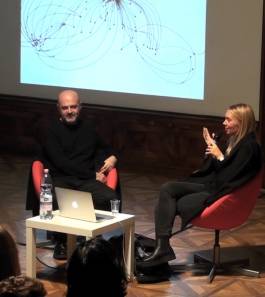
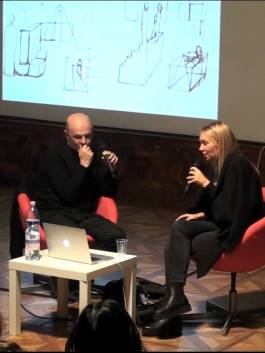
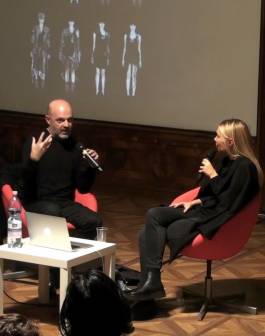
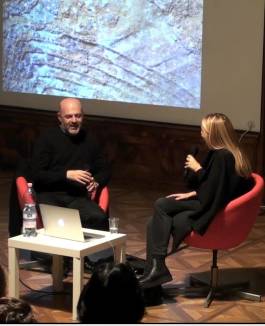
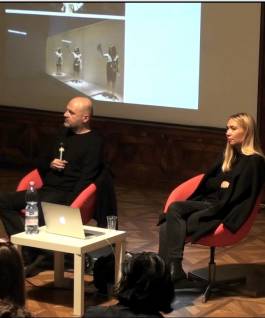
A talk with Hussein Chalayan, Heiligenkreuzer Hof, University of Applied Arts, Vienna, 2016.
2016
HUSSEIN CHALAYAN: EVEN THOUGH I AM VERY AWARE THAT I'M DESIGNING AND PRESENTING CLOTHES, I HAVE ALWAYS WANTED TO ADD SOME VALUE TO IT...
Dobrila Denegri: With “Transfashional,” we aim to explore the semantic resonances that fashion and fashion-related practices can evoke when presented in the context of contemporary art. It is imagined as “an exhibition in progress”, changing from one presentation to another, in accordance with developments of new and collaborative projects realised by participants.
Thus, the theme of the exhibition and the act of exhibiting are quite central. The exhibition can be understood in many ways, but it’s always connected with the following terms: space, narrative, elevation, temporality, and memory.
I recognised these exact terms when looking at your work in retrospect. These are the themes I would like to discuss, in relation to some of your collections and art presentations, from the early 1990s to today.
I'd like to begin with one of the images that really resonated with me, as it is both symbolic and highly relevant to understanding your concept of space: a graphic representation of flight paths.
Hussein Chalayan: It was one of my early graphics, actually one of my favourites from the collection “Along False Equator”. This collection was constructed by departing from airline routes, cardiograms, meteorological charts, as well as prints and decorative elements. I wanted to explore ubiquity, the notion of being in transit while simultaneously being omnipresent. With prints of flight paths printed on neoprene and jersey, I wanted to create a kind of atlas that embodies the sense of constant movement.
DD: This was your Autumn/Winter 1995 collection, and the early 90s were a period when we were just starting to grasp what the process of globalisation and the emergence of the World Wide Web could lead us to. Were your references to the themes of ubiquity and transit connected to this phenomenon, or was there something more personal?
HC: Being from somewhere, but being from nowhere is an interesting situation for me. I feel quite rootless. And I see this condition as a sort of richness; a condition that makes you more open, since you are constantly in a position to negotiate which parts of your cultural background you can leave behind and which new cultural inputs you can assimilate. Clearly, this state of shifting identity has to do with my private life, with my Turkish Cypriot origins, a child of emigrants who had to flee after the pro-Greek coup in 1974, raised between rural Cyprus and the multicultural and very urban context of London of the late 70s.
DD: I have personally experienced the threat of war and involuntary displacement. It comes with the sense of trauma. You addressed this theme through your work, and what is probably considered one of your most iconic collections, “Afterwords” A/W 2000, is, for me, one of the most poetic metaphors of something so hard to go through: leaving the place you feel you belong.
HC: “Afterwords” was exactly about having to leave your home at a time of war. I remember asking my mother during the period of inter-communal conflict in Cyprus what the first thing she thought about taking with her was. She replied: “My clothes, photographs and a blanket.” So, I thought, how could you hide your clothes in the event that your home is raided during a pillage? This was my way of dealing with these issues. Coming up with the idea of clothes/chair covers, and objects becoming garments, pieces of furniture becoming something to wear. It symbolised the urge to bring home.
And, yes, the collection has become so iconic that it is now difficult to find something new to say about it. Still, when we presented it, it was such a risk! So many things could have gone wrong! I was so nervous during the show. However, I felt a kind of urge that kept me moving forward, experimenting with different formats for presenting and communicating my subjects. I’m glad that I did it in this way, because art museums started to follow and collect my work. That was an important recognition.
DD: What is the difference between showing this kind of work in a fashion and an art context? A lot was said about your ability to bring forms and contents to the runway which belong more to the tradition of art performance. How do you relate to these two different contexts of presentation?
HC: First of all, I have to say that I really wasn't thinking about other platforms at the time I was working on this presentation. I couldn't have imagined that there would be such interest and an embracing reception of my work from art museums and other exhibition spaces. For me, it was important to experiment with different formats for presenting my collections, most of all because, even though I am very aware that I’m designing and presenting clothes, I have always wanted to add some value to it. I thought that the presentation itself could be a kind of cultural experience.
DD: If we look in sequence collections at the works we mentioned, “Along False Equator”, “Afterwords” or these preparatory drawings for “Between” S/S 1998, what I see is elaboration of the notion of space which runs through all of them, as a sort of red thread. What would be for you a conceptual connection between these collections, if there is one?
HC: I think that it is about my perspective as a creator. I am someone who likes to explore and, at the same time, likes to create another perspective on an existing situation. So, I think of myself as someone who is permanently studying and also saying, “Could we look at this in some other way?” It’s this duality —a combination of the two approaches —that is closest to me.
In particular, “Between” was for me an exploratory project and again, a massively risky one.
DD: It must have been mind-blowing to see on the runway models “dressed” in chador, but with portions of their bodies exposed. Yet, what I also find very interesting are your sketches and drawings, where the body seems to be imprisoned in cloth, in a veil. Both body, furniture and garment seem to form the same architectural entity. They appear as a merged single block.
HC: The collection “Between” was about how you define your territory through a religious code. That‘s how it started, at least. In the beginning, there was a naked model who became more and more covered, until she looked like a mummy. It was a chador.
It is worth noting that this collection was created before 9/11 and the rise of Islamic controversy. So, today it resonates differently than it did at the time. Back then, it was about how you can deconstruct the territory built through the dress code.
The starting point was a session with models in open air, in Exeter; I gave them a cord, and asked them if they would mind being nude. Then they were asked to delimitate their territory with a given cord. I used photos of this performative action as a part of my creative process, as well as some of the conversations I had with models about their experience.
Part of the collection included headdresses; one was a mirror that framed the model's face, reflecting back the gaze she would receive, while the other piece encapsulated the head, veiling the face. The question was, how can you create an identity without the face, how do you define someone‘s identity? I was experimenting with it, incorporating religious references.
DD: Anthropology teaches us that religion lies on the basis of each culture. Talking about roots, I would like to ask you to comment on another collection in which the theme of cultural background seems to be central. I’m thinking of “Ambimorphous” A/W 2002.
HC: I wanted to look at the idea of the folk costume and how it can be deconstructed and become, through various stages, simple black dresses, which are an epitome of a Western code. It was also about power and powerlessness. The more the folk costume got eaten away, the more powerless the body became. It was presented like a storybook, starting from a very richly embroidered costume from Western Turkey, up to the black garments. In sequence, it looked almost like an animation. Sartorially, this was a very challenging collection, and even if it seemed so simple, I had to be really careful with every intermediate stage. It was constructed/deconstructed in two ways, from a folk costume, to a black gown, back to the costume again. So that’s what the name of the collection stood for: “ambimorphous” forms, or forms that can be morphed in two different directions.
DD: For me, it’s interesting to see this collection in relation to one that followed, “Manifest Destiny”, S/S 2003. The question of power and cultural predominance seems to be the issue for you here. “Manifest Destiny” was also the name of a doctrine which was supposed to legitimise American expansion in the late 19th century. It implies violence, as well as the extinction of different traditions and languages, something that still strongly echoes today, when we are heading towards total cultural uniformity and homogeneity, and cultural and natural extinctions are one of the biggest threats to our planet.
HC: “Manifest Destiny” was a controversial collection that didn't receive a good reception at first, but later gained reevaluation. It was extremely complex in terms of pattern-cutting. Overlapping and layering of lycra-infused materials created an impression of the body enveloping itself. My initial inspiration was disgust. I wanted to examine the anatomy of the body and how clothes, which cover and control the body, could reappropriate and highly recultivate anatomy to an unrecognisable extent, disguising all notions of “disgust.” What interested me, and that’s where this title resonates, is the way in which the force that attempts to civilise our animal state… Of course, there are also connotations, which have to do with psychological and physical implications of imperial expansion… Clothing is an important part of cultural imposition, I believe.
DD: Through the collections we have talked about, I see a correspondence, in the sense that through each of them, you allude to space, understood in a concrete and metaphoric sense. One of your early artworks, a film entitled “Place of Passage”, might be seen as a voyage through time, as well as through space.
HC: The Script was about a person who makes a journey from London to Istanbul. Thanks to the commission by Lucky Strike and Honda, we could build a very peculiar vessel, a sort of cocoon. It was about all the changes that happened within the vessel, which, in the end, got flooded with water. There is a strong sense of isolation in this work, too. Also, a reflection about going back to where one originally comes from, physically and culturally.
This piece is part of an art collection now. For me, it is important because it is a kind of extension of my work… reaching the domain of film, which is a visual language I feel strongly connected to.
DD: I would like to ask about your working process, especially in reference to the very first collection you presented as a degree show at Central Saint Martins. I’m interested in the way you construct a narrative, a storyline that runs as an undercurrent through your work, whether it be a collection or an art piece. I got the idea that for you, a starting point might be creating something like a script.
In the case of “The Tangent Flows” from 1993, you effectively created a crime story about death and destruction, with the main protagonists being killed. However, it also had a philosophical edge, as you quoted Jung, Newton, and Descartes as references.
HC: Indeed, I had a story written in the clothes, to tell how they would evolve. When I look at it now, I think I must’ve been out of my head, but it was really enjoyable. However, when I was preparing for this show, I wasn't thinking about any career backlashes or press attention… I couldn't even dream of Bjork buying and wearing some of my stuff… But it was generally an exciting moment. I fear that if a student were to come up with that kind of presentation today, he/she would be laughed at.
When it comes to my work, I think that the narrative approach is very important because it gives a sense of life to design. This first collection was a mixture of intellectual and playful at the same time. I was trying to make a statement about the absurdity of mind/body dualism, which is so rooted in Western ways of thinking. I wrote a fiction story about a scientist who attempts to integrate Eastern philosophy into the Western Cartesian worldview. However, as important as the process is, what really matters is the outcome. The clothes, in this case.
DD: It’s still stunning to see images and details of fabrics you made for this collection, traces of rust, corrosion, processes that happen under the earth. To me, they have some pictorial quality and beauty as well. But also interesting is this allusion to processes of decay and destruction, which strongly resonated through the art of the early 90s. The YBA movement and its sensational use of imagery charged with death, sex and violence, was a part of a cultural climate in which designers like you and Alexander McQueen emerged. Did this climate affect you?
HC: Definitely! London was electric. With the art and music scene, Brit Pop… I wish this kind of climate could come back; it generated so much adrenaline and creative power.
But in my work, there has always been a strong biographic element. The early 90s were marked by civil war in Yugoslavia, too. The shock of having a war zone on the very territory of Europe made me think a lot about my own childhood. I came from a city which was divided, and going to the other side was forbidden. My house was near an abandoned, disused international airport. The river that was running through Nicosia was carrying things from the Greek part, a part we weren't allowed to go to… so, all this was making a strong impression on my imagination when I was a child. Later, I tried to sublimate these memories, viewing them as a positive and creative drive, and using them in my work.
So yes, the theme of destruction resurfaced often through my work, but it’s not something that comes from one source only. Never is, I guess.
DD: It’s interesting how you were able to aestheticise violence and destruction. At first glance, the imagery of “Ventriloquy” S/S 2001 looks very hi-tech and seductive…
HC: Yes, it was another risky project. So many things could go wrong, and we were lucky they didn’t! We had a computer animation in the background, and in 2001, it was something really pioneering. Models were emulating what was happening on the screens, moving like robots and wearing garments made of sugar-glass. Dresses were smashed on the stage by other models!
DD: It must have been a quite exciting, cathartic moment… and it’s interesting to see in contraposition with the totally different kind of presentation you did for collections “Sakuku” S/S 2011 and its segment “Haiku”, which again, through other formal language introduces a principle of sequence, editing, film-making… and brings us back to art context as well, as a chosen site for the presentation, even if it was within Paris Fashion Week…
HC: In the 90s, we were inventing, experimenting, seeking the most provocative, astonishing, exciting and innovative forms which really transformed the catwalk into a stage…
But for me, it’s never spectacle for its own sake; it’s about the story I want to convey. Now I think that it’s important to bring back attention to things that are fundamental to what we, as designers, do.
Craft is important; materials are important, as is the quality intrinsic to the product.
“Sakuku” was inspired by my trip to Japan, and it literally means “locked country”, a term coined to name Japanese foreign policy in the mid-19th century, when it was prohibited to enter or leave the country under the penalty of death.
I was deeply touched by the choreographed and ritualistic aspects of life in Japanese culture. To present this collection, I decided to create a film and display it in the space of an art gallery, away from the commotion of the fashion world. The film was constructed through choreographed sequences showing the draping of a chiffon dress, each sequence corresponding to an ideogram, which would ultimately compose the term “sonzai suru”, meaning something like “to exist”.
The effect achieved in the film, featuring real people who almost blended into a black background, with their moving clothes, was incredible. Shadow has a strong presence in Japanese culture, and my film was an homage to that.
So, yes, I would say that I work closely with film directors, but I capture things that already exist.
DD: One of your recent challenges was directing a piece presented in the theatre…
HC: It was one of the most challenging projects I ever got involved in. I directed a dance piece, “Gravity Fatigue”, which premiered at Sadler‘s Wells in London in October 2015. We had four performances in London, but it took me over two years to prepare this piece. Essential was collaboration with choreographer Damien Jalet, who is really amazing in his work with dancers.
For me, this was a very important experience because it brought together all the work I had done up to that point. Some ideas I had many years ago, but never had the chance to put into practice, and others emerged from the process of composing this complex visual narrative, which is all about the body and clothes.
DD: You come from a secular background, and when you tickled religion, it was more from an anthropological point of view. But there is a recurrent component of your work which alludes to the state of elevation, be it physical or mental, spiritual. It can be found in early collections, such as “Temporary Interference” (S/S 1995) or “Nothing Interscope” (S/S 1996), up to “Kinship Journeys” (A/W 2003).
HC: I was always fascinated by the idea of unseen, invisible, so that’s where my interest in religion comes from, disembodiment, notion of loss of the self… in the collection “Nothing Interscope” I was really looking for ways to channel this idea of “world beyond”, so we made this very particular mouthpieces, which were keeping model’s mouth open, as it can be seen on the medieval or Renaissance paintings of dead Christ.
Yes, with these collections, I was exploring what elevation might mean and how reflections about transcendence can be approached through something as material as dress and body, or channelled through the language of fashion, which is by its very nature considered something transitory and ephemeral.
DD: For “Kinship Journeys” presentation within Paris Fashion Week, the stage you built was almost a theatrical set, or artistic installation… very elaborate and full of complex symbology…
HC: It was initially conceived as an installation to be presented within the exhibition curated by Jose Teunissen at the Centraal Museum in Utrecht. The piece became part of the museum’s collection after the exhibition. This installation comprised elements such as a stylised confession box, trampoline, and death coffin— a set of symbolically highly charged objects alluding to spirituality, religious rituals, mortality, and the afterlife, and generally to the contradictions inherent in these notions.
So models were wearing clothes connected to balloons, which ought to “carry them up”, “to reach God”, but obviously they failed in doing so. It was a very elaborate collection, dealing with many aspects, among which was also the idea that reaching for the divine can be ridiculous.
DD: A totally different effect was emanating from “Readings” S/S 2008, which again brought the theme of transcendence, through the magical effects of laser lights and very ethereal presences of models.
HC: It was a collection sponsored by Swarovski, which allowed us to use crystals, as well as sophisticated technological devices, something like 200 moving lasers and to play with setting, scenography, and musical arrangement realised in collaboration with Anthony Hegarty.
Also, the film, produced in collaboration with Nick Knight, was part of this spectacular presentation at Galerie Magda Danysz in Paris.
For me, “Readings” was about a cycle of energy between the devotional object and its audience. We used cross-reflections and mirroring of laser-rays in order to transform the space into some dematerialised ambient, a mirage. It was about icons and worshipping. Perhaps also related to the hollowness associated with worship and idolatry.
DD: Conventionally understood, art is timeless while fashion is transitory…
You addressed the category of time in your work, for example, in “Mapreading” A/W 2001, which I find very interesting. Could you tell me more about it?
HC: Generally speaking, I’m inspired by time because, obviously, it is connected to change and metamorphosis. My connection with time is about metamorphosis, because I can give shape to time, so to speak.
“Mapreading” was an important step in my design process. I was interested in morphing techniques, changing those standard items, such as a black dress, a white shirt, or a denim jacket, one into another. It was like a sequence, a series of film stills in which each silhouette transformed into the next. In a way, it was like a compression of time, which is something I came back to also later. In “One Hundred and Eleven”, I morphed garments from different eras.
DD: I was just about to ask you about “One Hundred and Eleven”, S/S 2007…
HC: We created five mechanically engineered dresses that visualised the transformation of dress design from one epoch to another, starting with the Victorian period. Representing a fashion history in pills, we began with the Victorian silhouette of the late 19th century, which, with the touch of a button, transformed into a loose-fitting dress of the early 20th century, which in turn transformed into a flapper dress of the 1920s. What I found interesting was the question of how world events, including wars, revolutions, and political and social changes, influenced fashion over the course of the century.
The project was again done in collaboration with Swarovski, which was celebrating its 111th anniversary. It took us about a year to produce it.
DD: Talking about time and change, it is interesting to bring up a collection entitled “Inertia” S/S 2009, where speed and stillness are brought into a single vision… focus seems to be on an instant?
HC: Speed is one of the primary characteristics of the era in which we live. We have to accomplish as many tasks as possible in the shortest time possible. The result of this is a crash. It represents the outcome of this way of living, where everything is perceived as an emergency.
DD: You also created an exhibition featuring moulds and sculptural pieces related to this collection. What was the difference for you in showing this collection in an art gallery and in the context of fashion week?
HC: For me, there is no particular difference. Time is different for sure, because a fashion audience sees everything in about fifteen minutes, while the art audience can dedicate as much time as they wish to look at the shown work.
DD: Another recurrent theme that I could recognise in your work is the notion of memory. I suppose DNA could be understood as a sort of “memory deposit” as well. “Genometrics” A/W 2005 was your way to discuss the migration and blending of different codes. How did this collection come about?
HC: I got my DNA tested years ago, before it was widely available. I got it through a friend at university, from UCL in London, in the genetic anthropology department. Even though I’m Turkish Cypriot, I discovered that I have some Viking genes, too.
So, this collection wanted to play with assumptions of what we are and how we define our cultural self. It seemed particularly relevant to ask this question in relation to such a multicultural place as London.
Further investigations into what genetics and genetic engineering mean for our present and future, brought me to another conceptually related work: a film “Absent Presence” premiered at the Venice Biennial when I represented Turkey. The protagonist was a scientist, played by Tilda Swinton, and the film narrates a story inspired by all those people we consider foreigners, migrants, asylum seekers… The narrative followed anonymous female donors from non-British backgrounds whose DNA was extracted from their clothes for analysis, and based on this analysis, new garments were created.
Even if it is fiction, this film has a lot to do with the government’s “hard line” on immigration, a topic that remains even more relevant today.
DD: Showing within the prestigious frame of the Venice Biennial wasn't your first experience of presenting your work in an art context. What does it mean for you to show in the museum?
HC: The first solo museum show was in 2005 at the Groninger Museum in the Netherlands. The whole building was dedicated to my retrospective, which was really exciting. Exhibitions dedicated to my generation of designers hadn't been done yet, so I had no role models, nowhere to look, especially not for the kind of display that we were keen to do. For a fashion designer, it’s always an honour to exhibit your work in the context of the museum. It also gives a chance to the audience - both fashion lovers and ordinary public - to go in-depth, see the work through narrative lines, observe details, and make connections which otherwise wouldn't emerge. Having a substantial body of work on display in the same place means that your personal narrative becomes clearer and coherent.
However, seeing my work in retrospect makes me feel more critical. I became a bit obsessive-compulsive about details, so yes, it‘s painful as well.
DD: How would you judge your journey so far? You were very innovative and brave, but to keep creativity on a high level and be independent in the context of today's fashion industry, it must be hard.
HC: There are things you feel you have to do because you love it, no matter if you are poor, with no social life, and so on. I recall that when I first started, I lived in the studio virtually. Couldn’t pay for things, and this made me find solutions. Not having money makes you think of things in a different way.
For me, it’s been a long journey, and even after 21 years, I find it still difficult.
Nevertheless, I believe you have to push yourself to do things you think you would never be able to do, and then you can be surprised when you discover that you have overcome your boundaries.
I think the biggest thing for me is risk-taking.
If I can be frank, the main thing I’m proud of is the risk-taking. Because, yes, I’m an idealist. But you pay for the risk-taking, too. In the past, it was hard to push boundaries creatively and maintain the business side. One or the other part would suffer.
Now I have a good team, and the business side is going well, too. Thanks to the team I have, I can come to Vienna to teach or do similar things.
DD: Do you think that figure of the fashion designer is jeopardised somehow today? Celebrities are designing collections, the industry is demanding novelty without cultivating space/time for creativity, technology is promising DIY solutions, introducing a customer as a part of the creative process… where is the place of the fashion designer in this scenario?
HC: These are circumstances one has to accept. Of course, it is hard to compete with celebrity culture, not because it’s really a celebrity making a collection, but because of the huge advertising and marketing machinery that moves around these products done by others and signed by a celebrity of the moment. It’s all about money, really, so when the main drive is profit, the critical mindset diminishes.
DD: How do you feel about selling one’s own brand, like Lang or Margiela did? To me, it looks like selling your name in a way.
HC: It’s so sad. Fashion is an unfair industry, and it's normal that creative and innovative designers, who were really into the advancement of the language of fashion, finally gave up and moved towards domains where they can exercise some creative freedom, or just retire. If the industry really cared for the creative people, maybe designers wouldn‘t feel this way.
I think it’s important to have good reasons to be a designer.
A talk with Hussein Chalayan, Heiligenkreuzer Hof, University of Applied Arts, Vienna, 2016.