


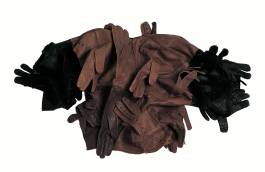
Lucy + Jorge Orta, “Identity + Refuge - Glove bolero”, 1995, 24 pairs of leather gloves, Photo: Marie Clerin
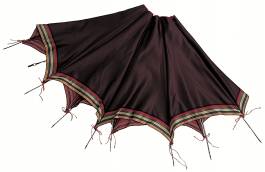
Lucy + Jorge Orta, “Identity + Refuge - Umbrella skirt”, 1995, Silk umbrella circa 1950, Photo: JJ Crance
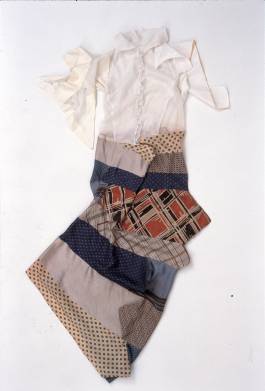
Lucy + Jorge Orta, “Identity + Refuge - Cocktail dress”, 1995, Cotton jabot circa 1910, 1170's silk ties, Photo: Marie Clerin
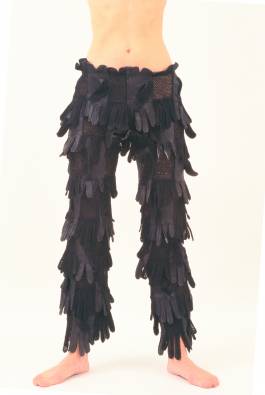
Lucy + Jorge Orta, “Identity + Refuge - Hipster pant”, 1995, 36 pairs of black leather gloves, Photo: Marie Clerin
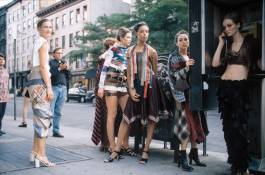
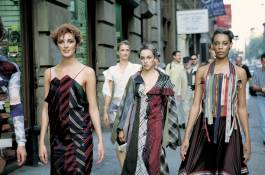
Lucy + Jorge Orta, “Identity + Refuge II - experimental catwalk (Catwalk from Salvation Army Spring Street to Dietch Projects, New York)”, 199, Photo: Marie Clerin
2019
LUCY ORTA: WHAT I WAS DOING WAS A SOCIAL PRACTICE THAT USED CREATIVITY AS A STARTING POINT
Dobrila Denegri: I would like to start this conversation by asking you about the term “co-creation”, which you applied to very early projects you realised in the mid-‘90s, as well as to some realised in 2018.
Kate Fletcher speaks about “co-design” as a model “shaped by the goal of collaboratively designing products together with the people who will use them.
Co-design principles of inclusiveness, cooperative processes, and participative action work to disrupt hierarchical power relations (as exemplified in most fashion brands) and offer users of clothes more control over their garments’ design and production.”
On the other hand, Sandy Black uses the term “co-creation” to address the intersections between fashion, science and technology, pointing to collaborative practices that involve researchers from different disciplinary fields.
I would be interested to understand what you intend by the term “co-creation” and whether this differs from how this and the term “co-design” are interpreted by other scholars.
Lucy Orta: The definition of “co-design” that Kate Fletcher cites is very similar to what we term “co-creation”, and inclusiveness, cooperative processes and participative actions are methods we employ when working with different groups of people. Kate’s research operates in the field of fashion design and its related practices, and she speaks of ‘product’ outcomes linked to clothing and its surrounding industry.
My practice, and that of Studio Orta, operates in the field of contemporary art, and we have approached the concept from a different disciplinary stance. The co-creation we refer to is deeply rooted in Jorge’s collaborative practice throughout the 1970s in Argentina, and the methods and processes he experimented with are inherently bound to the development of my artistic practice from the 1990s.
The dictatorship dominated the 1970s in Argentina, and contemporary art practice shifted radically due to the political climate and the restrictions it imposed. With the military oppression and violence, Jorge and his young colleagues began questioning the ‘traditional’ academic art practices, looking for new artistic means to condemn the increasing social injustice, challenge the structures of power and give new visual forums to suppressed issues. The work they created couldn’t be exhibited in public for fear of repression, and so the question of audience became a preoccupation; who were the audiences for the new art forms they wanted to develop, and how could they interact with them under a regime of imposed silence? Informal gatherings and underground activities became one of the methods; they served both as a safe space to create together and as a way to reach new audiences through shared expression. The notion of a single authorship was not a preoccupation or goal, and there were no points of dissemination; no museums or galleries were interested in presenting this kind of subversive work. Art was created together, in groups with a collective voice, in response to the extreme political climate.
DD: When you realised “Co-creation”, was it intended as a fashion project, or as an artistic one? And what was the reception of your works in the domain of contemporary art and in the domain of fashion-related research?
LO: The first co-creation project I developed was “Identity + Refuge” (1995). It evolved organically from the responses I received to my “Refuge Wear” exhibition at the Salvation Army Cité de Refuge in Paris (1994). I had been organising workshops with the hostel residents to gather their feedback, and the director of the Salvation Army, an amazing champion of the arts, suggested I create a fashion show featuring the “Refuge Wear” on exhibition. As the work was not conceived as clothing or ‘objects of fashion’, I didn’t think it was appropriate, so I proposed a new workshop to engage more residents in the hostel. It would include elements of fashion – designing clothes and a catwalk – but would be based on a more social approach to making, with an element of psychology involved. I based the idea on Social Enterprise models I had seen in Australia; as far as I knew, they were not present in France at the time. Together with the residents and staff, we would go on to create a collection of clothing out of the discarded surplus clothing donated to the thrift store, using simple methods of transformation, breathing new life into unwanted goods to create a new identity both for the clothes and possibly for the participants involved. I believed that developing creativity and pairing it with training activities such as reconditioning or manufacturing could eventually lead to reinsertion. What I was doing was a social practice that used creativity as a starting point, and the co-creation methodologies I put in place could potentially be applied across different disciplines. The director of the Salvation Army was a great inspiration; he deeply believed in the power of art and culture to bring about change, and that the role of artists was to bring culture to the doorsteps of minorities and to involve them in the process.
The final result, a collection of innovative clothes, received a lot of positive attention in the critical fashion press, and it was even copied by Martin Margiela¹.
The art critics slandered it as ‘social work’ and as not relevant to contemporary art's current concerns.
What was extremely motivating about “Identity + Refuge” and other co-creation projects that followed was a deep sense that we were breaking down the elite bastions of contemporary art. We were taking art out of galleries and museums and into people’s lives, implicating them in the process of creation. We were acting as the go-between, giving people marginalised from the centres of power access to culture. We brought communities who would have never ventured into a museum or a gallery into these spaces. In the same way that co-design “attempts to disrupt hierarchical power relations”, the co-creation we experimented with in the 1970s and 1990s did the same.
By the mid- to late-90s, graduates from the new MAs in Curating Contemporary Art were entering the workforce². Educational outreach programmes were being established, and as a result, new curatorial practices were being implemented. But despite these efforts, many virulent critics still didn’t see a place or role for artists working with communities. Some of the museums I worked with didn’t really know how to stage an exhibition that wasn’t a single-named artist, and we argued incessantly about interpretation labels for the artwork and the best way to represent the participants or groups. Although we created fantastic work with different communities, it wasn’t a very satisfying period in terms of its dissemination, and so many of the project outcomes of this period have not been widely presented, and some have never been exhibited; they remain buried within our studio archives. However, later you will find other examples of artists who used the medium of clothing in similar social and political ways - Alica Framis, Andrea Zittel, and Mela Jaasma, for example³ - and so eventually there is a ‘trickle-down’ effect.
DD: Were there any specific theoretical references which played a role in your early work?
LO: Very early on in my artistic development, in the mid-90s, I began experimenting with co-creation without the knowledge of Jorge’s earlier practice in Argentina. One explanation could be that the political climate once again triggered a repositioning of the practice of art (and design). With the outbreak of the first Gulf War, my meeting with Jorge and the economic recession that unfolded post-war, I began to question my profession as a fashion designer, which no longer seemed relevant in the face of society’s collapse. I shifted my perspective away from design, searching for ways to use my creativity to express social concerns and bring about a new social consciousness. I looked for examples outside of the field of fashion because there were none that I could relate to from within.
One of my references was the curator and writer Mary Jane Jacob, who published “Culture in Action” (1995)⁴. She curated public and site-specific art projects and worked with a number of artists who were engaging with communities to explore social and political issues through art-making - this was later to become known as ‘socially engaged art’, or ‘social practice’. Mary was a pioneer and remains the most important proponent of this genre. I read about the work and cooperative methods employed by artists, including Suzanne Lacey, Mark Dion, Judy Chicago, and Mierle Laderman Ukeles, for example.
DD: I am wondering about the resonance that projects like “Procession Banners” have now in the fashion and art world… after twenty years, what has changed, and what is the response of communities you are interacting with now?
LO: Being involved in “Procession Banners” (2018) has renewed my interest in the potential for co-creation, and my new projects will be focusing on this. Thanks to the Social Responsibility team at London College of Fashion (LCF), University of the Arts London, and an important commission from Historic England, I was able to work with a group of women from HMP Downview to pay homage to the suffragettes who were imprisoned at Holloway during their struggle to obtain the women’s right to vote⁵. The embroidered textile banners resulting from the collective workshop boldly express the thoughts, feelings, and aspirations of the women involved. The women of Downview were proud to be represented, to project their voice beyond the confinement of the prison walls. At the same time, they learnt a lot about working together on a common project and their collective voice on the thirty banners was the powerful outcome.
After the mass procession on June 10th 2018, which brought together over 30,000 women to celebrate the 100 years of the Representation of the People Act, I contacted museums and galleries in the UK, looking for opportunities to present the work, and I was overwhelmed by their positive responses. The “Procession Banners” were exhibited by the Ikon Gallery in Birmingham, in their new space at the Medicine Gallery (October 2018 to January 2019). Now they are hanging at the De La Warr Pavilion as part of an important exhibition that explores the many forms resistance can take, “Still I Rise: Feminisms, Gender, Resistance, Act 2” (February to May, 2019). The Serpentine Gallery have expressed an interest in supporting a second phase of this project, which is very exciting. It goes to demonstrate that established institutions and curators have now fully embedded social engagement in their programming and have the resources to encourage more experimental community-driven approaches.
As well as new curatorial approaches, perhaps the interest and support today is reflective of a number of other influencing factors: an renewed appreciation in the hand-crafts, which are skills that can be relatively easily adopted and shared with groups of people in co-creation settings; a wider appreciation of so-called ‘feminine’ approaches to making (textiles, embroidery, crochet, etc.); a better representation of women artists using these kinds of techniques in major museums; and a better representation of non-western styles of art and therefore an opening-up to new cultures, styles, techniques that offer new ways of interpreting and appreciating art. There is also the breaking down and merging of disciplines, which I see through the wide variety of educational programmes that I’m invited to speak to.
DD: It seems that we are reaching a moment when larger ecological, sociocultural, and economic forces will cause a re-examination of design’s value systems as well as the places where design skills are applied. Do you think this might lead to the emergence of new roles for (fashion) designers and new places to apply creative capacities outside traditional product-based routes?
LO: Yes, you are right. These forces have been developing for quite some time, and the more traction they gain, the more they will become part of a new system. We have waited almost 30 years for social practice to become more mainstream, so we should expect a similar timeframe for design practices. However, there is a difference between ‘product’ and ‘art’, and this will need reevaluation, especially in terms of any institutional or cooperative frameworks that need to be put in place or consolidated to support these emerging practices. For example, how do these new designers disseminate their work, where and to whom, and how are they supported financially in order for these practices to become more sustainable, etc.?
There is also the question of aesthetics, and this is a much more complicated area to pin down and negotiate. Hopefully, these new practices will begin to disrupt dominant aesthetics, especially in fashion, which is controlled by global trends. The term Nicolas Bourriaud uses is ‘circumstantial aesthetics’ - the outcomes produced during co-creation or cooperative processes are related to the context and circumstances in which they are produced, together in discussion with people from different ages and backgrounds. The outcomes take on a new aesthetic that we are less attuned to or familiar with, and therefore not yet so comfortable with. A better understanding of how new aesthetics can influence the emergence and establishment of these domains could be an interesting area to explore further.
DD: How can educational institutions and research programs encourage the younger generations to explore these new routes?
LO: Together with very passionate colleagues, we established the first social and sustainable Master of Design programme at Design Academy Eindhoven in 2002, with the ambition to underpin an introduction of sustainable issues across all the programmes at the BA and MA levels. I think it’s essential that a basic education relevant to the discipline be rolled out across all undergraduate courses. This means training or recruiting knowledgeable pedagogic and academic staff in the subject areas. Now at LCF, I’m taking part in a new Better Lives Unit under the heading ‘Democracy & Activism’. The Better Lives Units will be offered to all first-year BA students. Other headings include: ‘Social Justice’, ‘Nature’, ‘Identities’, ‘Empathy’, ‘Cultural Sustainability’, ‘Wellbeing’, ‘Power’, ‘Representation’, ‘Collaboration’, and ‘Inclusion’. This is an incredible offer that will give young people an opportunity to confront topics that may be new to them. These kinds of proposals need to be embedded throughout any student’s trajectory.
¹ Maison Margiela Artisanal Collection, 2001.
² The RCA established its MA in Contemporary Curating in 1992 and Goldsmiths in 1995.
³ Alicia Framis: Anti-dog, 2002; Andrea Zittel, Uniform 2003; Mela Jaasma: The Follower, 2002, Refugee Only 2003.
⁴ E.M. Olson, M. Brenson, M.J. Jacob, Culture in Action. Seattle: Bay Press, 1995.
⁵ Workshops in the LCF Making Change Unit at HMP Downview ran from January to June 2018.
Lucy + Jorge Orta, “Identity + Refuge - Glove bolero”, 1995, 24 pairs of leather gloves, Photo: Marie Clerin
Lucy + Jorge Orta, “Identity + Refuge - Umbrella skirt”, 1995, Silk umbrella circa 1950, Photo: JJ Crance
Lucy + Jorge Orta, “Identity + Refuge - Cocktail dress”, 1995, Cotton jabot circa 1910, 1170's silk ties, Photo: Marie Clerin
Lucy + Jorge Orta, “Identity + Refuge - Hipster pant”, 1995, 36 pairs of black leather gloves, Photo: Marie Clerin
Lucy + Jorge Orta, “Identity + Refuge II - experimental catwalk (Catwalk from Salvation Army Spring Street to Dietch Projects, New York)”, 199, Photo: Marie Clerin