


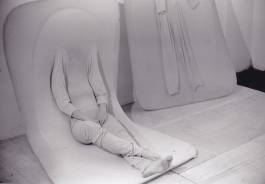
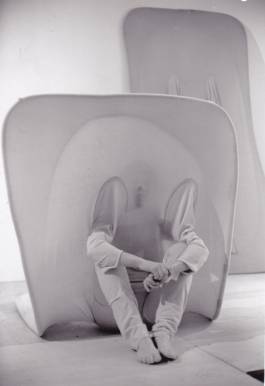
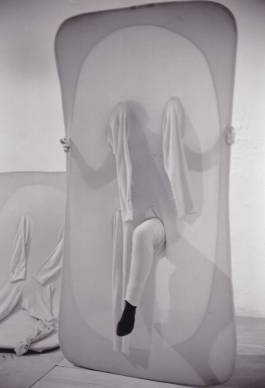
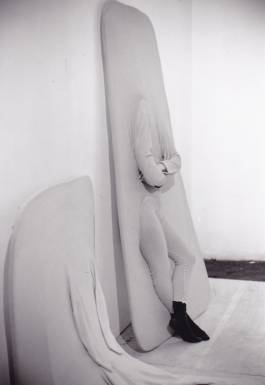
Ute Neuber “Walking Wall”, 1991, Photo by Angela Althaler
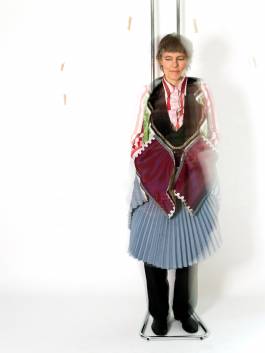
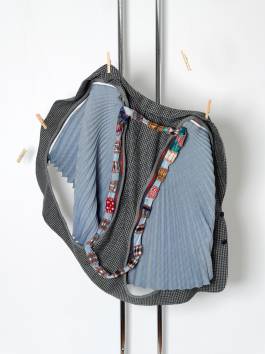
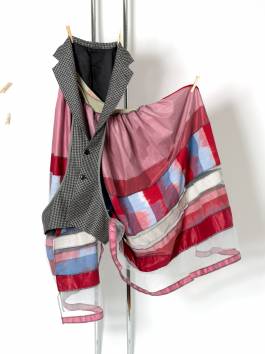
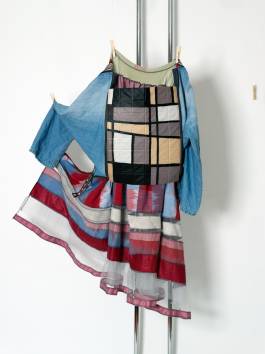
Ute Neuber “Daily News”, 2013, Photo by Gisela Erlacher
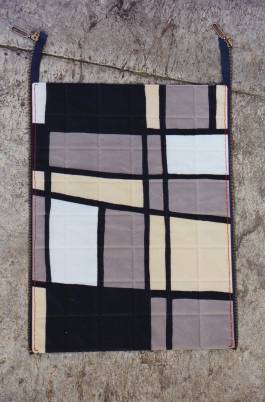
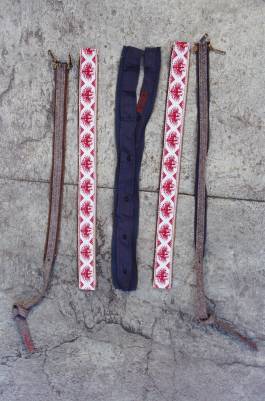
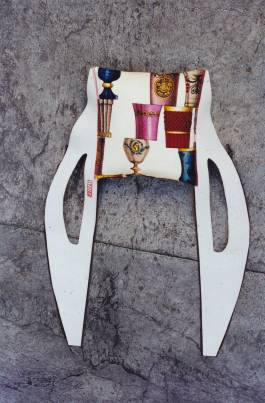
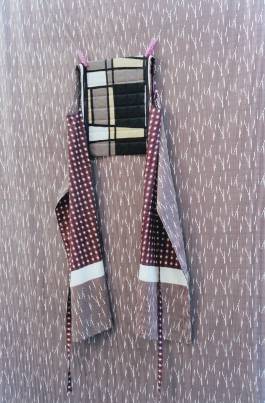
Ute Neuber “Daily News”, 2013, Photo by Elmar Fröschl
2019
UTE NEUBER: I AM INTERESTED IN THE SHIFT FROM CONSUMER TO CREATOR
Dobrila Denegri: You are sometimes defined as a performer, but still, a significant part of your work relates to the fields of fashion and textiles. Where would you locate your current practice in disciplinary terms?
Ute Neuber: I started with goldsmith studies, metal product design, and millinery, but soon I shifted my interests towards textiles and interactions between garments, body and space. On one occasion, Barbara Putz-Plecko introduced me as ‘undisciplined’ and spoke about where my practice should be located.
I could also see myself under the term you proposed once: “experimental artistic design”. My practice developed gradually, and I started acting on my own in front of people in 1989, not to perform, but to demonstrate how my modular mounting system, the 18-part endless dress, works.
“To show how something (also ideas) works” is my motivation to perform.
Initially, all my thoughts and experiments revolved around the question of how dress can be used to change or adapt to the surrounding space. I call this phase “wearable dwellings”. At that time, I also developed an interest in the work that Lucy Orta was doing. I created foldable textile structures for several experimental pieces and developed installation strategies for quick changes. Through my work, I was exploring body/space relations, but always starting from me, my mechanical human potential and my perception. I see my process-oriented style of working as a bodywork practice.
DD: Through your work and your workshops, you challenge some of the foundational aspects of the fashion-design process, starting with the omission of the “Lavigne bust”, a mannequin created in 1841 by Lavigne as an ideal body shape on which to base the creation of garments. What happens when you remove basic systems of guidance?
UN: The idea of not using mannequins came out of the concrete conditions of several workshops I had been leading since the late 90s, and it came as a part of a spontaneous and empirical approach to the space, and how my students and I reacted to a given space.
Traditionally, it is expected that in fashion workshops you find big tables for cutting, mirrors and “Lavigne busts” which occupy most of the space and implicitly give directions on what to do and how to do it. Certainly, Alexis Lavigne, the Master Tailor who worked in Paris in the nineteenth century, was an important figure, and his inventions, patented tools (like a model’s bust or the tape measure), and the principles of teaching cutting methods are still in use. ESMOD, the school he founded, remains a point of reference for certain approaches to tailoring and creating fashion. Yet, in my approach, I recognise references to methods used at the Bauhaus school, which were re-proposed at the Angewandte during my studies, although I am not happy with the distinctions between design and fashion that it introduced, omitting to include fashion design courses in its curriculum.
In my later practice, the work of Otto von Busch and his fashion-activist writings and manifestos had a lot of resonance.
But as I mentioned initially, focusing on proper body and space emerged from a concrete situation. I was a part of a collective called “modebus”, and each of us from the team led a short course at the Salzburg Summer Academy. For my course, I sewed one meter cubicles for each of the 12 students and hung them from the ceiling so that these transparent shapes would occupy the ‘airspace’. To my huge surprise, the first thing students did was to enter these cubicles. These hanging structures increased our awareness of the space between the ceiling and the floor, and automatically, our movement in the space became more dominant and dynamic.
Forming free-hanging textiles became part of the form-finding processes that the students undertook. One of the students transformed this cubicle into trousers, for example. He started the form-finding process by inserting strings at the vertical edges, so that the lengths could be varied. When he saw the effects of these variations on the cube, he came to a vision of trousers. This principle of shifting attention from the still, steady body of a mannequin to the space itself, and in particular to the empty ‘airspace’ where we, as participants in the workshop, could move, developed further on several subsequent occasions.
In 2014, AUT University in Auckland launched a call for “ShapeShifting - Conference on Transformative Paradigms in Fashion & Textile Design,” and we at the Angewandte started preparing our participation. During these preparatory sessions, one of my students, who was a climber, brought her equipment and set it up in the room, so we again focused on the ‘airspace’. Through her work, she offered us the opportunity for unusual bodily experiences. The group of students concluded that wiggle-room, in the sense of a playground, is needed to trigger collective activities for the development of cloth. Our subsequent workshops always began with removing furniture ("Möbelrücken") to clear the ground, so we could lay carpets, which became part of our equipment from then on. While lying, sitting and moving on the floor, we discussed and worked.
DD: What does “form-finding” mean in your practice?
UN: I connect “form-finding” with systems I develop for playing, like “Kleiderbausatz” or other shape-shifting tools, as well as with forms I find around and use as a starting point to develop something new. These are “form-finding” and “form-founding”.
I began with closed loops, fascinated by the possibility of building something around the body and away from it, starting with a bracing loop outline. Then, in my atelier, I found a cut-off section from a long dress, which I transformed into a closed loop, and took this as an inspiration for a closed loop series of “Kleiderbausatz” parts.
DD: How important is the fact that you reuse existing garments for the creation of modular elements, which can then be infinitely reassembled and recombined?
UN: When I started with the “Kleiderbausatz”, it was not important to reuse existing garments. It was just useful and easy to take existing clothes for material drafts, in order to test the system, which I began to develop.
During the process of development, I was invited to collaborate with Tiroler Künstler*schaft in Innsbruck. The idea was that Tyrolean artists would design patterns for fabrics out of which I would create something fashion-related. So I started to think about my relationship with patterns. For me, patterns were more than printed fabrics; it was more about textures, material treatments and characteristic textiles with all their details and particularities. Ease and the theme of fabric patterns brought existing garments into play. When they were in, they became important because people often react to them. Sometimes people want to bring garments they don’t wear anymore, to transform them into a personal “Kleiderbausatz”. Thus, the “Kleiderbausatz” is sometimes seen as an upcycling project, but it is not what I focus on primarily.
DD: Is there a distinction between dressing and wearing, according to you?
UN: Since I started with an interest in modern jewellery, I often thought about the shift between jewellery and cloth. I made the distinction between how and where something is held on the body.
Later, when I started to develop my systems, like “Kleiderbausatz”, I started to sum up my experiences, perceptions and thoughts, and I came up with phrases like: “To wear the process or to be dressed with the process”, or “to be dressed in the experience of the dressing-process.” They tend to describe what I go through while carrying on “Kleiderbausatz” as a daily practice, or daily exercise. For a while, I was doing something I used to call “Daily News”, which consisted of a daily action I would undertake: going to my atelier to dress myself in “Kleiderbausatz”.
Dressed like that, I would walk to the shoe shop where some of my pieces were displayed in the window, together with a big photo of “Kleiderbausatz”. So once in the shop, I would exchange pieces, keeping some I was wearing and putting on others that were already there.
Through this work, I came to experience what dressing and wearing practice means.
The time I spent doing these actions brought a sense of playful ease to the whole day. I had the feeling that I was creating a sort of immaterial dress just through this process of dressing up.
DD: Challenging foundational elements of the design process and using already existing garments - does this indicate some new way to make/understand what fashion is or what it might become?
UN: I am interested in the shift from consumer to creator. Already existing garments are helpful for this. How do consumers adapt clothes for themselves? When I work with students who will become educators, they engage with that issue very well. First, they shift from consumer to creator, and then they can disseminate their experiences and skills in their work at school.
DD: I see an important choreographic element in your work, if in the word “choreography” we hear an echo of two correlated interpretations: one connected with the Greek root of the term “choreo”, which means dance, movement; the other connected to the term “chorus”, which indicates a group, a relation/interaction between several subjects. What role do these elements have in your practice?
UN: During my search for activities for the “ShapeShifting” Conference in Auckland in 2014, I became interested in archive approaches around dance and choreography, like “Motion Bank”, a project by The Forsythe Company providing a broad context for research in choreographic practice, or AID (Les archives internationales de la danse 1931-1952) which, through a library, archives, exhibitions and lectures, tried to give wide public access to a true choreographic culture, and played an essential part in the dissemination of modernism in dance.
In Vienna, the state's search for concepts to support the dance and fashion scene, nationally and internationally, began about the same time, around 2000. Already at that point, I had the feeling that it would be interesting for the fashion scene to build something like the Tanzquartier Wien TQW for them as well. When I read about the motion bank or the AID, I saw that fashion again, as a métier of body/movement/social art, like dance and choreography, could have been implemented in those archives.
Like choreography and dance, my experimental process-oriented developments are not directly related to commercial aspects. I want to bring something into the world that one can start to experiment with and play with, in order to experience oneself in surprising form-development-actions, which most people immediately want to share and do with others. Therefore, I create settings and tools for exhibitions, performances and informal meetings. The opportunities to experiment and to surprise oneself are the same for me.
Ute Neuber “Walking Wall”, 1991, Photo by Angela Althaler
Ute Neuber “Daily News”, 2013, Photo by Gisela Erlacher
Ute Neuber “Daily News”, 2013, Photo by Elmar Fröschl