


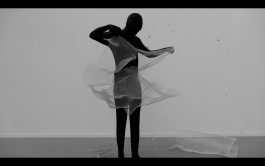
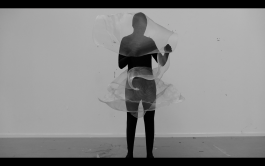
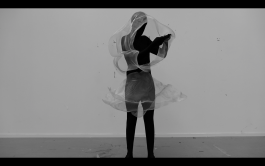
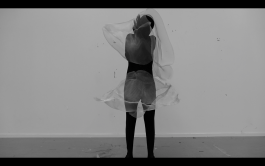
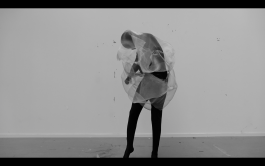
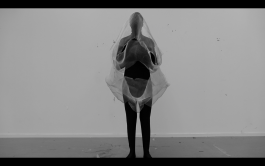
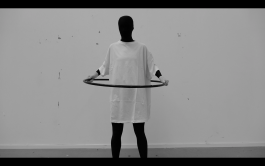
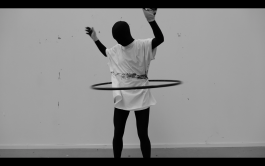
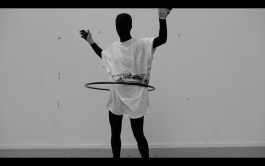
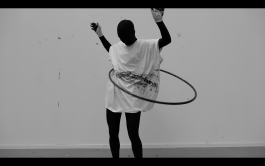
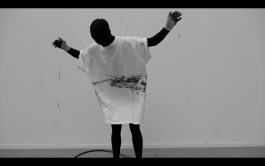
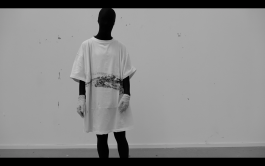
“Dressing Wearing”, 2014/15, Video still
2019
ULRIK MARTIN LARSON: THE “GARMENT” COULD BE ANYTHING AND EVERYTHING THAT RELATES TO THE BODY
Dobrila Denegri: You have been trained as a fashion designer, but very early on, you shifted your interests and engagements towards costume design. Where would you locate your current practice in disciplinary terms?
Ulrik Martin Larson: The shift towards costume design was pretty random at the time; I was asked to make a tuxedo for a friend of a friend’s wedding, and that friend turned out to be a dancer/choreographer at The Royal Danish Ballet. We quickly became friends, and he asked if I was interested in doing some costume work for two modern pieces he was choreographing at the time. I had just graduated and was quite undecided about what I wanted to do, so I jumped at the opportunity to try working in a slightly different field.
It was a very fruitful collaboration, and to me, there wasn't any fundamental difference - I was dressing the body, and in this case, highly skilled and trained bodies that could do amazing stuff with garments in movement, which, in turn, of course, opened up a lot of new ideas and approaches.
Along the way, there have been several other collaborations, within costume design, fashion design and photography/sculpture, and I feel at home working in all those disciplines. Over time, I have discovered that I'm more interested in the idea and in finding the proper context or medium to suit that idea.
DD: There are many examples of collaborations between fashion designers and choreographers engaged in contemporary dance. Are there any among those that you feel are particularly inspirational/referential to your way of dealing with the choreographers and dancers you collaborate with?
UML: It's difficult to get insight into how other collaborations work, as we are normally only faced with the final result. Purely based on the visual output and the concept, many works are visually arresting, and I have a soft spot for Sasha Waltz and her seminal work "Körper", in which bodies, scenography and objects all interact with movement. To me, this was one of the first pieces where I experienced a different sort of synergy on stage, in which a narrative unfolded through the relationship among the body, movement, and object.
DD: In the experimental sessions you conducted and filmed, it seems to me that the “garment” is a subject and an object of choreography. But then this “garment” is not really a garment in a conventional sense of the term. What is this “garment" for you?
UML The garment is an object that facilitates certain movements or movement patterns and directs the body. It could be seen as a kind of implicit choreography held within the form of the garment. To a certain extent, the "garments" are speculative, as they are designed to instigate movement without knowing exactly what those movements will be before the wearer takes over. Generally speaking, the “garment” in my view could be anything and everything that relates to the body.
DD: Is a “garment” determining the movement, or is it a negotiation in which you and the performer also play a role?
UML: It’s a triangulation of performer, garment and me as a sort of instructor; in some cases, I leave it open for the performer to discover what to do with the garment, at other times, I give simple instructions and a way to start the bodily conversation between the performer and “garment”. Improvisation plays a big part in this process, and it’s often a question of starting over many times, each time with a new focus, a new placement of the “garment”, involving more performers and trying to exhaust the possibilities or the potential of the “garment”.
DD: Are your experimental filmed sessions a “work” in their own right, or do they have some other, maybe even practical, end/aim?
UML: They are both results and processes, open and finished. I hope that they are also a kind of manual, a way to start working with or think about garments, bodies and movement in a different way.
DD: Do you see films as mere documents of experimental exercises you conducted, or do they have the status of an “artwork” to be shown within exhibitions?
UML: In most of the films, there has been an editing process to ensure a flow of sequences; there has been tampering with the speed and flow to pinpoint or obscure certain elements, so in this respect, there have been some artistic choices made. I guess you could say that they are artistic documentations.
DD: What is, in your opinion, the distinction between dressing and wearing?
UML: Wearing and dressing are, of course, closely related, and in analysing and conducting my practical work, I get quite confused at times. Dressing to me represents all the in-between stages of a garment, the garment in movement, whilst being put on or taken off the body. The scope of dressing is somewhat wider, as actions such as holding the garment, picking it up from a chair, or unfolding, unbuttoning, or unzipping all point to an impending action involving the garment. Wearing, on the other hand, implies that the garment “follows” the body.
DD: Laying the attention on “wearing” (as it seems that you are doing) - does this indicate some new way to make/understand what fashion is or might become?
UML: I find it quite fascinating that the making of form in fashion is such a static endeavour; in most cases, garments are based on flat pattern constructions or draping on a dress stand (mostly just a torso without a head, neck, arms, legs, feet, or hands).
I suspect there is significant potential in involving the moving, active, or performing body much more in the development of garments and form in general.
“Dressing Wearing”, 2014/15, Video still