


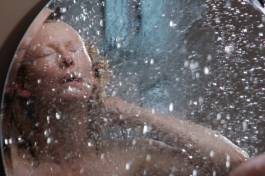
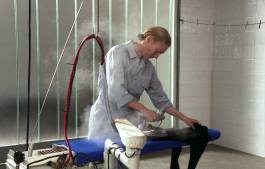
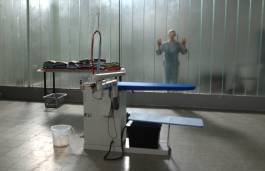
Hussein Chalayan, “The Absent Presence”, 2005, Videostills, video 12’53’’, Courtesy of the artist and Galerist, Istanbul, © Hussein Chalayan.
2013
HUSSEIN CHALAYAN
Turkish by origin, born in Cyprus, and emigrated to Britain, Hussein Chalayan explores themes of displacement, nomadism, identity, and trans-culturalism through his work from the very beginning, regardless of the chosen medium. He crossed disciplines and worked simultaneously within the fields of fashion and visual art, introducing innovative and experimental approaches through the application of new materials and advanced technologies.
From the memorable so-called “Airplane” dress from the spring/summer collection 2000, to the morphing dress “One Hundred And Eleven” and the 15.600 LED dress from the “Airborne” collection of 2007, and the organic speed dress from the “Inertia” collection (2009), he reinvented the very notion of garment, transforming it into a sculptural or performative object.
Furthermore, he produced several videos and short films, either as part of more complex installations or as standalone artworks, such as in the case of “Absent Presence,” realised in 2005 as a five-channel projection that premiered at the Venice Biennale when he represented Turkey, in the exhibition curated by Beral Madra.
“Absent Presence” emphasises the paranoia and the logic of securitisation in developed countries since 9/11.
It is presented as an experiment conducted in the UK, a nation with very high asylum rates and strict immigration policies.
The experiment is narrated by a British biologist (played by Tilda Swinton), who gathers biological data from the clothing of anonymous non-British women. Using the DNA extracted from these samples, the biologist develops a series of hypotheses about the appearance and social traits of the non-British individuals.
With the Arian scientist overseeing the experiment, Hussein Chalayan offers a pictographic account of modern essentialist views that could lead to biological racism in a radical environment similar to Nazism. The film ends with the biologist’s despair as they realise it is impossible to truly determine the biological origins of the examined individuals.
Chalayan works across the fields of art and fashion interchangeably, with a focus on the performative body and the construction of cultural identity.
He was recognised as British Designer of the Year in 1999 and 2000.
His solo exhibitions include those at the Design Museum, London; Lisson Gallery, London; Galerist, Istanbul; Istanbul Modern; and the Museum of Contemporary Art, Tokyo.
He has also exhibited at the Victoria & Albert Museum, London; Museum Bellerive, Zürich; Kunstmuseum, Wolfsburg; and the Royal Academy of Arts, London.
Hussein Chalayan, “The Absent Presence”, 2005, Videostills, video 12’53’’, Courtesy of the artist and Galerist, Istanbul, © Hussein Chalayan.