


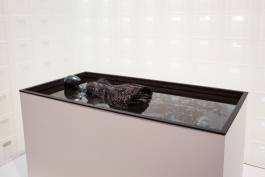
Iris van Herpen, installation view from the exhibition Future of Fashion is Now, 2014, Museum Boijmans Van Beuningen, Rotterdam.
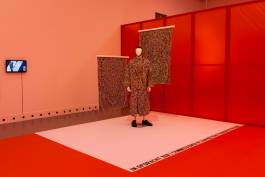
Craig Green, installation view from the exhibition Future of Fashion is Now, 2014, Museum Boijmans Van Beuningen, Rotterdam.
2016
JOSE TEUNISSEN: CURATING FASHION IS A CULTURAL PHENOMENON
Dobrila Denegri: Fashion curator is still considered a relatively new professional profile. How did you get started, and what does curating fashion mean for you?
Jose Teunissen: I started in fashion and fashion theory. I wrote a lot as a fashion journalist, and when I got a chance to work as a fashion curator, it felt like an opening, a chance to explore fashion differently. I think fashion is a powerful cultural phenomenon. It’s something we experience unconsciously, something deeply interwoven into our culture. But we are not so much aware of it. From the very start, I looked into what is happening now, or what will be happening – grab the moment and make sense out of it.
Curation is different; it‘s a visual language you have to think about and define its teams. It’s always important to select artists/designers who can present something interesting, but what is even more important is to be able to tell a convincing story. Despite being relatively new, fashion curation goes beyond mere exhibition-making. It is a part of the commercial industry, too.
For me, curating means bringing something that's normally hidden to the surface, making things visible, and putting them into a range that is not commonly defined. The interest of both the academic and commercial world is that fashion behind the object has a cultural story to tell, or that it can engage with an audience by presenting physical artefacts in a specific way. In this sense, a fashion exhibition fulfils a space that a classical catwalk, photography, and written studies are unable to provide. That is why the curator’s profession became more relevant than it used to be.
DD: What were your first steps in fashion curating?
JT: It was 1998 when I started at the Centraal Museum in Utrecht, a museum with a big historical collection of costumes in the Netherlands. The museum’s policy allowed me to invest in young designers, which was quite uncommon back then. Thus, I started to include in the museum’s collection work of emerging designers such as Margiela and alike, not knowing if they will ever become icons. One of the very few museums that had a similar approach was the Kyoto Costume Institute. It proved to be the right strategy, and many pieces that we bought for affordable prices became iconic over time.
Centraal Museum was in the process of rebuilding when I started, and this gave me time for reflection. My first exhibition dealt with what later became known as “The Dutch Wave”. We showed together fashion and product design of the upcoming generation of designers, stressing the fact that they come from the same cultural tradition and share the same conceptual premises.
But it’s my second project that really became a marker of what I mostly do. Exhibitions I developed were based upon the same principle, which was called “A Woman By”. It debated the role of the woman as an ideal object for a designer. I noticed that many designers have a very specific concept of a “woman” behind their designs, so I asked nine designers to take part in the exhibition and commissioned them to produce works conceived especially for the occasion. It was interesting to put in perspective and compare the visions of women from designers such as John Galliano, Viktor & Rolf, Hussein Chalayan, Ann Demeulemeester, Martin Margiela, Vivian Westwood, etc. This gave me a chance to talk about femininity, about a woman as an object in fashion and the role a woman plays in fashion.
DD: Since the theme of cross-pollination between art and fashion is one of the key features of this project, I would like to ask how you approached this issue through your curatorial projects.
JT: “The Art of Fashion / Installing Allusions”, curated alongside Judith Clark, was an exhibition about relations between art and fashion, and it was presented in the Boijmans Van Beuningen museum in Rotterdam in 2009. We wanted to explore how the avant-garde fashion is more and more about exploring its boundaries, using further elements from the field of art. Fashion shows became performances, clothes became non-wearable objects and so on. This is the process we tried to visualise in the exhibition. Yet, what we encountered was a still persisting dogma that these two domains of creativity shouldn't be mixed because one represents “high” and the other “low” culture. It was profoundly shocking for me.
This brought me to the second exhibition, which can also be seen as somehow related to the project we are now doing together. It is “The Future of Fashion is Now”, also presented in the Boijmans Museum in 2014. It was a challenge because the starting point was to seek out the new names, young and still emerging designers who are doing some forward-thinking work. We did extensive research and scouting and came up with an exhibition that presented some well-known artists and designers, along with a generation of interdisciplinary practitioners who knew each other’s work through the internet but had never met in person. This show brought the world together and made us aware that the world has changed.
“The Future of Fashion is Now” made me think about how we were helping, shaping, and developing the future that was happening now. We had to tell the story of it and make it understandable.
DD: Does outlining such a global perspective also require specific theoretical back-up? Where do you derive your inspiration from?
JT: I base my exhibitions on the things I read. For instance, the writings of Nicolas Bourriaud were very influential. Even if he writes about art, his reflections can be easily transposed to fashion. We live in the era of constant mobility; now people settle and root in different places over their lives. Bourriaud compares it to strawberry plants: you move, ground in this new place for a while, and then move again. Every time you move, you adopt something from the culture you encounter, and you tell a story about your own cultural background, trying to use as universal a language as you can. This notion of identity as something in a constant process of becoming was for me very interesting. Bourriaud speaks about this phenomenon as “radikant” identity. For him, to be “radicant” means setting one’s roots in motion, staging them in heterogeneous contexts and formats, denying them any value as origins, translating ideas, transcoding images, transplanting behaviours, exchanging rather than imposing.
Transposed into fashion, these ideas prompt us to question how we build new relations between our bodies and the world around us. Also, ask how clothing will impact the construction of this new form of hybrid identities, or what beauty ideals it can generate and how it can change the notion of luxury.
Another inspiring author is Arjun Appadurai, who wrote about the impacts of media on our collective imaginary already in the 90s, before the internet really connected the world.
DD: Could you mention some names? Who are the designers whose work you could signal as particularly relevant in relation to these issues concerning identity and gender shifting, or urgencies linked to the environment and technological advancement?
JT: As pioneers, who I often involved in mentioned exhibitions and other projects, I would mention Hussein Chalayan, Viktor & Rolf, as well as Iris Van Herpen, Craig Green, Christophe Coppens. Among the younger ones who speak about ethics and responsibility, I find the very interesting work of Elsa Van Joolen, with her critical stance towards industry and brand construction. Or Victoria Ledig, who is standing for more transparent and direct communication when it comes to marketing strategies. She is a young Dutch designer who produces bags from leather industry byproducts. She is not creating some kind of artificial dream story like traditional luxury houses, such as Luis Vuitton, would do to sell their products; she is telling a real story about the responsible use of the prime matter.
When it comes to the question of the environment and technological advancement, one of my colleagues from UAL, Carole Collet, works on the futuristic idea that plants could be genetically engineered to produce textiles alongside food. Another future-oriented project which responds to the need to correct body posture through clothing is “FysioPal", developed by Pauline van Dongen in collaboration with Elitac.
DD: What would you say is fashion’s biggest resistance when it comes to renewing itself and its standards?
JT: Maybe the last taboo of fashion is its aesthetic rigour. The model designers are using has to be young and size 34. That’s fashion’s “standard” body, the one you'll see in all magazines. But does it have to be the only ideal? Or we can be a little playful? We addressed this question in the exhibition section entitled “Redefining Human Body”. There is a parallel history of “altered” bodies, found in the domains of carnivalesque, grotesque, and similar literary and performative traditions. Today, we have artists/designers, as Japanese Pyuupiru, who address the question of the body beyond binary definitions. It’s not only the question of gender, it’s a question of different standards of what beauty and “ideal body” might look like. Pyuupiru creates these excessive body extensions, altering the “natural” morphology of the body to shake conventional understandings of beauty.
DD: How do you see the position of fashion designer versus this super-accelerated rhythm of the fashion system and its hunger for “the next big thing”? Many designers are taking a step back…
JT: Among the first who addressed this problem, abandoning ready-to-wear production and returning to haute couture, were Viktor & Rolf, a Dutch design couple with whom I worked from the very beginning of their careers. What they wanted to do was to find again the space of “freedom” where they could return to explore the limits of wearability, function, and form. What they do now is create very limited-edition items, as in the case of one of their last collections, when they made garments from leftovers, creating wearable art in the real sense of the word.
Some younger designers incorporate slowness, randomness, and a very poetic approach into their creative process as a statement against the imperatives of industry and commerce. An interesting example is Aliki van der Kruijs, a Dutch designer, who made a beautiful collection of scarves called “Made by Rain”. She developed her own technique, ‘pluviography’: photographic recordings of rainfall on textiles with a film coating sensitive to water. She literally “captured” and inscribed rain in the textile, transforming something highly ephemeral and uncontrollable into a fabric pattern. On each of the cloths, she also imprinted actual precipitation data, including location, time, and weather conditions.
DD: Seems that new generations seek new paradigms?
JT: I’d say that fashion designers are redefining values now. They are exploring the question: what imagination is and how it can be brought back to daily life, in contact with ordinary people. At the same time, imagination is coming into contact with new technologies, new tools which will determine the shape of our future.
Upcoming generations are finding more inventive forms to express themselves, going beyond classical formats, such as a collection of garments. They use films, presentations, exhibitions, interventions… and that is important because it replaces the catwalks and the classical fashion campaign. It also gives a wider span of materials to be shown, allowing fashion exhibitions to become more artistic and concept-driven.
DD: Coming back to curating, would you argue that fashion needs exhibitions?
JT: As I pointed out earlier, exhibition is about showing objects in the right way, but more importantly, it is about telling a story. For me, the main purpose of exhibiting is to tell something, to underline a certain narrative. To make something visible, tangible to make it accessible to people, to become aware of something that they hadn’t been aware of before. That is also a way to be political, to raise awareness or debate, to bring something into the spotlight. To create this free space in which different issues and perspectives can emerge and be discussed. We do need this space, especially in a moment like the present one, when everything seems to be about economics or political agendas that are becoming increasingly conservative and backwards-looking.
Iris van Herpen, installation view from the exhibition Future of Fashion is Now, 2014, Museum Boijmans Van Beuningen, Rotterdam.
Craig Green, installation view from the exhibition Future of Fashion is Now, 2014, Museum Boijmans Van Beuningen, Rotterdam.