


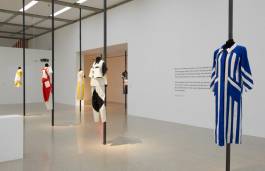
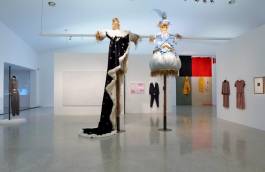
Costumes made after designs of Liubov Popova (1922) and Varvara Stepanova (1922), realised by Erika Hoffmann-Koenige in 1979, exhibition view “Reflecting Fashion”, 2012.
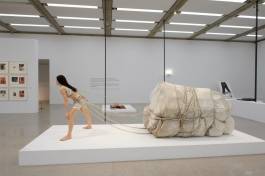
“Wedding Dress” by Christo (1967), exhibition view “Reflecting Fashion”, 2012.
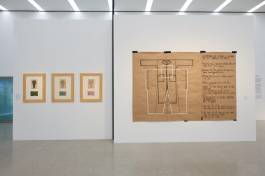
Tuta by Ernesto Michahelles – Thayaht (1912), exhibition view “Reflecting Fashion”, 2012.
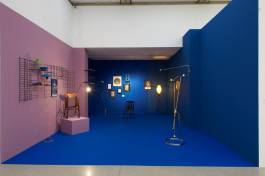
Jakob Lena Knebl, exhibition view “Reflecting Fashion”, 2012.
2016
SUSANNE NEUBURGER: I HAD BEEN PROPOSING EXHIBITIONS ABOUT THE RELATIONSHIP BETWEEN ART AND FASHION FOR OVER A DECADE, BUT I FACED RESISTANCE FROM THE MUSEUM OF MODERN ART IN ACCEPTING FASHION AS PART OF ITS EXHIBITION PROGRAMME...
Dobrila Denegri: The relationship between art and fashion throughout history is a topic to which you have devoted significant curatorial work and research. Please tell us briefly about projects you find especially meaningful.
Susanne Neuburger: I have organised several exhibitions on that subject, but the last one, titled “Reflecting Fashion - Art in Fashion since Modernism”, is my favourite. I am grateful to the director of mumok, Karola Kraus, who immediately embraced the idea when she took on her role at the museum. Before her, I had been proposing exhibitions like this for over a decade, but I faced resistance from the Museum of Modern Art in accepting fashion as part of its exhibition programme.
The first exhibition I curated was in the 1990s, and it examined cases where a genuine crossover between art and fashion occurred among Austrian contemporary artists.
The second was in 2008 at Kunstraum Niederösterreich, entitled “The Enforced Dress”, and the last one was “Reflecting Fashion - Art in Fashion since Modernism”, which took place in mumok in 2012. It was a large-scale exhibition, spanning four floors and covering a time period of over a hundred years, from early Modernism to the present day. I was fortunate to have a good team of collaborators, among whom Barbara Rüdiger made a significant contribution. Moreover, the exhibition display also addressed questions of fashion and was designed by two talented young artists, Julia Hohenwarter and Liesl Raff.
DD: What was the exhibition’s range in terms of topics and artists/designers involved?
SN: “Reflecting Fashion” united more than 300 paintings, drawings, sketches, textiles, videos and photographs by such artists as Giacomo Balla, Sonia Delaunay, Joseph Beuys, Andy Warhol, Yayoi Kusama, Cindy Sherman, Stephen Willats and many more.
The exhibition featured works on loan from over 70 internationally renowned institutions and private collections. There were a few thematic guidelines, among which I could mention a few.
“Let there be fashion, down with art!” was a section that dealt with the role Surrealism and other avant-garde movements played in the interplay between art and fashion. With his motto “Fiat Modes – Pereat Ars” Max Ernst claimed the ascendancy of fashion over art. Another important moment was Schiaparelli’s “Lobster dress” (Woman’s Dinner Dress, 1937), which she created together with Salvador Dali in reference to his “Lobster Telephone” (“Téléphone-homard”, 1936) that was first shown at the “Exposition Internationale du Surréalisme” in Paris in 1938.
Another section was inspired by the motto “Everything will be art, and then nothing will be art,” and it examined the fashion of the 1960s in relation to then-groundbreaking movements such as Pop Art, Fluxus, and Neo-Dada.
Performative and intermedia experimentations increasingly defined the artistic approach to the subject of fashion. Especially the Pop Art icon Andy Warhol was a perfect example of how art, fashion, glamour and business could combine to form an artistic synthesis. “Reflecting Fashion” presented Warhol as a model and as a trendsetter.
We also presented in the exhibition Yayoi Kusama’s seminal work “Golddress” (1966) made with pasta, along with Christo’s oversized “Wedding Dress” (1967), which, during a fashion show at an exhibition opening in Philadelphia, was pulled through the room by a model for the first time, providing a critical and ironic commentary on fashion.
Feminist works by Martha Rosler, Sanja Iveković and VALIE EXPORT represent a further important aspect. From the 1980s through the 1990s and recent years, the number of collaborations and crossovers between art and fashion has increased.
Through the exhibition, we examined significant examples, such as Cindy Sherman’s collaborations with various fashion labels, including Comme des Garçons, Issey Miyake, and Balenciaga.
In the context of Austrian art, we couldn’t omit Erwin Wurm, who created a sculpture for Hermès, and Elfie Semotan, whose fashion photographs inspired some of Martin Kippenberger’s paintings, as well as a long-standing working relationship with Helmut Lang.
DD: Why was it important to start with early Modernism?
SN: My initial studies focused on the work of women artists, such as Sonia Delaunay and Sophie Taeuber-Arp, so it was natural to begin there. Most of all because they transferred to the body, to the dress, the same ideological and structural concerns that Modernist artists were carrying on in other visual media. It's evident in the example of dresses made by Liubov Popova and Warwara Stepanowa, which carry the same concerns of colour and composition as a constructivist painting. We were also showcasing some early and rare textiles from the Vienna Werkstätte, including those by Maria Likarz-Strauss. It was great to obtain some originals for the show, as not much of the artistic production of costumes and garments from the beginning of the 20th century remained. The Russian dresses were copies made in the Seventies. With the Futurists – especially Giacomo Balla – along with artists such as Sonia and Robert Delaunay and Sophie Taeuber-Arp, modernism became more colourful and diverse. Beginning in 1914 with the design of an overall, Balla transformed the idea of the suit with ostentatious and dynamic reinterpretations which are very close to his paintings.
DD: Fashion, as we understand it today, is actually a product of the Modern Era…
SN: In fact, the book “Tigersprung: Fashion in Modernity”, by Ulrich Lehmann, was a kind of bible for me. In the book, he discusses Walter Benjamin’s thesis about fashion’s ability to draw from its “classical” repertoire, bringing the past into the present. Benjamin conjured the image of the ‘Tigersprung’ (tiger’s leap) to explain how fashion is able to leap from the contemporary to the ancient and back again without coming to rest exclusively in one temporal or aesthetic configuration. This generates a novel view of historical development. Coupled with the dialectical image, the tiger's leap under the open skies of history marks a convergence that is revolutionary in its essence.
The text that contains the “Tigersprung” thesis suggests what “The Arcades Project” could have become in terms of a radical rethinking of fashion in modern culture, had Benjamin completed it. Its excerpts demonstrate the leap from a sociological, art historical, or material observation of clothes to an understanding of fashion's unique character as a historical constituent, a structuring device, potentially even a revolutionary force.
DD: Were you respecting chronological order in the display, or did you organise the exhibition in thematic blocks?
SN: We worked with artists, Julia Hohenwarter and Liesl Raff, on the display. They traced axes which were vertically piercing the building, ideally “connecting" spaces on different levels. These “axes” were like large needles that created the illusion of continuity from one floor to the next. At the same time, they served as functional display props on which garments were hung. It was a very minimalistic exhibition design, conceptual in a way, but also very elegant and dry, quite dissimilar from the usual spectacular and over-designed displays of fashion exhibitions.
Not everything was displayed in chronological order. We were working on correlations between past and present-day events. Next to garments from the beginning of the 20th century, we presented the work of a Romanian collective, Apparatus 22 (Erika Olea, Maria Farcas, Dragos Olea, Ioana Nemes), which worked with the idea of a jumping suit. The first “tuta” (jumping suit) was designed by Italian Ernesto Michahelles-Thayaht in 1912 and published in a daily paper, allowing everyone to copy and make it at home. It was the first universal uniform, made in a version for men and women. Apparatus 22 transformed it into a work of institutional critique.
DD: Discussing the Viennese scene at the start of the 20th century, which was notably characterised by a strong connection between fine and applied arts - would you say that’s where modernism began to emerge?
SN: Yes, we could say that modernity starts there, where artists began making dresses. A good example is Kolo Moser, as well as other contemporaries and protagonists of Wiener Werkstätte, such as Johannes Schweiger, who worked and transformed a pattern by Maria Likarz-Strauss.
Talking about Vienna, well, we can’t omit the importance of Emilie Flöge, who was Klimt’s partner and owner of the first avant-garde fashion salon at Mariahilfer Strasse. She started with reform dressing, and it’s interesting to see from publications that she was signing her work with Klimt’s name. This marked the beginning of Klimt‘s career as a designer. Emilie Flöge is one of the pioneers and plays a crucial role in the discussions about ‘Reformkleider’.
DD: What other Modernist peaks did you highlight through the show?
SN: Of course, Surrealism, since it’s probably the movement which celebrated most explicitly the connection with fashion. Including the famous Lobster Dress, a collaboration between Elsa Schiaparelli & Salvador Dalí, in the show is a must, and I’m really proud that we secured this loan. Because of its uniqueness, it was also important to include another significant historic dress: one created by Ellsworth Kelly, a pioneer of the Colour Field movement. When he was staying in France in the 1950s, he was approached by a textile company to create patterns in the style of the abstract paintings he was producing at the time. He actually made some textile patterns, but only one dress and a tent.
DD: Among contemporary Austrian artists or fashion designers, who can you highlight as particularly relevant for this discourse about body and clothing?
SN: I would like to mention Ines Douiak and, of course, Jakob Lena Knebl, who had a larger room in the show.
DD: With this exhibition, you were generally exploring the ways in which artists addressed clothing and fashion in different periods. What is the contribution that art has made to fashion from Modernism till today?
SN: Since Baudelaire (1821–1867), fashion has been considered to be the epitome of modernity. He understood them to be nearly synonymous, describing them in terms of the ephemeral, fleeting and the possible. The modernisation of society was reflected in the fashion consciousness of forward-looking artists, who simultaneously promoted new, progressive role models. The convergence of art and fashion had already been fully developed more than 100 years ago. Today, they have combined in a productive crossover that defines the creative expression of a new lifestyle.
DD: How do art institutions relate to fashion nowadays? Did you address the theme of art and fashion in some of your more recent projects?
SN: Again, I have to mention Jakob Lena Knebl, with an exhibition at mumok in 2017. Knebl’s installations involve us in a thickly woven web. Knebl employs formal-aesthetic characteristics from design and art, inscribing themselves within their codes and social connotations. Their own self always plays a key role. They always integrate themselves, as when they transform their own body into various design objects.
Costumes made after designs of Liubov Popova (1922) and Varvara Stepanova (1922), realised by Erika Hoffmann-Koenige in 1979, exhibition view “Reflecting Fashion”, 2012.
“Wedding Dress” by Christo (1967), exhibition view “Reflecting Fashion”, 2012.
Tuta by Ernesto Michahelles – Thayaht (1912), exhibition view “Reflecting Fashion”, 2012.
Jakob Lena Knebl, exhibition view “Reflecting Fashion”, 2012.