


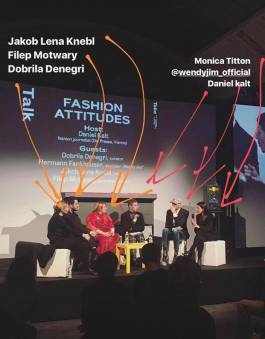
Take Festival, Vienna, 2017
“Fashion Attitudes”, talk
Dobrila Denegri, Filep Motwary, Jakob Lena Knebl, Daniel Kalt, Hermann Frankhauser (Wendy Jim), Monica Titton
2017
DOBRILA DENEGRI: IT’S EASY TO SAY WHAT ART OR FASHION IS... WE LACK A NAME FOR THOSE THINGS THAT FALL SOMEWHERE IN BETWEEN
The Take: What do you like most about working in creative industries?
Dobrila Denegri: Having access to innovative thinking and new creative approaches… It’s good for sensing the pulse of the current zeitgeist … and even more for imagining and envisioning the future.
TT: The Take Festival is all about fashion and art, and their interfaces. Do you think that there are any confines, and when do you indicate a project as pure fashion or art?
DD: Duchamp gave us a great lesson: it’s all about convention. If you claim to be an artist and place an object in the art context, you immediately redefine what art is. So for me now it's not so much about borders between disciplines as much as about ways in which all those productions which fuse elements of art and fashion can be defined, conceptualised and legitimised… Creatively, these productions are always most intriguing and provoking, because they put us in a state of uncertainty - we don't know what they are, to which category they belong, or how they should be named. I think it’s easier to say what is pure art or pure fashion… but we lack names for all those things that fall somewhere in between. Lacking this vocabulary and categorisation means that these creative people, who do challenging things, have to struggle more to carry on their work and get not only legitimised but also sustained. They need more platforms, and Take seems to be providing a significant one.
TT: What are you looking forward to experiencing during your stay in Vienna besides being a jury member? Any favourite places?
DD: Galleries and museums are a must for me - Vienna always has some good exhibitions… and I like to wander around the fourth/fifth district - I like the atmosphere there…
TT: Which one was your most exciting exhibition/project you have ever curated?
DD: I’m always most excited about what I’m on at the moment. Right now I’m curating a project which evolves from one presentation to another, including new productions in every new exhibition… It is entitled “Transfashional” and it's entirely process-oriented. We started last year with collective collaborative sessions in Vienna with Hussein Chalayan, José Teunissen, the new artistic director of Arnheim Fashion Biennial, Susanne Neuburger from MUMOK and Barbara Putz-Plecko and Beatrice Jaschke from Die Angewandte, as well as a group of young artists and designers from various cultural and professional backgrounds. After the latest show held in London, we are now preparing the next one for Warsaw, in the Centre of Contemporary Art Zamek Ujazdowski in May, with people like Anna-Sophie Berger, Maximilian Mauracher & Bernhard Eiling, Ana Rajčević, Anna Schwarz, Lara Torres, Christina Dörfler-Raab, Lisa Edi, Afra Kirchdorfer, Manora Auersperg, Kate Langrish-Smith, as well as a huge group of Polish young creatives who move between fashion and design.
What I find interesting is that this generation highlights the need for a profound revision of the processes of production and social relations which derive from them. They turn away from the fashion industry and its super-accelerated rhythms of production. Their quest for alternatives drives them, and they are totally into new productions - not of goods but of ideas. What they produce, more than wearable and functional, is a kind of critical, engaged and conceptual statement. It’s very much about creating a tabula rasa, and then starting from scratch… with new paradigms and new operative and relational structures.
TT: Do you have any suggestions for young artists?
DD: Sol Le Witt’s advice to Eva Hesse is one of those that functions always, for both young and less young: “Learn to say 'fuck you' to the world once in a while. You have every right to. Just stop thinking, worrying, looking over your shoulder, wondering, doubting, fearing, hurting, hoping for some easy way out, struggling, grasping, confusing, rumbling, tumbling, scrumbling, bitching, hutching, itching, moaning, groaning, honing, horse-shitting, hair-splitting, nit-picking, piece-stickling, no-sticking, ass groaning, eyeball-popping, finger-pointing, alley-sneaking, long-waiting, small-stepping, evil-eying, back-scratching, scratching, perching, best-smirching, grinding, grinding way out of yourself. Stop and just do. Don’t worry about cool. Make your own un-cool. Make your own world. You must practice being stupid, dumb, unthinking, empty, and then you will be able to do. (…) Try to do some bad work. The worst you can think of, and see what happens. But mainly relax and let everything go to hell!”
Take Festival, Vienna, 2017
“Fashion Attitudes”, talk
Dobrila Denegri, Filep Motwary, Jakob Lena Knebl, Daniel Kalt, Hermann Frankhauser (Wendy Jim), Monica Titton