


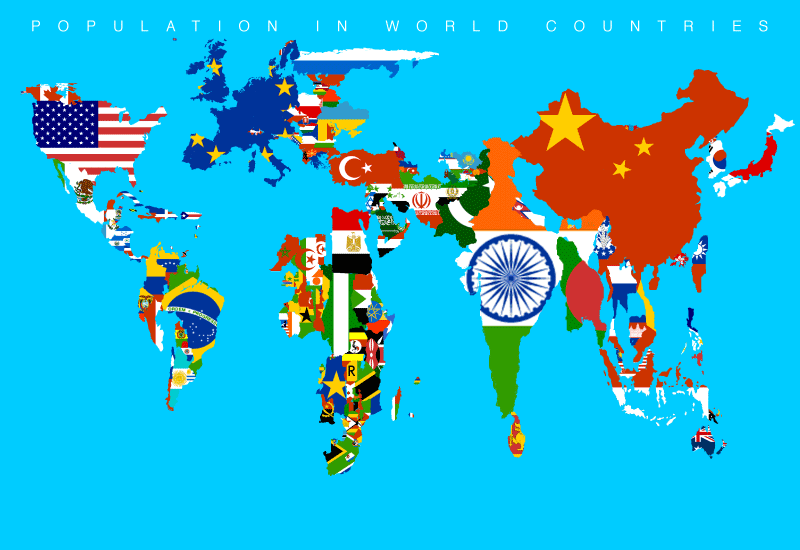
"Human World" Population in World Countries
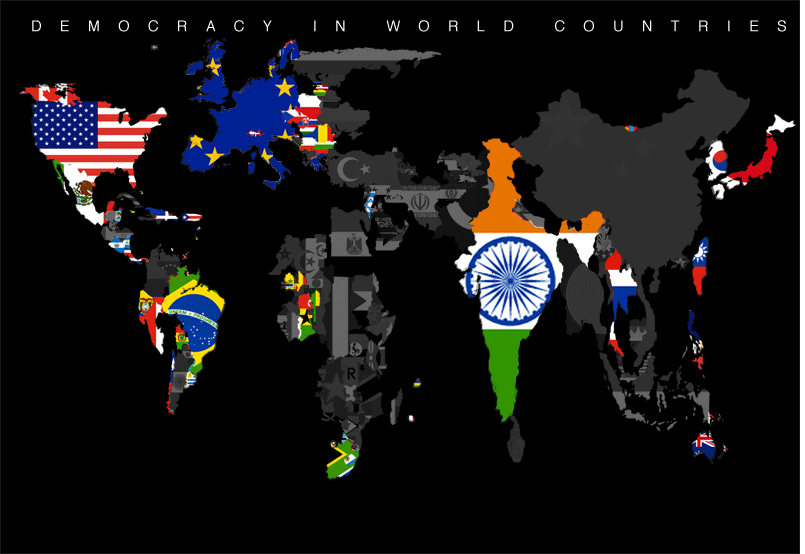
"Human World" Democracy in world countries
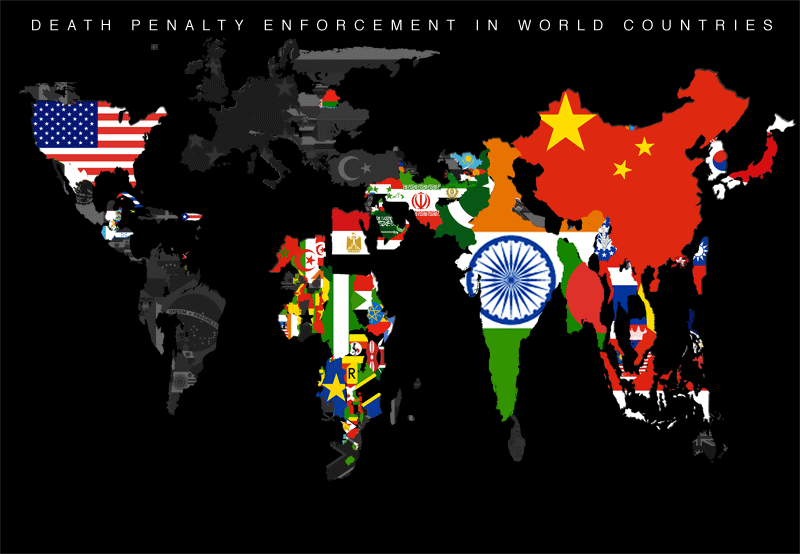
"Human World" Death penalty
2005
ANTONIO SCARPONI: THE MATERIAL I WORK WITH IS INFORMATION
Dobrila Denegri: I would like to start by asking about your beginnings – what were your main interests in the field of architecture and art?
Antonio Scarponi: In my training as an architect, art and architecture have never been entirely separate fields. Or rather, there is one aspect of the art tradition, painting in particular, that has always interested me: the representation of space, understood as a tool that allows us to depict buildable and habitable spaces, whether as architecture or as imagined spaces. In this sense, I have always been interested in the relationship between art and architecture, which I see as a dialectical interplay between imagination and reality. I believe that it is only possible to change reality through imagination, and if art is the tool that allows this transition, architecture constructs it; by this, I mean not necessarily in material and physical terms, but also in conceptual and mental terms. I think that the projects that have most influenced architectural thought and culture have been, after all, projects that were never realised, projects on paper, but which nevertheless constructed a widely shared idea of the world.
From this perspective, I have always seen a direct relationship, for example, between Masaccio's painting and Brunelleschi's architecture, between Mondrian's compositions and those of Ludwig Mies van der Rohe. There are many examples that could be cited, but the central issue, in my view, is that there is no clear distinction between these two types of knowledge. I believe that these experiences are inseparable; they are forms of knowledge that merge into one another. Another classic example in this sense is Le Corbusier's work, which, to me, seems to be a perfect synthesis of the different aspects of the visual experience of his time. It would be interesting to re-examine his architectural work, observing it and comparing it with what he was doing at the same time in painting. I find a direct relationship. I realise that it is easier to study the two types of production separately, partly because Le Corbusier was not a particularly original painter, but it is still a stretch. These are fields that are not separate; they are the result of the same research.
DD: How did the map project come about? Where did you get the data from?
AS: “Human World” came about slowly, about five years ago, during a year spent at the Cooper Union School of Architecture in New York, where I won a scholarship as a visiting student. Cooper has a very experimental teaching tradition (in the literal sense of the term), in which students are encouraged to develop tools that contribute to the construction of architectural thinking, starting from their radical questioning. For a student like me, coming from a very structured school with a long tradition (and, if you like, a somewhat doctrinal one) such as Venice, it was a real culture shock at first. In reality, it was there that I learned to blend different disciplinary experiences by questioning the tools I had learned up to that point. In general, a geographical shift always implies a shift in perspective, both on oneself and on one's surroundings. It wasn't easy for me, but I must say that the reflections that arose during that period are still the anchors on which my current research is based, partly because, after all, not much time has passed...
In one of these attempts, I developed a project for an installation that combined Hans Haacke's and Ricardo Scofidio's courses. The project involved the spatialisation of information about the population of the state of Panama and its canal (the subject of Scofidio's course). The result was a sort of humanscape, not very effective, I think, on a visual level, but which then allowed me to develop “Human World”.
The first map was of the internet, which is part of my degree thesis in urban planning, a research project on telecommunications, specifically the internet. I needed that map to represent the dimensions of the information society, to try to define its limits. How many people have access to the network? How large is the population of the “global village”? Through this work, I realised that, after all, the “village” is just a village and not even that “global”. This led me to reflect on the idea of the information society. The hypothesis is: if, theoretically, all people can communicate with each other in a fraction of a second, then we must imagine a world made up of people, a world where each individual produces and consumes information, an image of a world where humans are the unit of measurement; and this is how the “Human World” project took shape. “Human World” seeks to represent the contemporary human scenario. With a little research and thanks to the internet, population data can be found quite easily on the websites of the various United Nations agencies that publish the most up-to-date research from non-governmental organisations working in the field.
DD: Even though you trained as an architect, you work in the fields of design and art... how do you see the relationship between these disciplines in relation to your work?
AS: I think that art, architecture and design are somewhat obsolete categories for interpreting cultural production. The boundaries between these disciplines are now too blurred to distinguish them clearly. I believe these terms are too ambiguous and risk causing confusion, so they do not help much in understanding the current state of research. At least from my point of view.
I personally prefer to talk about visual knowledge. In contemporary culture, the visual experience is total. We live submerged in images, and I refuse to think of them as separate categories. They are all part of our existence, and we work with them indiscriminately. Visual knowledge is cumulative, like other forms of knowledge. The visual experience is layered; it is a heritage that can be modified infinitely, like all forms of language, for that matter.
The material I work with is information. Information has the power to change behavioural habits; it is a constantly evolving flow that we generally call culture, that immense system of codes that holds society together through the continuous reworking of shared values. In this sense, as far as my work is concerned, I prefer to talk about conceptual devices, understood as tools that give symbolic form to information, transforming it into visual knowledge. A conceptual device is a tool that allows the values on which our society is based to be shifted, incorporating information into symbolic images that allow other forms of thought to be reworked. Information (of any kind) has no substance unless it is linked to an image, which in this sense recalls a lived experience. In this way, I believe it is possible to construct shared imaginaries and interact with individual and social behaviour, re-establishing a different order of things and overturning the values on which our perception of reality has become fossilised.
The legacy of these disciplines, which for convenience we call art, architecture and design, is a means through which it is possible to construct physical or imagined reality. A legacy that provides the tools to better understand the world we live in; therefore, if you like, what I call conceptual devices are nothing more than cognitive tools that take shape by bringing together different forms of knowledge.
DD: Your work shows a tendency to range between art, architecture and design... Could you tell me about the historical references and models that you consider important or that have inspired your work?
AS: In general, I can say that I have always been interested in cultural experiences that have had a direct impact on society. I find that much of the research that began in the 1960s and 1970s, and the issues it raised, remain unresolved, somewhat suppressed, or forgotten. Many of the issues I am trying to investigate stem more or less from those premises. I am referring above all to the major themes opened up by Italian radical architecture and, in particular, the critical contribution of Andrea Branzi; in more general terms, however, the nomadic path of Constant's “New Babylon” or the Cedric Prize work. These authors, along with many others whom, for one reason or another, I feel are further removed from my personal path, have opened up major lines of research, many of which have been abandoned but which I consider extremely relevant today. In any case, I can say that I am interested in all those reflections that open up possibilities and construct scenarios for sharing. I believe that this is ultimately what I expect from the contemporary visual experience. What fascinates me is the possibility of transferring visual knowledge to fields beyond mere cultural production.
I believe this was a major contribution by these authors. Another important example of this is Hans Haacke's work. I am thinking, for example, of the project on the “Manhattan property market”, which exposed the corruption linked to property sales, for which he earned the censorship of his solo exhibition at the Guggenheim at the beginning of his career; but also many of Boetti's works, such as his work on “The longest rivers in the world”, for example, or his maps, which I myself have taken up in my work.
"Human World" Population in World Countries
"Human World" Democracy in world countries
"Human World" Death penalty