

2025
2010
MARIA LUISA FRISA: CURATING IS AN ATTITUDE THAT INCORPORATES ALL CREATIVE STRATEGIES
“Forms Becoming Attitudes”
Conversations on Fashion Curating for the CURA Magazine
2009 - 2012
Ilaria Marotta, founding director of CURA magazine, was my collaborator at MACRO - Museum of Contemporary Art in Rome. In 2008, after we all were forced to leave the museum due to the change of the Mayor of Rome, and consequently the change of the museum’s direction, Ilaria started a free-press magazine in 2009 for which she asked me to collaborate.
My column was called “Forms Becoming Attitudes” and in every issue I was contributing with texts or interviews to curators dealing with fashion display in museums and other platforms.
This must have been one of the very pioneering surveys on Fashion Curating, still a very new field, since all I spoke with were known within a very niche of like-minded professionals.
I started with Linda Loppa, a founding director of MoMu in Antwerp and, back then, a newly appointed director of Polimoda in Florence. Then followed conversations with Tomas Rajnai, Maria Luisa Frisa, Helena Hertov, Judith Clark, Barbara Franchin, Sabine Seymour, Kaat Debo, Valerie Steele, Emanuele Quinz and Luca Marchetti.
Most of these names are today established and recognised fashion scholars, curators and exhibition makers.
Maria Luisa Frisa
Critic and curator, Maria Luisa Frisa was Professor at Iuav University of Venice, where she established the BA Program in Fashion Design and Multimedia Arts. She was Editor-in-Chief of the journal “Dune: Writings on Fashion, Design and Visual Culture” published by Flash Art. Her seminal book is “Le forme della moda” (Il Mulino, 2015). She edited “Desire and Discipline: Designing Fashion at Iuav” (Marsilio, 2016) and among her curatorial projects we can mention: the exhibition and the book “Bellissima. Italy and High Fashion 1945-1968” (Rome, MAXXI, 2014-15; Bruxelles, BOZAR, 2015; Monza, Villa Reale, 2015-16; Fort Lauderdale, NSU Art Museum, 2016); the exhibition and the book “ITALIANA. Italy Through the Lens of Fashion 1971-2001” (Milano, Palazzo Reale, 2018); the exhibition and the book “Memos. On Fashion in This Millennium” (Milano, Museo Poldi Pezzoli, 2020).
Dobrila Denegri: I would like to begin our conversation by speaking about what got you started in the world of fashion, even though your training was closer to the arts. Is this correct? When did you become aware that your work could be defined as fashion curating?
Maria Luisa Frisa: I studied the history of art in Florence; however, my classes covered only up to the end of the nineteenth century and, seeing as how my real interest was contemporary art, I decided to take an exam in semiotics with Egidio Mucci in the School of Architecture. Working with him were Pier Luigi Tazzi, Carlo Bertocci, and Eugenio Miccini, one of the founders of Gruppo ‘70 and of visual poetry, who were carrying out pioneering research on contemporary language. Thanks to them, I came into contact with the then very alive world of contemporary art in Florence and, helped by Bertocci, I began a collaboration with Flash Art magazine.
This was the beginning of the 1980s - the beginning of committed criticism and of close collaboration, I would say almost symbiotic, between artists and critics.
In general, there was a great cultural ferment occurring, animated by the activities of theatre groups such as Magazzini Criminali and Krypton, as well as other groups and organisations involved in the arts, such as Zona by Maurizio Nannucci or the gallery Schema by Alberto Moretti. This was all happening, for some reason, in Florence. During those years, together with Stefano Tonchi, we decided to start a magazine, and this is how “Westuff” (a fusion of west and stuff, intended to signify “Western things”) came into being. In America and England, similar magazines like Face, iD, and Interview already existed. Still, in Italy, we were among the first to create an independent bilingual magazine covering fashion, art, design, architecture, music, theatre, literature, all closely tied to current events and to research. It was a magazine produced with great attention to detail, both graphically and in terms of content, and with previously unpublished photo shoots. We were highly esteemed; all said we had a high-calibre magazine - yet no one was buying advertising. We released eleven issues of “Westuff”, and then Stefano and I went our separate ways, but we remained in close contact. He started working for “Uomo Vogue”, and meanwhile, I got a call from Rosanna Armani asking me to help develop “Emporio Armani” magazine, which was to be modelled after “Westuff”.
It was a time at which fashion was aware of its ability to create worlds and new realities composed not only of clothing but also of images, sounds, attitudes, and widely shared and recognisable tastes. I came to realise that I was interested in studying fashion within the complexity of its social and cultural systems.
Before then, I had been interested in cutting-edge fashion; I wore J.P. Gaultier, Comme des Garçons, Azzedine Alaïa, Vivienne Westwood.
I realised the importance of Armani, not only as a stylist-creator of modern male and female “uniform”, but also as a communicator and innovator in advertising strategy. From this point of view, my professional experience in the context of its great “creative factory” was very important for what I decided to do next.
I began as an art critic, interested in the active and, I would say, performance-like aspects of this profession, but today I consider myself, above all, a fashion critic and curator. My participation as a fashion curator in the London College of Fashion’s Centenary, alongside Judith Clark and Valerie Steele, made me realise how much I was a pioneer in my work, even though the role of fashion curating had already been defined abroad.
DD: I started to think for the first time about the genesis of the role of fashion curator, reading the conversation between Gae Aulenti and Franca Sozzani. The pages of printed paper, more than a physical space, seemed to me the platform on which to carry out creative impulses to put fashion “on display.”
Then I saw the catalogues of exhibitions that you curated with Francesco Bonami and Stefano Tonchi. I came to realise that a catalogue is, on the one hand, a sequential exhibition and, at the same time, a hybrid between book and magazine. Can a curator move amongst these spaces, reinventing them from time to time, in order to best highlight that which he or she desires to put on display?
MLF: Thinking about the genesis of the role of fashion curator, I would like to remember that today, curating is an attitude that incorporates all creative strategies. I cannot help but recall Diana Vreeland, cult director of “Vogue” in the 1960s and then consultant to the Costume Institute at the Metropolitan Museum of Art in New York, a truly important figure - even if controversial, above all for her totally free approach toward clothes and the definition of display - a figure who is still a stimulus and a role model. Thanks to her, during the 1960s “Vogue” became a platform for the continuous evolution of style, which wasn’t afraid to experiment or innovate and which worked with the most interesting photographers and the most unusual models - those who had a certain “look” and personality. Diana Vreeland was the first to dedicate, with great scandal, an exhibition to a living fashion designer - Yves Saint Laurent, whom she considered a giant in the world of fashion - and to conceive exhibitions which transformed all that they presented into mythology. For her, truth wasn’t as important as the verisimilitude of truth, the expression of points of view, and above all, the knowledge of interpreting fashion: she used clothes, images, and words to construct visions and, ultimately, to tell a story and identify trends in the world of fashion in a truly global project.
For me, as well, my background as a magazine editor has been very important, above all for the aptitudes I learned for projecting, formatting, imagining, and creating within the two-dimensional limits of the page, things which I apply today in completely different contexts.
DD: In your opinion, which have been the most significant exhibitions dedicated to fashion? Which are the moments that have placed fashion at the centre of a more serious reflection and have made it more culturally relevant?
MLF: One of the first exhibitions which deserves mention took place in 1971 at the Victoria & Albert Museum in London: “Fashion: An Anthology”. For it, Cecil Beaton created specialised thematic routes accompanied by highly original displays. A very significant moment, not only for Italy but also for other countries, was when Germano Celant and Ingrid Sischy put on the great exhibition “Il Tempo e la Moda” in Florence, emphasising the need to frame fashion within a deeper social and cultural perspective.
DD: I wouldn’t describe the exhibitions that you curated for Pitti Immagine at the beginning of the last decade as fashion exhibitions, but rather as exhibitions on fashion, meaning a complex social phenomenon and a trigger for specific individual behaviours. That which was transpiring from “Uniforme” and also from “Quarto sesso” was stirring up reflections on phenomena such as homologation and the power of seduction and authority. Can you tell me more about curating these projects for Pitti in Florence?
MLF: The first exhibition was “Uniforme: Ordine e Disordine”, which Stefano Tonchi and I conceived to investigate the symbolism of a uniform, a theme to investigate under various aspects, that was holding together fashion, art, and pop culture. Even though art and fashion retain their own distinct languages, contemporary culture increasingly places them in a position of mutual influence through imagery, as they move in a kaleidoscopic manner, creating new horizons of meaning. Fashion is the device, capable of grasping these images, which reorganises them because it needs, in order to survive, to continuously renew itself. The departure point was a photo shoot by the photographer Carter Smith that appeared in Arena: “Fashion is Hell, This Season Khaki’s The Colour To Die For”, a quotation - in the construction and sequence of images - from Spielberg’s “Saving Private Ryan”. Those images were the signal that the elements and marks of the uniform, torn out of their military context and devoured by the creative processes of fashion, were powerfully occupying the gangways. At the same time, those same images, metabolised by pop culture and used by art, were serving to bring into discussion the ordering language of social and aesthetic marks. In the exhibition, the visitor was constrained to pass through a narrow wardrobe where various uniforms were hung, to confront oneself with Jeff Wall’s gigantic light box “Dead Troops Talk” - reconstruction of a terrifying reality of death during the war in Afghanistan - and to go through a path made up of artefacts which interwove fashion and pop culture. Along this path were laid out thirty pieces of clothing regarded as icons and displayed, inside glass boxes like reliquaries. In the book, a parallel but independent project from the exhibition, as have been all the books/catalogues that I have curated, images of photojournalism, cinema, art, photo shootings and advertising campaigns were placed together without hierarchy. The book proceeded freely along a loosely defined trail of visual texts, shown side-by-side and without interruption to facilitate comparison and contrast. A central section contained more in-depth analysis of scholars, writers, and journalists. The intention was to offer a point of view and, as far as I’m concerned, my critical point of view.
DD: Revival is a constant in the fashion world. When you decided, with “Excess”, to dedicate an exhibition to the 1980s - a period of unprecedented greed and linguistic admixing - were you motivated by a return to a certain type of “sensibility” that we still feel today, or was your intention to frame a very fertile and innovative period in a historical perspective?
MLF: When Stefano Tonchi and I began to think of doing an exhibition on this controversial decade, the idea of a revival couldn’t be applied in the strictest sense. The 1980s were labelled as an extremely superficial period with a series of clichés - sequins, paillettes, “Milano da bere” - and quickly brushed aside. But there were some more underground aspects of this decade that we wanted to examine in more detail. These were painful, neuralgic years, marking the passage from the “anni di piombo” [literally, “years of lead,” a reference to the period of terrorism in Italy from the end of the 1960s until the mid-1980s ed.] to a lighter, more open atmosphere, subsequently interrupted by AIDS, which cut down the worlds of fashion and art. These were years in which Italy’s production in all areas peaked and, thus, because of the need to confront our own history (which our country always avoids doing) and to determine a proper cultural identity, we wanted to do this exhibition titled “Excess - Fashion and underground in the Eighties.”
DD: Today, we can affirm that the dialogue between art, fashion, and design is generating radical hybridisations requiring new classifications, a new lexicon, and a new manner of presentation within the structure of the exhibition. Fashion and design no longer seem so alien within the context of art. What is the importance of “the frame” in which fashion artefacts are placed, according to their intrinsic value and meaning? And what could the most suitable “frames” be? Can you imagine an ideal exhibition space for all the hybridisations of fashion and art being born today?
MLF: It’s true that there is a long history of interconnection between fashion and art; it is a well-known history. It’s also true that today, both artists and fashion designers of the latest generations are trained in a universe of images which doesn’t make distinctions between different languages. Fashion has become a pattern the world follows; it determines lifestyles and traces out paths which influence even contemporary art, and, on the other hand, we see young fashion designers using elaborate practices previously established by artists. It is possible to retrace notable parallels between the “conceptual” and creative processes which fashion designers and artists use. Designers such as Comme des Garçons, Hussein Chalayan, and others who came after them have created a kind of fashion that unveils new mechanisms focused on meaning, in addition to form - and these are just some of the more fascinating aspects of contemporary fashion.
All of this requires a greater theoretical awareness in the approach to fashion and its creations, and at the same time, new strategies in the search for more appropriate ways to create exhibitions.
As far as exhibition spaces are concerned, I would say that the “ideal space” could be even small or marginal, a viral “fashion project room”, as long as experimentation is permitted.
DD: Speaking of standard curatorial practices, you have often spoken of responsibility and risks. What does accepting these mean to you?
MLF: It means having the possibility of constructing a different dialogue on fashion and of offering new points of observation, but it also means imagining and trusting one’s intuition. It means taking part in the game and accepting the risks of this participation. The curator takes risks because he is putting an idea to the test, following an intuition and constructing a project that will reveal itself only when it is completed. And he must inevitably submit to the judgment of others.
Published in cura.magazine issue 04

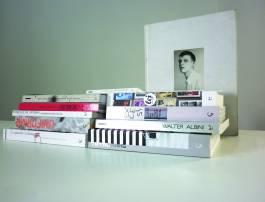
A selection of Maria Luisa Frisa's editorial projects. Among the books: “Total Living” (Charta, 2002), “Raf Simons Redux” (Charta-Fondazione Pitti Discovery, 2005), “Walter Albini e il suo tempo: L’immaginazione al potere” (Marsilio-Fondazione Pitti Discovery, 2010), “Una nuova moda italiana” (Marsilio-Fondazione Pitti Discovery, 2011), “Lei e le altre: Moda e stili nelle riviste RCS dal 1930 a oggi” (Marsilio, 2011), and the book published on the occasion of the exhibition “Diana Vreeland After Diana Vreeland” (Marsilio, 2012).
Photo Serena Becagli. Laboratorium
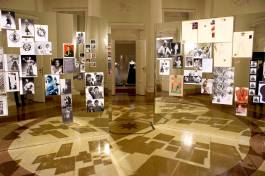
Images from “Albiniana”, installation curated by Maria Luisa and Stefano Tonchi with photos, videos and original materials, Florence, Saloncino da Ballo of the Costume Gallery of Palazzo Pitti, January 2010, on the occasion of the presentation of the book “Walter Albini e il suo tempo: L’immaginazione al potere” (“Walter Albini and his time: Imagination in power”).
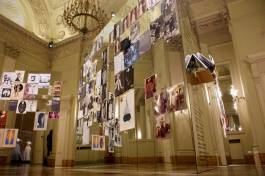
Images from “Albiniana”, installation curated by Maria Luisa and Stefano Tonchi with photos, videos and original materials, Florence, Saloncino da Ballo of the Costume Gallery of Palazzo Pitti, January 2010, on the occasion of the presentation of the book “Walter Albini e il suo tempo: L’immaginazione al potere” (“Walter Albini and his time: Imagination in power”).
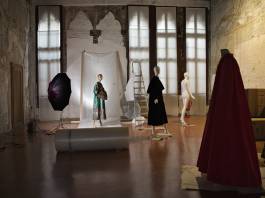
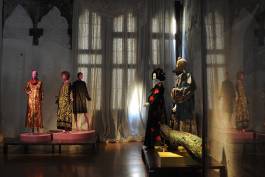
Images from the exhibition “Diana Vreeland After Diana Vreeland”, curated by Judith Clark and Maria Luisa Frisa, Venice, Palazzo Fortuny, 10 March-25 June 2012.
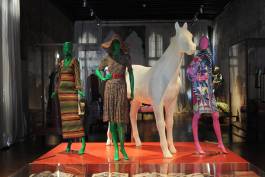
Images from the exhibition “Diana Vreeland After Diana Vreeland”, curated by Judith Clark and Maria Luisa Frisa, Venice, Palazzo Fortuny, 10 March-25 June 2012.
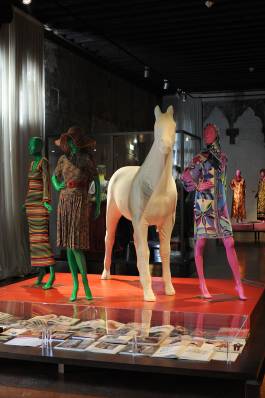
Images from the exhibition “Diana Vreeland After Diana Vreeland”, curated by Judith Clark and Maria Luisa Frisa, Venice, Palazzo Fortuny, 10 March-25 June 2012.
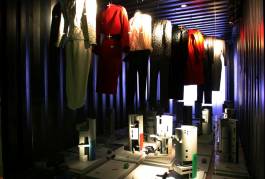
Images from the exhibition “Diana Vreeland After Diana Vreeland”, curated by Judith Clark and Maria Luisa Frisa, Venice, Palazzo Fortuny, 10 March-25 June 2012.
Images from the exhibition “Excess: Fashion and Underground in the 1980s”, curated by Maria Luisa Frisa and Stefano Tonchi, Florence, Stazione Leopolda, 8 January-8 February 2004.
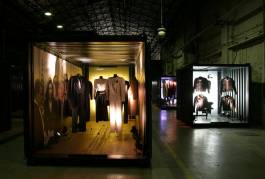
Images from the exhibition “Excess: Fashion and Underground in the 1980s”, curated by Maria Luisa Frisa and Stefano Tonchi, Florence, Stazione Leopolda, 8 January-8 February 2004.
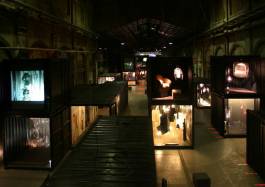
Images from the exhibition “Excess: Fashion and Underground in the 1980s”, curated by Maria Luisa Frisa and Stefano Tonchi, Florence, Stazione Leopolda, 8 January-8 February 2004.
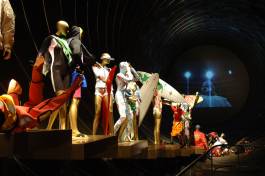
Image from the exhibition “Human Game: Winners and Losers”, curated by Francesco Bonami, Maria Luisa Frisa, Stefano Tonchi, Florence, Stazione Leopolda, 22 June-21 July 2006.
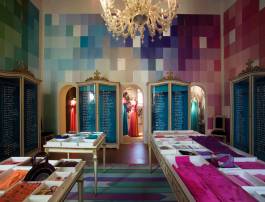
Image of “Pucci: The coloured rooms”, a project curated by Maria Luisa Frisa to celebrate the Pucci fashion house on its sixtieth anniversary, Florence, Palazzo Pucci, May 2007.
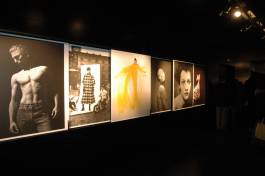
Images from the exhibition “Lo sguardo italiano: Italian fashion photography from 1951 to today”, curated by Maria Luisa Frisa, Milan, Rotonda di via Besana, 24 February-20 March 2005.
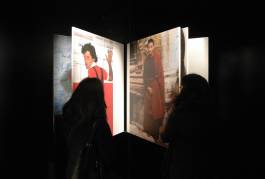
Images from the exhibition “Lo sguardo italiano: Italian fashion photography from 1951 to today”, curated by Maria Luisa Frisa, Milan, Rotonda di via Besana, 24 February-20 March 2005.
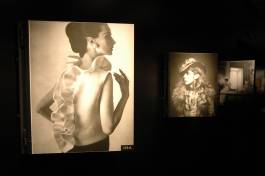
Images from the exhibition “Lo sguardo italiano: Italian fashion photography from 1951 to today”, curated by Maria Luisa Frisa, Milan, Rotonda di via Besana, 24 February-20 March 2005.
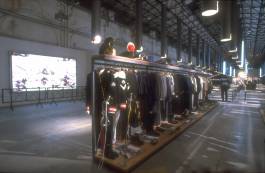
Images from the exhibition “Uniform: Order and Disorder”, curated by Francesco Bonami, Maria Luisa Frisa, Stefano Tonchi, Florence, Stazione Leopolda, 11 January-18 February 2001.
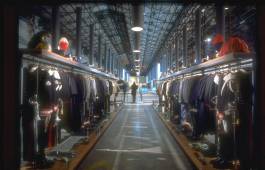
Images from the exhibition “Uniform: Order and Disorder”, curated by Francesco Bonami, Maria Luisa Frisa, Stefano Tonchi, Florence, Stazione Leopolda, 11 January-18 February 2001.
2025
“Forms Becoming Attitudes”
Conversations on Fashion Curating for the CURA Magazine
2009 - 2012
Ilaria Marotta, founding director of CURA magazine, was my collaborator at MACRO - Museum of Contemporary Art in Rome. In 2008, after we all were forced to leave the museum due to the change of the Mayor of Rome, and consequently the change of the museum’s direction, Ilaria started a free-press magazine in 2009 for which she asked me to collaborate.
My column was called “Forms Becoming Attitudes” and in every issue I was contributing with texts or interviews to curators dealing with fashion display in museums and other platforms.
This must have been one of the very pioneering surveys on Fashion Curating, still a very new field, since all I spoke with were known within a very niche of like-minded professionals.
I started with Linda Loppa, a founding director of MoMu in Antwerp and, back then, a newly appointed director of Polimoda in Florence. Then followed conversations with Tomas Rajnai, Maria Luisa Frisa, Helena Hertov, Judith Clark, Barbara Franchin, Sabine Seymour, Kaat Debo, Valerie Steele, Emanuele Quinz and Luca Marchetti.
Most of these names are today established and recognised fashion scholars, curators and exhibition makers.
Maria Luisa Frisa
Critic and curator, Maria Luisa Frisa was Professor at Iuav University of Venice, where she established the BA Program in Fashion Design and Multimedia Arts. She was Editor-in-Chief of the journal “Dune: Writings on Fashion, Design and Visual Culture” published by Flash Art. Her seminal book is “Le forme della moda” (Il Mulino, 2015). She edited “Desire and Discipline: Designing Fashion at Iuav” (Marsilio, 2016) and among her curatorial projects we can mention: the exhibition and the book “Bellissima. Italy and High Fashion 1945-1968” (Rome, MAXXI, 2014-15; Bruxelles, BOZAR, 2015; Monza, Villa Reale, 2015-16; Fort Lauderdale, NSU Art Museum, 2016); the exhibition and the book “ITALIANA. Italy Through the Lens of Fashion 1971-2001” (Milano, Palazzo Reale, 2018); the exhibition and the book “Memos. On Fashion in This Millennium” (Milano, Museo Poldi Pezzoli, 2020).
2010
MARIA LUISA FRISA: CURATING IS AN ATTITUDE THAT INCORPORATES ALL CREATIVE STRATEGIES
Dobrila Denegri: I would like to begin our conversation by speaking about what got you started in the world of fashion, even though your training was closer to the arts. Is this correct? When did you become aware that your work could be defined as fashion curating?
Maria Luisa Frisa: I studied the history of art in Florence; however, my classes covered only up to the end of the nineteenth century and, seeing as how my real interest was contemporary art, I decided to take an exam in semiotics with Egidio Mucci in the School of Architecture. Working with him were Pier Luigi Tazzi, Carlo Bertocci, and Eugenio Miccini, one of the founders of Gruppo ‘70 and of visual poetry, who were carrying out pioneering research on contemporary language. Thanks to them, I came into contact with the then very alive world of contemporary art in Florence and, helped by Bertocci, I began a collaboration with Flash Art magazine.
This was the beginning of the 1980s - the beginning of committed criticism and of close collaboration, I would say almost symbiotic, between artists and critics.
In general, there was a great cultural ferment occurring, animated by the activities of theatre groups such as Magazzini Criminali and Krypton, as well as other groups and organisations involved in the arts, such as Zona by Maurizio Nannucci or the gallery Schema by Alberto Moretti. This was all happening, for some reason, in Florence. During those years, together with Stefano Tonchi, we decided to start a magazine, and this is how “Westuff” (a fusion of west and stuff, intended to signify “Western things”) came into being. In America and England, similar magazines like Face, iD, and Interview already existed. Still, in Italy, we were among the first to create an independent bilingual magazine covering fashion, art, design, architecture, music, theatre, literature, all closely tied to current events and to research. It was a magazine produced with great attention to detail, both graphically and in terms of content, and with previously unpublished photo shoots. We were highly esteemed; all said we had a high-calibre magazine - yet no one was buying advertising. We released eleven issues of “Westuff”, and then Stefano and I went our separate ways, but we remained in close contact. He started working for “Uomo Vogue”, and meanwhile, I got a call from Rosanna Armani asking me to help develop “Emporio Armani” magazine, which was to be modelled after “Westuff”.
It was a time at which fashion was aware of its ability to create worlds and new realities composed not only of clothing but also of images, sounds, attitudes, and widely shared and recognisable tastes. I came to realise that I was interested in studying fashion within the complexity of its social and cultural systems.
Before then, I had been interested in cutting-edge fashion; I wore J.P. Gaultier, Comme des Garçons, Azzedine Alaïa, Vivienne Westwood.
I realised the importance of Armani, not only as a stylist-creator of modern male and female “uniform”, but also as a communicator and innovator in advertising strategy. From this point of view, my professional experience in the context of its great “creative factory” was very important for what I decided to do next.
I began as an art critic, interested in the active and, I would say, performance-like aspects of this profession, but today I consider myself, above all, a fashion critic and curator. My participation as a fashion curator in the London College of Fashion’s Centenary, alongside Judith Clark and Valerie Steele, made me realise how much I was a pioneer in my work, even though the role of fashion curating had already been defined abroad.
DD: I started to think for the first time about the genesis of the role of fashion curator, reading the conversation between Gae Aulenti and Franca Sozzani. The pages of printed paper, more than a physical space, seemed to me the platform on which to carry out creative impulses to put fashion “on display.”
Then I saw the catalogues of exhibitions that you curated with Francesco Bonami and Stefano Tonchi. I came to realise that a catalogue is, on the one hand, a sequential exhibition and, at the same time, a hybrid between book and magazine. Can a curator move amongst these spaces, reinventing them from time to time, in order to best highlight that which he or she desires to put on display?
MLF: Thinking about the genesis of the role of fashion curator, I would like to remember that today, curating is an attitude that incorporates all creative strategies. I cannot help but recall Diana Vreeland, cult director of “Vogue” in the 1960s and then consultant to the Costume Institute at the Metropolitan Museum of Art in New York, a truly important figure - even if controversial, above all for her totally free approach toward clothes and the definition of display - a figure who is still a stimulus and a role model. Thanks to her, during the 1960s “Vogue” became a platform for the continuous evolution of style, which wasn’t afraid to experiment or innovate and which worked with the most interesting photographers and the most unusual models - those who had a certain “look” and personality. Diana Vreeland was the first to dedicate, with great scandal, an exhibition to a living fashion designer - Yves Saint Laurent, whom she considered a giant in the world of fashion - and to conceive exhibitions which transformed all that they presented into mythology. For her, truth wasn’t as important as the verisimilitude of truth, the expression of points of view, and above all, the knowledge of interpreting fashion: she used clothes, images, and words to construct visions and, ultimately, to tell a story and identify trends in the world of fashion in a truly global project.
For me, as well, my background as a magazine editor has been very important, above all for the aptitudes I learned for projecting, formatting, imagining, and creating within the two-dimensional limits of the page, things which I apply today in completely different contexts.
DD: In your opinion, which have been the most significant exhibitions dedicated to fashion? Which are the moments that have placed fashion at the centre of a more serious reflection and have made it more culturally relevant?
MLF: One of the first exhibitions which deserves mention took place in 1971 at the Victoria & Albert Museum in London: “Fashion: An Anthology”. For it, Cecil Beaton created specialised thematic routes accompanied by highly original displays. A very significant moment, not only for Italy but also for other countries, was when Germano Celant and Ingrid Sischy put on the great exhibition “Il Tempo e la Moda” in Florence, emphasising the need to frame fashion within a deeper social and cultural perspective.
DD: I wouldn’t describe the exhibitions that you curated for Pitti Immagine at the beginning of the last decade as fashion exhibitions, but rather as exhibitions on fashion, meaning a complex social phenomenon and a trigger for specific individual behaviours. That which was transpiring from “Uniforme” and also from “Quarto sesso” was stirring up reflections on phenomena such as homologation and the power of seduction and authority. Can you tell me more about curating these projects for Pitti in Florence?
MLF: The first exhibition was “Uniforme: Ordine e Disordine”, which Stefano Tonchi and I conceived to investigate the symbolism of a uniform, a theme to investigate under various aspects, that was holding together fashion, art, and pop culture. Even though art and fashion retain their own distinct languages, contemporary culture increasingly places them in a position of mutual influence through imagery, as they move in a kaleidoscopic manner, creating new horizons of meaning. Fashion is the device, capable of grasping these images, which reorganises them because it needs, in order to survive, to continuously renew itself. The departure point was a photo shoot by the photographer Carter Smith that appeared in Arena: “Fashion is Hell, This Season Khaki’s The Colour To Die For”, a quotation - in the construction and sequence of images - from Spielberg’s “Saving Private Ryan”. Those images were the signal that the elements and marks of the uniform, torn out of their military context and devoured by the creative processes of fashion, were powerfully occupying the gangways. At the same time, those same images, metabolised by pop culture and used by art, were serving to bring into discussion the ordering language of social and aesthetic marks. In the exhibition, the visitor was constrained to pass through a narrow wardrobe where various uniforms were hung, to confront oneself with Jeff Wall’s gigantic light box “Dead Troops Talk” - reconstruction of a terrifying reality of death during the war in Afghanistan - and to go through a path made up of artefacts which interwove fashion and pop culture. Along this path were laid out thirty pieces of clothing regarded as icons and displayed, inside glass boxes like reliquaries. In the book, a parallel but independent project from the exhibition, as have been all the books/catalogues that I have curated, images of photojournalism, cinema, art, photo shootings and advertising campaigns were placed together without hierarchy. The book proceeded freely along a loosely defined trail of visual texts, shown side-by-side and without interruption to facilitate comparison and contrast. A central section contained more in-depth analysis of scholars, writers, and journalists. The intention was to offer a point of view and, as far as I’m concerned, my critical point of view.
DD: Revival is a constant in the fashion world. When you decided, with “Excess”, to dedicate an exhibition to the 1980s - a period of unprecedented greed and linguistic admixing - were you motivated by a return to a certain type of “sensibility” that we still feel today, or was your intention to frame a very fertile and innovative period in a historical perspective?
MLF: When Stefano Tonchi and I began to think of doing an exhibition on this controversial decade, the idea of a revival couldn’t be applied in the strictest sense. The 1980s were labelled as an extremely superficial period with a series of clichés - sequins, paillettes, “Milano da bere” - and quickly brushed aside. But there were some more underground aspects of this decade that we wanted to examine in more detail. These were painful, neuralgic years, marking the passage from the “anni di piombo” [literally, “years of lead,” a reference to the period of terrorism in Italy from the end of the 1960s until the mid-1980s ed.] to a lighter, more open atmosphere, subsequently interrupted by AIDS, which cut down the worlds of fashion and art. These were years in which Italy’s production in all areas peaked and, thus, because of the need to confront our own history (which our country always avoids doing) and to determine a proper cultural identity, we wanted to do this exhibition titled “Excess - Fashion and underground in the Eighties.”
DD: Today, we can affirm that the dialogue between art, fashion, and design is generating radical hybridisations requiring new classifications, a new lexicon, and a new manner of presentation within the structure of the exhibition. Fashion and design no longer seem so alien within the context of art. What is the importance of “the frame” in which fashion artefacts are placed, according to their intrinsic value and meaning? And what could the most suitable “frames” be? Can you imagine an ideal exhibition space for all the hybridisations of fashion and art being born today?
MLF: It’s true that there is a long history of interconnection between fashion and art; it is a well-known history. It’s also true that today, both artists and fashion designers of the latest generations are trained in a universe of images which doesn’t make distinctions between different languages. Fashion has become a pattern the world follows; it determines lifestyles and traces out paths which influence even contemporary art, and, on the other hand, we see young fashion designers using elaborate practices previously established by artists. It is possible to retrace notable parallels between the “conceptual” and creative processes which fashion designers and artists use. Designers such as Comme des Garçons, Hussein Chalayan, and others who came after them have created a kind of fashion that unveils new mechanisms focused on meaning, in addition to form - and these are just some of the more fascinating aspects of contemporary fashion.
All of this requires a greater theoretical awareness in the approach to fashion and its creations, and at the same time, new strategies in the search for more appropriate ways to create exhibitions.
As far as exhibition spaces are concerned, I would say that the “ideal space” could be even small or marginal, a viral “fashion project room”, as long as experimentation is permitted.
DD: Speaking of standard curatorial practices, you have often spoken of responsibility and risks. What does accepting these mean to you?
MLF: It means having the possibility of constructing a different dialogue on fashion and of offering new points of observation, but it also means imagining and trusting one’s intuition. It means taking part in the game and accepting the risks of this participation. The curator takes risks because he is putting an idea to the test, following an intuition and constructing a project that will reveal itself only when it is completed. And he must inevitably submit to the judgment of others.
Published in cura.magazine issue 04

A selection of Maria Luisa Frisa's editorial projects. Among the books: “Total Living” (Charta, 2002), “Raf Simons Redux” (Charta-Fondazione Pitti Discovery, 2005), “Walter Albini e il suo tempo: L’immaginazione al potere” (Marsilio-Fondazione Pitti Discovery, 2010), “Una nuova moda italiana” (Marsilio-Fondazione Pitti Discovery, 2011), “Lei e le altre: Moda e stili nelle riviste RCS dal 1930 a oggi” (Marsilio, 2011), and the book published on the occasion of the exhibition “Diana Vreeland After Diana Vreeland” (Marsilio, 2012).
Photo Serena Becagli. Laboratorium

Images from “Albiniana”, installation curated by Maria Luisa and Stefano Tonchi with photos, videos and original materials, Florence, Saloncino da Ballo of the Costume Gallery of Palazzo Pitti, January 2010, on the occasion of the presentation of the book “Walter Albini e il suo tempo: L’immaginazione al potere” (“Walter Albini and his time: Imagination in power”).

Images from “Albiniana”, installation curated by Maria Luisa and Stefano Tonchi with photos, videos and original materials, Florence, Saloncino da Ballo of the Costume Gallery of Palazzo Pitti, January 2010, on the occasion of the presentation of the book “Walter Albini e il suo tempo: L’immaginazione al potere” (“Walter Albini and his time: Imagination in power”).

Images from the exhibition “Diana Vreeland After Diana Vreeland”, curated by Judith Clark and Maria Luisa Frisa, Venice, Palazzo Fortuny, 10 March-25 June 2012.

Images from the exhibition “Diana Vreeland After Diana Vreeland”, curated by Judith Clark and Maria Luisa Frisa, Venice, Palazzo Fortuny, 10 March-25 June 2012.

Images from the exhibition “Diana Vreeland After Diana Vreeland”, curated by Judith Clark and Maria Luisa Frisa, Venice, Palazzo Fortuny, 10 March-25 June 2012.

Images from the exhibition “Diana Vreeland After Diana Vreeland”, curated by Judith Clark and Maria Luisa Frisa, Venice, Palazzo Fortuny, 10 March-25 June 2012.

Images from the exhibition “Excess: Fashion and Underground in the 1980s”, curated by Maria Luisa Frisa and Stefano Tonchi, Florence, Stazione Leopolda, 8 January-8 February 2004.

Images from the exhibition “Excess: Fashion and Underground in the 1980s”, curated by Maria Luisa Frisa and Stefano Tonchi, Florence, Stazione Leopolda, 8 January-8 February 2004.

Images from the exhibition “Excess: Fashion and Underground in the 1980s”, curated by Maria Luisa Frisa and Stefano Tonchi, Florence, Stazione Leopolda, 8 January-8 February 2004.

Image from the exhibition “Human Game: Winners and Losers”, curated by Francesco Bonami, Maria Luisa Frisa, Stefano Tonchi, Florence, Stazione Leopolda, 22 June-21 July 2006.

Image of “Pucci: The coloured rooms”, a project curated by Maria Luisa Frisa to celebrate the Pucci fashion house on its sixtieth anniversary, Florence, Palazzo Pucci, May 2007.

Images from the exhibition “Lo sguardo italiano: Italian fashion photography from 1951 to today”, curated by Maria Luisa Frisa, Milan, Rotonda di via Besana, 24 February-20 March 2005.

Images from the exhibition “Lo sguardo italiano: Italian fashion photography from 1951 to today”, curated by Maria Luisa Frisa, Milan, Rotonda di via Besana, 24 February-20 March 2005.

Images from the exhibition “Lo sguardo italiano: Italian fashion photography from 1951 to today”, curated by Maria Luisa Frisa, Milan, Rotonda di via Besana, 24 February-20 March 2005.

Images from the exhibition “Uniform: Order and Disorder”, curated by Francesco Bonami, Maria Luisa Frisa, Stefano Tonchi, Florence, Stazione Leopolda, 11 January-18 February 2001.

Images from the exhibition “Uniform: Order and Disorder”, curated by Francesco Bonami, Maria Luisa Frisa, Stefano Tonchi, Florence, Stazione Leopolda, 11 January-18 February 2001.
INSTAGRAM
@EXPERIMENTS.FASHION.ART