


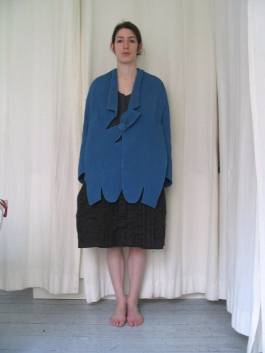
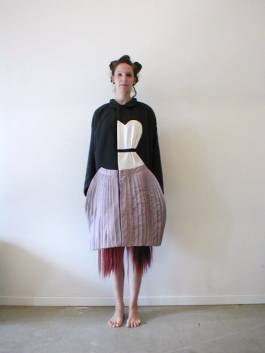
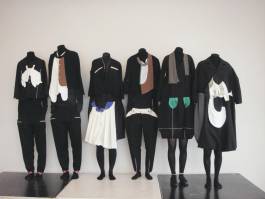
Andrea Ayala Closa, Collection “Denominate a Space” 2006.
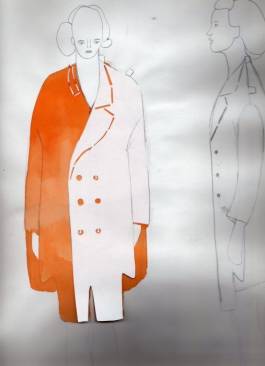
2011
ANDREA AYALA CLOSA: I CONSIDER MYSELF A "THINKER OF GARMENTS"
Andrea Ayala Closa's work exists at the crossroads of art and fashion, where imagination and creativity dominate. It is no coincidence that she describes herself as a “garment thinker”: her creations stem from a thoughtful reflection on the symbolism and meaning of clothing. They are not simply designed to cover the body but to reshape its features, eliminate sexual differences, and, most importantly, reveal the most intimate and hidden aspects of the individual. They also evoke the many worlds within this young Spanish artist/designer: the fairy-tale realms of her childhood in the countryside, in harmony with nature, and others—equally captivating yet far more intricate—that have arisen from her curiosity about historical and contemporary artistic experiences, and especially from her training at the Royal Academy in Antwerp, led by Walter Van Beirendonck, where craftsmanship, experimentation, tradition, and innovation weave together.
Dobrila Denegri: “If you carry your childhood with you, you never become older.”
I feel that this quote from Tom Stoppard (playwright who co-wrote screenplays for films like Brazil) could be a good starting point for this conversation… Firstly, because one can perceive in your work some aspects commonly associated with childhood, aspects like fantasy, playfulness, and even certain inquietude, especially in your drawings … Secondly, because your work brings us into that complex universe called fashion, which identifies itself with constant change and permanent pursuit of novelty and youthfulness…
How was your childhood, and how much of your early memories re-emerge in this imaginary world that you are constructing with colours and clothes?
Andrea Ayala: I had a very, very nice childhood. I think it is because I was living in a small village, Arenys de Munt, quite far from central cities and civilisation. We had three neighbours, the forest surrounded our house, plenty of trees and paths to discover… and walking through the woods was what I liked the most. In the wild nature, I felt so free. Also, the school I attended until the age of 10 had the same concept: we had animals to take care of, plants to grow, and we had a lot of music lessons, and we were learning folkloric Catalan dances. School ended at 8 o’clock, so there was time to study, too, but these other disciplines were very important. In my work, there is for sure some of that very nice past. It’s challenging to grow up then…
Maybe that is why I recall those memories all the time.
Many other things influenced me and my work later. The 5 years I spent in Antwerp, in another culture very different from my own, made me discover another side of my personality. There, I developed a more mental and conceptual approach to my work.
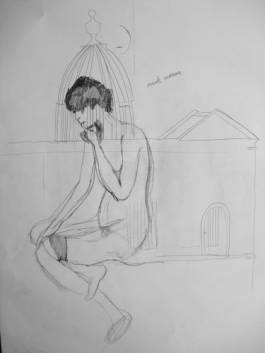
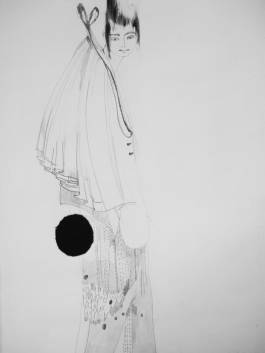
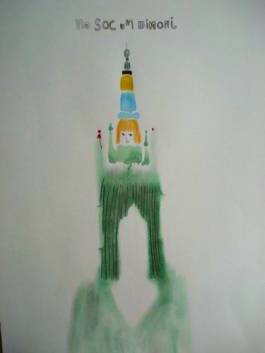
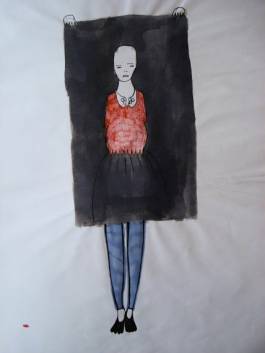
DD: While looking at your works, in particular images like this, I can’t help wondering… if they would appear in some contemporary fairy-tale… what kind of characters they would be and what stories would they tell…
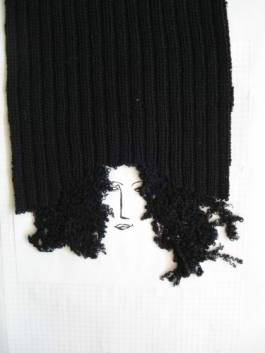
AA: There is a drawing that I made in 2003 showing a person trying on a hat with hair: A Lot of hair symbolises nature for me… I remember having very thick, dull-browed eyebrows when I was a child, and I now regret having them plucked during puberty.
My characters are more like silhouettes, and they don’t have a gender. I hate to make a difference between men and women. The person in this drawing is just enjoying. It has a face like Gioconda. It is neither smiling nor serious. It’s just an expression. It's one of my favourites, and I made other versions: the face stays the same, and the hat-hair changes… The inspiration came from antique Roman sculpture, where male and especially female busts and portraits have their curls meticulously engraved.
DD: Is there a specific point of departure, when you start working on a new collection… a specific image, idea, found object… or for you it is more like a flow of ideas that are decanting from one collection to another?
AA: There is no starting point for a collection here in my studio, now in Barcelona… things, objects, and drawings constantly appear and disappear. There is constant movement. I never really know what the whole new project would be until I go very, very far away with each thing. There is a point I tell myself to stop and look back, but with the new collection, I still have not reached it.
I always try to sit down and draw, put on paper all my ideas, I think this is a good discipline that I keep from each project/collection.
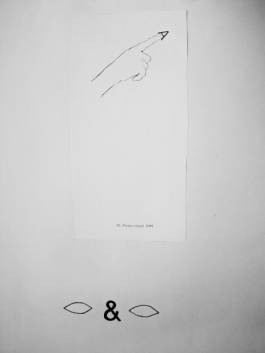
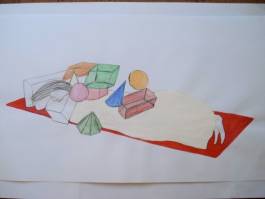
DD: Your work moves really on the edge between disciplines… and the way you refer to art or visual poetry deeply triggered my interest… For me was fascinating to observe how certain surrealist tradition echoes in your work… in particular in the collection “Denominate a Space” with idea of “mannequin/dressmaker's dummy”, but than, there are also traces of ideas about inner/outer space that Gordon Matta-Clark (who is a son of a surrealist painter after all) explored with his architectonic interventions…
Do you have special hero-figures from the world of art?
AA: There are so many artists I admire, and more that I keep discovering. I like Joan Brossa a lot - a Catalan poet and founder of the avant-garde Dadaist/Surrealist group “Dau al Set” (“7th face of the dice”), in which were also involved Joan Ponç, Antoni Tàpies and other artists. Brossa created many visual poems and object poems that I really admire.
Gordon Matta-Clark, Erwin Wurm and Rachel Whiteread were good inspirations for a while. I do have a special passion for futuristic and metaphysical artists, including De Chirico, Max Ernst, František Kupka, Philip Guston, Arshile Gorky, and Gary Hume. Maybe my real hero would be Pablo Picasso.
I also like some more contemporary artists who work with the body and textiles, such as Anna-Nicole Ziesche, Freddie Robins, and Nick Cave’s “Soundsuits” pieces, as well as the photographic works of Pinar Yolacan.
DD: I have a feeling that terms like fashion or art can’t really grasp the multiplicity of hybrid creations and practices that are emerging more and more… there is a need for a new vocabulary, I guess…
Since neither art nor fashion seems fitting, how would you describe/define your creative practice?
AA: I define myself as a garment thinker. I do not think about selling while I work; I do not put any boundaries in my process.
Dressing the human body is another form of artistic expression. The body reacts in one way, and clothes and patterns in another; it works in 3D and with movement, too. And then you have a face —the face of a person, which is the most expressive thing that exists.
I can make very commercial, trendy collections, and I've actually done some since I have been working for different companies… and I liked it too. But my projects go beyond the logic of the fashion industry, beyond seasons, trends and commercial productive requests. My studio is a laboratory of ideas! That was also the central theme of “Denominate a Space Collection”
DD: As a Spaniard, have you had a catholic education? Has it influenced your concept of fashion in some way?
AA: Yes, it has. My grandmother is very, very catholic, luckily my parents are not, but my early education definitely had this religious imprinting… Constantly aware of what is correct or not, the sins, the punishments… The only thing I find funny is when you have to rely on St. Antonio, for example, to bring you good luck in something or to Santa Rita to help you find something you lost… those things are nice to know.
I went through the rituals of baptism and communion, but as a child, I didn’t really know what they were all about. I did not really know what it was all about. However, I started reading some chapters of the Bible when I first arrived in Antwerp.
DD: Are you doing now what you dreamed of doing as a child?
AA: Yes, I am enjoying it like a child.
Published in DROME magazine, an issue about Childhood.
Andrea Ayala Closa, Collection “Denominate a Space” 2006.