

2025
2010
HELENA HERTOV: IT IS IMPORTANT TO CREATE NEW PRESENTATIONAL FORMS BASED ON FASHION'S CONDITIONS
“Forms Becoming Attitudes”
Conversations on Fashion Curating for the CURA Magazine
2009 - 2012
Ilaria Marotta, founding director of CURA magazine, was my collaborator at MACRO - Museum of Contemporary Art in Rome. In 2008, after we all were forced to leave the museum due to the change of the Mayor of Rome, and consequently the change of the museum’s direction, Ilaria started a free-press magazine in 2009 for which she asked me to collaborate.
My column was called “Forms Becoming Attitudes” and in every issue I was contributing with texts or interviews to curators dealing with fashion display in museums and other platforms.
This must have been one of the very pioneering surveys on Fashion Curating, still a very new field, since all I spoke with were known within a very niche of like-minded professionals.
I started with Linda Loppa, a founding director of MoMu in Antwerp and, back then, a newly appointed director of Polimoda in Florence. Then followed conversations with Tomas Rajnai, Maria Luisa Frisa, Helena Hertov, Judith Clark, Barbara Franchin, Sabine Seymour, Kaat Debo, Valerie Steele, Emanuele Quinz and Luca Marchetti.
Most of these names are today established and recognised fashion scholars, curators and exhibition makers.
Helena Hertov
Helena Hertov is a curator at Rian Design Museum. Rian Design Museum in Falkenberg, Sweden, exhibits design, crafts, fashion and architecture.
Previously, she was a founder of Fashionplay, an artist-driven platform for alternative fashion, whose aim was to strengthen fashion as an art form. Through various interventions, Fashionplay wanted to explore and broaden the idea of what fashion is and can be.
Dobrila Denegri: You have been running an initiative called “Fashionplay” for some time... To start this conversation, I’d like to ask you about the initial premises that led you to start this project and how it has been evolving over time.
Helena Hertov: In 2006, both Therese Dahlqvist and I were still in school. Therese studied fine art at the Royal Art Academy, and I studied fashion/textile at Konstfack, University College for Arts, Craft and Design in Sweden. We were both curious about each other’s fields and were missing a forum for the space between art and fashion. We were quite tired of the view of fashion being just commercial and superficial, so we decided to work to highlight fashion from different angles and perspectives with an ambition to develop fashion as a cultural expression. During the last forty years, there has been a long conflict around the fashion concept in Sweden, so we have a lot to work with.
It has been important for us to move between different disciplines; therefore, our work takes different shapes depending on the project we are involved in. Sometimes we are working to draw attention to other artists’ and theorists’ work, and sometimes we focus on our own artistic projects.
DD: In your opinion, who are the artists and/or fashion designers of the younger generation that “inhabit” this hybrid world in-between, where art and fashion intersect? How do their productions redefine notions of fashion and art, and are they creating a new vocabulary that more accurately captures and describes their work? How does your work relate to these productions?
HH: At the art schools in the last few years, there has been a large group of people wanting to work with clothes in relation to body, identity and societal development. The work has also focused on the artistic process and finding new methods of working with fashion. I also think that there is a longing to work with one’s own hands and not with mass-produced fashion, and to challenge the tradition of Swedish fashion as being a bit clean and boring.
People we think are good examples of this way of working are: Josefin Arnell, Erik Annerborn, Minna Palmqvist, Démode and Paulina Wallenberg Olsson and of course ourselves. We would describe their work as interdisciplinary. The designer/artist can move between disciplines depending on which project they are working on.
At the moment, “Fashionplay” are working on a project about fashion and ageing and how the elderly in Sweden use fashion in their construction of identity. It is a project that connects practice with theory with a focus on fashion’s performative aspects. But it is quite clear that we now need to find new concepts for defining these various types of fashion. We hope that Fashion Studies at Stockholm University might be able to contribute to this.
DD: The current Swedish, and generally Nordic, contemporary fashion scene has become extremely experimental, innovative, vibrant and productive. How would you explain this recent phenomenon, and who might you indicate as particularly interesting among the protagonists of this scene?
HH: New generations always react to previous expressions and have a longing to find new ways of working. In Sweden, experimental fashion has been on the move for some years, but it is now that we see results. Fashion has also been accepted as a science and an important social, economic and cultural phenomenon. This opens up the notion of fashion and creates new opportunities for designers/artists to develop new paths and working routines in fashion. Of course, the successes abroad of Sandra Backlund, Patrik Söderstam and Helena Hörstedt have focused attention on us, whilst inspiring younger artists.
DD: Would you define yourself as “fashion curators”? How would you describe this particular figure that has recently emerged, and do you see differences between an art and a fashion curator in their competencies and approaches?
HH: We do not work only as curators, but also as artists/designers, but when we curate, we feel no need to define ourselves as “fashion curators”. Our background as artists and designers gives us another perspective on exhibitions and on how the field between fashion and art can be presented. We think it is important to create new presentational forms based on fashion’s own conditions and to avoid putting fashion into the space of art (the “white cube”). A curator who works with fashion must have knowledge about fashion’s history and theory, as well as insight into how a designer/artist works. Fashion and clothing are related to everyday life and are a medium that all people use and have a relationship with. Clothing’s connection to the body and everyday performance is something that differs from art, and that we think a fashion curator should relate to.
DD: What, do you think, are the potential platforms for the activity of a “fashion curator”?
HH: As long as there are people who are interested in this field and carry the force and energy required to drive it, I think there is nothing that can stop it from growing. Then one hopes that it can be supported to enable it to grow on the basis of its own conditions, like all other cultural genres.
DD: Can you imagine a comparable institution, such as a Kunsthalle, but dedicated to fashion? If yes, what would it be like?
HH: “Fashionplay” has for a long time nurtured the dream of a space that can be used as an exhibition space, space for workshops and other creative work, different kinds of actions, lectures and seminars, etc., etc. All related to fashion in some way or another.
DD: How do you approach fashion, and how does your work interact with fashion’s more conventional “rules” (like seasons, trends, etc.)?
HH: Our work is probably more about communicating and depicting the significance and impact of fashion than trying to create fashion. Therefore, we feel no obligation to conduct ourselves in relation to seasons, and in this way, we feel completely free. Then, when it comes to trends in fashion, they are somehow tied to trends in society, which, in turn, are almost impossible not to be influenced by as a creative person.
Published in cura.magazine issue 06


Erik Annerborn, Hedda Viå , Ingrid Cogne
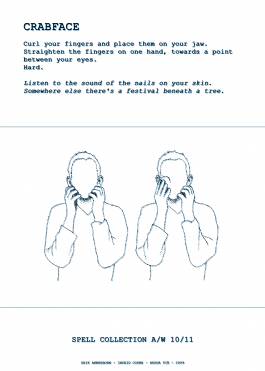
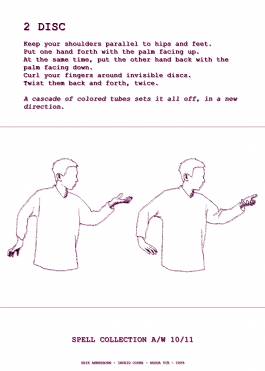
Our project was an immaterial fashion concept, a shot at answering the question: “How can the fashion system be maintained in a world where material consumption is no longer possible?” Our answer is “Spells”, movements replacing clothes as private expression in public space.
Our event during “Fashionplay” was a sort of subtle manifestation, where this concept infiltrated the main shopping street of Stockholm. Needless to say, this was very much time and place-based.
Our collection is best presented through instructions.
Relational fashion may seem pretentious, but the future may have to be a bit less material than now.


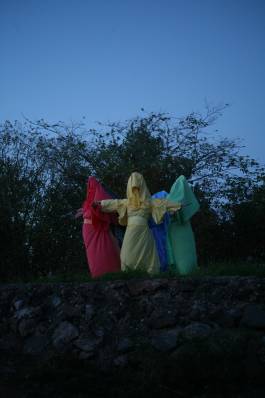

Nadine Byrne, “Dream Family”, performance. Photos by Björn Engberg
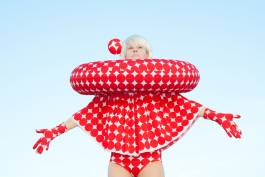
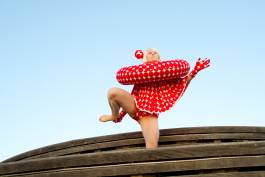
Paulina Wallenberg Olsson, “Where is the Ocean? Where is the Sea?”, performance at the public bathhouse Eriksdalsbadet in Stockholm. Photos by Leo Góngora
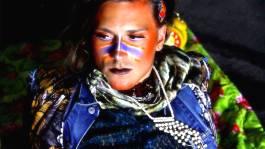
"Sthlm freak show", fashion short film presented under Fashionplay 2010.
Stylist: Helena Ekström from Démode
Hair & Make up: Emma Nilsson from Démode
Photo: Taivas Larriera Mikkola
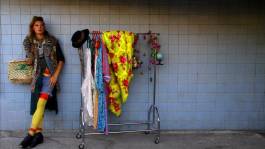
"Sthlm freak show", fashion short film presented under Fashionplay 2010.
Stylist: Helena Ekström from Démode
Hair & Make up: Emma Nilsson from Démode
Photo: Taivas Larriera Mikkola
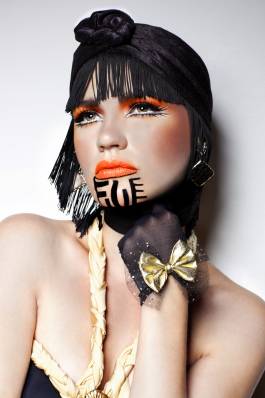
"Sthlm freak show", fashion short film presented under Fashionplay 2010.
Stylist: Helena Ekström from Démode
Hair & Make up: Emma Nilsson from Démode
Photo: Erik Lundback
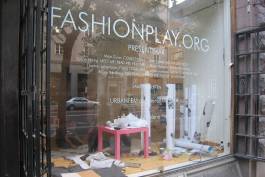
Fashionplay #3, Building exhibition at Birger Jarlsgatan 37
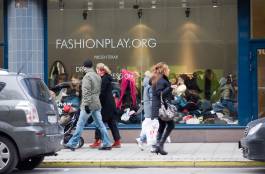
Fashionplay #4, Clothing swap shop together with Dress Off Dress On from 2008 at Regeringsgatan. Photo by Jon Hertov
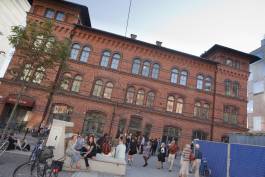
Fashionplay #6, “Fashion Walk”, from the opening of the main exhibition of the Stockholm Fashion Walk at Stationshuset, 18 different designers/artists participated
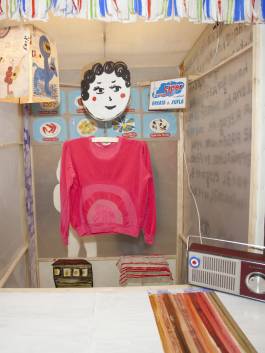
Fashionplay #6, “Fashion Walk”, Jenny Bergman and Karolina Serning. Photo by Jon Hertov
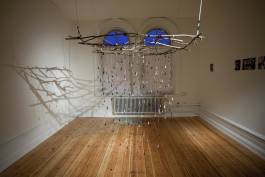
Fashionplay #6, “Fashion Walk”, Ariah, ARIAH.09.b, installation, Stockholm. Photo by Jon Hertov
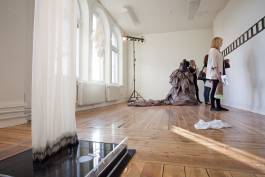
Fashionplay #6, “Fashion Walk”, Minna Palmqvist, Intimately Social 4.09, installation. Photo by Jon Hertov
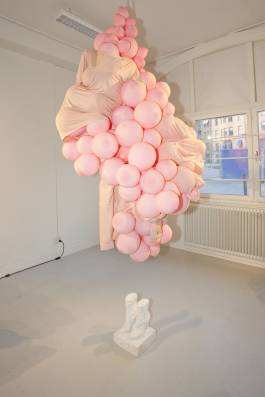
Fashionplay #6, “Fashion Walk”, Sarah Isaksson, Kontroll(f?st). Photo by Jon Hertov
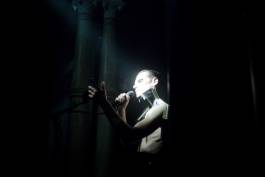
Fashionplay #6, Tobias Bernstrup, performance during the opening of the Stockholm Fashion Walk. Photo by Jon Hertov
2025
“Forms Becoming Attitudes”
Conversations on Fashion Curating for the CURA Magazine
2009 - 2012
Ilaria Marotta, founding director of CURA magazine, was my collaborator at MACRO - Museum of Contemporary Art in Rome. In 2008, after we all were forced to leave the museum due to the change of the Mayor of Rome, and consequently the change of the museum’s direction, Ilaria started a free-press magazine in 2009 for which she asked me to collaborate.
My column was called “Forms Becoming Attitudes” and in every issue I was contributing with texts or interviews to curators dealing with fashion display in museums and other platforms.
This must have been one of the very pioneering surveys on Fashion Curating, still a very new field, since all I spoke with were known within a very niche of like-minded professionals.
I started with Linda Loppa, a founding director of MoMu in Antwerp and, back then, a newly appointed director of Polimoda in Florence. Then followed conversations with Tomas Rajnai, Maria Luisa Frisa, Helena Hertov, Judith Clark, Barbara Franchin, Sabine Seymour, Kaat Debo, Valerie Steele, Emanuele Quinz and Luca Marchetti.
Most of these names are today established and recognised fashion scholars, curators and exhibition makers.
Helena Hertov
Helena Hertov is a curator at Rian Design Museum. Rian Design Museum in Falkenberg, Sweden, exhibits design, crafts, fashion and architecture.
Previously, she was a founder of Fashionplay, an artist-driven platform for alternative fashion, whose aim was to strengthen fashion as an art form. Through various interventions, Fashionplay wanted to explore and broaden the idea of what fashion is and can be.
2010
HELENA HERTOV: IT IS IMPORTANT TO CREATE NEW PRESENTATIONAL FORMS BASED ON FASHION'S CONDITIONS
Dobrila Denegri: You have been running an initiative called “Fashionplay” for some time... To start this conversation, I’d like to ask you about the initial premises that led you to start this project and how it has been evolving over time.
Helena Hertov: In 2006, both Therese Dahlqvist and I were still in school. Therese studied fine art at the Royal Art Academy, and I studied fashion/textile at Konstfack, University College for Arts, Craft and Design in Sweden. We were both curious about each other’s fields and were missing a forum for the space between art and fashion. We were quite tired of the view of fashion being just commercial and superficial, so we decided to work to highlight fashion from different angles and perspectives with an ambition to develop fashion as a cultural expression. During the last forty years, there has been a long conflict around the fashion concept in Sweden, so we have a lot to work with.
It has been important for us to move between different disciplines; therefore, our work takes different shapes depending on the project we are involved in. Sometimes we are working to draw attention to other artists’ and theorists’ work, and sometimes we focus on our own artistic projects.
DD: In your opinion, who are the artists and/or fashion designers of the younger generation that “inhabit” this hybrid world in-between, where art and fashion intersect? How do their productions redefine notions of fashion and art, and are they creating a new vocabulary that more accurately captures and describes their work? How does your work relate to these productions?
HH: At the art schools in the last few years, there has been a large group of people wanting to work with clothes in relation to body, identity and societal development. The work has also focused on the artistic process and finding new methods of working with fashion. I also think that there is a longing to work with one’s own hands and not with mass-produced fashion, and to challenge the tradition of Swedish fashion as being a bit clean and boring.
People we think are good examples of this way of working are: Josefin Arnell, Erik Annerborn, Minna Palmqvist, Démode and Paulina Wallenberg Olsson and of course ourselves. We would describe their work as interdisciplinary. The designer/artist can move between disciplines depending on which project they are working on.
At the moment, “Fashionplay” are working on a project about fashion and ageing and how the elderly in Sweden use fashion in their construction of identity. It is a project that connects practice with theory with a focus on fashion’s performative aspects. But it is quite clear that we now need to find new concepts for defining these various types of fashion. We hope that Fashion Studies at Stockholm University might be able to contribute to this.
DD: The current Swedish, and generally Nordic, contemporary fashion scene has become extremely experimental, innovative, vibrant and productive. How would you explain this recent phenomenon, and who might you indicate as particularly interesting among the protagonists of this scene?
HH: New generations always react to previous expressions and have a longing to find new ways of working. In Sweden, experimental fashion has been on the move for some years, but it is now that we see results. Fashion has also been accepted as a science and an important social, economic and cultural phenomenon. This opens up the notion of fashion and creates new opportunities for designers/artists to develop new paths and working routines in fashion. Of course, the successes abroad of Sandra Backlund, Patrik Söderstam and Helena Hörstedt have focused attention on us, whilst inspiring younger artists.
DD: Would you define yourself as “fashion curators”? How would you describe this particular figure that has recently emerged, and do you see differences between an art and a fashion curator in their competencies and approaches?
HH: We do not work only as curators, but also as artists/designers, but when we curate, we feel no need to define ourselves as “fashion curators”. Our background as artists and designers gives us another perspective on exhibitions and on how the field between fashion and art can be presented. We think it is important to create new presentational forms based on fashion’s own conditions and to avoid putting fashion into the space of art (the “white cube”). A curator who works with fashion must have knowledge about fashion’s history and theory, as well as insight into how a designer/artist works. Fashion and clothing are related to everyday life and are a medium that all people use and have a relationship with. Clothing’s connection to the body and everyday performance is something that differs from art, and that we think a fashion curator should relate to.
DD: What, do you think, are the potential platforms for the activity of a “fashion curator”?
HH: As long as there are people who are interested in this field and carry the force and energy required to drive it, I think there is nothing that can stop it from growing. Then one hopes that it can be supported to enable it to grow on the basis of its own conditions, like all other cultural genres.
DD: Can you imagine a comparable institution, such as a Kunsthalle, but dedicated to fashion? If yes, what would it be like?
HH: “Fashionplay” has for a long time nurtured the dream of a space that can be used as an exhibition space, space for workshops and other creative work, different kinds of actions, lectures and seminars, etc., etc. All related to fashion in some way or another.
DD: How do you approach fashion, and how does your work interact with fashion’s more conventional “rules” (like seasons, trends, etc.)?
HH: Our work is probably more about communicating and depicting the significance and impact of fashion than trying to create fashion. Therefore, we feel no obligation to conduct ourselves in relation to seasons, and in this way, we feel completely free. Then, when it comes to trends in fashion, they are somehow tied to trends in society, which, in turn, are almost impossible not to be influenced by as a creative person.
Published in cura.magazine issue 06


Erik Annerborn, Hedda Viå , Ingrid Cogne
Our project was an immaterial fashion concept, a shot at answering the question: “How can the fashion system be maintained in a world where material consumption is no longer possible?” Our answer is “Spells”, movements replacing clothes as private expression in public space.
Our event during “Fashionplay” was a sort of subtle manifestation, where this concept infiltrated the main shopping street of Stockholm. Needless to say, this was very much time and place-based.
Our collection is best presented through instructions.
Relational fashion may seem pretentious, but the future may have to be a bit less material than now.


Nadine Byrne, “Dream Family”, performance. Photos by Björn Engberg


Paulina Wallenberg Olsson, “Where is the Ocean? Where is the Sea?”, performance at the public bathhouse Eriksdalsbadet in Stockholm. Photos by Leo Góngora

"Sthlm freak show", fashion short film presented under Fashionplay 2010.
Stylist: Helena Ekström from Démode
Hair & Make up: Emma Nilsson from Démode
Photo: Taivas Larriera Mikkola

"Sthlm freak show", fashion short film presented under Fashionplay 2010.
Stylist: Helena Ekström from Démode
Hair & Make up: Emma Nilsson from Démode
Photo: Taivas Larriera Mikkola

"Sthlm freak show", fashion short film presented under Fashionplay 2010.
Stylist: Helena Ekström from Démode
Hair & Make up: Emma Nilsson from Démode
Photo: Erik Lundback

Fashionplay #3, Building exhibition at Birger Jarlsgatan 37

Fashionplay #4, Clothing swap shop together with Dress Off Dress On from 2008 at Regeringsgatan. Photo by Jon Hertov

Fashionplay #6, “Fashion Walk”, from the opening of the main exhibition of the Stockholm Fashion Walk at Stationshuset, 18 different designers/artists participated

Fashionplay #6, “Fashion Walk”, Jenny Bergman and Karolina Serning. Photo by Jon Hertov

Fashionplay #6, “Fashion Walk”, Ariah, ARIAH.09.b, installation, Stockholm. Photo by Jon Hertov

Fashionplay #6, “Fashion Walk”, Minna Palmqvist, Intimately Social 4.09, installation. Photo by Jon Hertov

Fashionplay #6, “Fashion Walk”, Sarah Isaksson, Kontroll(f?st). Photo by Jon Hertov

Fashionplay #6, Tobias Bernstrup, performance during the opening of the Stockholm Fashion Walk. Photo by Jon Hertov
INSTAGRAM
@EXPERIMENTS.FASHION.ART