


2025
2011
KAAT DEBO: WHAT INTERESTS US IS NOT MERELY DISPLAYING GARMENTS, BUT CREATING A DISCOURSE ABOUT FASHION IN ITS TOTALITY
“Forms Becoming Attitudes”
Conversations on Fashion Curating for the CURA Magazine
2009 - 2012
Ilaria Marotta, founding director of CURA magazine, was my collaborator at MACRO - Museum of Contemporary Art in Rome. In 2008, after we were all forced to leave the museum due to the change of the Mayor of Rome and consequently the museum’s new direction, Ilaria started a free-press magazine in 2009, for which she asked me to collaborate.
My column was called “Forms Becoming Attitudes” and in every issue I was contributing with texts or interviews to curators dealing with fashion display in museums and other platforms.
This must have been one of the very pioneering surveys on Fashion Curating, still a very new field, since all I spoke with were known within a very niche of like-minded professionals.
I started with Linda Loppa, a founding director of MoMu in Antwerp and, back then, a newly appointed director of Polimoda in Florence. Then followed conversations with Tomas Rajnai, Maria Luisa Frisa, Helena Hertov, Judith Clark, Barbara Franchin, Sabine Seymour, Kaat Debo, Valerie Steele, Emanuele Quinz and Luca Marchetti.
Most of these names are today established and recognised fashion scholars, curators and exhibition makers.
Kaat Debo
Director and chief curator of MoMu / https://www.momu.be
Kaat Debo serves as the director and chief curator of MoMu, the Fashion Museum in Antwerp. She studied literature at the universities of Antwerp and Berlin and joined MoMu in 2001 as a curator, focusing on the museum’s exhibitions and publications. From 2007 to 2008, she was the editor-in-chief of A MAGAZINE, and in 2009, she was appointed general director of MoMu. Since her arrival, she has collaborated with some of the world’s leading fashion designers and houses. Over her 20+ years at the museum, she has realised more than 50 exhibitions, several of which she curated. She has played a key role in enhancing the museum’s international reputation by showcasing its exhibitions in cities such as Paris, London, Tokyo, and Melbourne. She oversaw the extensive renovation and expansion of the museum from 2018 to 2021. Additionally, she frequently lectures on contemporary (Belgian) fashion.
Dobrila Denegri: It would be interesting to begin our conversation by speaking about the way you started to work in the field of fashion… in particular, it would be interesting to know if your academic formation influenced in any way your approach to fashion and your curatorial work?
Kaat Debo: Even if my studies were not directly connected with fashion, there is a certain methodology, as well as a certain set of academic tools that I acquired during my studies of literature and contemporary dance that I still find very useful and that I apply in my present work. My involvement in fashion developed gradually, with a focus on practical rather than theoretical aspects, since it started just as MoMU opened in Antwerp in 2001. Its first director, Linda Loppa, was looking for collaborators, and I applied for the job. I think that, for both of us, it was a very exciting process because the lack of specific academic training left us with a greater openness to experiment and to shape the profile of this newborn institution more empirically and intuitively. But from the very beginning, for us, it was very clear one point: that what interests us is not merely displaying garments, but creating a certain discourse about fashion in its totality. Fashion is a visual field. It deals with images and creates imagery. These were the initial premises for each exhibition project that we undertook and realised in MoMu. We would start each exhibition with entirely empty space and build a show as a complete visual and sensual experience, each time around a different concept, theme, or author.
For me, today is still very important, this aspect of exhibition design, as well as the whole collaborative process and dialogue with the designer to whom we are dedicating the show. For example, for an exhibition of Walter Van Beirendonck, we have worked intensively with him to give dynamism to the space and to the presentation of his collections, insisting on accessories, shoes, details or on the movement of mannequins in order to overcome those limitations that an exhibition of garments necessarily has. Clothes are made for the body in movement; they have to be worn. It is always a new challenge to find solutions to present garments in ways that are not static or conventional, and, naturally, haven’t been seen before.
DD: What were the challenges for you when you started to direct MoMu in Antwerp, and what guided you in the choice of designers to whom you dedicated solo exhibitions like Veronique Branquinho, Maison Martin Margiela, Bernhard Willhelm and others?
KD: When I invite the designer to mount a solo exhibition, what I'm actually offering him/her is the possibility to look back and see what he/she has done. But what we try to do when we exhibit contemporary fashion, or fashion in general, is to provide the context. I think a lot of traditional museums don't do that. They focus on the garment, which is nice and interesting, but it doesn't tell the whole fashion story. Sometimes it can also be interesting when you do the exhibition on a house or a designer, to show how they communicate with their fashion, how they sell their fashion. For example, in our Margiela exhibition, we had one theme focusing on the stores. For some designers, it's interesting to show what position they have within the fashion system, and how they react against it, or maybe don't react against it. In order to give people a perspective on fashion, you have to think of all those elements. And we try to do all this in a visual way. You can always exhibit the garments, and have a long text on the wall next to it, but that doesn't really trigger people, it doesn't appeal to them, they don't really feel it. Fashion has a lot to do with emotions, so it's not only about understanding, but also about feeling it. Fashion is a visual medium, and we try to respect that. We try to work a little bit in the same way - to trigger people visually.
DD: How would you define fashion “curating” in relation to your own practice, and especially in relation to exhibitive formats you developed in the Fashion Museum situated in such an important centre for contemporary fashion, as Antwerp?
KD: One important aspect is selection. Some designers are able to make collections and achieve great commercial success, but for me, as curator, it is much more interesting to observe how certain designers were able to build their own strong and recognisable imagery. To present this imagery in a wider frame, to expose all different aspects that are connected with the work of each designer and not to focus exclusively on garments is our primary aim. This is not reflected only in the way in which we conceive and make exhibitions, but also in the way in which we approach our collection. It is not only about garments as final products, but also about all those additional and accompanying elements that create the totality of the designer’s visual identity.
DD: Could you tell me a bit more about this aspect of MoMu’s activity and your approach when it comes to the creation of a fashion collection?
KD: MoMu has a specific aim: to collect Belgian fashion heritage. We have a historical collection, and we also have a contemporary collection, which means that I actively buy items from Belgian designers. Our yearly budget is not very big. We have 30,000 € for new items. From designers, we collect not only garments but also DVDs of their fashion shows, invitations, all the graphic work they make, lookbooks, invitations for special events, and press releases. We do all this to give researchers a complete overview of what the designers do, because fashion design is much more than only designing a garment or a collection. I see that many larger institutions, more traditional museums, didn't think of all those ephemera. They just focus on the garment. But, if you have the look book together with the garment, you can also see how the garment was combined with the shoes, what styling was, what the make-up was, and what the hair was. I guess we are one of the few museums that collect all these items.
DD: Antwerp became famous as a centre for fashion, also because of its academy. A great number of young, talented aspiring fashion designers come to study there. After finishing their training period, they continue to carry this particular “mark” that makes them so recognisable. Could you imagine that Antwerp also becomes an important point for the formation of those young persons who would like to undertake a career in fashion curator or fashion theoretician? Do you see a possibility or a need to develop a course of this kind within the Museum?
KD: It is something about which I have been thinking a lot, and even if we haven’t started yet, we have the intention to develop and implement this aspect within the activity of the museum. As I stated on a few previous occasions, I would be interested in talking with the University of Antwerp to explore the possibility of integrating fashion into art history, cultural history, and other departments. I think this is very interesting. That's the click that many people at the university have to make. They usually say: ”Oh, I don't know anything about fashion.” But, they do. You have to use the same tools you use to analyse art, photography, theatre, drama, etc. You can do the same for fashion. It would be interesting to have people with different academic backgrounds analysing fashion. But I think it's a long-term project. What I would like to do first is to start with a small, maybe summer school, invite people from abroad, and make people here enthusiastic. It will take time to have PHD students working on fashion in Antwerp. People have to be able to teach. But I think it could be pretty interesting for Antwerp University to attract more foreign students. With fashion design, we have already done that, and it would be great to combine. I have a feeling that now there is a big interest in this, which was not the case 10 years ago, when the University was not at all interested in it. The gap is getting smaller now, and I'm really excited to start working with them on some project proposals.
DD: Do you also see the pages of the magazine as a potential “exhibitive” or “curatorial” space? For some time, you have been editor-in-chief of “A Magazine”, which was commissioned and “curated” by a different fashion designer every six months. Among others involved were: Maison Martin Margiela, Yohji Yamamoto, Haider Ackermann, Jun Takahashi / Undercover, Martine Sitbon, Veronique Branquinho, Kris van Assche, etc. How was it to work with designers within this kind of frame?
KD: Yes, of course, a magazine is also a potential exhibition space, even if it functions in a completely different way, primarily because we have to deal with two-dimensional, plain space. It is sort of a limit but also a trigger for the designer to come up with inedited solutions for combining image and text. For me, each issue was a new and exciting experience, which I like to compare with the work on the exhibition catalogue, which is another interesting medium we have to explore when we talk about “curating” and exhibiting. In the case of “A Magazine”, I noticed that for all invited designers, involvement in the visual part always prevailed.
Published in the cura.magazine, issue 10
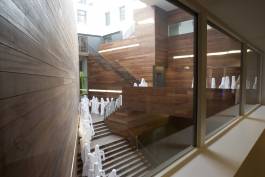
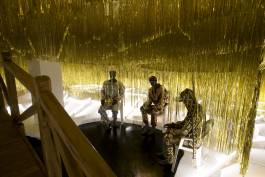
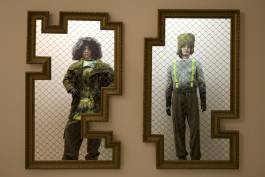

Bernhard Willhelm, Het Totaal Rappel, Photography by Ronald Stoops.
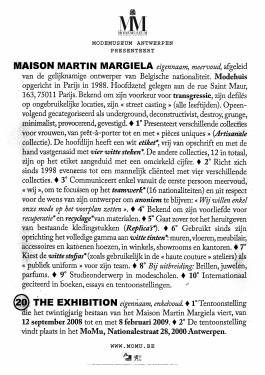
MMM (20) The Exhibition Poster.

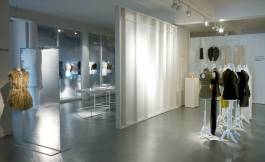
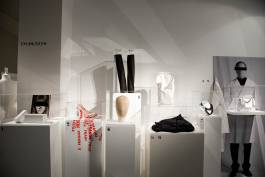
MMM (20) The Exhibition, Photography by Ronald Stoops.
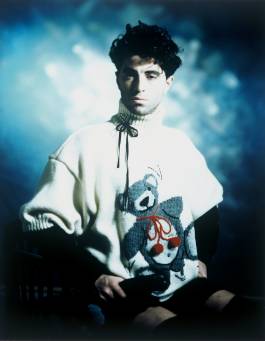
Walter Van Beirendonck A/W 1986–87, Bad Baby Boys - Photo: Patrick Robyn.
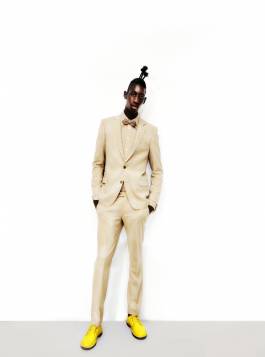
Walter Van Beirendonck A/W 2011–12, Hand on Heart - Photo: Ronald Stoops.
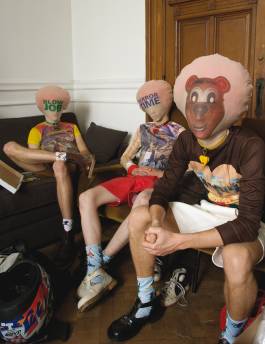
W.&L.T. S/S 1996, Killer/Astral Travel/4D-Hi-D - Photo: Ronald Stoops.
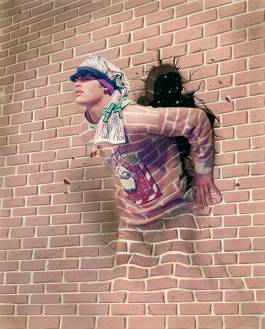
Walter Van Beirendonck S/S 1989, King Kong Kooks - Photo: Ronald Stoops, Illustration: Jan Bosschaert.
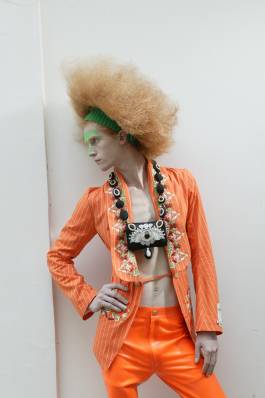
Walter Van Beirendonck S/S 2006, Relics from the Future - Photo: Ronald Stoops.
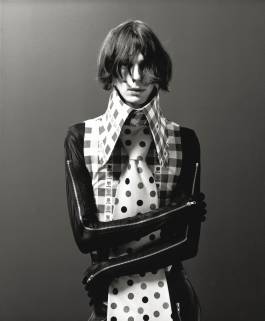
Walter Van Beirendonck A/W 2001–02, Revolution! - Photo: Elisabeth Broekaert.
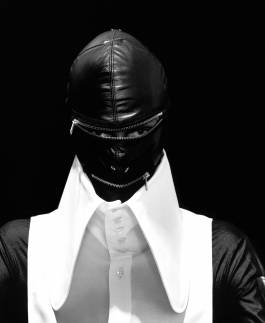
Walter Van Beirendonck A/W 2001–02, Revolution! - Photo: Elisabeth Broekaert.
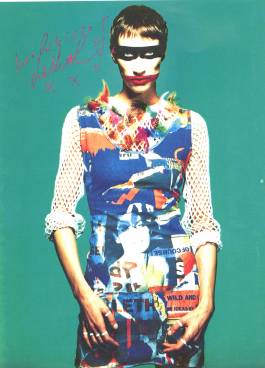
Walter Van Beirendonck S/S 1993, Wild & Lethal Trash! - Photo: Ronald Stoops.
2025
“Forms Becoming Attitudes”
Conversations on Fashion Curating for the CURA Magazine
2009 - 2012
Ilaria Marotta, founding director of CURA magazine, was my collaborator at MACRO - Museum of Contemporary Art in Rome. In 2008, after we were all forced to leave the museum due to the change of the Mayor of Rome and consequently the museum’s new direction, Ilaria started a free-press magazine in 2009, for which she asked me to collaborate.
My column was called “Forms Becoming Attitudes” and in every issue I was contributing with texts or interviews to curators dealing with fashion display in museums and other platforms.
This must have been one of the very pioneering surveys on Fashion Curating, still a very new field, since all I spoke with were known within a very niche of like-minded professionals.
I started with Linda Loppa, a founding director of MoMu in Antwerp and, back then, a newly appointed director of Polimoda in Florence. Then followed conversations with Tomas Rajnai, Maria Luisa Frisa, Helena Hertov, Judith Clark, Barbara Franchin, Sabine Seymour, Kaat Debo, Valerie Steele, Emanuele Quinz and Luca Marchetti.
Most of these names are today established and recognised fashion scholars, curators and exhibition makers.
Kaat Debo
Director and chief curator of MoMu / https://www.momu.be
Kaat Debo serves as the director and chief curator of MoMu, the Fashion Museum in Antwerp. She studied literature at the universities of Antwerp and Berlin and joined MoMu in 2001 as a curator, focusing on the museum’s exhibitions and publications. From 2007 to 2008, she was the editor-in-chief of A MAGAZINE, and in 2009, she was appointed general director of MoMu. Since her arrival, she has collaborated with some of the world’s leading fashion designers and houses. Over her 20+ years at the museum, she has realised more than 50 exhibitions, several of which she curated. She has played a key role in enhancing the museum’s international reputation by showcasing its exhibitions in cities such as Paris, London, Tokyo, and Melbourne. She oversaw the extensive renovation and expansion of the museum from 2018 to 2021. Additionally, she frequently lectures on contemporary (Belgian) fashion.
2011
KAAT DEBO: WHAT INTERESTS US IS NOT MERELY DISPLAYING GARMENTS, BUT CREATING A DISCOURSE ABOUT FASHION IN ITS TOTALITY
Dobrila Denegri: It would be interesting to begin our conversation by speaking about the way you started to work in the field of fashion… in particular, it would be interesting to know if your academic formation influenced in any way your approach to fashion and your curatorial work?
Kaat Debo: Even if my studies were not directly connected with fashion, there is a certain methodology, as well as a certain set of academic tools that I acquired during my studies of literature and contemporary dance that I still find very useful and that I apply in my present work. My involvement in fashion developed gradually, with a focus on practical rather than theoretical aspects, since it started just as MoMU opened in Antwerp in 2001. Its first director, Linda Loppa, was looking for collaborators, and I applied for the job. I think that, for both of us, it was a very exciting process because the lack of specific academic training left us with a greater openness to experiment and to shape the profile of this newborn institution more empirically and intuitively. But from the very beginning, for us, it was very clear one point: that what interests us is not merely displaying garments, but creating a certain discourse about fashion in its totality. Fashion is a visual field. It deals with images and creates imagery. These were the initial premises for each exhibition project that we undertook and realised in MoMu. We would start each exhibition with entirely empty space and build a show as a complete visual and sensual experience, each time around a different concept, theme, or author.
For me, today is still very important, this aspect of exhibition design, as well as the whole collaborative process and dialogue with the designer to whom we are dedicating the show. For example, for an exhibition of Walter Van Beirendonck, we have worked intensively with him to give dynamism to the space and to the presentation of his collections, insisting on accessories, shoes, details or on the movement of mannequins in order to overcome those limitations that an exhibition of garments necessarily has. Clothes are made for the body in movement; they have to be worn. It is always a new challenge to find solutions to present garments in ways that are not static or conventional, and, naturally, haven’t been seen before.
DD: What were the challenges for you when you started to direct MoMu in Antwerp, and what guided you in the choice of designers to whom you dedicated solo exhibitions like Veronique Branquinho, Maison Martin Margiela, Bernhard Willhelm and others?
KD: When I invite the designer to mount a solo exhibition, what I'm actually offering him/her is the possibility to look back and see what he/she has done. But what we try to do when we exhibit contemporary fashion, or fashion in general, is to provide the context. I think a lot of traditional museums don't do that. They focus on the garment, which is nice and interesting, but it doesn't tell the whole fashion story. Sometimes it can also be interesting when you do the exhibition on a house or a designer, to show how they communicate with their fashion, how they sell their fashion. For example, in our Margiela exhibition, we had one theme focusing on the stores. For some designers, it's interesting to show what position they have within the fashion system, and how they react against it, or maybe don't react against it. In order to give people a perspective on fashion, you have to think of all those elements. And we try to do all this in a visual way. You can always exhibit the garments, and have a long text on the wall next to it, but that doesn't really trigger people, it doesn't appeal to them, they don't really feel it. Fashion has a lot to do with emotions, so it's not only about understanding, but also about feeling it. Fashion is a visual medium, and we try to respect that. We try to work a little bit in the same way - to trigger people visually.
DD: How would you define fashion “curating” in relation to your own practice, and especially in relation to exhibitive formats you developed in the Fashion Museum situated in such an important centre for contemporary fashion, as Antwerp?
KD: One important aspect is selection. Some designers are able to make collections and achieve great commercial success, but for me, as curator, it is much more interesting to observe how certain designers were able to build their own strong and recognisable imagery. To present this imagery in a wider frame, to expose all different aspects that are connected with the work of each designer and not to focus exclusively on garments is our primary aim. This is not reflected only in the way in which we conceive and make exhibitions, but also in the way in which we approach our collection. It is not only about garments as final products, but also about all those additional and accompanying elements that create the totality of the designer’s visual identity.
DD: Could you tell me a bit more about this aspect of MoMu’s activity and your approach when it comes to the creation of a fashion collection?
KD: MoMu has a specific aim: to collect Belgian fashion heritage. We have a historical collection, and we also have a contemporary collection, which means that I actively buy items from Belgian designers. Our yearly budget is not very big. We have 30,000 € for new items. From designers, we collect not only garments but also DVDs of their fashion shows, invitations, all the graphic work they make, lookbooks, invitations for special events, and press releases. We do all this to give researchers a complete overview of what the designers do, because fashion design is much more than only designing a garment or a collection. I see that many larger institutions, more traditional museums, didn't think of all those ephemera. They just focus on the garment. But, if you have the look book together with the garment, you can also see how the garment was combined with the shoes, what styling was, what the make-up was, and what the hair was. I guess we are one of the few museums that collect all these items.
DD: Antwerp became famous as a centre for fashion, also because of its academy. A great number of young, talented aspiring fashion designers come to study there. After finishing their training period, they continue to carry this particular “mark” that makes them so recognisable. Could you imagine that Antwerp also becomes an important point for the formation of those young persons who would like to undertake a career in fashion curator or fashion theoretician? Do you see a possibility or a need to develop a course of this kind within the Museum?
KD: It is something about which I have been thinking a lot, and even if we haven’t started yet, we have the intention to develop and implement this aspect within the activity of the museum. As I stated on a few previous occasions, I would be interested in talking with the University of Antwerp to explore the possibility of integrating fashion into art history, cultural history, and other departments. I think this is very interesting. That's the click that many people at the university have to make. They usually say: ”Oh, I don't know anything about fashion.” But, they do. You have to use the same tools you use to analyse art, photography, theatre, drama, etc. You can do the same for fashion. It would be interesting to have people with different academic backgrounds analysing fashion. But I think it's a long-term project. What I would like to do first is to start with a small, maybe summer school, invite people from abroad, and make people here enthusiastic. It will take time to have PHD students working on fashion in Antwerp. People have to be able to teach. But I think it could be pretty interesting for Antwerp University to attract more foreign students. With fashion design, we have already done that, and it would be great to combine. I have a feeling that now there is a big interest in this, which was not the case 10 years ago, when the University was not at all interested in it. The gap is getting smaller now, and I'm really excited to start working with them on some project proposals.
DD: Do you also see the pages of the magazine as a potential “exhibitive” or “curatorial” space? For some time, you have been editor-in-chief of “A Magazine”, which was commissioned and “curated” by a different fashion designer every six months. Among others involved were: Maison Martin Margiela, Yohji Yamamoto, Haider Ackermann, Jun Takahashi / Undercover, Martine Sitbon, Veronique Branquinho, Kris van Assche, etc. How was it to work with designers within this kind of frame?
KD: Yes, of course, a magazine is also a potential exhibition space, even if it functions in a completely different way, primarily because we have to deal with two-dimensional, plain space. It is sort of a limit but also a trigger for the designer to come up with inedited solutions for combining image and text. For me, each issue was a new and exciting experience, which I like to compare with the work on the exhibition catalogue, which is another interesting medium we have to explore when we talk about “curating” and exhibiting. In the case of “A Magazine”, I noticed that for all invited designers, involvement in the visual part always prevailed.
Published in the cura.magazine, issue 10
Bernhard Willhelm, Het Totaal Rappel, Photography by Ronald Stoops.
MMM (20) The Exhibition Poster.
MMM (20) The Exhibition, Photography by Ronald Stoops.
Walter Van Beirendonck A/W 1986–87, Bad Baby Boys - Photo: Patrick Robyn.
Walter Van Beirendonck A/W 2011–12, Hand on Heart - Photo: Ronald Stoops.
W.&L.T. S/S 1996, Killer/Astral Travel/4D-Hi-D - Photo: Ronald Stoops.
Walter Van Beirendonck S/S 1989, King Kong Kooks - Photo: Ronald Stoops, Illustration: Jan Bosschaert.
Walter Van Beirendonck S/S 2006, Relics from the Future - Photo: Ronald Stoops.
Walter Van Beirendonck A/W 2001–02, Revolution! - Photo: Elisabeth Broekaert.
Walter Van Beirendonck A/W 2001–02, Revolution! - Photo: Elisabeth Broekaert.
Walter Van Beirendonck S/S 1993, Wild & Lethal Trash! - Photo: Ronald Stoops.
INSTAGRAM
@EXPERIMENTS.FASHION.ART