


2025
2012
EMANUELE QUINZ & LUCA MARCHETTI
MOSIGN: OUR RESEARCH FOCUSES ON PROCESSES EVEN MORE THAN ON ARTWORKS
“Forms Becoming Attitudes”
Conversations on Fashion Curating for the CURA Magazine
2009 - 2012
Ilaria Marotta, founding director of CURA magazine, was my collaborator at MACRO - Museum of Contemporary Art in Rome. In 2008, after we were all forced to leave the museum due to the change of the Mayor of Rome and consequently the museum’s new direction, Ilaria started a free-press magazine in 2009, for which she asked me to collaborate.
My column was called “Forms Becoming Attitudes” and in every issue I was contributing with texts or interviews to curators dealing with fashion display in museums and other platforms.
This must have been one of the very pioneering surveys on Fashion Curating, still a very new field, since all I spoke with were known within a very niche of like-minded professionals.
I started with Linda Loppa, a founding director of MoMu in Antwerp and, back then, a newly appointed director of Polimoda in Florence. Then followed conversations with Tomas Rajnai, Maria Luisa Frisa, Helena Hertov, Judith Clark, Barbara Franchin, Sabine Seymour, Kaat Debo, Valerie Steele, Emanuele Quinz and Luca Marchetti.
Most of these names are today established and recognised fashion scholars, curators and exhibition makers.
Luca Marchetti
Luca Marchetti has been teaching as a senior lecturer at the Institut Français de la Mode in Paris since 2004, at the University of Bologna (Italy) and the Sorbonne Nouvelle University in Paris in the context of the Master's on “Creative industries” co-directed with the luxury group LVMH.
He also works internationally as a brand consultant and event curator for brands or museums, and regularly collaborates with magazines such as Vogue or Revue. He recently published (ed.) “Fashion Curating / La Mode Expose: Understanding Fashion through the Exhibition” (HEAD
Publisher, 2017) and “Exhibit! Fashion on display: exhibitions and brand spaces” (with Simona S.-Reinach, Mondadori-Pearson, 2020).
In 2019, he co-founded the foresight and innovation consultancy studio THE PROSPECTIVISTS.
Emanuele Quinz
Emanuele Quinz is an Art and Design Historian and Curator, PhD, Associate Professor at Paris 8 University and at École nationale supérieure des Arts Décoratifs (EnsAD), Paris.
His research focuses on contemporary art theories and practices crossing disciplines, like visual, media and performing arts, music and design. Since 2012, together with Samuel Bianchini, he has been coordinating the “Behaviors” research project (Labex ArtsH2H, EUR Artec, in collaboration with the Centre Pompidou). He is the author of “Le cercle invisible. Environnements, systèmes, dispositifs” (Les presses du réel, 2017), and editor of several international publications.
As a free-lance curator, he curated the international exhibitions “Invisibile” (Siena, 2004), and with L. Marchetti “Experience Design” (Bolzano, 2005), “Dysfashional” (Luxembourg 2007, Lausanne 2008, Paris 2009, Berlin, Moscow 2010, Jakarta 2011), and “Basic Instincts” (Berlin, 2011, Arnhem, Shenzhen 2012).
Dobrila Denegri: How did each of you begin your curatorial work within the field of contemporary fashion, and how has your involvement evolved with Mosign projects?
Luca Marchetti: Emanuele and I have different profiles. As for myself, I come from the disciplines of communication and semiotics, while Emanuele has an art history and media aesthetics background. I became intrigued and then interested in fashion and design at the university, studying comparative strategies of communication common in popular culture.
We met in Paris, where Emanuele had co-created an association called “Anomos”, focusing on cross-disciplinary art projects. I proposed to add to this practice the approach I had started to develop regarding fashion and design. So I took the direction of mosign as the pole of the association devoted to fashion and design.
Later, we decided to make mosign evolve, from the status of an association to that of a company, in order to manage more structured and consistent projects both in public, non-profit and private contexts.
As for concerns fashion curation in particular, our goal is to work with the specific knowledge fashion developed in order to express a critical point of view on matters as the conception of the body, corporeality and proprioception, the spatial context, identity… More widely, the idea of “experience” is recurrent and pivotal reference for us: fashion has developed a complex of competence of signification, which allow to deal interestingly with the notions of aesthetics, self representation, “performativity”, etc. through embodied solutions, according to the fact that on this field (as opposite to what happens in industrial design) critical reflexion led by creatives rarely is a mater of theory and more often a matter of practice.
DD: What were the challenges for you when you started with mosign, and how would you define your current activity?
mosign: We had (and partly still have) to deal mainly with two challenges: first of all, making fashion acceptable as a “legitimate” field of interest and investigation in the frame of contemporary arts. Secondly, it has been anything but obvious to assess mosign’s will to develop both commercial and no-profit (purely artistic) projects. For many of our interlocutors, the two practices looked contradictory.
DD: Could we talk about different exhibition formats that you developed and made tours in the last years… how important is this itinerary aspect for your projects?
mosign: This is a question I particularly appreciate, because the “format” is one of the aspects we most care about in our projects. This is because our research focuses on processes even more than on artworks: the shape, the form of an exhibition is obviously a statement and fully part of its content. The two main exhibition we are currently developing are based on two quite radical staging principles: “Dysfashional” has been conceived as a construction site, a 360° workshop site in which artworks interact with their specific features: visual aesthetics, sound, temperature… while “Basic Instincts” is conceived as a “galaxy” of different landscapes, each developing an aspect of the show’s main theme. Every landscape is identified by a structure, a shell, designed by the Danish artist and fashion designer Henrik Vibskov according to the core theme of the landscape in order to host different artworks from different disciplines.
Both exhibitions underline the will of not creating a hierarchy among the artworks and the different art expressions invited within the project. They also attract visitors’ attention to the possibility of establishing unexpected critical connections between the artworks: the openness of the space and the visible accessibility of the whole exhibition at once authorise it.
The very last project we are developing is called “Dutch Paradox”. Similarly to “Basic Instincts” it investigates aspects of Dutch creativity, but it focuses on the ambiguity of some industrial design pieces by Dutch designers. In order to explore the value of this ambiguity, which demands a higher engagement of the user for the comprehension of objects’ functions, we decided to choose the format of the video-performance. We asked Alessandro Dalbuoni to photograph and film a performer improvising an interaction with the selected objects. We will exhibit objects and photos/videos for a month in the windows of Lafayette Maison (the design space of the Galeries Lafayette in Paris). Once more, processes become the core of the project and artworks, garments or design pieces are seen as their embodiments.
DD: I find your project “Dysfashional” particularly interesting - could you tell me a bit more about it, and in particular about collaboration with artists that work on the border between “fashion” and science, like Sissel Tolass?
mosign: The collaboration with Sissel Tolaas was generated by our will to address fashion issues beyond the notions of style. Our question, and the challenge proposed to Sissel, involved the possibility of fashion apart from signs, images, styles and attitudes. We thought that olfactive portraits of fashion cities would be an explicit way of questioning identity through abstract/immaterial expressions of it. We were looking for a non-representational way of exploring fashion sensibility proper to a specific city and culture. Her conceptual approach to identity is perfect to serve this purpose.
The same happened with Showstudio, Nick Knight’s digital communication project. The installation “Anechoic” was a perfect solution to our will to embody fashion beyond images. The artwork uses clothes noises for the purpose of identifying bands/maison’s identity…
DD: Besides your activity within mosign, you both teach, too. How should be training for those young persons who would like to undertake a career of fashion curator or fashion theoretician?
mosign: What I can suggest above anything else is to keep one’s eyes open. Fashion criticism has the advantage of being multi-disciplinary and not submitted to a theoretical formal standard. This maintains the field of fashion curation in an uncertain context of laxness, but it also gives it freedom and flexibility. This is an aspect of this growing discipline which deserves to be protected. For this purpose, it is very important to keep oneself in contact with the art scene in a broader way: seeing exhibitions, performances, events, reading catalogues and critical essays, but also acquainting oneself with very popular and “unofficial” supports of communication, such as retail spaces, brand communication media, magazines and web-content. This profession should assume, first of all, the “power of the unofficial” fashion has, by this I mean its potential of establishing critical bridges between popular daily culture and academia…
DD: In your opinion, which were the most significant exhibitions dedicated to fashion, or in general, what were important exhibition moments that triggered more serious reflection about fashion, making it culturally more relevant?
mosign: Sorry for being so self-centred, but “Dysfahional” still seems to me an unequalled project, because of its attempt to deal with abstraction and “sensibility” in a field mainly dominated by images and visual signs.
Besides it, I remember the Florence Biennales (the first one by Germano Celant) and the exhibitions produced later by Pitti Immagine Discovery by Lapo Cianchi, Maria-Luisa Frisa and Stefano Tonchi, still in Florence. They saw fashion from a complex point of view, as a powerful platform to develop a point of view on contemporary culture.
Another moment of enlightenment was the visit to the exhibition “The Fourth Sex”, curated by Raf Simons and exploring adolescence and an identity-searching playground through fashion and art.
Last but not least, any artwork by Hussein Chalayan (his exhibition at Les Arts Décoratifs in Paris, for example), an artist who unfortunately tends to be taken as “obvious” in this field, but whose work is still unparalleled in terms of lucidity and properness of language.
“Dysfashional”, curated by Luca Marchetti and Emanuele Quinz.
After Luxembourg (2007), Lausanne (2008), Paris (2009), Berlin (2010), Moscow (2010), the exhibition in the context of fashion and art took place in Jakarta (2011).
Among the artists presented in the framework of “Dysfashional”: Raf Simons, Antonio Marras, Maison Martin Margiela, Hussein Chalayan, Damien Blottière & Pierre Hardy, Justin Morin & Billie Mertens, Bernhard Willhelm & Christophe Hamaide-Pierson, Kostas Murkudis, Gaspard Yurkievich & Florence Doléac, Hiroaki Ohya, Jerszy Seymour, Michael Sontag, Sissel Tolaas, Bless, Item Idem, Amie Dicke and Marc Turlan. http://www.premsela.org/en/exhibitions/basic-instincts_1/
www.mosign.fr
Published in cura.magazine issue 12
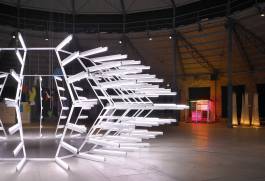
Dysfashional #1 Luxembourg, curated by Luca Marchetti & Emanuele Quinz, European Culture Capital 2007, view of the exhibition, PS, installation by Phililppe Rahm, photo : André Morin © mosign
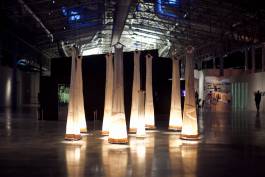
Dysfashional #5 Moscou, curated by Luca Marchetti & Emanuele Quinz, Garage Center for Contemporary Culture, 2011, view of the exhibition, photo : July 16th © July 16th,, mosign
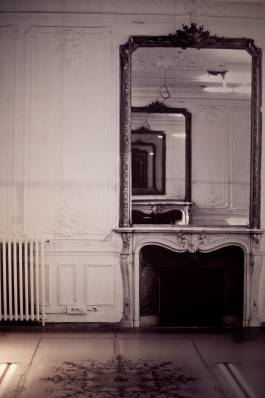
Maison Martin Margiela, Sans Titre, installation produced for Dysfashional © mosign
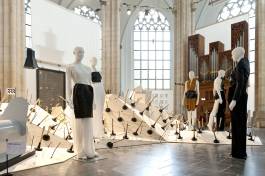
Basic Instincts, curated by Luca Marchetti & Emanuele Quinz, scenography by Henrik Vibskov, produced by Premsela, Arnhem 2012, photo Lizzy Kalisvaart © Premsela
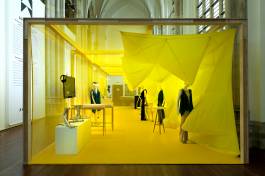
Basic Instincts, curated by Luca Marchetti & Emanuele Quinz, scenography by Henrik Vibskov, produced by Premsela, Arnhem 2012, photo Lizzy Kalisvaart © Premsela
2025
“Forms Becoming Attitudes”
Conversations on Fashion Curating for the CURA Magazine
2009 - 2012
Ilaria Marotta, founding director of CURA magazine, was my collaborator at MACRO - Museum of Contemporary Art in Rome. In 2008, after we were all forced to leave the museum due to the change of the Mayor of Rome and consequently the museum’s new direction, Ilaria started a free-press magazine in 2009, for which she asked me to collaborate.
My column was called “Forms Becoming Attitudes” and in every issue I was contributing with texts or interviews to curators dealing with fashion display in museums and other platforms.
This must have been one of the very pioneering surveys on Fashion Curating, still a very new field, since all I spoke with were known within a very niche of like-minded professionals.
I started with Linda Loppa, a founding director of MoMu in Antwerp and, back then, a newly appointed director of Polimoda in Florence. Then followed conversations with Tomas Rajnai, Maria Luisa Frisa, Helena Hertov, Judith Clark, Barbara Franchin, Sabine Seymour, Kaat Debo, Valerie Steele, Emanuele Quinz and Luca Marchetti.
Most of these names are today established and recognised fashion scholars, curators and exhibition makers.
Luca Marchetti
Luca Marchetti has been teaching as a senior lecturer at the Institut Français de la Mode in Paris since 2004, at the University of Bologna (Italy) and the Sorbonne Nouvelle University in Paris in the context of the Master's on “Creative industries” co-directed with the luxury group LVMH.
He also works internationally as a brand consultant and event curator for brands or museums, and regularly collaborates with magazines such as Vogue or Revue. He recently published (ed.) “Fashion Curating / La Mode Expose: Understanding Fashion through the Exhibition” (HEAD
Publisher, 2017) and “Exhibit! Fashion on display: exhibitions and brand spaces” (with Simona S.-Reinach, Mondadori-Pearson, 2020).
In 2019, he co-founded the foresight and innovation consultancy studio THE PROSPECTIVISTS.
Emanuele Quinz
Emanuele Quinz is an Art and Design Historian and Curator, PhD, Associate Professor at Paris 8 University and at École nationale supérieure des Arts Décoratifs (EnsAD), Paris.
His research focuses on contemporary art theories and practices crossing disciplines, like visual, media and performing arts, music and design. Since 2012, together with Samuel Bianchini, he has been coordinating the “Behaviors” research project (Labex ArtsH2H, EUR Artec, in collaboration with the Centre Pompidou). He is the author of “Le cercle invisible. Environnements, systèmes, dispositifs” (Les presses du réel, 2017), and editor of several international publications.
As a free-lance curator, he curated the international exhibitions “Invisibile” (Siena, 2004), and with L. Marchetti “Experience Design” (Bolzano, 2005), “Dysfashional” (Luxembourg 2007, Lausanne 2008, Paris 2009, Berlin, Moscow 2010, Jakarta 2011), and “Basic Instincts” (Berlin, 2011, Arnhem, Shenzhen 2012).
2012
EMANUELE QUINZ & LUCA MARCHETTI
MOSIGN: OUR RESEARCH FOCUSES ON PROCESSES EVEN MORE THAN ON ARTWORKS
Dobrila Denegri: How did each of you begin your curatorial work within the field of contemporary fashion, and how has your involvement evolved with Mosign projects?
Luca Marchetti: Emanuele and I have different profiles. As for myself, I come from the disciplines of communication and semiotics, while Emanuele has an art history and media aesthetics background. I became intrigued and then interested in fashion and design at the university, studying comparative strategies of communication common in popular culture.
We met in Paris, where Emanuele had co-created an association called “Anomos”, focusing on cross-disciplinary art projects. I proposed to add to this practice the approach I had started to develop regarding fashion and design. So I took the direction of mosign as the pole of the association devoted to fashion and design.
Later, we decided to make mosign evolve, from the status of an association to that of a company, in order to manage more structured and consistent projects both in public, non-profit and private contexts.
As for concerns fashion curation in particular, our goal is to work with the specific knowledge fashion developed in order to express a critical point of view on matters as the conception of the body, corporeality and proprioception, the spatial context, identity… More widely, the idea of “experience” is recurrent and pivotal reference for us: fashion has developed a complex of competence of signification, which allow to deal interestingly with the notions of aesthetics, self representation, “performativity”, etc. through embodied solutions, according to the fact that on this field (as opposite to what happens in industrial design) critical reflexion led by creatives rarely is a mater of theory and more often a matter of practice.
DD: What were the challenges for you when you started with mosign, and how would you define your current activity?
mosign: We had (and partly still have) to deal mainly with two challenges: first of all, making fashion acceptable as a “legitimate” field of interest and investigation in the frame of contemporary arts. Secondly, it has been anything but obvious to assess mosign’s will to develop both commercial and no-profit (purely artistic) projects. For many of our interlocutors, the two practices looked contradictory.
DD: Could we talk about different exhibition formats that you developed and made tours in the last years… how important is this itinerary aspect for your projects?
mosign: This is a question I particularly appreciate, because the “format” is one of the aspects we most care about in our projects. This is because our research focuses on processes even more than on artworks: the shape, the form of an exhibition is obviously a statement and fully part of its content. The two main exhibition we are currently developing are based on two quite radical staging principles: “Dysfashional” has been conceived as a construction site, a 360° workshop site in which artworks interact with their specific features: visual aesthetics, sound, temperature… while “Basic Instincts” is conceived as a “galaxy” of different landscapes, each developing an aspect of the show’s main theme. Every landscape is identified by a structure, a shell, designed by the Danish artist and fashion designer Henrik Vibskov according to the core theme of the landscape in order to host different artworks from different disciplines.
Both exhibitions underline the will of not creating a hierarchy among the artworks and the different art expressions invited within the project. They also attract visitors’ attention to the possibility of establishing unexpected critical connections between the artworks: the openness of the space and the visible accessibility of the whole exhibition at once authorise it.
The very last project we are developing is called “Dutch Paradox”. Similarly to “Basic Instincts” it investigates aspects of Dutch creativity, but it focuses on the ambiguity of some industrial design pieces by Dutch designers. In order to explore the value of this ambiguity, which demands a higher engagement of the user for the comprehension of objects’ functions, we decided to choose the format of the video-performance. We asked Alessandro Dalbuoni to photograph and film a performer improvising an interaction with the selected objects. We will exhibit objects and photos/videos for a month in the windows of Lafayette Maison (the design space of the Galeries Lafayette in Paris). Once more, processes become the core of the project and artworks, garments or design pieces are seen as their embodiments.
DD: I find your project “Dysfashional” particularly interesting - could you tell me a bit more about it, and in particular about collaboration with artists that work on the border between “fashion” and science, like Sissel Tolass?
mosign: The collaboration with Sissel Tolaas was generated by our will to address fashion issues beyond the notions of style. Our question, and the challenge proposed to Sissel, involved the possibility of fashion apart from signs, images, styles and attitudes. We thought that olfactive portraits of fashion cities would be an explicit way of questioning identity through abstract/immaterial expressions of it. We were looking for a non-representational way of exploring fashion sensibility proper to a specific city and culture. Her conceptual approach to identity is perfect to serve this purpose.
The same happened with Showstudio, Nick Knight’s digital communication project. The installation “Anechoic” was a perfect solution to our will to embody fashion beyond images. The artwork uses clothes noises for the purpose of identifying bands/maison’s identity…
DD: Besides your activity within mosign, you both teach, too. How should be training for those young persons who would like to undertake a career of fashion curator or fashion theoretician?
mosign: What I can suggest above anything else is to keep one’s eyes open. Fashion criticism has the advantage of being multi-disciplinary and not submitted to a theoretical formal standard. This maintains the field of fashion curation in an uncertain context of laxness, but it also gives it freedom and flexibility. This is an aspect of this growing discipline which deserves to be protected. For this purpose, it is very important to keep oneself in contact with the art scene in a broader way: seeing exhibitions, performances, events, reading catalogues and critical essays, but also acquainting oneself with very popular and “unofficial” supports of communication, such as retail spaces, brand communication media, magazines and web-content. This profession should assume, first of all, the “power of the unofficial” fashion has, by this I mean its potential of establishing critical bridges between popular daily culture and academia…
DD: In your opinion, which were the most significant exhibitions dedicated to fashion, or in general, what were important exhibition moments that triggered more serious reflection about fashion, making it culturally more relevant?
mosign: Sorry for being so self-centred, but “Dysfahional” still seems to me an unequalled project, because of its attempt to deal with abstraction and “sensibility” in a field mainly dominated by images and visual signs.
Besides it, I remember the Florence Biennales (the first one by Germano Celant) and the exhibitions produced later by Pitti Immagine Discovery by Lapo Cianchi, Maria-Luisa Frisa and Stefano Tonchi, still in Florence. They saw fashion from a complex point of view, as a powerful platform to develop a point of view on contemporary culture.
Another moment of enlightenment was the visit to the exhibition “The Fourth Sex”, curated by Raf Simons and exploring adolescence and an identity-searching playground through fashion and art.
Last but not least, any artwork by Hussein Chalayan (his exhibition at Les Arts Décoratifs in Paris, for example), an artist who unfortunately tends to be taken as “obvious” in this field, but whose work is still unparalleled in terms of lucidity and properness of language.
“Dysfashional”, curated by Luca Marchetti and Emanuele Quinz.
After Luxembourg (2007), Lausanne (2008), Paris (2009), Berlin (2010), Moscow (2010), the exhibition in the context of fashion and art took place in Jakarta (2011).
Among the artists presented in the framework of “Dysfashional”: Raf Simons, Antonio Marras, Maison Martin Margiela, Hussein Chalayan, Damien Blottière & Pierre Hardy, Justin Morin & Billie Mertens, Bernhard Willhelm & Christophe Hamaide-Pierson, Kostas Murkudis, Gaspard Yurkievich & Florence Doléac, Hiroaki Ohya, Jerszy Seymour, Michael Sontag, Sissel Tolaas, Bless, Item Idem, Amie Dicke and Marc Turlan. http://www.premsela.org/en/exhibitions/basic-instincts_1/
www.mosign.fr
Published in cura.magazine issue 12
Dysfashional #1 Luxembourg, curated by Luca Marchetti & Emanuele Quinz, European Culture Capital 2007, view of the exhibition, PS, installation by Phililppe Rahm, photo : André Morin © mosign
Dysfashional #5 Moscou, curated by Luca Marchetti & Emanuele Quinz, Garage Center for Contemporary Culture, 2011, view of the exhibition, photo : July 16th © July 16th,, mosign
Maison Martin Margiela, Sans Titre, installation produced for Dysfashional © mosign
Basic Instincts, curated by Luca Marchetti & Emanuele Quinz, scenography by Henrik Vibskov, produced by Premsela, Arnhem 2012, photo Lizzy Kalisvaart © Premsela
Basic Instincts, curated by Luca Marchetti & Emanuele Quinz, scenography by Henrik Vibskov, produced by Premsela, Arnhem 2012, photo Lizzy Kalisvaart © Premsela
INSTAGRAM
@EXPERIMENTS.FASHION.ART