


2025
“Spaceship Earth”
Curated by Dobrila Denegri
Centre of Contemporary Art, Torun, Poland
In 2010, I was appointed as the Artistic Director of the newest and one of the largest contemporary art museums in Poland, located in the beautiful medieval town of Torun, known as the birthplace of Nicolaus Copernicus.
“Spaceship Earth” was my debut exhibition. I was thinking about the Copernican Revolution and paradigm shifts. Also, I reflected on historical moments that marked a change in how we perceive our place in the world and the direction we are heading.
“Operating Manual For Spaceship Earth” was the title of the book that Richard Buckminster Fuller wrote in 1969, giving instructions about the preservation of the planet, which still resonate today. He was among the pioneers, among many other things, of what we came to consider an ecological consciousness, and my absolute hero. He also predicted the Internet, imagining it as a network for knowledge exchange.
In 1969, Polish-born engineer and computer scientist Paul Baran conducted pioneering work on distributed networks, which laid the foundation for the development of the internet.
In 1970, the first Earth Day was established, the Environmental Protection Agency was founded, and generally, this era marked a shift from conservation to a broader focus on ecology and biodiversity.
The exhibition began with ‘60s artists involved with architecture and design, such as Croatian Aleksandar Srnec, Italian Gianni Colombo, and scientists-turned-artists like Polish/French Piotr Kowalski and Croatian Vladimir Bonacić. It developed through a diverse group of practitioners whose work was based on interdisciplinary research, interlacing science, technology, architecture, design, and fashion, including: Acconci Studio, Micol Assaël, Massimo Bartolini, Loris Cecchini, Olafur Eliasson, Xárene Eskandar, Alicja Kwade, Jarosław Kozakiewicz, Christiane Löhr, Katarina Löfström, Jakub Nepraš, Ernesto Neto, Christopher O’Leary & Casey Alt, Lucy + Jorge Orta, Diller Scofidio + Renfro, Tobias Putrih, Martin Rille, Simon Thorogood & Stephen Wolff, Nikola Uzunovski, Johannes Vogl, Victoria Vesna & James Gimzewski.
One part of the exhibition focused on the “second” and the “third” skin: fashion and architecture, and how they can merge to form a kind of meta-space or meta-body where artifice meets nature.
Fashion designers like Simon Thorogood and Lucy Orta were featured, along with architects Acconci Studio, Xárene Eskandar, Jorge Orta, and a media artist, Martin Rille.
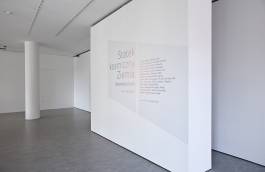
Entrance to the exhibition “Spaceship Earth”, Centre of Contemporary Art, Torun, 2011, Curated by Dobrila Denegri , Photo: Wojciech Olech.
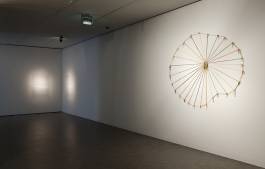
Ernesto Neto, “Meditation on Colour Vibration – Matter Colour”, 2007, Cotton fabric and plastic rings; 240 x 277 cm, Courtesy: the Artist, Galerie Max Hetzler, Berlin, Photo: Wojciech Olech.
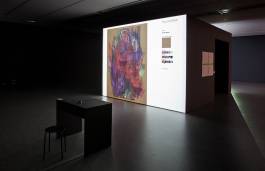
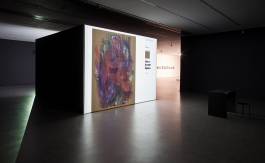
Simon Thorogood, “SoundWear”, 2007, In collaboration with Stephen Wolff, Interactive software, website and installation concerned with the generation of garment form, silhouette, colour and surface decoration from any captured sound source, Courtesy of the Artist, Photo: Wojciech Olech
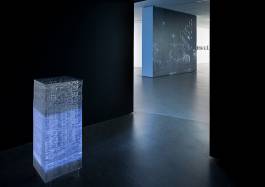
Christopher O’Leary In collaboration with Casey Alt, “Future Times”, 2008, plexiglass plates, videoprojector, dvd; 116 x 60 x 60 cm, Courtesy of Arts Learning Institute and European Community, Photo: Wojciech Olech.
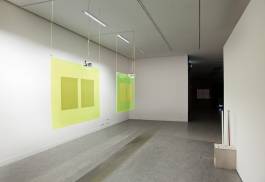
Piotr Kowalski, “Mesures à prendre”, 1969, plexiglass plates, generator of electromagnetic fields, electromagnetic field antenna, colored neone tubes. Courtesy of Andrea Kowalski, Photo: Wojciech Olech.
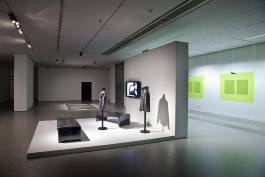
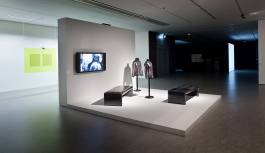
Martin Rille, “Coded Sensation”, 2008, cassette tape suits completely made out of recorded cassette tapes, Courtesy of the Artist, Photo: Wojciech Olech.
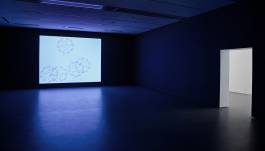
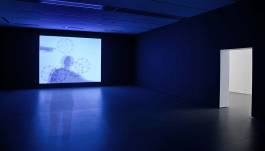
Victoria Vesna in collaboration with nanoscience pioneer James Gimzewski, “Zero@wavefunction”, 2002, Interactive installation; variable dimensions, Courtesy of the Artist, Photo: Wojciech Olech.
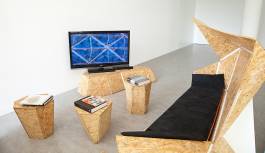
Entrance to the exhibition “Spaceship Earth”, Centre of Contemporary Art, Torun, 2011, Documentary about Richard Buckminister Fuller, Photo: Wojciech Olech.
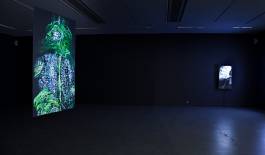
Jakub Nepraš, “Babylon Plant”, 2006, video collage, projections with 3 projectors, Courtesy of Raffaella and Stefano Sciarretta Collection, Nomas Foundation, Rome.
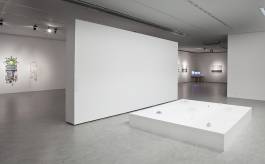
Christiane Löhr, “No Title”, 2011, Courtesy of the Artist, Photo: Wojciech Olech.
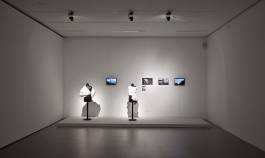
Xárene Eskandar, “Tentative Architecture of Other Earth_Coastline Inhabitants”, 2008, HVAC: wool felt, shape memory alloys, misc electronics, Photo: Wojciech Olech.
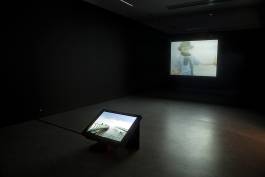
Diller Scofidio + Renfro, “Blur Building”, 2002, Exposition pavillon, Swiss Expo, Yverdon-les-Bains, Switzerland, Copyright: Beat Widmer, Photo: Wojciech Olech.
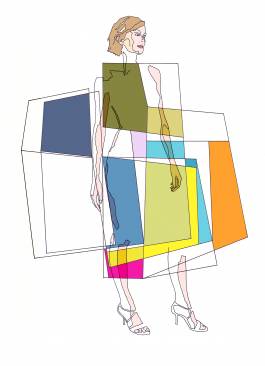
Simon Thorogood, in collaboration with the composer Stephen Wolff, “SoundWear / Eric Satie, Vexations”, 2007, Interactive software, website and installation concerned with the generation of garment form, silhouette, colour, and surface decoration from any captured sound source, (www.soundwear.co.uk).
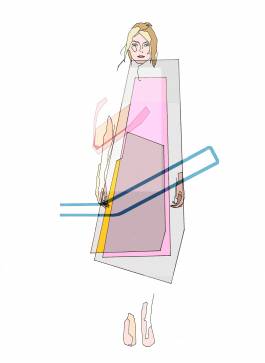
Simon Thorogood, in collaboration with the composer Stephen Wolff, “SoundWear / B. Parmegiani. En Phase/Hors Phase”, 2007, Interactive software, website and installation concerned with the generation of garment form, silhouette, colour, and surface decoration from any captured sound source, (www.soundwear.co.uk).
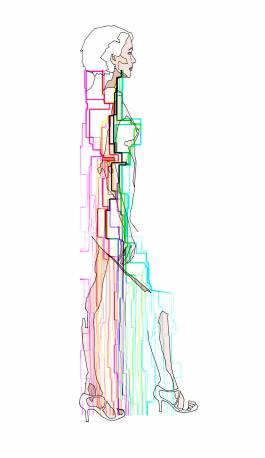
Simon Thorogood, in collaboration with the composer Stephen Wolff, “SoundWear / John Cage, In a Landscape”, 2007, Interactive software, website and installation concerned with the generation of garment form, silhouette, colour, and surface decoration from any captured sound source, (www.soundwear.co.uk).
2011
SIMON THOROGOOD
“SOUNDWEAR”
“SoundWear” was conceived by Simon Thorogood and Stephen Wolff as a speculative design tool for fashion design to be created or ‘suggested’ by music.
The intention was to develop an approach or a system that could complement, update or upset the traditional and conventional process of designing fashion. Could a paradoxical state of order and disorder, of chaos and cohesion, in which one could make unexpected discoveries in an unexpected fashion be generated?
The project is loosely based around the perception of synaesthesia, in which a sensation is experienced through different senses than those actually stimulated.
In this case, music is used as the starting point of a fashion story or a process in which sounds are employed to generate line, shape, silhouette, colour, layering and texture.
“SoundWear” grew out of a previous Thorogood/Wolff collaboration called “SoundForms”, in which the loudness or amplitude of musical composition would determine the size, brightness and definition of prepared shapes, graphics and photographs projected over a figure.
The “SoundWear” website extends this research by offering the audience an opportunity to play and interact with a system which allows them to develop and implement ideas for fashion directly from a library of music and sounds. Users will be able to register and submit their designs or ‘compothes’ (composition + clothes), as Thorogood calls them, some of which will be made up into finished garments for display at a later date.
Not only is “SoundWear” an interactive website, but it is also intended as a highly visual audience-interactive installation drawing on data and user interactions derived from previous website operation.
The installation version will also allow the audience to compose a garment using the system’s library and tools; additionally, it will provide an opportunity for diverse audiences to experience and participate in a novel process of fashion design in a playful, egalitarian space.
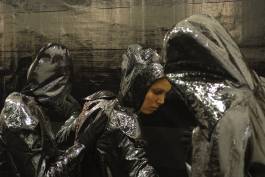
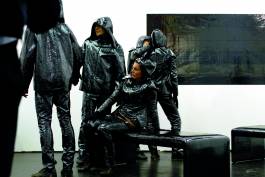
Martin Rille, “Coded Sensation”, 2008, Cassette tape suits entirely made out of recorded cassette tapes. Cooperation: Kinetic Art: Max Frey, Choreography: Amber Gabrielle, Philology/Literature: Michael Hammerschmid; Design/ Clothes: Sarah Hyee, Digital Art: Hannes Köcher.
MARTIN RILLE
“CODED SENSATION”
Writing the preface of his book “Micrographia”, Robert Hooke, an English natural philosopher, architect, and polymath who played an important role in the scientific revolution, called for enhanced senses as early as 1665. According to his words, "it’s not improbable that there may be found many mechanical inventions to improve our senses of hearing, smelling, tasting, and touching." In his time, glasses were considered an advanced instrument.
Today, we are entering the age of “wearables” – intelligent “second skins” that not only augment our senses but also connect with our entire beings. They are becoming parts of our bodies, indispensable for physical activities and integrated into daily routines. Bodies with technological “attachments” — “cybernetic organisms” rooted in our collective imagination since the '60s — are no longer confined to science fiction; they are becoming a part of everyday life. Inevitably, these “smart second skins" inspire the imaginative and creative potential of contemporary artists, prompting them to explore new applications and meanings. In this direction moves a project developed by Martin Rille, “Coded Sensation”, which postulates the possibility of transforming the surface of our bodies into a “sensible container” for data, knowledge, words, and sounds that can be “released” through body contact.
Touching, hearing, and feeling thus become as important as seeing; a synthesis of senses turns into a way of understanding the world. For now, it remains only a possibility; but that is precisely what art should do: envisage possibilities and open perspectives, allowing us to become aware of our present and, even more so, of our hypothetical future.
Viewing sculptural and performative works by Marin Rille makes us believe that the future is nearer than we think: it relates to a time dimension in which we can “unfold” our stories through sensory body-films that make us “speak” through movement, guiding us in a kind of sensuous dance enhanced by mysterious music and noise produced by dark, shiny “sound” suits. These suits, made of audio tape and entirely sustainable, not only suggest potential futuristic scenarios but also promote awareness of the environmental urgencies commanding our current age.
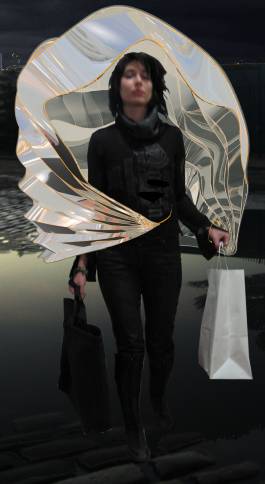
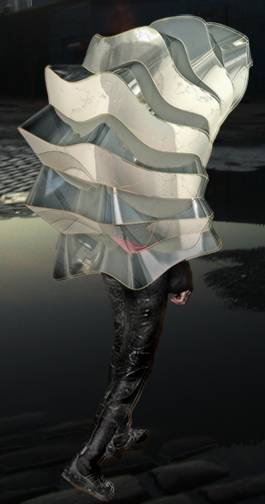
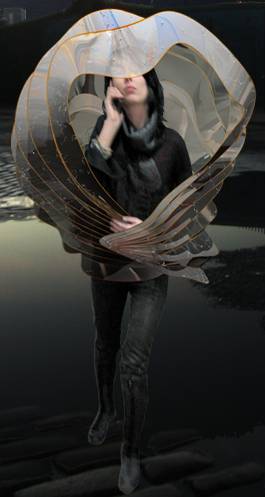
Acconci Studio (Vito Acconci, Francis Bitonti, Loke Chan, Pablo Kohan, Eduardo Marquez, Dario Nunez, Garrett Ricciardi). Consulting: Billings Jackson Design; Katie Gallagher), “Umbruffla”, 2005, silk, chiffon, radiant film, cotton thread, boning, 114,3 x 152,4 x 114,3 cm.
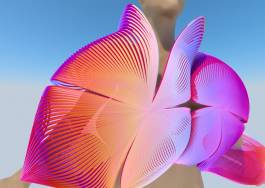
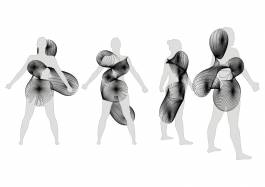
Acconci Studio (Vito Acconci, Ezio Blasetti)
MAGNETIC-FIELD CLOTHING, 2008
Let clothing emerge on the body, from the body, let clothing swarm over the body, into & out of the body: let one point on the body attract another, influence another, direct another: let clothing grow out of one point on the body & spread to another point, & another…
Pick a number of points – 5 points, say – on the body, front & back: the nipples, the navel, the vagina and/or asshole, the wings of the back. (It’s as if you’ve put your hand between somebody’s legs, your fingers stretch now up the front & up the back, from point to point on the body…)
One point affects the other, pulls the other, like a magnet. Separate the positive points from the negative points, some points attract while others repel…(I don’t know how to tell which is which, I don’t know how to choose; the rest of the Studio has to come in here, the choice is in their hands, in their minds: the Studio is affected, infected, the Studio is being pulled, as if by a magnet, not by me but by the desire for clothing, by the desire to dress, clothe, cover, shield, skin…)
Draw a line from point to point; from each point, point – from each point, draw a point to the attractor
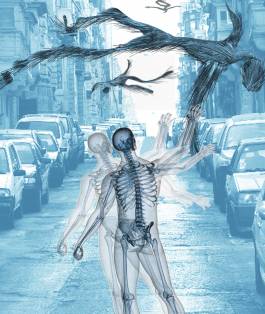
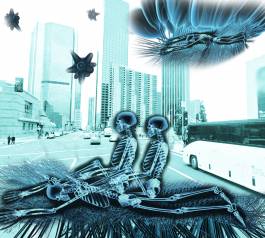
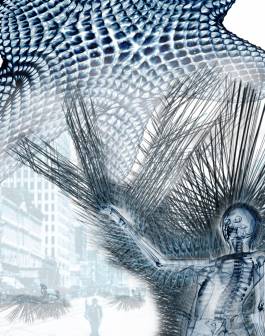
Acconci Studio (Vito Acconci, Francis Bitonti, Pablo Kohan, Bradley Rothenberg)
2-WAY SKIN-SUIT, 2010
It’s as if you’re breathing, & the breathing becomes visible; it’s turned into a house, & you’re wearing it. This clothing could have been a cloud, could have been atmosphere, but instead it’s broken down into pixels & particles; your second skin is a cluster of tubes, pipes, valves, straws, from head to fingers & toes: they draw nourishment in & waste out. These conduits poke & thrust (you spread out like a porcupine) when they’re at work: but, when they’re not, they lay down softly one on top of the other, like long luxurious hair…
ACCONCI STUDIO
Vito Acconci’s design and architecture come from the backgrounds of writing and art. His poems in the late 1960s treated words as matter and the page as a field to move around. His performances in the early 1970s shifted art from object to interaction. His installations in the late 1970s turned museums and galleries into community meetings. By the late ’80s, his work crossed over towards architecture.
He formed Acconci Studio, a design studio that mixes poetry and geometry, computer-scripting and sentence-structure, narrative and biology, chemistry and social. This design firm mixes poetry and geometry, computer-scripting and sentence-structure, narrative and biology, chemistry and social science. They treat architecture not as nodes but as circulation routes. It is about time as much as about space; they make spaces fluid, changeable and portable; they design buildings that slip into landscape and vice versa. They start with clothing and finish with vehicles. They make architecture subservient to people, rather than the other way around. They anticipate cities on the move.
Among the objects built in the last decade are: a man-made island in Graz, a clothing store as soft as clothing in Tokyo and in Coney Island, an elevated subway station façade that waves and bulges to make views and seats.
Recent projects include self-organisation, an interactive tunnel through a building in Indianapolis, and a building-complex fence that twists and rises to create wind screens and splits to develop public spaces in Toronto. They are also designing a meditation park around an archaeological site in Eindhoven, a portable retractable roof in Lucerne, and a plaza cluster of places for self-organisation in Santiago.
Acconci Studio (Vito Acconci, Francis Bitonti, Loke Chan, Pablo Kohan, Dario Nunez, Eduardo Marques, Garrett Ricciardi)
“Umbrufla”, since 2005
‘Ruffle’, verb: to agitate the surface of. ‘Ruffles’, noun: pleats, folds. ‘Ruffle’, noun (our definition): superfluity, miasma, luxuriance, swarm, swoon…
This new version of an umbrella is made from ruffles. It is closed by folding the ruffles into something no bigger than your fist. It opens by germination, emergence: the ruffles unfold, fan out, spring out into an “Umbruffla”…
Tie one end round your waist, the other round your wrist: your hands are left free to hold something else. Move your arm, shift your hips, and the “Umbruffla” moves with you. Turn it windward – dodge a passerby on a busy street – wrap it around yourself like a blanket -- take your companion under it with you, it is an “Umbruffla” built for two.
The thin mylar sheet of the “Umbruffla” gives you a thick skin. It’s a two-way mirror (seen from the outside, you disappear into the reflections of the city): Camouflage/Mirage (the city shimmers over you as you walk).
Acconci Studio (Vito Acconci, Ezio Blasetti)
“Magnetic-Field Clothing”, 2008
Let the clothing emerge on the body, from the body, let clothing swarm over the body, into and out of the body. Let one point on the body attract another, influence another, direct another. Let the clothing grow out of one point on the body and spread to another point and another…
Pick several points – 5 points, say – on the body, front and back: the nipples, the navel, the vagina and/or asshole, the wings on the back. (It is as if you put your hand between somebody’s legs, your fingers stretch now up the front and the back, from point to point on the body…).
One point affects the other, pulls the other like a magnet. Separate the positive points from the negative points, some points attract while others repel…(I do not know how to tell which is which, I do not know how to choose; the rest of the Studio has to come in here, the choice is in their hands, in their minds: the Studio is affected, infected, the Studio is being pulled, as if by a magnet, not by me but by the desire for clothing, by the desire to dress, clothe, cover, shield, skin…). Draw a line from point to point; from each point, draw a line to the attractor.
Acconci Studio (Vito Acconci, Francis Bitonti, Pablo Kohan, Bradley Rothenberg)
“Two-Way Skin Suit”, 2010
It is as if you were breathing, and the breathing becomes visible;
It is turned into a house, and you are wearing it.
This clothing could have been a cloud,
could have been the atmosphere,
but instead, it is broken down into pixels and particles;
Your second skin is a cluster of tubes, pipes, valves, and straws from head to fingers and toes.
They draw nourishment in and waste out.
These conduits poke and thrust (you spread out like a porcupine) when they are at work:
But, when they are not, they lie down softly one on top of the other, like long luxurious hair…
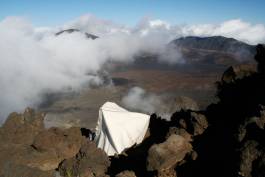
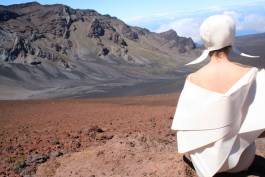
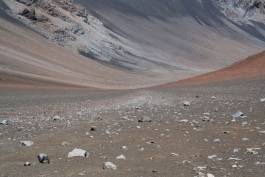
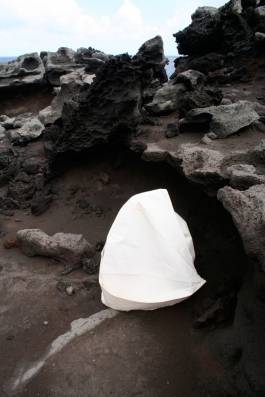
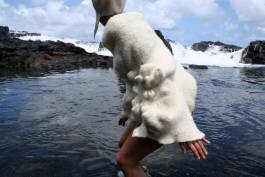
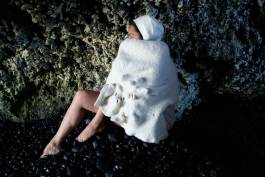
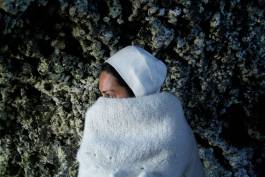
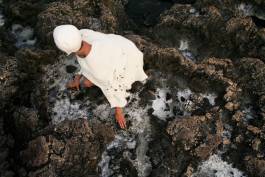
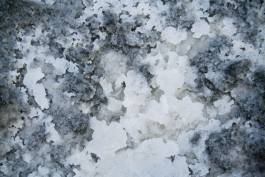
Xárene Eskandar, “Tentative Architecture of Other Earth_Coastline Inhabitants”, 2008, HVAC: wool felt, shape memory alloys, misc electronics, Shelter: cotton muslin, Concept and Design: Xárene Eskandar, Electronics: Joshua Hernandez, Producer: Grant Davis, Funding by: Grant Davis and UCLA Design Media Arts, Photo: Christopher O'Leary.
XÁRENE ESKANDAR
“OTHER EARTH”
Inspired by Yves Klein’s “Air Architecture”, “The Situationist City”, Constant Nieuwenhuis’ “New Babylon” and most of all, by concepts of ubiquitous sites developed by Madeline Gins and Arakawa, founders of “Architectural Body Research Foundation”, Xárene Eskandar initiated a study of architectural forms that should interconnect humans and the environment more organically and sustainably.
She developed a “model” called “Other Earth”, based on her concept of “Tentative Architecture”, which is “an immaterial architecture that can happen at any time and any point in space.
It is an architecture that relates immediately to the bodies occupying it and does not exist without their presence. “Other Earth” is a plan of urban structure as a rhizome. The nodes of the rhizome consist of individual nomads, living a technologically advanced, self-sufficient and no-impact lifestyle; nomads who at any moment can break away and exist on their own, wearing their tentative architecture on their bodies and allowing their environment to be defined by non-material means”.
More than a concept of architecture. Xárene Eskandar develops a whole new concept of social structure, of individual/collective interrelations and relations with their habitat that radically subverts all notions on which our present system is grounded. It is so far ahead that its becoming true is almost unimaginable.
But “Other Earth” is not actually a model; it is a metaphor; it is an invitation to step out from our conventional notions about space, society, possession and even our own bodies. It is a proposal to reconsider our values and to let go of many burdens imposed by our commoditised society. It is, after all, an artwork. A creation of an artist working in the post-utopian era, conscious of the existing social situation but convinced that art/architecture still preserves a space for experiment, adventure, sophisticated imaginative game and that these can still be synonyms for the basic notion of individual creative freedom.
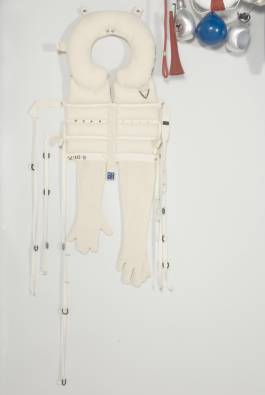
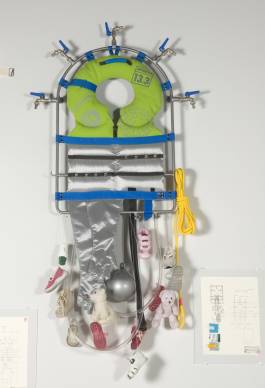
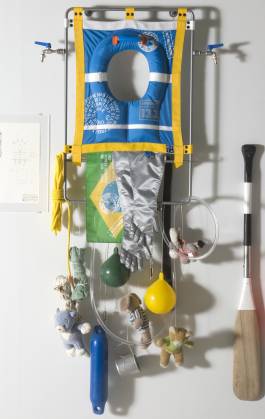
Lucy + Jorge Orta, “Life Line – Survival Kit”, 2008, cotton toile, various clips; Courtesy of the Artists, Photo: Thierry Bal.
LUCY + JORGE ORTA
“LIFE LINE – SURVIVAL KIT” / “ANTARCTIC VILLAGE - NO BORDERS”
Trained as a fashion designer and as an architect respectively, Lucy and Jorge Orta developed a large body of works that might be defined as “body architecture” or “architecture with a soul” – wearable devices that evoke the need for human interconnection, poetically prefiguring the social and environmental crisis of our culture and suggesting the need for alternative life-styles.
Since the early 90s when their collaborative adventure started, they have produced numerous interventions and actions, performances and installations, putting on a broader artistic agenda such crucial themes of the contemporary world as: community, social exclusion, dwelling, mobility, sustainable development and recycling. Nowadays, the focal issues for their work include water scarcity, migration, mobility and human survival, which they have explored in the most extreme way in one of their recent endeavours entitled Antarctica.
Installed near the Marambio Antarctic Base in March 2007, “Antarctic Village - No Borders” consisted of fifty igloo-like tents made of traditional tent cloth, flags from countries around the world and items of clothing. Evoking images of both a campsite and a refugee camp, the installation was an outgrowth of the Ortas’ ongoing interest in the region as a symbolic territory of hope – a politically neutral ground containing 90% of the world’s ice and approximately 70% of its fresh water.
Concurrently with the “Antarctic Village”, the real inhabitants of the research station, an international team of scientists, were invited to join the Ortas’ crew for a symbolic soccer game staged like an important international match.
However, each team carried a “multi-international” flag designed by the Ortas and were dressed in uniforms that did not differentiate countries nor even teams. For the Ortas, the Antarctic thus serves as a utopian site representing the notion of global statehood. They are also developing a project for an “Antarctic passport.” In this work, as well as in all the other striking large-scale installations realised by the British/Argentinian artistic couple, the clarity of design and the apparent functionality of objects are used to dramatise the plight of the non-combatant and, most of all, to prefigure the possibility of alternative forms of social formations and interactions.
Entrance to the exhibition “Spaceship Earth”, Centre of Contemporary Art, Torun, 2011, Curated by Dobrila Denegri , Photo: Wojciech Olech.
Ernesto Neto, “Meditation on Colour Vibration – Matter Colour”, 2007, Cotton fabric and plastic rings; 240 x 277 cm, Courtesy: the Artist, Galerie Max Hetzler, Berlin, Photo: Wojciech Olech.
Simon Thorogood, “SoundWear”, 2007, In collaboration with Stephen Wolff, Interactive software, website and installation concerned with the generation of garment form, silhouette, colour and surface decoration from any captured sound source, Courtesy of the Artist, Photo: Wojciech Olech
Christopher O’Leary In collaboration with Casey Alt, “Future Times”, 2008, plexiglass plates, videoprojector, dvd; 116 x 60 x 60 cm, Courtesy of Arts Learning Institute and European Community, Photo: Wojciech Olech.
Piotr Kowalski, “Mesures à prendre”, 1969, plexiglass plates, generator of electromagnetic fields, electromagnetic field antenna, colored neone tubes. Courtesy of Andrea Kowalski, Photo: Wojciech Olech.
Martin Rille, “Coded Sensation”, 2008, cassette tape suits completely made out of recorded cassette tapes, Courtesy of the Artist, Photo: Wojciech Olech.
Victoria Vesna in collaboration with nanoscience pioneer James Gimzewski, “Zero@wavefunction”, 2002, Interactive installation; variable dimensions, Courtesy of the Artist, Photo: Wojciech Olech.
Entrance to the exhibition “Spaceship Earth”, Centre of Contemporary Art, Torun, 2011, Documentary about Richard Buckminister Fuller, Photo: Wojciech Olech.
Jakub Nepraš, “Babylon Plant”, 2006, video collage, projections with 3 projectors, Courtesy of Raffaella and Stefano Sciarretta Collection, Nomas Foundation, Rome.
Christiane Löhr, “No Title”, 2011, Courtesy of the Artist, Photo: Wojciech Olech.
Xárene Eskandar, “Tentative Architecture of Other Earth_Coastline Inhabitants”, 2008, HVAC: wool felt, shape memory alloys, misc electronics, Photo: Wojciech Olech.
Diller Scofidio + Renfro, “Blur Building”, 2002, Exposition pavillon, Swiss Expo, Yverdon-les-Bains, Switzerland, Copyright: Beat Widmer, Photo: Wojciech Olech.
Simon Thorogood, in collaboration with the composer Stephen Wolff, “SoundWear / Eric Satie, Vexations”, 2007, Interactive software, website and installation concerned with the generation of garment form, silhouette, colour, and surface decoration from any captured sound source, (www.soundwear.co.uk).
Simon Thorogood, in collaboration with the composer Stephen Wolff, “SoundWear / B. Parmegiani. En Phase/Hors Phase”, 2007, Interactive software, website and installation concerned with the generation of garment form, silhouette, colour, and surface decoration from any captured sound source, (www.soundwear.co.uk).
Simon Thorogood, in collaboration with the composer Stephen Wolff, “SoundWear / John Cage, In a Landscape”, 2007, Interactive software, website and installation concerned with the generation of garment form, silhouette, colour, and surface decoration from any captured sound source, (www.soundwear.co.uk).
Martin Rille, “Coded Sensation”, 2008, Cassette tape suits entirely made out of recorded cassette tapes. Cooperation: Kinetic Art: Max Frey, Choreography: Amber Gabrielle, Philology/Literature: Michael Hammerschmid; Design/ Clothes: Sarah Hyee, Digital Art: Hannes Köcher.
Acconci Studio (Vito Acconci, Ezio Blasetti)
MAGNETIC-FIELD CLOTHING, 2008
Let clothing emerge on the body, from the body, let clothing swarm over the body, into & out of the body: let one point on the body attract another, influence another, direct another: let clothing grow out of one point on the body & spread to another point, & another…
Pick a number of points – 5 points, say – on the body, front & back: the nipples, the navel, the vagina and/or asshole, the wings of the back. (It’s as if you’ve put your hand between somebody’s legs, your fingers stretch now up the front & up the back, from point to point on the body…)
One point affects the other, pulls the other, like a magnet. Separate the positive points from the negative points, some points attract while others repel…(I don’t know how to tell which is which, I don’t know how to choose; the rest of the Studio has to come in here, the choice is in their hands, in their minds: the Studio is affected, infected, the Studio is being pulled, as if by a magnet, not by me but by the desire for clothing, by the desire to dress, clothe, cover, shield, skin…)
Draw a line from point to point; from each point, point – from each point, draw a point to the attractor
Acconci Studio (Vito Acconci, Francis Bitonti, Pablo Kohan, Bradley Rothenberg)
2-WAY SKIN-SUIT, 2010
It’s as if you’re breathing, & the breathing becomes visible; it’s turned into a house, & you’re wearing it. This clothing could have been a cloud, could have been atmosphere, but instead it’s broken down into pixels & particles; your second skin is a cluster of tubes, pipes, valves, straws, from head to fingers & toes: they draw nourishment in & waste out. These conduits poke & thrust (you spread out like a porcupine) when they’re at work: but, when they’re not, they lay down softly one on top of the other, like long luxurious hair…
Xárene Eskandar, “Tentative Architecture of Other Earth_Coastline Inhabitants”, 2008, HVAC: wool felt, shape memory alloys, misc electronics, Shelter: cotton muslin, Concept and Design: Xárene Eskandar, Electronics: Joshua Hernandez, Producer: Grant Davis, Funding by: Grant Davis and UCLA Design Media Arts, Photo: Christopher O'Leary.
Lucy + Jorge Orta, “Life Line – Survival Kit”, 2008, cotton toile, various clips; Courtesy of the Artists, Photo: Thierry Bal.