


2025
2012
VALERIE STEELE: AS A CURATOR, I AM INTERESTED IN CONTEXTUALISING FASHION
“Forms Becoming Attitudes”
Conversations on Fashion Curating for the CURA Magazine
2009 - 2012
Ilaria Marotta, founding director of CURA magazine, was my collaborator at MACRO - Museum of Contemporary Art in Rome. In 2008, after we were all forced to leave the museum due to the change of the Mayor of Rome and consequently the museum’s new direction, Ilaria started a free-press magazine in 2009, for which she asked me to collaborate.
My column was called “Forms Becoming Attitudes” and in every issue I was contributing with texts or interviews to curators dealing with fashion display in museums and other platforms.
This must have been one of the very pioneering surveys on Fashion Curating, still a very new field, since all I spoke with were known within a very niche of like-minded professionals.
I started with Linda Loppa, a founding director of MoMu in Antwerp and, back then, a newly appointed director of Polimoda in Florence. Then followed conversations with Tomas Rajnai, Maria Luisa Frisa, Helena Hertov, Judith Clark, Barbara Franchin, Sabine Seymour, Kaat Debo, Valerie Steele, Emanuele Quinz and Luca Marchetti.
Most of these names are today established and recognised fashion scholars, curators and exhibition makers.
Valerie Steele
Valerie Steele is director and chief curator of The Museum at the Fashion Institute of Technology, where she has personally organised more than 25 exhibitions since 1997, including “The Corset: Fashioning the Body”, “Gothic: Dark Glamour”, “A Queer History of Fashion”, “Pink: The History of a Punk”, “Pretty, Powerful Color”, and “Paris, Capital of Fashion”. She is also the founder and editor-in-chief of Fashion Theory: The Journal of Dress, Body & Culture, the first peer-reviewed, scholarly journal in Fashion Studies.
Steele combines serious scholarship (and a Yale PhD) with a rare ability to communicate with general audiences. She is author or co-author of more than two dozen books, including “Paris Fashion: A Cultural History”, “Women of Fashion, Fetish: Fashion, Sex and Power”, and “Fashion Designers A-Z: The Collection of The Museum at FIT”. Her books have been translated into Chinese, French, German, Italian, Portuguese, Russian, and Spanish.
As author, curator, editor, and public intellectual, Valerie Steele has been instrumental in creating the modern field of fashion studies and in raising awareness of the cultural significance of fashion. She has appeared on many television programs, including The Oprah Winfrey Show and “Undressed: The Story of Fashion”. Described in The Washington Post as one of fashion's brainiest women and by Suzy Menkes as “The Freud of Fashion”, she is listed as one of The People Shaping the Global Fashion Industry in the Business of Fashion 500 (2014-present).
Dobrila Denegri: How has your academic formation influenced your approach to fashion and your later curatorial work?
Valerie Steele: Even though I never finished High school, I went to college and then to grad school at Yale University to study modern European cultural and intellectual history. During the first term, we had a project to study articles from a scholarly journal and that's how I came across two articles in "Signs" that triggered my interest: one was Helene Roberts traditional feminist interpretation of the corset in the Victorian period. Other was a revisionist article by David Kunzle that treated corset not as oppressive and dangerous, but as sexually liberating element. Suddenly, I realised that fashion is a part of cultural history and that I could write about fashion. As soon as I started research, I realised that there was no such thing as fashion history. There was, of course, fashion journalism, as well as antiquarian costume history, but methodologically sophisticated fashion history was truly lacking. So I chose this as my field, even though all my professors dissuaded me. Of course, they were right that I would be unemployable as a specialist in fashion history.
Nevertheless, I decided to pursue my interests and go deeper in this field, studying Victorian fashion and focusing particularly on its erotic aspects. I dedicated my doctoral dissertation to this theme, which resulted in my first book "Fashion and Eroticism". There was an extensive chapter on the corset, of course, and years later I did a big exhibition on corsets, and a book too.
After I graduated, I spent a year at The Smithsonian Institute as a First Lady's Fellow at the Costume department. There was some political background to it, because at the time Ms. Reagan got in trouble for accepting free gifts from designers. Therefore the government started The First Lady’s Fellowship, offering scholars a chance to study fashion at the Smithsonian Museum of National History. So I had a chance to be the first, and I think the only, First Lady's fellow, and this brought me to another book project before I moved to New York. As a scholar specialised in fashion, New York was the only place to be, but nevertheless it wasn't easy: for a number of years I was part-time teaching at many schools, like FIT, Parsons New School of Design, Columbia and others, but none of them wanted to hire a full-time professor in fashion history. In 1997, I founded my magazine "Fashion Theory" and in the same year, I got hired at the Museum at FIT as chief curator. Prior to that, I have been teaching for eleven years in the graduate school at FIT. Then I started curating exhibition programs at the museum.
DD: What were the challenges for you when you started to work in a museum, and how would you define fashion “curating” in relation to your own practice, especially in relation to the exhibition formats you developed in the Museum at the Fashion Institute of Technology?
VS: The first challenge was to run an intensive exhibition schedule and restore the authority and visibility of this museum. Since the beginning of my work here, I have curated more than twenty exhibitions and collaborated and overseen at least another twenty. In the beginning, I was doing five exhibits a year, and the rhythm was really crazy… There were moments in which I'd be working on two exhibitions and two books simultaneously. Over time, I have built a very good team of collaborators, so now I'm doing one or two exhibitions yearly, and other curators and colleagues do the rest.
As a curator, my interest has always been to investigate certain fashion phenomena, to explore their cultural and historical background as well as their pertinency in the present moment.
As a curator, I am interested in contextualising fashion. Contextualisation is one of my major concerns.
In this regard, one of the more recent projects that I am very fond of is "Gothic: Dark Glamour", a show about gothic trends in fashion. I also worked on a monographic exhibition about Daphne Guinness, one of the greatest icons of contemporary style. Currently I'm working together with my colleague Fred Dennis on a show about homosexuality and fashion, which is entitled "Queer Style: from the Closet to the Catwalk", which will open in the fall of 2013.
DD: As one of the pioneers, would you say there is some methodological difference between curating in the field of art and the field of fashion and how would you trace the "history" of fashion curating?
VS: I think that the approach in art and fashion curating is very similar, but fashion curating as such is a very recent phenomenon. For a long period of time, garments were put on display in museums, but within a quite traditional and antiquated frame of what we call Costume History. Only recently has fashion started to be treated like a culturally relevant phenomenon which deserves, or actually requires, more profound theoretical consideration. Traditional costume history focused almost exclusively on elite fashion, and museum displays were predominantly done in a chronological format. Things started changing in the early '70s when Diana Vreeland began to make very extravagant and innovative exhibitions at the Costume Institute of the Metropolitan Museum. These exhibitions were historically inaccurate but theatrically very compelling, so they triggered the interest of people to a much larger extent. At the same time, in the early '70s, Cecil Beaton did a very important show involving a lot of his celebrity friends and, in doing so, he made a big extravaganza in England. In the same period, things started to happen here at FIT, not within the museum because it didn't exist yet, but within the "Design Laboratory” run by Richard Martin and Harold Koda. Even before them FIT made some very important exhibitions, like the Paul Poiret retrospective, for example, but with Richard and Harold things really got started thanks to some amazing exhibition projects, such as "Fashion and Surrealism, The Halston retrospective or "Three Women" which put in relation work by Madeleine Vionnet, Claire McCardell, and Rei Kawakubo. This show gave me inspiration to write a book, "Women of Fashion: Twentieth-Century Designers", where I investigated feminine creativity and women’s approach to designing, which appeared to be different from men's. Richard Martin died prematurely, and Harold Koda moved to The Metropolitan Museum. So, the Museum at FIT went downhill for a while, but I think that over the past decade or so, it has gone up again, thanks to some really great exhibitions that we have done here.
Many popular exhibitions, especially recent blockbusters, are those celebrating the star designer. We have also done some monographic exhibitions, but in general, I find them a bit problematic, because they tend to become a kind of cult-of-personality. They glorify the genius of a designer, saying how Armani, or Vivienne Westwood, or Alexander McQueen are exceptional. Not that it is not true, but this kind of exhibition, especially if the designer is alive, tends to become too celebratory, missing some of the historical distance or analytical rigour. Personally, I prefer to do thematic shows, whether it is about a garment, like a corset, which I would trace through time and observe how it developed and how its meaning changed, or thematic shows like the one about Gothic. This theme was approached in art in many different ways, from historical examples up to contemporary artists, but it wasn't approached in fashion. "Gothic: Dark Glamour" treated gothic style both in high fashion and in subcultural styles, and we designed a spectacular and elaborate mise-en-scène developed in collaboration with Simon Costin, the British art director and set designer who also worked with Alexander McQueen. Sets evoked some of the typical "gothic" atmosphere: “The ruined castle”, “the laboratory” and even “the graveyard”. We alluded to the Victorian cult of mourning and to vampire stories. Besides this extraordinary exhibition, we did a monographic show on Daphne Guinness, with whom I worked for two years and who was a co-curator of the show. We made a hologram of Daphne, a life-size moving hologram of her in McQueen's cat-suit. I wanted to do this show also because we have seen many exhibitions about individual designers, but very few about individual women of style… women who created a style of their own and became universal fashion icons.
DD: I find the particularly interesting exhibition about Japanese fashion you curated, "Japan Fashion Now", realised last year. Could you tell me more about the conceptual framework as well as about designers and fashion phenomena treated in this show?
VS: It was another challenge because so many exhibitions about Japanese fashion have been done already, mostly highlighting these three "giants": Issey Miyake, Yohji Yamamoto and Rei Kawakubo of Comme des Garçons, whose work really can be treated as artistic. Most of these exhibitions underlined the conceptual and sculptural aspects of their work, but other aspects of Japanese fashion were rarely treated. However, Japanese fashion is such a complex and multilayered phenomenon, because other tendencies developed alongside avant-garde fashion, tendencies that are rooted in popular and youth culture connected with comics and music. So for the first time, my show focused on all these different aspects. The show started with a room dedicated to the '80s and the "big three": Rei, Yohji and Issey and it went on with a second room with huge and fractured images of Tokyo combined with a vast range of styles you could see there: from early CDG creations to Jun Takahashi for Undercover, to men's wear, street style, cosplay, Lolitas and Gothic Lolitas and even school uniforms. I even showed some of the clothing of motorcycle gangs, which are very controversial for the Japanese, since they are regarded as total hoodlums. I think that this show was interesting and important because it went a step forward, treating not only avant-garde designers who have become a sort of synonym for Japanese fashion.
DD: Among many exhibitions curated by you, there is one monographic that dealt more directly with “boundaries of fashion” and its way of dialoguing with art. Could you tell me more about the exhibition “Toledo/Toledo: The Marriage of Art and Fashion” and the exhibition and book about “Isabel Toledo: Fashion from the Inside Out" that you co-authored with Patricia Mears. I found it very interesting and courageous the way in which Isabel collaborated with some contemporary artists, in particular with Victoria Vesna, a media artist deeply involved in crossing boundaries between art and science. Could you tell me what your view is on this interdisciplinary and cross-boundary approach that links art and fashion?
VS: I started to follow the work of Isabel Toledo since the late '80s when I published my "Women in Fashion" book and than we did the first exhibition in the late '90s, but I came back to her work again recently when we granted her one of our most prestigious prizes: The Couture Council Award for Artistry of Fashion. This is my big fundraiser, which we have been doing for the last six years, with a committee of curators, journalists and buyers and with a benefit luncheon for which guests pay 25000 USD and 1000 USD per seat. So if you get this award, it means big recognition and it includes an exhibition in the museum, too. The project was done in collaboration with Isabel and her husband, fashion illustrator, Ruben Toledo, and it was done according to her own ideas about clothing, organised into different categories: those which she called "shadows", "organic geometry" and so on. Together with the display of her beautiful clothes and patterns, we had 300 linear feet of Ruben's drawings, which he mostly did especially for the occasion. I worked on different occasions with both of them, and I always appreciated their kind of "downtown" artistry. They work in a very symbiotic way: she doesn't develop her ideas on paper; she talks and he sketches… and then she manages to transform her visions into something functional and wearable, even though most people would think it's impossible.
DD: Beside your activities in the museum, you were teaching and are now actively lecturing. How should training be structured for young people who want to pursue a career as a fashion curator or fashion theoretician?
VS: Every year, we organise here a huge fashion symposium where we treat the theme of that Fall’s exhibition. FIT also has literally hundreds of classes that students take here in the museum. They are in contact with curators and museum staff working on the exhibitions, they have tours with professors and curators, and finally they are asked to work together on an exhibition. A Professor from the graduate school and her class collaborate directly with one of our curators, and together they put up an exhibition according to a topic that I give them, for example, the fashion of the '60s and the counter-culture movement of the time. That's how "Youthquake: Mods and Hippies" was created: students came up with the title and the whole concept for the show, starting from an input given by me.
For this kind of profession, theoretical preparation is important, but most of all, it is valuable to have direct working experience through which each student can develop further in a practical and creative way. We teach them how to design an exhibition, how to write labels and prepare a brochure, how to position each garment, etc Basically, we accompany them through all phases of the creation of the exhibition. Some years ago, with the Dean of Graduate Studies, we created a program course called Fashion & Textile Studies: History, Theory and Museum Practice, which can be considered as a sort of course for becoming a fashion curator or conservator.
DD: In your opinion, which have been the most significant exhibitions dedicated to contemporary fashion, or more precisely, which exhibitive events placed fashion at the centre of a more serious reflection and have made it more culturally relevant?
VS: One of the most important certainly was The Biennale of Fashion held in Florence in the mid '90s, which was partly brought to the Guggenheim and which was curated by Germano Celant and Ingrid Sischy. There were also some earlier examples that I'd point out as particularly important: Yves Saint Laurent's retrospective at The Costume Institute in the Metropolitan in the early '70s, which was the first exhibition about a living designer organised by Diana Vreeland. It was very controversial! I'd also say "Street Style" at the V&A Museum in London, "Fashion and Surrealism" in The Museum in FIT done in 1987 and among recent exhibition, I'd mention Alexander McQueen's retrospective at The Costume Institute. This show really reinforced, not only popularity, but the significance of fashion in museums.
I wrote an article for "Fashion Theory" called "Museum Quality", where I tried to focus on the fact that exhibitions in museums contribute to the prestige of fashion. It is still controversial whether fashion can be considered as art, and I have written about that too, but it remains a fact that exhibiting fashion within the frame of art institutions lifts its cultural credentials. This kind of exhibition proved to be very popular with the public, and even the controversies that have occurred have contributed to the development of a more substantial discourse about fashion as a cultural phenomenon.
DD: Talking about the dialogue between art and fashion, were there any exhibitions that treated this subject in a more profound or innovative way, according to your opinion?
VS: This is a very complex topic, and I'm not sure that a really relevant exhibition has been done yet. Ever since I saw the show "Il tempo de la moda" curated by Celant and set at The Guggenheim after Florence, as well as some others on a similar subject, I had a feeling that there are two parallel tracks: either historical examples of collaborations between artists and designers - like Schiaparelli and Dalì for example - are presented or some works are shown done by contemporary artists in which fashion is used, both as material and a symbolic element. The Guggenheim exhibition seemed like two exhibits in one: The first treating fashion designers trying to get some cultural capital from art, and the second talking about artists who worked with the theme of clothing from a very different perspective.
Now there are some people doing interesting things on the edge between art and fashion. I find the work of E. V. Day or Charles LeDray cool, so maybe new hybrid forms can be a departure point for exhibitions about art & fashion, developing new perspectives for the future.
Published at cura.magazine issue 11
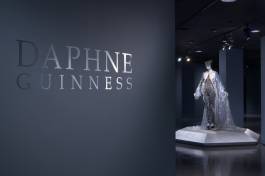
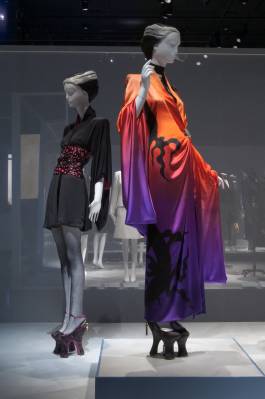
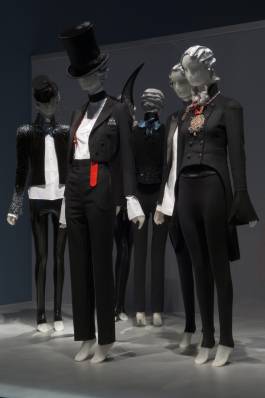
Installation images from the exhibition Daphne Guinness, The Museum at FIT (September 16, 2011 – January 7, 2012). Photo courtesy the Museum at FIT.
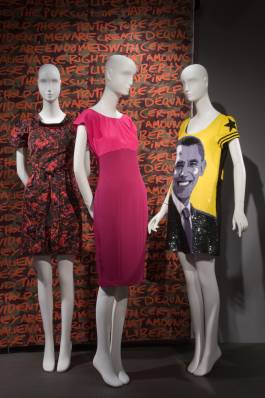
Installation image from the exhibition Fashion & Politics, The Museum at FIT (July 7, 2009 - November 7, 2009). Photo courtesy the Museum at FIT.
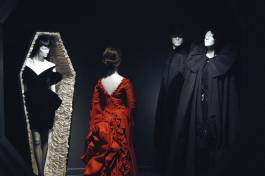
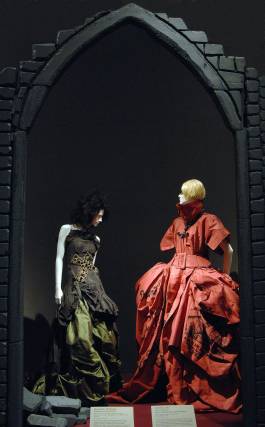
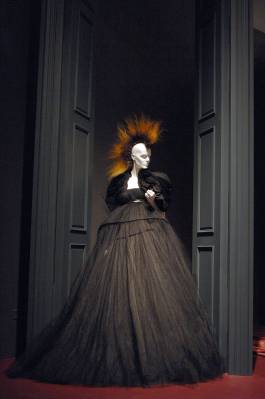
Installation images from the exhibition Gothic: Dark Glamour, The Museum at FIT (September 5, 2008 – February 21, 2009). Photo courtesy the Museum at FIT.
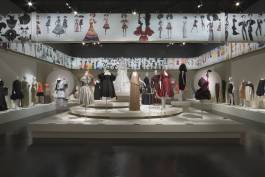
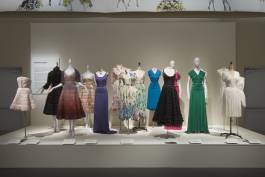
Installation images from the exhibition Isabel Toledo, The Museum at FIT (June 17, 2009 - September 26, 2009). Photo courtesy the Museum at FIT.
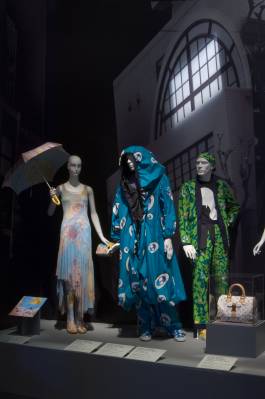
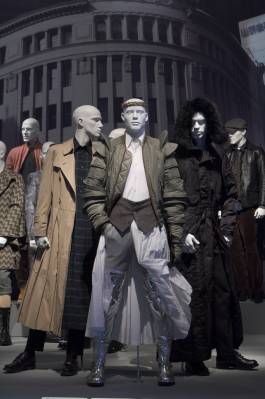
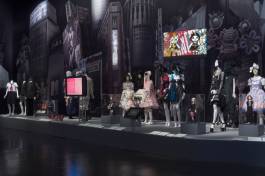
Installation images from the exhibition Japan Fashion Now, The Museum at FIT (September 17, 2010 -– April 2, 2011). Photo courtesy the Museum at FIT.
2025
“Forms Becoming Attitudes”
Conversations on Fashion Curating for the CURA Magazine
2009 - 2012
Ilaria Marotta, founding director of CURA magazine, was my collaborator at MACRO - Museum of Contemporary Art in Rome. In 2008, after we were all forced to leave the museum due to the change of the Mayor of Rome and consequently the museum’s new direction, Ilaria started a free-press magazine in 2009, for which she asked me to collaborate.
My column was called “Forms Becoming Attitudes” and in every issue I was contributing with texts or interviews to curators dealing with fashion display in museums and other platforms.
This must have been one of the very pioneering surveys on Fashion Curating, still a very new field, since all I spoke with were known within a very niche of like-minded professionals.
I started with Linda Loppa, a founding director of MoMu in Antwerp and, back then, a newly appointed director of Polimoda in Florence. Then followed conversations with Tomas Rajnai, Maria Luisa Frisa, Helena Hertov, Judith Clark, Barbara Franchin, Sabine Seymour, Kaat Debo, Valerie Steele, Emanuele Quinz and Luca Marchetti.
Most of these names are today established and recognised fashion scholars, curators and exhibition makers.
Valerie Steele
Valerie Steele is director and chief curator of The Museum at the Fashion Institute of Technology, where she has personally organised more than 25 exhibitions since 1997, including “The Corset: Fashioning the Body”, “Gothic: Dark Glamour”, “A Queer History of Fashion”, “Pink: The History of a Punk”, “Pretty, Powerful Color”, and “Paris, Capital of Fashion”. She is also the founder and editor-in-chief of Fashion Theory: The Journal of Dress, Body & Culture, the first peer-reviewed, scholarly journal in Fashion Studies.
Steele combines serious scholarship (and a Yale PhD) with a rare ability to communicate with general audiences. She is author or co-author of more than two dozen books, including “Paris Fashion: A Cultural History”, “Women of Fashion, Fetish: Fashion, Sex and Power”, and “Fashion Designers A-Z: The Collection of The Museum at FIT”. Her books have been translated into Chinese, French, German, Italian, Portuguese, Russian, and Spanish.
As author, curator, editor, and public intellectual, Valerie Steele has been instrumental in creating the modern field of fashion studies and in raising awareness of the cultural significance of fashion. She has appeared on many television programs, including The Oprah Winfrey Show and “Undressed: The Story of Fashion”. Described in The Washington Post as one of fashion's brainiest women and by Suzy Menkes as “The Freud of Fashion”, she is listed as one of The People Shaping the Global Fashion Industry in the Business of Fashion 500 (2014-present).
2012
VALERIE STEELE: AS A CURATOR, I AM INTERESTED IN CONTEXTUALISING FASHION
Dobrila Denegri: How has your academic formation influenced your approach to fashion and your later curatorial work?
Valerie Steele: Even though I never finished High school, I went to college and then to grad school at Yale University to study modern European cultural and intellectual history. During the first term, we had a project to study articles from a scholarly journal and that's how I came across two articles in "Signs" that triggered my interest: one was Helene Roberts traditional feminist interpretation of the corset in the Victorian period. Other was a revisionist article by David Kunzle that treated corset not as oppressive and dangerous, but as sexually liberating element. Suddenly, I realised that fashion is a part of cultural history and that I could write about fashion. As soon as I started research, I realised that there was no such thing as fashion history. There was, of course, fashion journalism, as well as antiquarian costume history, but methodologically sophisticated fashion history was truly lacking. So I chose this as my field, even though all my professors dissuaded me. Of course, they were right that I would be unemployable as a specialist in fashion history.
Nevertheless, I decided to pursue my interests and go deeper in this field, studying Victorian fashion and focusing particularly on its erotic aspects. I dedicated my doctoral dissertation to this theme, which resulted in my first book "Fashion and Eroticism". There was an extensive chapter on the corset, of course, and years later I did a big exhibition on corsets, and a book too.
After I graduated, I spent a year at The Smithsonian Institute as a First Lady's Fellow at the Costume department. There was some political background to it, because at the time Ms. Reagan got in trouble for accepting free gifts from designers. Therefore the government started The First Lady’s Fellowship, offering scholars a chance to study fashion at the Smithsonian Museum of National History. So I had a chance to be the first, and I think the only, First Lady's fellow, and this brought me to another book project before I moved to New York. As a scholar specialised in fashion, New York was the only place to be, but nevertheless it wasn't easy: for a number of years I was part-time teaching at many schools, like FIT, Parsons New School of Design, Columbia and others, but none of them wanted to hire a full-time professor in fashion history. In 1997, I founded my magazine "Fashion Theory" and in the same year, I got hired at the Museum at FIT as chief curator. Prior to that, I have been teaching for eleven years in the graduate school at FIT. Then I started curating exhibition programs at the museum.
DD: What were the challenges for you when you started to work in a museum, and how would you define fashion “curating” in relation to your own practice, especially in relation to the exhibition formats you developed in the Museum at the Fashion Institute of Technology?
VS: The first challenge was to run an intensive exhibition schedule and restore the authority and visibility of this museum. Since the beginning of my work here, I have curated more than twenty exhibitions and collaborated and overseen at least another twenty. In the beginning, I was doing five exhibits a year, and the rhythm was really crazy… There were moments in which I'd be working on two exhibitions and two books simultaneously. Over time, I have built a very good team of collaborators, so now I'm doing one or two exhibitions yearly, and other curators and colleagues do the rest.
As a curator, my interest has always been to investigate certain fashion phenomena, to explore their cultural and historical background as well as their pertinency in the present moment.
As a curator, I am interested in contextualising fashion. Contextualisation is one of my major concerns.
In this regard, one of the more recent projects that I am very fond of is "Gothic: Dark Glamour", a show about gothic trends in fashion. I also worked on a monographic exhibition about Daphne Guinness, one of the greatest icons of contemporary style. Currently I'm working together with my colleague Fred Dennis on a show about homosexuality and fashion, which is entitled "Queer Style: from the Closet to the Catwalk", which will open in the fall of 2013.
DD: As one of the pioneers, would you say there is some methodological difference between curating in the field of art and the field of fashion and how would you trace the "history" of fashion curating?
VS: I think that the approach in art and fashion curating is very similar, but fashion curating as such is a very recent phenomenon. For a long period of time, garments were put on display in museums, but within a quite traditional and antiquated frame of what we call Costume History. Only recently has fashion started to be treated like a culturally relevant phenomenon which deserves, or actually requires, more profound theoretical consideration. Traditional costume history focused almost exclusively on elite fashion, and museum displays were predominantly done in a chronological format. Things started changing in the early '70s when Diana Vreeland began to make very extravagant and innovative exhibitions at the Costume Institute of the Metropolitan Museum. These exhibitions were historically inaccurate but theatrically very compelling, so they triggered the interest of people to a much larger extent. At the same time, in the early '70s, Cecil Beaton did a very important show involving a lot of his celebrity friends and, in doing so, he made a big extravaganza in England. In the same period, things started to happen here at FIT, not within the museum because it didn't exist yet, but within the "Design Laboratory” run by Richard Martin and Harold Koda. Even before them FIT made some very important exhibitions, like the Paul Poiret retrospective, for example, but with Richard and Harold things really got started thanks to some amazing exhibition projects, such as "Fashion and Surrealism, The Halston retrospective or "Three Women" which put in relation work by Madeleine Vionnet, Claire McCardell, and Rei Kawakubo. This show gave me inspiration to write a book, "Women of Fashion: Twentieth-Century Designers", where I investigated feminine creativity and women’s approach to designing, which appeared to be different from men's. Richard Martin died prematurely, and Harold Koda moved to The Metropolitan Museum. So, the Museum at FIT went downhill for a while, but I think that over the past decade or so, it has gone up again, thanks to some really great exhibitions that we have done here.
Many popular exhibitions, especially recent blockbusters, are those celebrating the star designer. We have also done some monographic exhibitions, but in general, I find them a bit problematic, because they tend to become a kind of cult-of-personality. They glorify the genius of a designer, saying how Armani, or Vivienne Westwood, or Alexander McQueen are exceptional. Not that it is not true, but this kind of exhibition, especially if the designer is alive, tends to become too celebratory, missing some of the historical distance or analytical rigour. Personally, I prefer to do thematic shows, whether it is about a garment, like a corset, which I would trace through time and observe how it developed and how its meaning changed, or thematic shows like the one about Gothic. This theme was approached in art in many different ways, from historical examples up to contemporary artists, but it wasn't approached in fashion. "Gothic: Dark Glamour" treated gothic style both in high fashion and in subcultural styles, and we designed a spectacular and elaborate mise-en-scène developed in collaboration with Simon Costin, the British art director and set designer who also worked with Alexander McQueen. Sets evoked some of the typical "gothic" atmosphere: “The ruined castle”, “the laboratory” and even “the graveyard”. We alluded to the Victorian cult of mourning and to vampire stories. Besides this extraordinary exhibition, we did a monographic show on Daphne Guinness, with whom I worked for two years and who was a co-curator of the show. We made a hologram of Daphne, a life-size moving hologram of her in McQueen's cat-suit. I wanted to do this show also because we have seen many exhibitions about individual designers, but very few about individual women of style… women who created a style of their own and became universal fashion icons.
DD: I find the particularly interesting exhibition about Japanese fashion you curated, "Japan Fashion Now", realised last year. Could you tell me more about the conceptual framework as well as about designers and fashion phenomena treated in this show?
VS: It was another challenge because so many exhibitions about Japanese fashion have been done already, mostly highlighting these three "giants": Issey Miyake, Yohji Yamamoto and Rei Kawakubo of Comme des Garçons, whose work really can be treated as artistic. Most of these exhibitions underlined the conceptual and sculptural aspects of their work, but other aspects of Japanese fashion were rarely treated. However, Japanese fashion is such a complex and multilayered phenomenon, because other tendencies developed alongside avant-garde fashion, tendencies that are rooted in popular and youth culture connected with comics and music. So for the first time, my show focused on all these different aspects. The show started with a room dedicated to the '80s and the "big three": Rei, Yohji and Issey and it went on with a second room with huge and fractured images of Tokyo combined with a vast range of styles you could see there: from early CDG creations to Jun Takahashi for Undercover, to men's wear, street style, cosplay, Lolitas and Gothic Lolitas and even school uniforms. I even showed some of the clothing of motorcycle gangs, which are very controversial for the Japanese, since they are regarded as total hoodlums. I think that this show was interesting and important because it went a step forward, treating not only avant-garde designers who have become a sort of synonym for Japanese fashion.
DD: Among many exhibitions curated by you, there is one monographic that dealt more directly with “boundaries of fashion” and its way of dialoguing with art. Could you tell me more about the exhibition “Toledo/Toledo: The Marriage of Art and Fashion” and the exhibition and book about “Isabel Toledo: Fashion from the Inside Out" that you co-authored with Patricia Mears. I found it very interesting and courageous the way in which Isabel collaborated with some contemporary artists, in particular with Victoria Vesna, a media artist deeply involved in crossing boundaries between art and science. Could you tell me what your view is on this interdisciplinary and cross-boundary approach that links art and fashion?
VS: I started to follow the work of Isabel Toledo since the late '80s when I published my "Women in Fashion" book and than we did the first exhibition in the late '90s, but I came back to her work again recently when we granted her one of our most prestigious prizes: The Couture Council Award for Artistry of Fashion. This is my big fundraiser, which we have been doing for the last six years, with a committee of curators, journalists and buyers and with a benefit luncheon for which guests pay 25000 USD and 1000 USD per seat. So if you get this award, it means big recognition and it includes an exhibition in the museum, too. The project was done in collaboration with Isabel and her husband, fashion illustrator, Ruben Toledo, and it was done according to her own ideas about clothing, organised into different categories: those which she called "shadows", "organic geometry" and so on. Together with the display of her beautiful clothes and patterns, we had 300 linear feet of Ruben's drawings, which he mostly did especially for the occasion. I worked on different occasions with both of them, and I always appreciated their kind of "downtown" artistry. They work in a very symbiotic way: she doesn't develop her ideas on paper; she talks and he sketches… and then she manages to transform her visions into something functional and wearable, even though most people would think it's impossible.
DD: Beside your activities in the museum, you were teaching and are now actively lecturing. How should training be structured for young people who want to pursue a career as a fashion curator or fashion theoretician?
VS: Every year, we organise here a huge fashion symposium where we treat the theme of that Fall’s exhibition. FIT also has literally hundreds of classes that students take here in the museum. They are in contact with curators and museum staff working on the exhibitions, they have tours with professors and curators, and finally they are asked to work together on an exhibition. A Professor from the graduate school and her class collaborate directly with one of our curators, and together they put up an exhibition according to a topic that I give them, for example, the fashion of the '60s and the counter-culture movement of the time. That's how "Youthquake: Mods and Hippies" was created: students came up with the title and the whole concept for the show, starting from an input given by me.
For this kind of profession, theoretical preparation is important, but most of all, it is valuable to have direct working experience through which each student can develop further in a practical and creative way. We teach them how to design an exhibition, how to write labels and prepare a brochure, how to position each garment, etc Basically, we accompany them through all phases of the creation of the exhibition. Some years ago, with the Dean of Graduate Studies, we created a program course called Fashion & Textile Studies: History, Theory and Museum Practice, which can be considered as a sort of course for becoming a fashion curator or conservator.
DD: In your opinion, which have been the most significant exhibitions dedicated to contemporary fashion, or more precisely, which exhibitive events placed fashion at the centre of a more serious reflection and have made it more culturally relevant?
VS: One of the most important certainly was The Biennale of Fashion held in Florence in the mid '90s, which was partly brought to the Guggenheim and which was curated by Germano Celant and Ingrid Sischy. There were also some earlier examples that I'd point out as particularly important: Yves Saint Laurent's retrospective at The Costume Institute in the Metropolitan in the early '70s, which was the first exhibition about a living designer organised by Diana Vreeland. It was very controversial! I'd also say "Street Style" at the V&A Museum in London, "Fashion and Surrealism" in The Museum in FIT done in 1987 and among recent exhibition, I'd mention Alexander McQueen's retrospective at The Costume Institute. This show really reinforced, not only popularity, but the significance of fashion in museums.
I wrote an article for "Fashion Theory" called "Museum Quality", where I tried to focus on the fact that exhibitions in museums contribute to the prestige of fashion. It is still controversial whether fashion can be considered as art, and I have written about that too, but it remains a fact that exhibiting fashion within the frame of art institutions lifts its cultural credentials. This kind of exhibition proved to be very popular with the public, and even the controversies that have occurred have contributed to the development of a more substantial discourse about fashion as a cultural phenomenon.
DD: Talking about the dialogue between art and fashion, were there any exhibitions that treated this subject in a more profound or innovative way, according to your opinion?
VS: This is a very complex topic, and I'm not sure that a really relevant exhibition has been done yet. Ever since I saw the show "Il tempo de la moda" curated by Celant and set at The Guggenheim after Florence, as well as some others on a similar subject, I had a feeling that there are two parallel tracks: either historical examples of collaborations between artists and designers - like Schiaparelli and Dalì for example - are presented or some works are shown done by contemporary artists in which fashion is used, both as material and a symbolic element. The Guggenheim exhibition seemed like two exhibits in one: The first treating fashion designers trying to get some cultural capital from art, and the second talking about artists who worked with the theme of clothing from a very different perspective.
Now there are some people doing interesting things on the edge between art and fashion. I find the work of E. V. Day or Charles LeDray cool, so maybe new hybrid forms can be a departure point for exhibitions about art & fashion, developing new perspectives for the future.
Published at cura.magazine issue 11
Installation images from the exhibition Daphne Guinness, The Museum at FIT (September 16, 2011 – January 7, 2012). Photo courtesy the Museum at FIT.
Installation image from the exhibition Fashion & Politics, The Museum at FIT (July 7, 2009 - November 7, 2009). Photo courtesy the Museum at FIT.
Installation images from the exhibition Gothic: Dark Glamour, The Museum at FIT (September 5, 2008 – February 21, 2009). Photo courtesy the Museum at FIT.
Installation images from the exhibition Isabel Toledo, The Museum at FIT (June 17, 2009 - September 26, 2009). Photo courtesy the Museum at FIT.
Installation images from the exhibition Japan Fashion Now, The Museum at FIT (September 17, 2010 -– April 2, 2011). Photo courtesy the Museum at FIT.
INSTAGRAM
@EXPERIMENTS.FASHION.ART