


2025
2013
LINDA LOPPA: I AM CURATING FASHION EVERY DAY NOW, BY TALKING ABOUT THE CHANGES WE HAVE TO MAKE
“Wonderingmode”
Conversations on Fashion Curating
2013
While working on the exhibition project “Wonderingmode” at the Centre of Contemporary Art in Torun, I carried out in-depth research into emerging designers and creatives. Linda Loppa, Kaat Debo, Helena Hertov, Annemartine van Kesteren, and Stefan Siegel offered valuable insights and connections.
After mainly curating art exhibitions, creating this show on fashion meant I had to adopt a different method, approach, and attitude. This prompted me to reflect on the practice of fashion curation, and I revisited the interviews I conducted with curators who were role models for me at the time.
Therefore, I included edited versions of earlier conversations with some of the curators published in Cura magazine.
Fashion curation was a very new subject in Poland, and republishing interviews was an important addition to the catalogue accompanying the show.
While re-editing interviews, I also received updated visuals from some of my interlocutors, which is why I wanted to include these shorter, reviewed versions here, along with new pictures and their biographical notes from that time.
Linda Loppa
Linda Loppa, born in Antwerp, Belgium, to a family of Italian origin, has a career spanning over 40 years in fashion. She is one of the most noted faces of international education in the industry. Graduating in fashion design in 1971 at the Royal Academy of Fine Arts Antwerp, she began working as a designer for various companies in Belgium and as a promoter for many avant-garde designers. In 1981, she was called to the Royal Academy of Antwerp to teach and take on the role of Head of the Fashion Department, where she cultivated many new talents, attracting the attention of the design world and specialised international press. Between 1978 and 1991, she opened various men’s and women’s clothing stores, importing Italian, French and Japanese fashions into her multi-brand store.
From 1991 to 1997, she worked part-time as manager of the worldwide distribution department of Dries Van Noten.
In 1996, she contributed to the creation and development of two new international institutes: Flanders Fashion Institute and ModeNatie, and in 2002, she was appointed director of the new MoMu Museum of Fashion in Antwerp, where she curated numerous shows.
Since 2007 to date, nominated by the President Ferruccio Ferragamo and members of the board, she has held the post of Director of Polimoda, Florence, International Institute of Fashion, Design and Marketing: a centre of excellence renowned for the highest standards of fashion education.
Dobrila Denegri: Your engagement in the field of fashion education began many years ago in Antwerp, when you were at Hogeschool, an academy to which are linked well-known names like Martin Margela or “Antwerp Six”: Walter Van Beirendonck, Ann Demeulemeester, Dries van Noten, Dirk Van Saene, Dirk Bikkembergs, Marina Yee and many more. For two decades, this school and the city of Antwerp itself have become synonymous with a very particular type of fashion, often described as “artistic” or “conceptual”. You mentioned that art, in particular contemporary art, had a strong impact on your activity and your approach to conceiving and teaching fashion. How did all this start?
Linda Loppa: More than twenty years ago, I started a project in Antwerp entitled “Vetrine”, and I owe the inspiration, at least some of it, to Jan Hoet, a curator and museum director who was also able to act as a real cultural catalyst. I remember very well his Documenta 9, but it was the famous exhibition “Chambres d’Amis” that he made in 1986 in Ghent, which convinced me to follow contemporary art more closely. It convinced me so much that it represented a turning point in my life in the truest sense of the word. The way this exhibition emphasised the harmony between art and daily life struck me deeply. After meeting Anton Herbert, one of the greatest and most refined collectors in Belgium, I couldn’t avoid taking a radical step: I sold my house and my husband and I bought a large space of about 1500 square metres at the port of Antwerp. This space has become our new home and the headquarters of the Micheline Szwajcer Gallery, where over the years we have seen some extraordinary exhibitions and lived side by side with works of important artists like Daniel Buren, Luciano Fabro, Giovanni Anselmo, to mention but a few. Thanks to the new perspective that contemporary art opened up for me, I found new ways to present fashion outside traditional contexts, facing what has always been the greatest challenge: to attribute a symbolic and semantic value to a specific item of clothing.
DD: Going back to stages of your professional career, like the period in which you were at the Hogeschool Antwerpen, one of the most experimental and cutting edge fashion schools, or the FFI Flanders Fashion Institute foundation, and the MoMu Fashion Museum in Antwerp, I would like to ask you what were the most important aspects of your training and if you would define yourself a fashion curator.
LL: Contemporary art, which I’ve been following closely, has been of great importance for my training, especially when art and fashion were presented next to each other, as in the 1996 Fashion Biennale in Florence. In the nineties, there was much talk about body and corporality in art, and this reflection, carried on by Germano Celant and Ingrid Sischy, but also by some curators and critics, was very stimulating. I could also mention another fundamental influence: the book by Caroline Evans, “Fashion at the Edge”, an extraordinary analysis of contemporary fashion which offers a reading that is more profound than usual, tracing in fashion the same symptoms we had detected in the art production of the nineties: a dramatic and perturbing end-of-the-century image. I was so impressed by this book that I tried to translate it into an exhibition curated with Judith Clark at the MoMu and at the London’s Victoria & Albert Museum, entitled “Malign Muses - When Fashion Turns Back”: an investigation of the relationship between fashion and history and, at the same time, a story of alienation, traumas, shadows and ghosts resurfacing through the creations of experimental fashion. Although I have had various professional experiences, my greatest passion has always been curating fashion, but lately I enjoy the freedom of expression of curating more outside the museum walls.
DD: The figure of the fashion curator has emerged in the last few years with more preponderance than before. This introduces another interesting question: what is a “fashion curator” according to you? Did you consider yourself a fashion curator when working within the frame of the Fashion Museum?
LL: The creation of an exhibition requires great attention in three specific fields: I would identify the first with research. I often acted spontaneously and intuitively in my thematic choices, but I always investigated the themes so that I could present them in a way that could be both historically faithful and not too academic or déjà vu. It is important to be faithful to history, but what counts is to interpret and re-contextualise in a contemporary way. The second fundamental element is to build a relationship with space: the real ability of the curator is in translating his or her ideas within the available space. The third relevant aspect, in my opinion, has to do with communication and didactics: curators have to know how to explain convincingly the reasons for their choices and to give the audience the possibility to understand and learn.
I am curating fashion every day now, by talking about the changes we have to make, finding new ways of writing and building bridges with many more audiences, looking for new ways of body language, where education is also creative thinking and where space, body, calligraphy, dress, craft and imaginary are coming together.
Published in “Wonderingmode”, Ed. Centre of Contemporary Art, Torun, 2013.
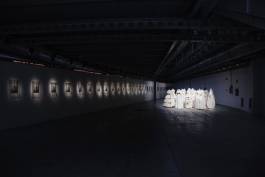
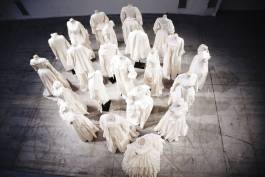
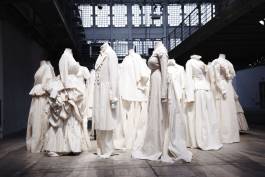
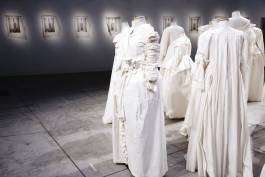
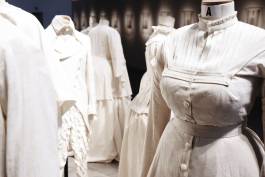
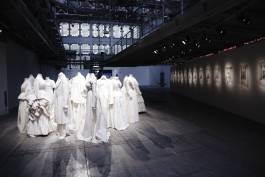
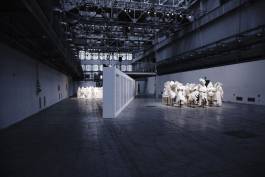
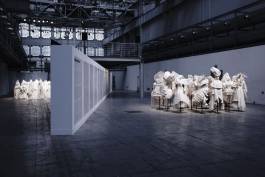
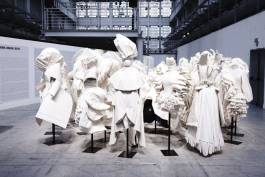
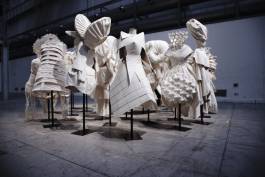
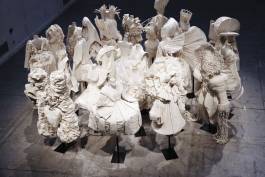
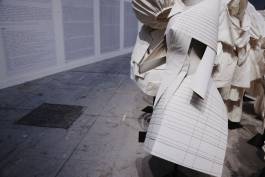
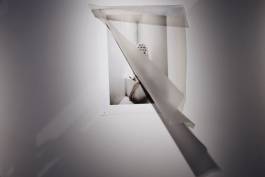
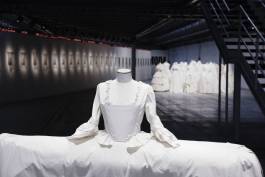
“The Bridge”, Photo by Enrico Labriola Studio.
2025
“Wonderingmode”
Conversations on Fashion Curating
2013
While working on the exhibition project “Wonderingmode” at the Centre of Contemporary Art in Torun, I carried out in-depth research into emerging designers and creatives. Linda Loppa, Kaat Debo, Helena Hertov, Annemartine van Kesteren, and Stefan Siegel offered valuable insights and connections.
After mainly curating art exhibitions, creating this show on fashion meant I had to adopt a different method, approach, and attitude. This prompted me to reflect on the practice of fashion curation, and I revisited the interviews I conducted with curators who were role models for me at the time.
Therefore, I included edited versions of earlier conversations with some of the curators published in Cura magazine.
Fashion curation was a very new subject in Poland, and republishing interviews was an important addition to the catalogue accompanying the show.
While re-editing interviews, I also received updated visuals from some of my interlocutors, which is why I wanted to include these shorter, reviewed versions here, along with new pictures and their biographical notes from that time.
Linda Loppa
Linda Loppa, born in Antwerp, Belgium, to a family of Italian origin, has a career spanning over 40 years in fashion. She is one of the most noted faces of international education in the industry. Graduating in fashion design in 1971 at the Royal Academy of Fine Arts Antwerp, she began working as a designer for various companies in Belgium and as a promoter for many avant-garde designers. In 1981, she was called to the Royal Academy of Antwerp to teach and take on the role of Head of the Fashion Department, where she cultivated many new talents, attracting the attention of the design world and specialised international press. Between 1978 and 1991, she opened various men’s and women’s clothing stores, importing Italian, French and Japanese fashions into her multi-brand store.
From 1991 to 1997, she worked part-time as manager of the worldwide distribution department of Dries Van Noten.
In 1996, she contributed to the creation and development of two new international institutes: Flanders Fashion Institute and ModeNatie, and in 2002, she was appointed director of the new MoMu Museum of Fashion in Antwerp, where she curated numerous shows.
Since 2007 to date, nominated by the President Ferruccio Ferragamo and members of the board, she has held the post of Director of Polimoda, Florence, International Institute of Fashion, Design and Marketing: a centre of excellence renowned for the highest standards of fashion education.
2013
LINDA LOPPA: I AM CURATING FASHION EVERY DAY NOW, BY TALKING ABOUT THE CHANGES WE HAVE TO MAKE
Dobrila Denegri: Your engagement in the field of fashion education began many years ago in Antwerp, when you were at Hogeschool, an academy to which are linked well-known names like Martin Margela or “Antwerp Six”: Walter Van Beirendonck, Ann Demeulemeester, Dries van Noten, Dirk Van Saene, Dirk Bikkembergs, Marina Yee and many more. For two decades, this school and the city of Antwerp itself have become synonymous with a very particular type of fashion, often described as “artistic” or “conceptual”. You mentioned that art, in particular contemporary art, had a strong impact on your activity and your approach to conceiving and teaching fashion. How did all this start?
Linda Loppa: More than twenty years ago, I started a project in Antwerp entitled “Vetrine”, and I owe the inspiration, at least some of it, to Jan Hoet, a curator and museum director who was also able to act as a real cultural catalyst. I remember very well his Documenta 9, but it was the famous exhibition “Chambres d’Amis” that he made in 1986 in Ghent, which convinced me to follow contemporary art more closely. It convinced me so much that it represented a turning point in my life in the truest sense of the word. The way this exhibition emphasised the harmony between art and daily life struck me deeply. After meeting Anton Herbert, one of the greatest and most refined collectors in Belgium, I couldn’t avoid taking a radical step: I sold my house and my husband and I bought a large space of about 1500 square metres at the port of Antwerp. This space has become our new home and the headquarters of the Micheline Szwajcer Gallery, where over the years we have seen some extraordinary exhibitions and lived side by side with works of important artists like Daniel Buren, Luciano Fabro, Giovanni Anselmo, to mention but a few. Thanks to the new perspective that contemporary art opened up for me, I found new ways to present fashion outside traditional contexts, facing what has always been the greatest challenge: to attribute a symbolic and semantic value to a specific item of clothing.
DD: Going back to stages of your professional career, like the period in which you were at the Hogeschool Antwerpen, one of the most experimental and cutting edge fashion schools, or the FFI Flanders Fashion Institute foundation, and the MoMu Fashion Museum in Antwerp, I would like to ask you what were the most important aspects of your training and if you would define yourself a fashion curator.
LL: Contemporary art, which I’ve been following closely, has been of great importance for my training, especially when art and fashion were presented next to each other, as in the 1996 Fashion Biennale in Florence. In the nineties, there was much talk about body and corporality in art, and this reflection, carried on by Germano Celant and Ingrid Sischy, but also by some curators and critics, was very stimulating. I could also mention another fundamental influence: the book by Caroline Evans, “Fashion at the Edge”, an extraordinary analysis of contemporary fashion which offers a reading that is more profound than usual, tracing in fashion the same symptoms we had detected in the art production of the nineties: a dramatic and perturbing end-of-the-century image. I was so impressed by this book that I tried to translate it into an exhibition curated with Judith Clark at the MoMu and at the London’s Victoria & Albert Museum, entitled “Malign Muses - When Fashion Turns Back”: an investigation of the relationship between fashion and history and, at the same time, a story of alienation, traumas, shadows and ghosts resurfacing through the creations of experimental fashion. Although I have had various professional experiences, my greatest passion has always been curating fashion, but lately I enjoy the freedom of expression of curating more outside the museum walls.
DD: The figure of the fashion curator has emerged in the last few years with more preponderance than before. This introduces another interesting question: what is a “fashion curator” according to you? Did you consider yourself a fashion curator when working within the frame of the Fashion Museum?
LL: The creation of an exhibition requires great attention in three specific fields: I would identify the first with research. I often acted spontaneously and intuitively in my thematic choices, but I always investigated the themes so that I could present them in a way that could be both historically faithful and not too academic or déjà vu. It is important to be faithful to history, but what counts is to interpret and re-contextualise in a contemporary way. The second fundamental element is to build a relationship with space: the real ability of the curator is in translating his or her ideas within the available space. The third relevant aspect, in my opinion, has to do with communication and didactics: curators have to know how to explain convincingly the reasons for their choices and to give the audience the possibility to understand and learn.
I am curating fashion every day now, by talking about the changes we have to make, finding new ways of writing and building bridges with many more audiences, looking for new ways of body language, where education is also creative thinking and where space, body, calligraphy, dress, craft and imaginary are coming together.
Published in “Wonderingmode”, Ed. Centre of Contemporary Art, Torun, 2013.
“The Bridge”, Photo by Enrico Labriola Studio.
INSTAGRAM
@EXPERIMENTS.FASHION.ART