


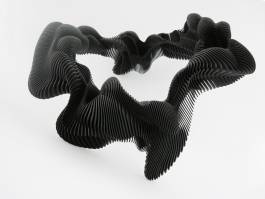
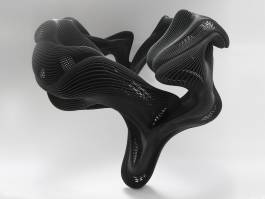
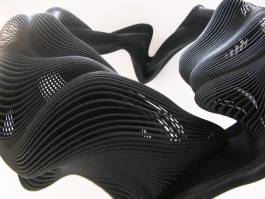
Daniel Widrig, Collection “Kinesis”, 2012, 3D printing jewellery collection, polyamide, Courtesy of the artist, © Daniel Widrig.
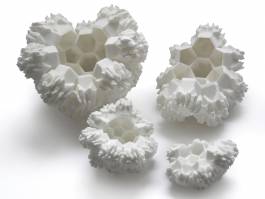
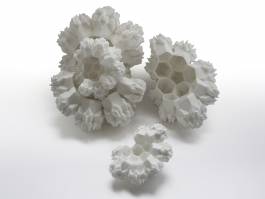
Daniel Widrig, “Fractal Forms”, 2012, Polyamide, Courtesy of the artist, © Daniel Widrig.
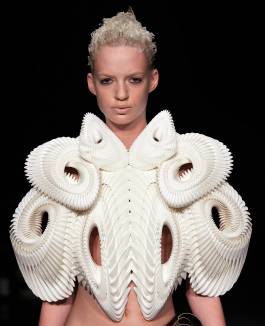
Iris van Herpen & Daniel Widrig, Collection “Crystallisation”, 2010, Garments produced with the use of 3D printing technology, Courtesy of the artists, Photo by Michel Zoeter.
2013
DANIEL WIDRIG “KINESIS”
Close to the ideas of Greg Lynn and long-term collaborator of Zaha Hadid, Daniel Widrig developed a visual vocabulary in which borders between organic and synthetic, futuristic and ancestral seemed entirely blurred.
His work stems from applying digital technologies and advanced animation programmes to architectural design. However, it also expands into the fields of fashion and design, through his own projects or collaborations with other creatives, such as Iris van Herpen, with whom he created several 3D-printed garments featured in her collections, “Escapism Couture” and “Crystallisation”.
Following a similar principle of creating wearable sculptures, Daniel Widrig developed his own collection of “wearable sculpture jewellery” titled “Kinesis,” which is made from laser-sintered polyamide.
“Kinesis” pieces are created with selective laser sintering (SLS), in which a high-power laser fuses particles of powder (in this case, polyamide) together to form a solid mass.
The outcome is something that bridges the gap between body and space, fashion and architecture: it is a piece of jewellery that resembles highly visionary architectural form applied to the body, which functions as adornment, but it is also an autonomous sculptural form in which abstraction and figuration are merged to create new aesthetic codes.
Daniel Widrig founded his studio in London in 2009. After graduating from the Architectural Association in London in 2006, Daniel worked for several years with Zaha Hadid, leading the designs of several award-winning architectural projects and products.
Widrig leads a dedicated team of specialists across various fields, including fashion, furniture, sculpture, stage design, and architecture. Having adopted digital systems from the outset, the studio is recognised as a leader in digital art and design.
He has received several prestigious awards, such as the Swiss Arts Award, the Feidad Merit Award, and the Rome Prize.
In 2009, Widrig was honoured as a Maya Master, a title bestowed by the digital design community and software industry, recognising individuals who challenge and expand the boundaries of technology and art.
In 2011, 3D printed dresses, created in collaboration with Iris van Herpen, were named one of the 50 Best Innovations of the year by Time Magazine.
Daniel Widrig, Collection “Kinesis”, 2012, 3D printing jewellery collection, polyamide, Courtesy of the artist, © Daniel Widrig.
Daniel Widrig, “Fractal Forms”, 2012, Polyamide, Courtesy of the artist, © Daniel Widrig.
Iris van Herpen & Daniel Widrig, Collection “Crystallisation”, 2010, Garments produced with the use of 3D printing technology, Courtesy of the artists, Photo by Michel Zoeter.