


2025
2015
CLEMENS THORNQUIST: MY PERSPECTIVE IS THAT A SCIENCE OF ALL DISCIPLINES EXISTS
12th - 16th of May 2015
17th annual conference of IFFTI - International Foundation of Fashion Technology Institutes
“MOMENTING THE MEMENTO”
Polimoda, Florence
At the end of Linda Loppa's tenure as director, Polimoda organised an international conference that, according to Linda’s vision, became a vibrant and multifaceted event: an academic conference, a set of exhibitive and performative events, a moment of collective brainstorming and generally, a statement about how fashion education can be rethought and redesigned.
I collaborated with Linda on the talk sessions “In Conversation With” that took place in the Odeon Cinema, as well as on other curatorial aspects, which led to the realisation of the entire event.
It all began much earlier. In 2012, there was a gathering called “SALON” organised by Linda, which I attended alongside Barbara Vinken, Filep Motwary, Stefan Siegel, Danilo Venturi, Alberto Salvadori, and several other panellists.
Then, between 2014 and 2015, we began to meet more often with Linda, to envision how an academic conference could become a way to re-evoke the Florentine Fashion Biennial organised by Germano Celant, Ingrid Sischy, Franca Sozzani, and Luigi Settembrini in 1996/97. The twentieth anniversary of that great event, a real milestone for the history of fashion curating, would be a year later, in 2016, and we were totally aware of that.
Danilo Venturi wrote an essay titled “Momenting the Memento”, which provided a conceptual spark and also served as the title for the entire event.
Linda formed a small group, inviting Francesca Tacconi from Pitti Immagine, Alberto Salvadori from Marino Marini Museum, myself, and a few more collaborators to serve as a jury and review the applications. We were gathering in a small room behind Linda’s office, which gradually became our “dream” place. Walls were covered with images, prints from portfolios, various visual references, and keywords BODY | SPACE | DRESS | IMAGERY | CALLIGRAPHY | CRAFT that were central to the curatorial and conceptual framework Linda envisioned.
Clemens Thornquist, designer, fashion educator
Clemens is a professor in Fashion Design at The Swedish School of Textiles, University of Borås, Sweden. He has a background in fashion design and arts management. His research spans fashion, art, and philosophy, with the aim of developing fashion design through experimental research methods. His action-based artistic research on the intersection of art, fashion, philosophy and organisation has resulted in numerous books, publications, and artistic research work in different media exhibited worldwide.
Dobrila Denegri: How can (or should) fashion schools and universities foster more cross-disciplinary approaches? What’s your interpretation of the term ‘science’ in relation to fashion?
Clemens Thornquist: My fundamental perspective is that a science of all disciplines exists. There is a science of art, for example. Not a history of art, but a science of art. If you look for the broader definition of the term science, it stands for the advancement of knowledge in a systematic way. Following the same principle, I believe that we can also talk about the ‘science of fashion’. Therefore, my main question is ‘how do we advance the fundamental knowledge in fashion design’? What theoretical quests must we address? Which ontological, logical and epistemological challenges must we face?
My interest in these issues started with the observation that clothes are used in many different disciplines and art forms. Clothes are used to address issues of identity in the field of social sciences. They are also used as tools in the performance arts or as elements in art installations, etc. But this doesn't necessarily develop fashion design – clothing – itself. It’s about using pre-existing clothing, models, archetypes, and symbols in order to articulate different representational and historical perspectives.
That’s why my main quest was: how do we define basic, fundamental questions in the field of fashion itself?
What are the definitions of clothing?
What does dress mean?
What does jacket mean?
And how can they be explored in a very concrete, direct and experimental way?
So, rather than using and adopting narrative methods borrowed from other disciplines, or asking questions about the role of garments in society, it is important to seek an adequate experimental approach which can be focused on fashion design development.
This is my scientific agenda.
Foundational science is very much science for science itself, just as art is art for the sake of art. And this is essential to truly find and build original knowledge.
I believe that these methodologies, which are quite classical in both the artistic and scientific realms, are also fundamental to fashion design as a form of art (“techne”).
So the first step is focusing our research on these basic, ontological questions about the garment and the elements that compose it, and the second step might then be to use garments (or fashion) to explore applied issues such as class, gender, identity or other broader cultural, political agendas.
But there is also a stage at which, if I want to gain a better understanding of gender-based issues, I might (or should) develop a different type of garment. So this new type of garment, therefore, becomes an even better prism through which I can look and understand certain gender issues. That is why I believe that the very basic questions in fashion design must be addressed at the start.
They can lead us toward the creation of something really new and different.
DD: You are teaching at the University of Borås in Sweden, but your career has crossed various fields, from designing for Vivienne Westwood Ltd to becoming Arts Manager for theatre director and visual artist Robert Wilson.
With such a trans-disciplinary background, you are now focusing on “increasing the conceptual level of fashion design”. How is this translated into the practical aspect of what you do, into your own creative work, and your writing?
CT: Writing was already an important part of my practical work back when I was s student.
I wrote my PHD in the form of a novel, a partly fictional novel, which was a bit controversial considering that I was graduating in the social sciences department. But the fact that this novel was partly a lie paradoxically made it more truthful; it gave a more realistic picture.
This writing, combined with some photographic work I had done, triggered all my later projects in which I was exploring the ways in which knowledge can be represented.
Today I focused mainly on the question of how art (or fashion) can not only illustrate, but actually affect, argue or validate certain concepts.
Usually, we ask ‘how many words do I need’ when we want to explore an issue or express a concept. Instead, I asked the question: ‘How few words do I need?’
I have written a text, which can also be seen as a form of poetry, but actually it is a comparative analysis of science and art, expressed using as few words as possible.
This is also one of the ways with which I try to challenge scientific presentation, by finding new ways of demonstrating knowledge or working on epistemological questions.
DD: Today, there are more and more synergies between design, fashion, science and technology. New materials are being produced, new forms of clothing tested, new concepts of “fashion” imagined… but we still seem to be missing a “new” vocabulary that is adequate to deal with all of this. Would you have any ideas about some “new words” we might need?
CT: This is a very important question. Language is indeed something that we struggle with and strive to develop. Here at Borås University, we forbid the use of words such as translation, inspiration, collection…
So instead of talking about inspiration, we ask a question such as: ‘What is your starting point? ’ We ask ‘What is the motivation to make a specific work.
Why is it important? Why must it be developed?
So this is not the usual language used for fashion design, particularly not in a school.
It’s the same with the word ‘translation’, because we prefer to focus more on the question of ‘what is the core principle’ of something and how that principle can be further built upon.
Another problem in fashion is the concept of the collection.
Usually, and also in education, a collection stands for something that is symbolically tied together. Colours, materials, shapes, which can be defined as the common denominator, tie together a set of garments in what we call a ‘collection’.
So, for example, if you look at an early Jill Sander collection, you can see that it was held together by the similarity of the pieces. On the other hand, Martin Margiela’s collection from ten years ago was held together by something that is in between the garments, some kind of pattern of difference between the garments.
So, we don’t talk about collections, but instead about a series of examples and how these define something.
Instead of an outfit, we talk about ‘an example’.
Starting from the language itself, we are trying to change the standardised way of teaching and thinking about fashion and what it produces. We try to experiment with different methodological approaches, which can eventually lead us towards new forms of creative self-expression.
I don’t know if we need to come up with any new words, but we could at least start by using some different terminology for design methods. This is very important.
DD: What should we, as a collective, aspire to?
CT: Being.
DD: Towards what should fashion creatives aspire to?
CT: Body.
DD: What should the individual aspire to?
CT: Acting.
Published at the Polimoda website during the IFFTI Conference
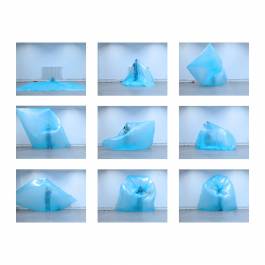
Exploration of body dress space relationships
2025
12th - 16th of May 2015
17th annual conference of IFFTI - International Foundation of Fashion Technology Institutes
“MOMENTING THE MEMENTO”
Polimoda, Florence
At the end of Linda Loppa's tenure as director, Polimoda organised an international conference that, according to Linda’s vision, became a vibrant and multifaceted event: an academic conference, a set of exhibitive and performative events, a moment of collective brainstorming and generally, a statement about how fashion education can be rethought and redesigned.
I collaborated with Linda on the talk sessions “In Conversation With” that took place in the Odeon Cinema, as well as on other curatorial aspects, which led to the realisation of the entire event.
It all began much earlier. In 2012, there was a gathering called “SALON” organised by Linda, which I attended alongside Barbara Vinken, Filep Motwary, Stefan Siegel, Danilo Venturi, Alberto Salvadori, and several other panellists.
Then, between 2014 and 2015, we began to meet more often with Linda, to envision how an academic conference could become a way to re-evoke the Florentine Fashion Biennial organised by Germano Celant, Ingrid Sischy, Franca Sozzani, and Luigi Settembrini in 1996/97. The twentieth anniversary of that great event, a real milestone for the history of fashion curating, would be a year later, in 2016, and we were totally aware of that.
Danilo Venturi wrote an essay titled “Momenting the Memento”, which provided a conceptual spark and also served as the title for the entire event.
Linda formed a small group, inviting Francesca Tacconi from Pitti Immagine, Alberto Salvadori from Marino Marini Museum, myself, and a few more collaborators to serve as a jury and review the applications. We were gathering in a small room behind Linda’s office, which gradually became our “dream” place. Walls were covered with images, prints from portfolios, various visual references, and keywords BODY | SPACE | DRESS | IMAGERY | CALLIGRAPHY | CRAFT that were central to the curatorial and conceptual framework Linda envisioned.
Clemens Thornquist, designer, fashion educator
Clemens is a professor in Fashion Design at The Swedish School of Textiles, University of Borås, Sweden. He has a background in fashion design and arts management. His research spans fashion, art, and philosophy, with the aim of developing fashion design through experimental research methods. His action-based artistic research on the intersection of art, fashion, philosophy and organisation has resulted in numerous books, publications, and artistic research work in different media exhibited worldwide.
2015
CLEMENS THORNQUIST: MY PERSPECTIVE IS THAT A SCIENCE OF ALL DISCIPLINES EXISTS
Dobrila Denegri: How can (or should) fashion schools and universities foster more cross-disciplinary approaches? What’s your interpretation of the term ‘science’ in relation to fashion?
Clemens Thornquist: My fundamental perspective is that a science of all disciplines exists. There is a science of art, for example. Not a history of art, but a science of art. If you look for the broader definition of the term science, it stands for the advancement of knowledge in a systematic way. Following the same principle, I believe that we can also talk about the ‘science of fashion’. Therefore, my main question is ‘how do we advance the fundamental knowledge in fashion design’? What theoretical quests must we address? Which ontological, logical and epistemological challenges must we face?
My interest in these issues started with the observation that clothes are used in many different disciplines and art forms. Clothes are used to address issues of identity in the field of social sciences. They are also used as tools in the performance arts or as elements in art installations, etc. But this doesn't necessarily develop fashion design – clothing – itself. It’s about using pre-existing clothing, models, archetypes, and symbols in order to articulate different representational and historical perspectives.
That’s why my main quest was: how do we define basic, fundamental questions in the field of fashion itself?
What are the definitions of clothing?
What does dress mean?
What does jacket mean?
And how can they be explored in a very concrete, direct and experimental way?
So, rather than using and adopting narrative methods borrowed from other disciplines, or asking questions about the role of garments in society, it is important to seek an adequate experimental approach which can be focused on fashion design development.
This is my scientific agenda.
Foundational science is very much science for science itself, just as art is art for the sake of art. And this is essential to truly find and build original knowledge.
I believe that these methodologies, which are quite classical in both the artistic and scientific realms, are also fundamental to fashion design as a form of art (“techne”).
So the first step is focusing our research on these basic, ontological questions about the garment and the elements that compose it, and the second step might then be to use garments (or fashion) to explore applied issues such as class, gender, identity or other broader cultural, political agendas.
But there is also a stage at which, if I want to gain a better understanding of gender-based issues, I might (or should) develop a different type of garment. So this new type of garment, therefore, becomes an even better prism through which I can look and understand certain gender issues. That is why I believe that the very basic questions in fashion design must be addressed at the start.
They can lead us toward the creation of something really new and different.
DD: You are teaching at the University of Borås in Sweden, but your career has crossed various fields, from designing for Vivienne Westwood Ltd to becoming Arts Manager for theatre director and visual artist Robert Wilson.
With such a trans-disciplinary background, you are now focusing on “increasing the conceptual level of fashion design”. How is this translated into the practical aspect of what you do, into your own creative work, and your writing?
CT: Writing was already an important part of my practical work back when I was s student.
I wrote my PHD in the form of a novel, a partly fictional novel, which was a bit controversial considering that I was graduating in the social sciences department. But the fact that this novel was partly a lie paradoxically made it more truthful; it gave a more realistic picture.
This writing, combined with some photographic work I had done, triggered all my later projects in which I was exploring the ways in which knowledge can be represented.
Today I focused mainly on the question of how art (or fashion) can not only illustrate, but actually affect, argue or validate certain concepts.
Usually, we ask ‘how many words do I need’ when we want to explore an issue or express a concept. Instead, I asked the question: ‘How few words do I need?’
I have written a text, which can also be seen as a form of poetry, but actually it is a comparative analysis of science and art, expressed using as few words as possible.
This is also one of the ways with which I try to challenge scientific presentation, by finding new ways of demonstrating knowledge or working on epistemological questions.
DD: Today, there are more and more synergies between design, fashion, science and technology. New materials are being produced, new forms of clothing tested, new concepts of “fashion” imagined… but we still seem to be missing a “new” vocabulary that is adequate to deal with all of this. Would you have any ideas about some “new words” we might need?
CT: This is a very important question. Language is indeed something that we struggle with and strive to develop. Here at Borås University, we forbid the use of words such as translation, inspiration, collection…
So instead of talking about inspiration, we ask a question such as: ‘What is your starting point? ’ We ask ‘What is the motivation to make a specific work.
Why is it important? Why must it be developed?
So this is not the usual language used for fashion design, particularly not in a school.
It’s the same with the word ‘translation’, because we prefer to focus more on the question of ‘what is the core principle’ of something and how that principle can be further built upon.
Another problem in fashion is the concept of the collection.
Usually, and also in education, a collection stands for something that is symbolically tied together. Colours, materials, shapes, which can be defined as the common denominator, tie together a set of garments in what we call a ‘collection’.
So, for example, if you look at an early Jill Sander collection, you can see that it was held together by the similarity of the pieces. On the other hand, Martin Margiela’s collection from ten years ago was held together by something that is in between the garments, some kind of pattern of difference between the garments.
So, we don’t talk about collections, but instead about a series of examples and how these define something.
Instead of an outfit, we talk about ‘an example’.
Starting from the language itself, we are trying to change the standardised way of teaching and thinking about fashion and what it produces. We try to experiment with different methodological approaches, which can eventually lead us towards new forms of creative self-expression.
I don’t know if we need to come up with any new words, but we could at least start by using some different terminology for design methods. This is very important.
DD: What should we, as a collective, aspire to?
CT: Being.
DD: Towards what should fashion creatives aspire to?
CT: Body.
DD: What should the individual aspire to?
CT: Acting.
Published at the Polimoda website during the IFFTI Conference
Exploration of body dress space relationships
INSTAGRAM
@EXPERIMENTS.FASHION.ART