


2025
2015
CHARLOTTE GOLDTHORPE: I'M INSPIRED BY UNWANTED OBJECTS
12th - 16th of May 2015
17th annual conference of IFFTI - International Foundation of Fashion Technology Institutes
“MOMENTING THE MEMENTO”
Polimoda, Florence
At the end of Linda Loppa's tenure as director, Polimoda organised an international conference that, according to Linda’s vision, became a vibrant and multifaceted event: an academic conference, a set of exhibitive and performative events, a moment of collective brainstorming and generally, a statement about how fashion education can be rethought and redesigned.
I collaborated with Linda on the talk sessions “In Conversation With” that took place in the Odeon Cinema, as well as on other curatorial aspects, which led to the realisation of the entire event.
It all began much earlier. In 2012, there was a gathering called “SALON” organised by Linda, which I attended alongside Barbara Vinken, Filep Motwary, Stefan Siegel, Danilo Venturi, Alberto Salvadori, and several other panellists.
Then, between 2014 and 2015, we began to meet more often with Linda, to envision how an academic conference could become a way to re-evoke the Florentine Fashion Biennial organised by Germano Celant, Ingrid Sischy, Franca Sozzani, and Luigi Settembrini in 1996/97. The twentieth anniversary of that great event, a real milestone for the history of fashion curating, would be a year later, in 2016, and we were totally aware of that.
Danilo Venturi wrote an essay titled “Momenting the Memento”, which provided a conceptual spark and also served as the title for the entire event.
Linda formed a small group, inviting Francesca Tacconi from Pitti Immagine, Alberto Salvadori from Marino Marini Museum, myself, and a few more collaborators to serve as a jury and review the applications. We were gathering in a small room behind Linda’s office, which gradually became our “dream” place. Walls were covered with images, prints from portfolios, various visual references, and keywords BODY | SPACE | DRESS | IMAGERY | CALLIGRAPHY | CRAFT that were central to the curatorial and conceptual framework Linda envisioned.
Charlotte Goldthorpe
Charlotte Goldthorpe is a Senior Lecturer in the School of Art, Design and Architecture at the University of Huddersfield.
Having worked as a freelance art director/assistant in film and television between 2003 and 2006. In 2007, she qualified as a Design and Technology teacher from Goldsmiths University. She taught in East London for several years before completing her Master’s degree in Fashion Artefact at the London College of Fashion.
In 2015, Goldthorpe exhibited ‘Absence’ at the Basilica di Santa Croce in Florence as part of Polimoda and IFFTI’s “Momenting the Memento” conference and installation series.
She is currently working on a PhD in craft practice, exploring storytelling and the transmission of memories through making.
Previous commercial work has seen the design and production of bags and accessories.
https://www.charliegoldthorpe.com
Dobrila Denegri: How did you get involved with fashion? Can you tell us more about your professional formation and about inspirations, references, and influences that are critical for your work?
Charlotte Goldthorpe: My mother taught fashion and textiles and had a ‘sewing room’ at home, so I have always had access to fabric and materials and been able to play and experiment from being a child. Fashion has always been ‘behind the scenes’ until recently, when I chose to study ‘Fashion Artefact’ for my Master's degree. Until then, I had never academically been taught fashion, but it evolved from other material-based disciplines such as set design, product, printmaking and heritage craft. From my Master's, I went on to teach Fashion Design and now Fashion Communication, allowing a multidisciplinary approach to the subject.
Unwanted objects, individual artefacts, anything second-hand with a memory or story inspire me. I like to unpick the pieces of an object to see how they are made, then reconstruct or rework them into a new artefact, but capture the memory of the old within the new. The work of Rachel Whiteread and her practice of ‘solidifying space’ has been a constant inspiration, allowing us to see and feel something that does not or no longer exists. Ted Noten’s use of casting objects into new forms, taking away original functionality, replacing with new, is similar to the work of Gordon Matta-Clark and Richard Wilson, who localise elements of an object or environment and use clean lines, skew or change reality.
DD: Thinking about your work “Absence”, which consists of a set of artefacts which you created by “remodelling” objects that were once in use, makes me wander about the value of memory and attachment towards certain things that we possess. What was the idea behind the creation of this work, and how do you see it now, installed in such a specific space as Santa Croce in Florence?
CG: The idea behind the work was to capture the memories of objects by casting them in translucent silicone. The silicone revealed defects, wear, creases and embellishments created by the owner, allowing not only the memory of the possession but the presence of the owner to be embodied within it. I’m fascinated by how objects become personified by their owners and thus become part of the person. As the work ages, the leather darkens, the silicone yellows, and the objects mature, adding a new layer of memory of their new life, much like the next generation of themselves.
The Santa Croce feels like the ideal surroundings for a collection that is based on memory and personification, surrounded by great sculptures, composers, historians and astronomers, all of which are commemorated within the architecture and furniture of such a majestic building. It is an honour to think of my work sitting alongside that of such prolific artisans.
DD: What is the value of interdisciplinary research and practice within the frame of fashion education?
CG: Interdisciplinary research practice within the frame of fashion education is invaluable to push existing boundaries of creativity. Having worked with practitioners from a variety of disciplines allows different forms of thinking, experimentation and outcomes from an individual specialist. Without this cross-curricular way of working, we as individuals can become stagnant.
DD: Towards what should we, as a collective, aspire to?
CG: Cohesiveness
DD: Towards what should fashion creatives aspire to?
CG: Innovate
DD: Towards what should an individual aspire to?
CG: Limitless
Published at the Polimoda website during the IFFTI Conference
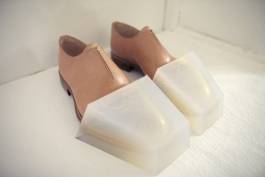

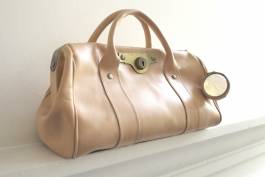
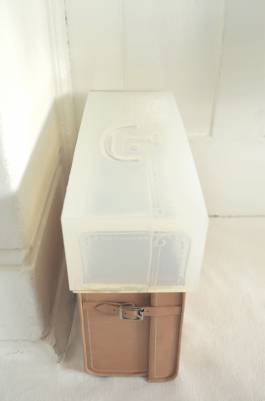

Charlotte Goldthorpe, “Absence” collection, 2011, The collection was exhibited in 2015 in the Santa Croce crypt in Florence as part of the 'Momenting the Memento' IFFTI conference in conjunction with Polimoda.
2025
12th - 16th of May 2015
17th annual conference of IFFTI - International Foundation of Fashion Technology Institutes
“MOMENTING THE MEMENTO”
Polimoda, Florence
At the end of Linda Loppa's tenure as director, Polimoda organised an international conference that, according to Linda’s vision, became a vibrant and multifaceted event: an academic conference, a set of exhibitive and performative events, a moment of collective brainstorming and generally, a statement about how fashion education can be rethought and redesigned.
I collaborated with Linda on the talk sessions “In Conversation With” that took place in the Odeon Cinema, as well as on other curatorial aspects, which led to the realisation of the entire event.
It all began much earlier. In 2012, there was a gathering called “SALON” organised by Linda, which I attended alongside Barbara Vinken, Filep Motwary, Stefan Siegel, Danilo Venturi, Alberto Salvadori, and several other panellists.
Then, between 2014 and 2015, we began to meet more often with Linda, to envision how an academic conference could become a way to re-evoke the Florentine Fashion Biennial organised by Germano Celant, Ingrid Sischy, Franca Sozzani, and Luigi Settembrini in 1996/97. The twentieth anniversary of that great event, a real milestone for the history of fashion curating, would be a year later, in 2016, and we were totally aware of that.
Danilo Venturi wrote an essay titled “Momenting the Memento”, which provided a conceptual spark and also served as the title for the entire event.
Linda formed a small group, inviting Francesca Tacconi from Pitti Immagine, Alberto Salvadori from Marino Marini Museum, myself, and a few more collaborators to serve as a jury and review the applications. We were gathering in a small room behind Linda’s office, which gradually became our “dream” place. Walls were covered with images, prints from portfolios, various visual references, and keywords BODY | SPACE | DRESS | IMAGERY | CALLIGRAPHY | CRAFT that were central to the curatorial and conceptual framework Linda envisioned.
Charlotte Goldthorpe
Charlotte Goldthorpe is a Senior Lecturer in the School of Art, Design and Architecture at the University of Huddersfield.
Having worked as a freelance art director/assistant in film and television between 2003 and 2006. In 2007, she qualified as a Design and Technology teacher from Goldsmiths University. She taught in East London for several years before completing her Master’s degree in Fashion Artefact at the London College of Fashion.
In 2015, Goldthorpe exhibited ‘Absence’ at the Basilica di Santa Croce in Florence as part of Polimoda and IFFTI’s “Momenting the Memento” conference and installation series.
She is currently working on a PhD in craft practice, exploring storytelling and the transmission of memories through making.
Previous commercial work has seen the design and production of bags and accessories.
https://www.charliegoldthorpe.com
2015
CHARLOTTE GOLDTHORPE: I'M INSPIRED BY UNWANTED OBJECTS
Dobrila Denegri: How did you get involved with fashion? Can you tell us more about your professional formation and about inspirations, references, and influences that are critical for your work?
Charlotte Goldthorpe: My mother taught fashion and textiles and had a ‘sewing room’ at home, so I have always had access to fabric and materials and been able to play and experiment from being a child. Fashion has always been ‘behind the scenes’ until recently, when I chose to study ‘Fashion Artefact’ for my Master's degree. Until then, I had never academically been taught fashion, but it evolved from other material-based disciplines such as set design, product, printmaking and heritage craft. From my Master's, I went on to teach Fashion Design and now Fashion Communication, allowing a multidisciplinary approach to the subject.
Unwanted objects, individual artefacts, anything second-hand with a memory or story inspire me. I like to unpick the pieces of an object to see how they are made, then reconstruct or rework them into a new artefact, but capture the memory of the old within the new. The work of Rachel Whiteread and her practice of ‘solidifying space’ has been a constant inspiration, allowing us to see and feel something that does not or no longer exists. Ted Noten’s use of casting objects into new forms, taking away original functionality, replacing with new, is similar to the work of Gordon Matta-Clark and Richard Wilson, who localise elements of an object or environment and use clean lines, skew or change reality.
DD: Thinking about your work “Absence”, which consists of a set of artefacts which you created by “remodelling” objects that were once in use, makes me wander about the value of memory and attachment towards certain things that we possess. What was the idea behind the creation of this work, and how do you see it now, installed in such a specific space as Santa Croce in Florence?
CG: The idea behind the work was to capture the memories of objects by casting them in translucent silicone. The silicone revealed defects, wear, creases and embellishments created by the owner, allowing not only the memory of the possession but the presence of the owner to be embodied within it. I’m fascinated by how objects become personified by their owners and thus become part of the person. As the work ages, the leather darkens, the silicone yellows, and the objects mature, adding a new layer of memory of their new life, much like the next generation of themselves.
The Santa Croce feels like the ideal surroundings for a collection that is based on memory and personification, surrounded by great sculptures, composers, historians and astronomers, all of which are commemorated within the architecture and furniture of such a majestic building. It is an honour to think of my work sitting alongside that of such prolific artisans.
DD: What is the value of interdisciplinary research and practice within the frame of fashion education?
CG: Interdisciplinary research practice within the frame of fashion education is invaluable to push existing boundaries of creativity. Having worked with practitioners from a variety of disciplines allows different forms of thinking, experimentation and outcomes from an individual specialist. Without this cross-curricular way of working, we as individuals can become stagnant.
DD: Towards what should we, as a collective, aspire to?
CG: Cohesiveness
DD: Towards what should fashion creatives aspire to?
CG: Innovate
DD: Towards what should an individual aspire to?
CG: Limitless
Published at the Polimoda website during the IFFTI Conference
Charlotte Goldthorpe, “Absence” collection, 2011, The collection was exhibited in 2015 in the Santa Croce crypt in Florence as part of the 'Momenting the Memento' IFFTI conference in conjunction with Polimoda.
INSTAGRAM
@EXPERIMENTS.FASHION.ART