




Exhibition view "Un percorso di lavoro: Fendi. Karl Lagerfeld”, GNAM - Galleria Nazionale d’Arte Moderna Rome, 1985/86


Opening of the exhibition "Un percorso di lavoro: Fendi. Karl Lagerfeld”

Opening of the exhibition "Un percorso di lavoro: Fendi. Karl Lagerfeld” (Ida Panicelli, Palma Bucarelli)

Opening of the exhibition "Un percorso di lavoro: Fendi. Karl Lagerfeld” (Carla Fendi, Ida Panicelli, Giulio Andreotti)
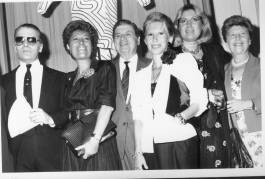
Opening of the exhibition "Un percorso di lavoro: Fendi. Karl Lagerfeld” (Karl Lagerfeld and Fendi sisters)

Opening of the exhibition "Un percorso di lavoro: Fendi. Karl Lagerfeld” (Ida Panicelli, Carla Fendi)

"Un percorso di lavoro: Fendi. Karl Lagerfeld”, GNAM - Galleria Nazionale d’Arte Moderna Rome, 9 May 1985 - February 1986
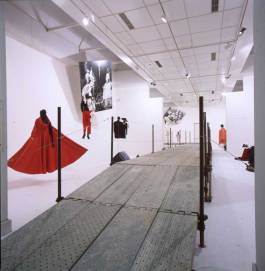
“Fellini: Costumes and Fashion” exhibition view, Centro Pecci Prato, 1994 (On the left, Gianfranco Ferrè (red cape
and red trouser suit). The two black outfits are by Krizia, inspired by Anita Ekberg's “priest” dresses in “La Dolce Vita” (1960, Piero Gherardi). Photo by Carlo Fei

“Fellini: Costumes and Fashion” exhibition view, Centro Pecci Prato, 1994 (On the left, stage costumes for “Ginger and Fred” (1983 Danilo Donati). Then, from the left, Armani (red trousers and black jacket), Valentino (black and white checked balloon skirt), Yves Saint Laurent (light blue skirt and “circus” jacket). Photo by Carlo Fei
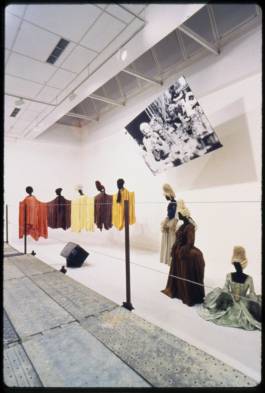
“Fellini: Costumes and Fashion” exhibition view, Centro Pecci Prato, 1994 (left: stage costumes for “Satyricon” (1969 Danilo Donati); right: stage costumes for “Casanova” (1976 Danilo Donati). Photo by Carlo Fei
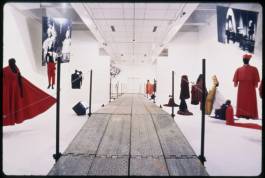
“Fellini: Costumes and Fashion” exhibition view, Centro Pecci Prato, 1994 (on the left, Ferrè and Krizia as in the first photo; on the right, stage costumes for Rome, parade of ecclesiastical garments (1972 Danilo Donati). Photo by Carlo Fei

“Fellini: Costumes and Fashion” exhibition view, Centro Pecci Prato, 1994 (stage costumes for Clowns and related shoes, (1970) Danilo Donati). Photo by Carlo Fei

“Fellini: Costumes and Fashion” exhibition view, Centro Pecci Prato, 1994 (Moschino (sky blue jacket), Valentino (black cape), then Margiela (sheer dress), and finally Paco Rabanne (gold sequinned dress). Photo by Carlo Fei

Massimo Vignelli, sketches for the display of the exhibition “Fellini: Costumes and Fashion” exhibition view, Centro Pecci Prato, 1994
2024
IDA PANICELLI: HOW CAN WE PRESENT COSTUMES WITHOUT BODIES?
Dobrila Denegri: As early as 1985, you were involved in curating a fashion exhibition in an art museum. It was "Un Percorso di Lavoro: Fendi. Karl Lagerfeld” at the National Gallery of Modern Art in Rome, at the time one of Italy’s most prestigious art institutions.
Later, in 1994, while you were the director of the Centro Luigi Pecci in Prato, you co-curated an exhibition with Samuele Mazza, titled "Fellini: Costumes and Fashion," which featured contemporary fashion designers inspired by Fellini's films. These designers included Gianni Versace, Thierry Mugler, Paco Rabanne, Vivienne Westwood, and Yves Saint Laurent, alongside original costumes by Piero Gherardi and Danilo Donati.
I would like to begin by asking you about the “Fendi” exhibition. What was it like for you, as an art curator, to work with a fashion brand?
Ida Panicelli: I started with research. Accessing the Fendi archives was a privilege, as we wanted to showcase the entire creative process, from the initial sketches to the technical innovations and final products. I spent weeks in the cold archive rooms selecting the best pieces from Fendi and Lagerfeld's collaboration over the years. The exhibition was held in honour of the twentieth anniversary of their collaboration.
However, showcasing a fashion house's work in a modern art museum was a pioneering attempt, so there were many infrastructural gaps between the two realities. I had to navigate these bureaucratic layers on my own.
I worked closely with Carla Fendi, discussing everything down to the most minute detail. She had a clear vision, and I was there to bring it to life, mediate, and organise the exhibition. She was in charge of media relations and the business side of the brand, and we planned most of it together, with the help of her spectacular team.
DD: Who was in charge of the display design?
IP: We worked with two architects involved with the brand, Claudio Lazzarini and Carmela Vigliotti, but Karl Lagerfeld conceived the largest installation, which presented the most famous fur coats on a stage resembling a carousel. Interestingly, the coats were displayed on hangers or scaffolding made of pipes instead of on mannequins, as we usually see in shop windows. There was an interesting contrast between the stage's almost industrial vibe and the softness and preciousness of the fur coats.
Even today, this display looks modern. The concept was to present the entire creative process, from design to the realisation and promotion of the final product. We had huge wall-mounted vitrines designed to hold blow-ups of Lagerfeld’s drawings and low horizontal vitrines containing pattern cuttings. There were also vitrines for individual models hanging on stylised bodies. Everything was graphic, clean, and minimalist. We wanted people to understand how much work went into it, from the initial idea to the many layers of production.
The most spectacular part of the exhibition was the stage for the fur coats. Some of these coats were symbols of the revolution that Lagerfeld brought to Fendi, a family-run atelier.
DD: As far as I can recall, the company was founded in 1925 as a small bag and fur shop with an adjoining laboratory on Via del Plebiscito. The founders, Edoardo and Adele Fendi, had five daughters—Paola, Franca, Carla, Anna, and Alda—who took over the business and transformed it into a fashion brand. Thanks to Karl Lagerfeld, who joined in 1965, fur coats became fun, funky, and innovative over time.
IP: He breathed new life into furs, transforming them from bourgeois status symbols into fashion fetishes. Much like Armani did with jackets in those same years, Lagerfeld deconstructed fur coats. Something that was once considered rigid, serious, and formal suddenly became light, easy, and fun.
During that time, Lagerfeld introduced many novelties. He used geometric inserts and fur puffs that resembled feathers. He caused a scandal when he started "shaving" mink. I bought a blue alpaca coat from that collection, which was revolutionary and fascinating. He painted the fur with the nuances and bright colours of the Macchiaioli, 19th-century Italian painters, and drew inspiration from nature, animals, and landscapes.
DD: Tell me about the opening of the exhibition. From the photos, it looks like quite an event!
IP: Oh, yes, it was very glamorous. We had Andreotti, the prime minister, the wife of the Senate president, and many celebrities. After the opening, Fendi organised the most magnificent dinner party in Palazzo Venezia. It was epic.
DD: Fendi made an important donation to the National Gallery, right?
IP: The deal Fendi made with the Galleria Nazionale was that they would donate a major painting by Giuseppe Capogrossi from the early period, which was lacking in the GNAM's collection. It's still there, with a label acknowledging the Fendi sisters as donors.
DD: How was this exhibition received in the press and among the art crowd?
IP: Needless to say, the show was a success, with thousands of visitors and the most glamorous opening ever. However, that success came with a scandal. Remember that it was 1985, and we installed the first show dedicated to a fashion brand in a national museum, something that was both unprecedented and inconceivable at the time. Admitting a commercial product to be displayed in an art museum was considered unacceptable. We were under attack in the press, and there was a lot of polemic and even controversy in Parliament. But all this contributed to the show's success.
DD: From 1988 to 1992, you were the editor of Artforum, one of the most influential international art magazines. There, too, you introduced fashion designers within the context of contemporary art.
You treated the magazine as an exhibition space. Rather than publishing only the usual essays and reviews, you introduced pages featuring art projects commissioned specifically for the magazine from leading artists and, eventually, designers. This approach offered a fresh perspective on curating within the magazine's two-dimensional space.
IP: Yes, I started the “drawing project” page early on, commissioned to artists, and I was the first editor to ask a fashion designer to create a special project for the March 1990 issue.
Romeo Gigli was a rising star in the fashion world at the time. He contributed two drawings from his Spring-Summer 1990 collection. This also raised a few eyebrows at the time. However, the real game changer was my predecessor, Ingrid Sischy, who put the now-famous Issey Miyake rattan jacket on the cover in February 1982. By doing so, she equated the language of fashion with art, writing, “The bodice and skirt on the cover by Issey Miyake represent a Modern convergence of signs. Equivalences are created between carving and modelling, between rigidity and softness, between the natural and the painted-over, between representation and showing.”
DD: After years in New York, you returned to Italy, to the Centro Pecci in Prato, and among several trans-disciplinary projects, you set up a show dedicated to Federico Fellini, one of the masters of Italian cinema. How did that exhibition come to be?
IP: One year after his passing, we opened an exhibition showcasing costumes from his films and the fashion designers who referenced them. It was called “Fellini: Costumes and Fashion”.
The exhibition included the Fontana Sisters' collaboration with costume designer Piero Gherardi, who won an Oscar for his work on “La Dolce Vita”. For this film, the Fontana Sisters remade their iconic "Pretino" dress for Anita Ekberg, in keeping with Fellini's vision.
The exhibition featured contemporary fashion designers who drew inspiration from the dreamlike and fantastical atmospheres of Fellini’s films, including Giorgio Armani, Gianfranco Ferrè, Fendi, Jean Paul Gaultier, Romeo Gigli, Missoni, Moschino, Martin Margiela, Yves Saint Laurent, Valentino, Versace, and Vivienne Westwood.
DD: Whose initiative was this exhibition?
IP: Samuele Mazza, an architect working for major textile companies in Prato, came up with the idea, which we then developed together.
At the time, Prato was an important centre of the Italian textile industry, so holding a fashion exhibition there made total sense.
Our close collaborator, Giulia Mafai, had worked with Fellini on many films. She tracked down original costumes from major costume ateliers in Rome. This wasn't easy because Fellini didn't keep things after shooting his movies. Some items were kept at Cinecittà, but many costumes and other pieces were lost.
For me, the most fascinating encounter was meeting Umberto Tirelli, one of the most important figures in costume design. He kept an archive of costumes he created for many film productions. Visiting their archive in Rome is like time travel. They have countless costumes from all eras. It's one of the most amazing places I've ever been. I interviewed Tirelli before he passed away, and I remember him discussing the creation of costumes and their relationship to historical evidence. Italian costume designers have a deep tradition of historical research and psychological character analysis.
For the show, we wanted to contrast the historical accuracy and craftsmanship of costume designers like Danilo Donati and Dante Ferretti, who worked with Fellini, with the inventiveness of fashion designers.
This produced extraordinary results.
DD: What about the design of the show?
IP: I had the opportunity to work with Massimo Vignelli, a renowned graphic designer based in New York, who agreed to my request to be in charge of the design and display of the exhibition.
The core team consisted of Giulia, Samuele, Massimo, and me. It was fantastic to work with all of them.
It was the pre-Internet era, so we worked primarily by phone and fax between Prato and New York, creating paper sketches and scale models of the space.
I would describe our ideas and themes to Vignelli, and he would send sketches via fax while we talked. Considering how we managed to organise the whole thing from such a distance before the Internet, it was a miracle.
Vignelli designed the show's layout, as well as the poster and catalogue.
I was glad the book included contributions by Laura Delli Colli, the daughter of the renowned cinematographer Tonino Delli Colli, and Maurizio Porro, a film critic.
Vignelli wanted the book to have a black background and black pages to symbolise the dreamy atmosphere of a movie theatre. He also wanted black-and-white photos of Fellini films that would appear bright. The only pages in colour were those featuring the fashion designers’ clothes.
We also treated the page as a screen, so all images were unframed. The whole process of working together was beautiful and fascinating.
DD: Was there a difference in installing costumes and fashion items?
IP: The first question we addressed was, “How can we present costumes without bodies?” In films, actors are fundamental because they give their characters a range of body types, each with its own peculiarities. Sometimes this body is non-normative, as in fashion. We created different types of bodies with our mannequins, such as standing or kneeling, narrow or wide, tall or short, ecclesiastic and sexy, to enhance the dramatic effect.
Our goal was to transport viewers' entire experience into the realm of memory or dream. We decided to suspend the costumes from the ceiling as ghostly presences surrounded by white walls and carpets, at the intersection of fiction and reality.
Viewers walked, as if in a dreamy space, on a suspended platform made of scaffolding poles and wooden boards, like those used on construction sites. We came up with this simple, inexpensive solution, inspired by the platform in the final scene of Fellini’s “8½.”
DD: How did you decide to organise the narrative of the exhibition, by films or by some specific Fellini motives?
IP: Large black-and-white still photos and film sequences were displayed, related to the issues we selected as central to Fellini’s imagination.
Each room had a different theme, ranging from the Catholic Church and food to seduction, love, death, dreams, the circus, and women.
The exhibit was like a condensed anthology of Fellini's key moments, synthesising his narrative content, symbolic figures, and physical types from his films.
The stills and videos created an immersive effect; you could hear the dialogue and music in each room.
DD: Were fashion designers involved personally?
IP: Oh, that was the other magic of that show!
Designers like Armani, Ferrè, Valentino, and Westwood were happy, and their contributions were wonderful and totally in line with the theme of the show. The garments arrived in long boxes wrapped in thick rice paper, and we opened them as if it were Christmas!
They were open to the idea because there hadn't been a show like that before. They were all very excited and said yes. Some of them selected clothes from past collections inspired by Fellini’s characters and themes. Others made clothes specially for the show.
Some came for the opening, like Missoni. Vivienne Westwood came a little later. I personally took her around the exhibition. She was delighted.
DD: How was the reception of the exhibition?
IP: Prato was a city of textile industries, so they loved the fashion and costume show. It was very well received in the press, of course, and there were also many visitors.
I was also proud that Rudi Fuchs, the new director of the Stedelijk Museum, wanted to restage the exhibition a few months later in Amsterdam for the Fellini festival organised by Cinecittà to commemorate the anniversary of the maestro’s death.
Vignelli wanted to stay true to the final scene of Fellini's film “Otto e mezzo”. Instead of using a white background and scaffolding, he incorporated the second element of that scene: beach sand. They filled the Stedelijk Museum with a dozen truckloads of white sand from the North Sea, which was quite an undertaking. Just imagine the challenge of cleaning up the museum after the show!
Exhibition view "Un percorso di lavoro: Fendi. Karl Lagerfeld”, GNAM - Galleria Nazionale d’Arte Moderna Rome, 1985/86
Opening of the exhibition "Un percorso di lavoro: Fendi. Karl Lagerfeld”
Opening of the exhibition "Un percorso di lavoro: Fendi. Karl Lagerfeld” (Ida Panicelli, Palma Bucarelli)
Opening of the exhibition "Un percorso di lavoro: Fendi. Karl Lagerfeld” (Carla Fendi, Ida Panicelli, Giulio Andreotti)
Opening of the exhibition "Un percorso di lavoro: Fendi. Karl Lagerfeld” (Karl Lagerfeld and Fendi sisters)
Opening of the exhibition "Un percorso di lavoro: Fendi. Karl Lagerfeld” (Ida Panicelli, Carla Fendi)
"Un percorso di lavoro: Fendi. Karl Lagerfeld”, GNAM - Galleria Nazionale d’Arte Moderna Rome, 9 May 1985 - February 1986
“Fellini: Costumes and Fashion” exhibition view, Centro Pecci Prato, 1994 (On the left, Gianfranco Ferrè (red cape
and red trouser suit). The two black outfits are by Krizia, inspired by Anita Ekberg's “priest” dresses in “La Dolce Vita” (1960, Piero Gherardi). Photo by Carlo Fei
“Fellini: Costumes and Fashion” exhibition view, Centro Pecci Prato, 1994 (On the left, stage costumes for “Ginger and Fred” (1983 Danilo Donati). Then, from the left, Armani (red trousers and black jacket), Valentino (black and white checked balloon skirt), Yves Saint Laurent (light blue skirt and “circus” jacket). Photo by Carlo Fei
“Fellini: Costumes and Fashion” exhibition view, Centro Pecci Prato, 1994 (left: stage costumes for “Satyricon” (1969 Danilo Donati); right: stage costumes for “Casanova” (1976 Danilo Donati). Photo by Carlo Fei
“Fellini: Costumes and Fashion” exhibition view, Centro Pecci Prato, 1994 (on the left, Ferrè and Krizia as in the first photo; on the right, stage costumes for Rome, parade of ecclesiastical garments (1972 Danilo Donati). Photo by Carlo Fei
“Fellini: Costumes and Fashion” exhibition view, Centro Pecci Prato, 1994 (stage costumes for Clowns and related shoes, (1970) Danilo Donati). Photo by Carlo Fei
“Fellini: Costumes and Fashion” exhibition view, Centro Pecci Prato, 1994 (Moschino (sky blue jacket), Valentino (black cape), then Margiela (sheer dress), and finally Paco Rabanne (gold sequinned dress). Photo by Carlo Fei
Massimo Vignelli, sketches for the display of the exhibition “Fellini: Costumes and Fashion” exhibition view, Centro Pecci Prato, 1994